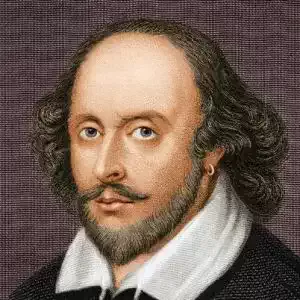
William Shakespeare

William Shakespeare

1564–1616 · lived 52 years GB GB

William Shakespeare is widely regarded as the greatest writer in the English language and the world's pre-eminent dramatist. His vast body of work, including tragedies, comedies, histories, and sonnets, explores the complexities of human nature with unparalleled depth and linguistic richness. His plays continue to be performed and studied globally, making him a timeless figure in literature and theatre.

n. 1564-04-23, Stratford-upon-Avon · m. 1616-04-23, Stratford-upon-Avon

130,443 Views

Shall I compare thee to a summer's day? (Sonnet 18)

Shall I compare thee to a summer's day? (Sonnet 18)

Shall I compare thee to a summer's day?
Thou art more lovely and more temperate.
Rough winds do shake the darling buds of May,
And summer's lease hath all too short a date.
Sometime too hot the eye of heaven shines,
And often is his gold complexion dimmed;
And every fair from fair sometime declines,
By chance, or nature's changing course, untrimmed;
But thy eternal summer shall not fade,
Nor lose possession of that fair thou ow'st,
Nor shall death brag thou wand'rest in his shade,
When in eternal lines to Time thou grow'st.


So long as men can breathe, or eyes can see,
So long lives this, and this gives life to thee.
Read full poem
Bio

Identification and basic context

William Shakespeare is the most celebrated playwright and poet in the English language. He is often referred to by his pseudonyms, though none were widely adopted during his lifetime. He was born and died in Stratford-upon-Avon, England. His father was a glover and alderman, placing him in a respectable social standing within the town. Shakespeare was an English national and wrote exclusively in English.

Childhood and education

Details of Shakespeare's childhood are scarce, but it is generally assumed he attended the Stratford grammar school, where he would have received a solid grounding in Latin and classical literature. This formal education, supplemented by his keen observation of life and his prodigious reading, laid the foundation for his literary genius. He did not pursue higher education at university.

Literary trajectory

Shakespeare began his career in London in the late 1580s or early 1590s, likely as an actor and adapter of plays before establishing himself as a playwright. His career spanned roughly two decades, during which he wrote approximately 39 plays, 154 sonnets, and several longer poems. His work evolved over time, moving from early comedies and historical plays to his great tragedies and later romances. He was a key member of the acting company the Lord Chamberlain's Men (later the King's Men) and a shareholder in the Globe Theatre.

Works, style, and literary characteristics

Shakespeare's major works encompass tragedies ('Hamlet', 'Othello', 'King Lear', 'Macbeth', 'Romeo and Juliet'), comedies ('A Midsummer Night's Dream', 'Twelfth Night', 'As You Like It'), history plays ('Richard III', 'Henry V'), and his sonnets. His dominant themes are universal and enduring: love, death, ambition, jealousy, revenge, fate, appearance versus reality, and the nature of power. He masterfully employed various forms, including blank verse (iambic pentameter) and rhyming couplets, experimenting with structure and pacing. His poetic devices are legendary, utilizing metaphor, simile, personification, and wordplay with extraordinary skill to create rich imagery and profound meaning. His tone varies dramatically, from the profound despair of tragedy to the lighthearted wit of comedy. His poetic voice is multifaceted, capable of capturing the inner lives of kings, commoners, lovers, and fools. His language is renowned for its richness, inventiveness, and rhetorical power, coining countless words and phrases that have entered common usage.

Cultural and historical context

Shakespeare lived during the Elizabethan and Jacobean eras, a period of significant cultural, political, and economic change in England. His plays reflect the political machinations of the court, the exploration of new territories, and the prevailing religious and social anxieties of the time. He was part of a vibrant London theatre scene, interacting with contemporaries like Christopher Marlowe and Ben Jonson. His work engages with Renaissance humanism, the concept of divine right of kings, and evolving ideas about psychology and human nature.

Personal life

While much of Shakespeare's personal life remains private, he married Anne Hathaway and had three children: Susanna, and twins Hamnet and Judith. The death of his son Hamnet at a young age is speculated to have influenced themes in plays like 'Hamlet'. His friendships within the theatre world were crucial to his career. He maintained strong ties to his hometown of Stratford-upon-Avon, where he eventually retired and purchased property. His religious beliefs are a subject of scholarly debate, but his works often engage with Christian morality and theology.

Recognition and reception

Shakespeare achieved considerable fame and financial success during his lifetime, though perhaps not the same level of academic reverence as he enjoys today. His plays were popular with audiences across social classes. Posthumously, his reputation grew exponentially, and he came to be recognized as the pre-eminent figure in English literature. His works are continuously performed, studied, and celebrated worldwide, solidifying his place in the global literary canon.

Influences and legacy

Shakespeare drew inspiration from classical Roman and Greek literature (Plutarch, Ovid, Seneca), medieval morality plays, and earlier English chronicles and romances. His influence on subsequent literature, theatre, and language is immeasurable. He has inspired countless playwrights, poets, novelists, and artists across centuries and cultures. His works have been translated into virtually every major language and continue to be a cornerstone of literary education and theatrical production. His inventive use of language has permanently enriched the English lexicon.

Interpretation and critical analysis

Shakespeare's plays have been subjected to endless critical interpretation, exploring themes of political power, social justice, gender roles, psychology, and existentialism. Scholars and critics continue to debate character motivations, historical accuracy, and the philosophical underpinnings of his works. His texts are constantly re-examined through new critical lenses, including feminist, post-colonial, and psychoanalytic approaches.

Curiosities and lesser-known aspects

Shakespeare's handwriting is notoriously difficult to decipher, with only a few authenticated signatures surviving. His acting career is less documented than his playwriting. The authorship question, suggesting someone else wrote the plays attributed to him, persists despite overwhelming scholarly consensus supporting Shakespeare of Stratford. His knowledge of legal matters and Italian settings in his plays has also been a subject of curiosity.

Death and memory

William Shakespeare died on April 23, 1616, in Stratford-upon-Avon. He was buried in the chancel of Holy Trinity Church. His will famously leaves his 'second-best bed' to his wife. His enduring memory is primarily preserved through the continuous performance and study of his plays and poems, the preservation of his birthplace and home, and his monumental impact on the English language and global culture.

Poems

206

Sonnet XCVII

Sonnet XCVII

How like a winter hath my absence been
From thee, the pleasure of the fleeting year!
What freezings have I felt, what dark days seen!
What old December's bareness every where!
And yet this time removed was summer's time,
The teeming autumn, big with rich increase,
Bearing the wanton burden of the prime,
Like widow'd wombs after their lords' decease:
Yet this abundant issue seem'd to me
But hope of orphans and unfather'd fruit;
For summer and his pleasures wait on thee,
And, thou away, the very birds are mute;
Or, if they sing, 'tis with so dull a cheer
That leaves look pale, dreading the winter's near.
319

Sonnet XCIV: They That Have Power to Hurt and Will Do None

Sonnet XCIV: They That Have Power to Hurt and Will Do None

They that have power to hurt and will do none,
That do not do the thing they most do show,
Who, moving others, are themselves as stone,
Unmoved, cold, and to temptation slow:
They rightly do inherit heaven's graces
And husband nature's riches from expense;
They are the lords and owners of their faces,
Others but stewards of their excellence.
The summer's flower is to the summer sweet
Though to itself it only live and die,
But if that flower with base infection meet,
The basest weed outbraves his dignity:
For sweetest things turn sourest by their deeds;
Lilies that fester smell far worse than weeds.
256

Sonnet XCV

Sonnet XCV

How sweet and lovely dost thou make the shame
Which, like a canker in the fragrant rose,
Doth spot the beauty of thy budding name!
O, in what sweets dost thou thy sins enclose!
That tongue that tells the story of thy days,
Making lascivious comments on thy sport,
Cannot dispraise but in a kind of praise;
Naming thy name blesses an ill report.
O, what a mansion have those vices got
Which for their habitation chose out thee,
Where beauty's veil doth cover every blot,
And all things turn to fair that eyes can see!
Take heed, dear heart, of this large privilege;
The hardest knife ill-used doth lose his edge.
388

Sonnet XC

Sonnet XC

Then hate me when thou wilt; if ever, now;
Now, while the world is bent my deeds to cross,
Join with the spite of fortune, make me bow,
And do not drop in for an after-loss:
Ah, do not, when my heart hath 'scoped this sorrow,
Come in the rearward of a conquer'd woe;
Give not a windy night a rainy morrow,
To linger out a purposed overthrow.
If thou wilt leave me, do not leave me last,
When other petty griefs have done their spite
But in the onset come; so shall I taste
At first the very worst of fortune's might,
And other strains of woe, which now seem woe,
Compared with loss of thee will not seem so.
276

Sonnet XCII

Sonnet XCII

But do thy worst to steal thyself away,
For term of life thou art assured mine,
And life no longer than thy love will stay,
For it depends upon that love of thine.
Then need I not to fear the worst of wrongs,
When in the least of them my life hath end.
I see a better state to me belongs
Than that which on thy humour doth depend;
Thou canst not vex me with inconstant mind,
Since that my life on thy revolt doth lie.
O, what a happy title do I find,
Happy to have thy love, happy to die!
But what's so blessed-fair that fears no blot?
Thou mayst be false, and yet I know it not.
400

Sonnet VI

Sonnet VI

Then let not winter's ragged hand deface
In thee thy summer, ere thou be distill'd:
Make sweet some vial; treasure thou some place
With beauty's treasure, ere it be self-kill'd.
That use is not forbidden usury,
Which happies those that pay the willing loan;
That's for thyself to breed another thee,
Or ten times happier, be it ten for one;
Ten times thyself were happier than thou art,
If ten of thine ten times refigured thee:
Then what could death do, if thou shouldst depart,
Leaving thee living in posterity?
Be not self-will'd, for thou art much too fair
To be death's conquest and make worms thine heir.
253

Sonnet VIII

Sonnet VIII

Music to hear, why hear'st thou music sadly?
Sweets with sweets war not, joy delights in joy.
Why lovest thou that which thou receivest not gladly,
Or else receivest with pleasure thine annoy?
If the true concord of well-tuned sounds,
By unions married, do offend thine ear,
They do but sweetly chide thee, who confounds
In singleness the parts that thou shouldst bear.
Mark how one string, sweet husband to another,
Strikes each in each by mutual ordering,
Resembling sire and child and happy mother
Who all in one, one pleasing note do sing:
Whose speechless song, being many, seeming one,
Sings this to thee: 'thou single wilt prove none.'
293

Sonnet LXXXVI

Sonnet LXXXVI

Was it the proud full sail of his great verse,
Bound for the prize of all too precious you,
That did my ripe thoughts in my brain inhearse,
Making their tomb the womb wherein they grew?
Was it his spirit, by spirits taught to write
Above a mortal pitch, that struck me dead?
No, neither he, nor his compeers by night
Giving him aid, my verse astonished.
He, nor that affable familiar ghost
Which nightly gulls him with intelligence
As victors of my silence cannot boast;
I was not sick of any fear from thence:
But when your countenance fill'd up his line,
Then lack'd I matter; that enfeebled mine.
342

Sonnet LXXXVIII

Sonnet LXXXVIII

When thou shalt be disposed to set me light,
And place my merit in the eye of scorn,
Upon thy side against myself I'll fight,
And prove thee virtuous, though thou art forsworn.
With mine own weakness being best acquainted,
Upon thy part I can set down a story
Of faults conceal'd, wherein I am attainted,
That thou in losing me shalt win much glory:
And I by this will be a gainer too;
For bending all my loving thoughts on thee,
The injuries that to myself I do,
Doing thee vantage, double-vantage me.
Such is my love, to thee I so belong,
That for thy right myself will bear all wrong.
305

Sonnet LXXXIX

Sonnet LXXXIX

Say that thou didst forsake me for some fault,
And I will comment upon that offence;
Speak of my lameness, and I straight will halt,
Against thy reasons making no defence.
Thou canst not, love, disgrace me half so ill,
To set a form upon desired change,
As I'll myself disgrace: knowing thy will,
I will acquaintance strangle and look strange,
Be absent from thy walks, and in my tongue
Thy sweet beloved name no more shall dwell,
Lest I, too much profane, should do it wrong
And haply of our old acquaintance tell.
For thee against myself I'll vow debate,
For I must ne'er love him whom thou dost hate.
331

Quotes

40

Videos

50

Comments (0)

Share
Log in to post a comment.

No comments yet. Be the first to comment.