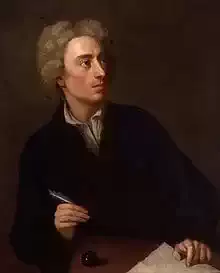
The Rape of the Lock: Canto 1
The Rape of the Lock: Canto 1
Nolueram, Belinda, tuos violare capillos;
Sedjuvat, hoc precibus me tribuisse tuis.
(Martial, Epigrams 12.84)
What dire offence from am'rous causes springs,
What mighty contests rise from trivial things,
I sing--This verse to Caryl, Muse! is due:
This, ev'n Belinda may vouchsafe to view:
Slight is the subject, but not so the praise,
If she inspire, and he approve my lays.
Say what strange motive, Goddess! could compel
A well-bred lord t' assault a gentle belle?
O say what stranger cause, yet unexplor'd,
Could make a gentle belle reject a lord?
In tasks so bold, can little men engage,
And in soft bosoms dwells such mighty rage?
Sol thro' white curtains shot a tim'rous ray,
And op'd those eyes that must eclipse the day;
Now lap-dogs give themselves the rousing shake,
And sleepless lovers, just at twelve, awake:
Thrice rung the bell, the slipper knock'd the ground,
And the press'd watch return'd a silver sound.
Belinda still her downy pillow press'd,
Her guardian sylph prolong'd the balmy rest:
'Twas he had summon'd to her silent bed
The morning dream that hover'd o'er her head;
A youth more glitt'ring than a birthnight beau,
(That ev'n in slumber caus'd her cheek to glow)
Seem'd to her ear his winning lips to lay,
And thus in whispers said, or seem'd to say.
"Fairest of mortals, thou distinguish'd care
Of thousand bright inhabitants of air!
If e'er one vision touch'd thy infant thought,
Of all the nurse and all the priest have taught,
Of airy elves by moonlight shadows seen,
The silver token, and the circled green,
Or virgins visited by angel pow'rs,
With golden crowns and wreaths of heav'nly flow'rs,
Hear and believe! thy own importance know,
Nor bound thy narrow views to things below.
Some secret truths from learned pride conceal'd,
To maids alone and children are reveal'd:
What tho' no credit doubting wits may give?
The fair and innocent shall still believe.
Know then, unnumber'd spirits round thee fly,
The light militia of the lower sky;
These, though unseen, are ever on theg,
Hang o'er the box, and hover round the Ring.
Think what an equipage thou hast in air,
And view with scorn two pages and a chair.
As now your own, our beings were of old,
And once inclos'd in woman's beauteous mould;
Thence, by a soft transition, we repair
From earthly vehicles to these of air.
Think not, when woman's transient breath is fled,
That all her vanities at once are dead;
Succeeding vanities she still regards,
And tho' she plays no more, o'erlooks the cards.
Her joy in gilded chariots, when alive,
And love of ombre, after death survive.
For when the fair in all their pride expire,
To their first elements their souls retire:
The sprites of fiery termagants in flame
Mount up, and take a Salamander's name.
Soft yielding minds to water glide away,
And sip with Nymphs, their elemental tea.
The graver prude sinks downward to a Gnome,
In search of mischief still on earth to roam.
The light coquettes in Sylphs aloft repair,
And sport and flutter in the fields of air.
Know further yet; whoever fair and chaste
Rejects mankind, is by some sylph embrac'd:
For spirits, freed from mortal laws, with ease
Assume what sexes and what shapes they please.
What guards the purity of melting maids,
In courtly balls, and midnight masquerades,
Safe from the treach'rous friend, the daring spark,
The glance by day, the whisper in the dark,
When kind occasion prompts their warm desires,
When music softens, and when dancing fires?
'Tis but their sylph, the wise celestials know,
Though honour is the word with men below.
Some nymphs there are, too conscious of their face,
For life predestin'd to the gnomes' embrace.
These swell their prospects and exalt their pride,
When offers are disdain'd, and love denied:
Then gay ideas crowd the vacant brain,
While peers, and dukes, and all their sweeping train,
And garters, stars, and coronets appear,
And in soft sounds 'Your Grace' salutes their ear.
'Tis these that early taint the female soul,
Instruct the eyes of young coquettes to roll,
Teach infant cheeks a bidden blush to know,
And little hearts to flutter at a beau.
Oft, when the world imagine women stray,
The Sylphs through mystic mazes guide their way,
Thro' all the giddy circle they pursue,
And old impertinence expel by new.
What tender maid but must a victim fall
To one man's treat, but for another's ball?
When Florio speaks, what virgin could withstand,
If gentle Damon did not squeeze her hand?
With varying vanities, from ev'ry part,
They shift the moving toyshop of their heart;
Where wigs with wigs, with sword-knots sword-knots strive,
Beaux banish beaux, and coaches coaches drive.
This erring mortals levity may call,
Oh blind to truth! the Sylphs contrive it all.
Of these am I, who thy protection claim,
A watchful sprite, and Ariel is my name.
Late, as I rang'd the crystal wilds of air,
In the clear mirror of thy ruling star
I saw, alas! some dread event impend,
Ere to the main this morning sun descend,
But Heav'n reveals not what, or how, or where:
Warn'd by the Sylph, oh pious maid, beware!
This to disclose is all thy guardian can.
Beware of all, but most beware of man!"
He said; when Shock, who thought she slept too long,
Leap'd up, and wak'd his mistress with his tongue.
'Twas then, Belinda, if report say true,
Thy eyes first open'd on a billet-doux;
Wounds, charms, and ardors were no sooner read,
But all the vision vanish'd from thy head.
And now, unveil'd, the toilet stands display'd,
Each silver vase in mystic order laid.
First, rob'd in white, the nymph intent adores
With head uncover'd, the cosmetic pow'rs.
A heav'nly image in the glass appears,
To that she bends, to that her eyes she rears;
Th' inferior priestess, at her altar's side,
Trembling, begins the sacred rites of pride.
Unnumber'd treasures ope at once, and here
The various off'rings of the world appear;
From each she nicely culls with curious toil,
And decks the goddess with the glitt'ring spoil.
This casket India's glowing gems unlocks,
And all Arabia breathes from yonder box.
The tortoise here and elephant unite,
Transform'd to combs, the speckled and the white.
Here files of pins extend their shining rows,
Puffs, powders, patches, bibles, billet-doux.
Now awful beauty puts on all its arms;
The fair each moment rises in her charms,
Repairs her smiles, awakens ev'ry grace,
And calls forth all the wonders of her face;
Sees by degrees a purer blush arise,
And keener lightnings quicken in her eyes.
The busy Sylphs surround their darling care;
These set the head, and those divide the hair,
Some fold the sleeve, whilst others plait the gown;
And Betty's prais'd for labours not her own.
The Rape of the Lock: Canto 3
The Rape of the Lock: Canto 3
Close by those meads, for ever crown'd with flow'rs,
Where Thames with pride surveys his rising tow'rs,
There stands a structure of majestic frame,
Which from the neighb'ring Hampton takes its name.
Here Britain's statesmen oft the fall foredoom
Of foreign tyrants and of nymphs at home;
Here thou, great Anna! whom three realms obey,
Dost sometimes counsel take--and sometimes tea.
Hither the heroes and the nymphs resort,
To taste awhile the pleasures of a court;
In various talk th' instructive hours they pass'd,
Who gave the ball, or paid the visit last;
One speaks the glory of the British queen,
And one describes a charming Indian screen;
A third interprets motions, looks, and eyes;
At ev'ry word a reputation dies.
Snuff, or the fan, supply each pause of chat,
With singing, laughing, ogling, and all that.
Meanwhile, declining from the noon of day,
The sun obliquely shoots his burning ray;
The hungry judges soon the sentence sign,
And wretches hang that jury-men may dine;
The merchant from th' Exchange returns in peace,
And the long labours of the toilet cease.
Belinda now, whom thirst of fame invites,
Burns to encounter two adventrous knights,
At ombre singly to decide their doom;
And swells her breast with conquests yet to come.
Straight the three bands prepare in arms to join,
Each band the number of the sacred nine.
Soon as she spreads her hand, th' aerial guard
Descend, and sit on each important card:
First Ariel perch'd upon a Matadore,
Then each, according to the rank they bore;
For Sylphs, yet mindful of their ancient race,
Are, as when women, wondrous fond of place.
Behold, four Kings in majesty rever'd,
With hoary whiskers and a forky beard;
And four fair Queens whose hands sustain a flow'r,
Th' expressive emblem of their softer pow'r;
Four Knaves in garbs succinct, a trusty band,
Caps on their heads, and halberds in their hand;
And parti-colour'd troops, a shining train,
Draw forth to combat on the velvet plain.
The skilful nymph reviews her force with care:
"Let Spades be trumps!" she said, and trumps they were.
Now move to war her sable Matadores,
In show like leaders of the swarthy Moors.
Spadillio first, unconquerable lord!
Led off two captive trumps, and swept the board.
As many more Manillio forc'd to yield,
And march'd a victor from the verdant field.
Him Basto follow'd, but his fate more hard
Gain'd but one trump and one plebeian card.
With his broad sabre next, a chief in years,
The hoary Majesty of Spades appears;
Puts forth one manly leg, to sight reveal'd;
The rest, his many-colour'd robe conceal'd.
The rebel Knave, who dares his prince engage,
Proves the just victim of his royal rage.
Ev'n mighty Pam, that kings and queens o'erthrew
And mow'd down armies in the fights of loo,
Sad chance of war! now destitute of aid,
Falls undistinguish'd by the victor Spade!
Thus far both armies to Belinda yield;
Now to the baron fate inclines the field.
His warlike Amazon her host invades,
Th' imperial consort of the crown of Spades.
The Club's black tyrant first her victim died,
Spite of his haughty mien, and barb'rous pride:
What boots the regal circle on his head,
His giant limbs, in state unwieldy spread;
That long behind he trails his pompous robe,
And of all monarchs, only grasps the globe?
The baron now his diamonds pours apace;
Th' embroider'd King who shows but half his face,
And his refulgent Queen, with pow'rs combin'd
Of broken troops an easy conquest find.
Clubs, Diamonds, Hearts, in wild disorder seen,
With throngs promiscuous strow the level green.
Thus when dispers'd a routed army runs,
Of Asia's troops, and Afric's sable sons,
With like confusion diff'rent nations fly,
Of various habit, and of various dye,
The pierc'd battalions disunited fall.
In heaps on heaps; one fate o'erwhelms them all.
The Knave of Diamonds tries his wily arts,
And wins (oh shameful chance!) the Queen of Hearts.
At this, the blood the virgin's cheek forsook,
A livid paleness spreads o'er all her look;
She sees, and trembles at th' approaching ill,
Just in the jaws of ruin, and codille.
And now (as oft in some distemper'd state)
On one nice trick depends the gen'ral fate.
An Ace of Hearts steps forth: The King unseen
Lurk'd in her hand, and mourn'd his captive Queen:
He springs to vengeance with an eager pace,
And falls like thunder on the prostrate Ace.
The nymph exulting fills with shouts the sky;
The walls, the woods, and long canals reply.
Oh thoughtless mortals! ever blind to fate,
Too soon dejected, and too soon elate!
Sudden, these honours shall be snatch'd away,
And curs'd for ever this victorious day.
For lo! the board with cups and spoons is crown'd,
The berries crackle, and the mill turns round.
On shining altars of Japan they raise
The silver lamp; the fiery spirits blaze.
From silver spouts the grateful liquors glide,
While China's earth receives the smoking tide.
At once they gratify their scent and taste,
And frequent cups prolong the rich repast.
Straight hover round the fair her airy band;
Some, as she sipp'd, the fuming liquor fann'd,
Some o'er her lap their careful plumes display'd,
Trembling, and conscious of the rich brocade.
Coffee, (which makes the politician wise,
And see through all things with his half-shut eyes)
Sent up in vapours to the baron's brain
New stratagems, the radiant lock to gain.
Ah cease, rash youth! desist ere 'tis too late,
Fear the just gods, and think of Scylla's fate!
Chang'd to a bird, and sent to flit in air,
She dearly pays for Nisus' injur'd hair!
But when to mischief mortals bend their will,
How soon they find fit instruments of ill!
Just then, Clarissa drew with tempting grace
A two-edg'd weapon from her shining case;
So ladies in romance assist their knight
Present the spear, and arm him for the fight.
He takes the gift with rev'rence, and extends
The little engine on his fingers' ends;
This just behind Belinda's neck he spread,
As o'er the fragrant steams she bends her head.
Swift to the lock a thousand sprites repair,
A thousand wings, by turns, blow back the hair,
And thrice they twitch'd the diamond in her ear,
Thrice she look'd back, and thrice the foe drew near.
Just in that instant, anxious Ariel sought
The close recesses of the virgin's thought;
As on the nosegay in her breast reclin'd,
He watch'd th' ideas rising in her mind,
Sudden he view'd, in spite of all her art,
An earthly lover lurking at her heart.
Amaz'd, confus'd, he found his pow'r expir'd,
Resign'd to fate, and with a sigh retir'd.
The peer now spreads the glitt'ring forfex wide,
T' inclose the lock; now joins it, to divide.
Ev'n then, before the fatal engine clos'd,
A wretched Sylph too fondly interpos'd;
Fate urg'd the shears, and cut the Sylph in twain,
(But airy substance soon unites again).
The meeting points the sacred hair dissever
From the fair head, for ever, and for ever!
Then flash'd the living lightning from her eyes,
And screams of horror rend th' affrighted skies.
Not louder shrieks to pitying Heav'n are cast,
When husbands or when lap-dogs breathe their last,
Or when rich China vessels, fall'n from high,
In glitt'ring dust and painted fragments lie!
"Let wreaths of triumph now my temples twine,"
The victor cried, "the glorious prize is mine!
While fish in streams, or birds delight in air,
Or in a coach and six the British fair,
As long at Atalantis shall be read,
Or the small pillow grace a lady's bed,
While visits shall be paid on solemn days,
When num'rous wax-lights in bright order blaze,
While nymphs take treats, or assignations give,
So long my honour, name, and praise shall live!
What time would spare, from steel receives its date,
And monuments, like men, submit to fate!
Steel could the labour of the gods destroy,
And strike to dust th' imperial tow'rs of Troy;
Steel could the works of mortal pride confound,
And hew triumphal arches to the ground.
What wonder then, fair nymph! thy hairs should feel
The conqu'ring force of unresisted steel?"
The Iliad: Book VI (excerpt)
The Iliad: Book VI (excerpt)
He said, and pass'd with sad presaging heart
To seek his spouse, his soul's far dearer part;
At home he sought her, but he sought in vain:
She, with one maid of all her menial train,
Had thence retir'd; and, with her second joy,
The young Astyanax, the hope of Troy,
Pensive she stood on Ilion's tow'ry height,
Beheld the war, and sicken'd at the sight;
There her sad eyes in vain her lord explore,
Or weep the wounds her bleeding country bore.
But he, who found not whom his soul desir'd,
Whose virtue charm'd him as her beauty fir'd,
Stood in the gates, and ask'd what way she bent
Her parting steps; if to the fane she went,
Where late the mourning matrons made resort,
Or sought her sisters in the Trojan court.
"Not to the court" replied th' attendant train,
"Nor, mixed with matrons, to Minerva's fane;
To Ilion's steepy tow'r she bent her way,
To mark the fortunes of the doubtful day.
Troy fled, she heard, before the Grecian sword;
She heard, and trembled for her absent lord.
Distracted with surprise, she seem'd to fly,
Fear on her cheek and sorrow in her eye.
The nurse attended with her infant boy,
The young Astyanax, the hope of Troy."
Hector, this heard, return'd without delay;
Swift through the town he trod his former way
Through streets of palaces and walks of state,
And met the mourner at the Scæan gate.
With haste to meet him sprung the joyful fair,
His blameless wife, E{"e}tion's wealthy heir
(Cilician Thebè great E{"e}tion sway'd,
And Hippoplacus' wide-extended shade);
The nurse stood near, in whose embraces prest
His only hope hung smiling at her breast,
Whom each soft charm and early grace adorn,
Fair as the new-born star that gilds the morn.
To this lov'd infant Hector gave the name
Scamandrius, from Scamander's honour'd stream;
Astyanax the Trojans call'd the boy,
From his great father, the defence of Troy.
Silent the warrior smil'd, and pleas'd, resign'd
To tender passions all his mighty mind:
His beauteous princess cast a mournful look,
Hung on his hand, and then dejected spoke;
Her bosom labour'd with a boding sigh,
And the big tear stood trembling in her eye.
"Too daring prince! ah whither dost thou run?
Ah, too forgetful of thy wife and son!
And think'st thou not how wretched we shall be,
A widow I, a helpless orphan he!
For sure such courage length of life denies,
And thou must fall, thy virtue's sacrifice.
Greece in her single heroes strove in vain;
Now hosts oppose thee, and thou must be slain!
Oh, grant me, gods! e'er Hector meets his doom,
All I can ask of heav'n, an early tomb!
So shall my days in one sad tenor run,
And end with sorrows as they first begun.
No parent now remains, my griefs to share,
No father's aid, no mother's tender care.
The fierce Achilles wrapp'd our walls in fire,
Laid Thebè waste, and slew my warlike sire!
His fate compassion in the victor bred;
Stern as he was, he yet rever'd the dead,
His radiant arms preserv'd from hostile spoil,
And laid him decent on the fun'ral pile;
Then rais'd a mountain where his bones were burn'd:
The mountain nymphs the rural tomb adorn'd;
Jove's sylvan daughters bade their elms bestow
A barren shade, and in his honour grow.
"By the same arm my sev'n brave brothers fell;
In one sad day beheld the gates of hell:
While the fat herds and snowy flocks they fed,
Amid their fields the hapless heroes bled!
My mother liv'd to bear the victor's bands,
The queen of Hippoplacia's sylvan lands;
Redeem'd too late, she scarce beheld again
Her pleasing empire and her native plain,
When, ah! oppress'd by life-consuming woe,
She fell a victim to Diana's bow.
"Yet while my Hector still survives, I see
My father, mother, brethren, all, in thee:
Alas! my parents, brothers, kindred, all,
Once more will perish if my Hector fall.
Thy wife, thy infant, in thy danger share:
Oh, prove a husband's and a father's care!
That quarter most the skilful Greeks annoy,
Where yon wild fig-trees join the wall of Troy:
Thou from this tow'r defend th' important post
There Agamemnon points his dreadful host,
That pass Tydides, Ajax, strive to gain,
And there the vengeful Spartan fires his train.
Thrice our bold foes the fierce attack have giv'n,
Or led by hopes, or dictated from heav'n.
Let others in the field their arms employ,
But stay my Hector here, and guard his Troy."
The chief replied: "That post shall be my care,
Not that alone, but all the works of war.
How would the sons of Troy, in arms renown'd,
And Troy's proud dames, whose garments sweep the ground,
Attaint the lustre of my former name,
Should Hector basely quit the field of fame?
My early youth was bred to martial pains,
My soul impels me to th' embattled plains:
Let me be foremost to defend the throne,
And guard my father's glories, and my own.
Yet come it will, the day decreed by fates,
(How my heart trembles while my tongue relates!)
The day when thou, imperial Troy! must bend,
And see thy warriors fall, thy glories end.
And yet no dire presage so wounds my mind,
My mother's death, the ruin of my kind,
Not Priam's hoary hairs defil'd with gore,
Not all my brothers gasping on the shore,
As thine, Andromache! thy griefs I dread;
I see thee trembling, weeping, captive led.
In Argive looms our battles to design,
And woes, of which so large a part was thine!
To bear the victor's hard commands, or bring
The weight of waters from Hyperia's spring!
There, while you groan beneath the load of life,
They cry, 'Behold the mighty Hector's wife!'
Some haughty Greek, who lives thy tears to see,
Embitters all thy woes by naming me.
The thoughts of glory past and present shame,
A thousand griefs, shall waken at the name!
May I lie cold before that dreadful day,
Press'd with a load of monumental clay!
Thy Hector, wrapp'd in everlasting sleep,
Shall neither hear thee sigh, nor see thee weep."
Thus having spoke, th' illustrious chief of Troy
Stretch'd his fond arms to clasp the lovely boy.
The babe clung crying to his nurse's breast,
Scar'd at the dazzling helm and nodding crest.
With secret pleasure each fond parent smil'd,
And Hector hasted to relieve his child;
The glitt'ring terrors from his brows unbound,
And plac'd the beaming helmet on the ground.
Then kiss'd the child, and, lifting high in air,
Thus to the gods preferr'd a father's pray'r:
"O thou! whose glory fills th' ethereal throne,
And all ye deathless pow'rs! protect my son!
Grant him, like me, to purchase just renown,
To guard the Trojans, to defend the crown,
Against his country's foes the war to wage,
And rise the Hector of the future age!
So when, triumphant from successful toils,
Of heroes slain he bears the reeking spoils,
Whole hosts may hail him with deserv'd acclaim,
And say, 'This chief transcends his father's fame':
While pleas'd, amidst the gen'ral shouts of Troy,
His mother's conscious heart o'erflows with joy."
He spoke, and fondly gazing on her charms,
Restor'd the pleasing burthen to her arms;
Soft on her fragrant breast the babe she laid,
Hush'd to repose, and with a smile survey'd.
The troubled pleasure soon chastis'd by fear,
She mingled with the smile a tender tear.
The soften'd chief with kind compassion view'd,
And dried the falling drops, and thus pursu'd:
"Andromache! my soul's far better part,
Why with untimely sorrows heaves thy heart?
No hostile hand can antedate my doom,
Till fate condemns me to the silent tomb.
Fix'd is the term to all the race of earth,
And such the hard condition of our birth.
No force can then resist, no flight can save;
All sink alike, the fearful and the brave.
No more--but hasten to thy tasks at home,
There guide the spindle, and direct the loom;
Me glory summons to the martial scene,
The field of combat is the sphere for men.
Where heroes war, the foremost place I claim,
The first in danger as the first in fame."
The Messiah : A Sacred Eclogue
The Messiah : A Sacred Eclogue
Ye nymphs of Solyma! begin the song,
To heavenly themes sublimer strains belong.
The mossy fountains, and the sylvan shades,
The dreams of Pindus, and the Aonian maids,
Delight no more - O thou, my voice inspire,
Who touched Isaiah's hallowed lips with fire!
Rapt into future times the bard begun,
A virgin shall conceive, a Virgin bear a son!
From Jesse's root behold a branch arise,
Whose sacred flower with fragrance fills the skies;
The ethereal Spirit o'er its leaves shall move,
And on its top descend the mystic Dove.
Ye heavens! from high the dewy nectar pour,
And in soft silence shed the kindly shower!
The sick and weak, the healing Plant shall aid,
From storms a shelter, and from heat a shade.
All crimes shall cease, and ancient fraud shall fail;
Returning justice lift aloft her scale.
Peace o'er the world her olive wand extend,
And white robed innocence from heaven descend.
Swift fly the years, and rise the expected morn!
O spring to light, auspicious Babe, be born!
See! nature hastes her earliest wreaths to bring,
WIth all the incense of the breathing spring!
See! lofty Lebanon his head advance,
See! nodding forests on the mountains dance:
See! spicy clouds from lowly Sharon rise;
And Carmel's flowery top perfumes the skies.
Hark! a glad voice the lonely desart cheers;
Prepare the way! a God, a God appears:
A God, a God! the vocal hills reply,
The rocks proclaim the approaching Deity.
Lo! earth receives him from the bending skies!
Sink down ye mountains, and ye vallies rise!
With heads declined ye cedars homage pay!
Be smooth ye rocks, ye rapid floods give way!
The Saviour comes! by ancient bards foretold:
Hear him ye deaf, and all ye blind, behold!
He from thick films shall purge the visual ray,
And on the sightless eye-ball pour the day.
'Tis he the obstructed paths of sound shall clear,
The dumb shall sing, the lame his crutch forego,
And leap exulting like the bounding roe:
No sigh, no murmer the wide world shall hear;
From every face he wipes off every tear.
In adamantine chains shall death be bound,
And hell's grim tyrant feel the eternal wound.
As the good shepherd tends his fleecy care,
Seeks freshest pastures and the purest air:
Explores the lost, the wandering sheep directs,
By day o'ersees them, and by night protects;
The tender lambs he raises in his arms,
Feeds from his hand, and in his bosom warms!
Thus shall mankind his guardian care engage,
The promis'd father of the future age.
No more shall nation against nation rise,
Nor ardent warriors meet with hateful eyes;
Nor fields with gleaming steel be cover'd o'er,
The brazen trumpets kindle rage no more;
But useless lances into scythes shall bend,
And the broad faulchion in a plough-share end.
Then palaces shall rise: the joyful son
Shall finish what his short-liv'd fire begun;
Their vines a shadow to their race shall yield,
And the same hand that sow'd, shall reap the field.
The swain in barren desarts with surprise
Sees lillies spring, and sudden verdure rise,
And starts amidst the thirsty wilds to hear
New falls of water murmuring in his ear;
On rifted rocks, the dragon's late abodes,
The green reed trembles, and the bulrush nods.
Waste sandy vallies once perplex'd with thorn,
The spiry fir and shapely box adorn;
The leafless shrubs the flow'ring palms succeed,
And odorous myrtle to the noisome weed.
The lambs with wolves shall grace the verdant mead,
And boys in flow'ry bands the tyger lead;
The steer and lion at one crib shall meet,
And harmless serpents lick the pilgrim's feet.
The smiling infant in his hand shall take
The crested basilisk and speckled snake;
Pleas'd, the green lustres of the scales survey,
And with their forky tongues shall innocently play.
Rise, crown'd with light, imperial Salem rise!
Exalt thy tow'ry head, and lift thy eyes!
See! a long race thy spacious courts adorn;
See! future sons and daughters yet unborn,
In crowding ranks on ev'ry side arise,
Demanding life, impatient for the skies!
See! barb'rous nations at thy gates attend,
Walk in thy light, and in thy temple bend;
See! thy bright altars throng'd with prostrate kings,
And heap'd with products of Sabaean springs!
For thee Idume's spicy forests blow,
And seeds of gold in Ophir's mountains glow.
See! heav'n its sparkling portals wide display,
And break upon thee in a flood of day!
No more the rising sun shall gild the morn,
Nor ev'ning Cynthia fill her silver horn;
But lost, dissolv'd in thy superior rays,
One tide of glory, one unclouded blaze,
O'erflow thy courts: the Light Himself shall shine
Reveal'd, and God's eternal day be thine!
The seas shall waste, the skies in smoke decay,
Rocks fall to dust, and mountains melt away;
But fix'd his word, his saving pow'r remains,
Thy realm for ever lasts, thy own Messiah reigns.
The Dying Christian to His Soul
The Dying Christian to His Soul
Vital spark of heav’nly flame!
Quit, O quit this mortal frame:
Trembling, hoping, ling’ring, flying,
O the pain, the bliss of dying!
Cease, fond Nature, cease thy strife,
And let me languish into life.
Hark! they whisper; angels say,
Sister Spirit, come away!
What is this absorbs me quite?
Steals my senses, shuts my sight,
Drowns my spirits, draws my breath?
Tell me, my soul, can this be death?
The world recedes; it disappears!
Heav’n opens on my eyes! my ears
With sounds seraphic ring!
Lend, lend your wings! I mount! I fly!
O Grave! where is thy victory?
O Death! where is thy sting?
The Dunciad: Book II.
The Dunciad: Book II.
High on a gorgeous seat, that far out-shone
Henley's gilt tub, or Flecknoe's Irish throne,
Or that where on her Curlls the public pours,
All-bounteous, fragrant grains and golden showers,
Great Cibber sate: the proud Parnassian sneer,
The conscious simper, and the jealous leer,
Mix on his look: all eyes direct their rays
On him, and crowds turn coxcombs as they gaze.
His peers shine round him with reflected grace,
New edge their dulness, and new bronze their face.
So from the sun's broad beam, in shallow urns
Heaven's twinkling sparks draw light, and point their horns.
Not with more glee, by hands Pontific crown'd,
With scarlet hats wide-waving circled round,
Rome in her Capitol saw Querno sit,
Throned on seven hills, the Antichrist of wit.
And now the queen, to glad her sons, proclaims
By herald hawkers, high heroic games.
They summon all her race: an endless band
Pours forth, and leaves unpeopled half the land.
A motley mixture! in long wigs, in bags,
In silks, in crapes, in garters, and in rags,
From drawing-rooms, from colleges, from garrets,
On horse, on foot, in hacks, and gilded chariots:
All who true dunces in her cause appear'd,
And all who knew those dunces to reward.
Amid that area wide they took their stand,
Where the tall maypole once o'er-looked the Strand,
But now (so Anne and piety ordain)
A church collects the saints of Drury Lane.
With authors, stationers obey'd the call,
(The field of glory is a field for all).
Glory and gain the industrious tribe provoke;
And gentle Dulness ever loves a joke.
A poet's form she placed before their eyes,
And bade the nimblest racer seize the prize;
No meagre, muse-rid mope, adust and thin,
In a dun night-gown of his own loose skin;
But such a bulk as no twelve bards could raise,
Twelve starveling bards of these degenerate days.
All as a partridge plump, full-fed, and fair,
She form'd this image of well-bodied air;
With pert flat eyes she window'd well its head;
A brain of feathers, and a heart of lead;
And empty words she gave, and sounding strain,
But senseless, lifeless! idol void and vain!
Never was dash'd out, at one lucky hit,
A fool, so just a copy of a wit;
So like, that critics said, and courtiers swore,
A wit it was, and call'd the phantom More.
All gaze with ardour: some a poet's name,
Others a sword-knot and laced suit inflame.
But lofty Lintot in the circle rose:
'This prize is mine; who tempt it are my foes;
With me began this genius, and shall end.'
He spoke: and who with Lintot shall contend?
Fear held them mute. Alone, untaught to fear,
Stood dauntless Curll: 'Behold that rival here!
The race by vigour, not by vaunts is won;
So take the hindmost Hell.' He said, and run.
Swift as a bard the bailiff leaves behind,
He left huge Lintot, and out-stripp'd the wind.
As when a dab-chick waddles through the copse
On feet and wings, and flies, and wades, and hops:
So labouring on, with shoulders, hands, and head,
Wide as a wind-mill all his figure spread,
With arms expanded Bernard rows his state,
And left-legg'd Jacob seems to emulate.
Full in the middle way there stood a lake,
Which Curll's Corinna chanced that morn to make:
(Such was her wont, at early dawn to drop
Her evening cates before his neighbour's shop,)
Here fortuned Curll to slide; loud shout the band,
And Bernard! Bernard! rings through all the Strand.
Obscene with filth the miscreant lies bewray'd,
Fallen in the plash his wickedness had laid:
Then first (if poets aught of truth declare)
The caitiff vaticide conceived a prayer:
'Hear, Jove! whose name my bards and I adore,
As much at least as any god's, or more;
And him and his if more devotion warms,
Down with the Bible, up with the Pope's arms.'
A place there is, betwixt earth, air, and seas,
Where, from Ambrosia, Jove retires for ease.
There in his seat two spacious vents appear,
On this he sits, to that he leans his ear,
And hears the various vows of fond mankind;
Some beg an eastern, some a western wind:
All vain petitions, mounting to the sky,
With reams abundant this abode supply;
Amused he reads, and then returns the bills
Sign'd with that ichor which from gods distils.
In office here fair Cloacina stands,
And ministers to Jove with purest hands.
Forth from the heap she pick'd her votary's prayer,
And placed it next him, a distinction rare!
Oft had the goddess heard her servant's call,
From her black grottos near the Temple-wall,
Listening delighted to the jest unclean
Of link-boys vile, and watermen obscene;
Where as he fish'd her nether realms for wit,
She oft had favour'd him, and favours yet.
Renew'd by ordure's sympathetic force,
As oil'd with magic juices for the course,
Vigorous he rises; from the effluvia strong
Imbibes new life, and scours and stinks along;
Repasses Lintot, vindicates the race,
Nor heeds the brown dishonours of his face.
And now the victor stretch'd his eager hand
Where the tall Nothing stood, or seem'd to stand;
A shapeless shade, it melted from his sight,
Like forms in clouds, or visions of the night.
To seize his papers, Curll, was next thy care;
His papers light, fly diverse, toss'd in air;
Songs, sonnets, epigrams the winds uplift,
And whisk them back to Evans, Young, and Swift.
The embroider'd suit at least he deem'd his prey,
That suit an unpaid tailor snatch'd away.
No rag, no scrap, of all the beau, or wit,
That once so flutter'd, and that once so writ.
Heaven rings with laughter: of the laughter vain,
Dulness, good queen, repeats the jest again.
Three wicked imps, of her own Grub Street choir,
She deck'd like Congreve, Addison, and Prior;
Mears, Warner, Wilkins run: delusive thought!
Breval, Bond, Bezaleel, the varlets caught.
Curll stretches after Gay, but Gay is gone,
He grasps an empty Joseph for a John:
So Proteus, hunted in a nobler shape,
Became, when seized, a puppy, or an ape.
To him the goddess: 'Son! thy grief lay down,
And turn this whole illusion on the town:
As the sage dame, experienced in her trade,
By names of toasts retails each batter'd jade;
(Whence hapless Monsieur much complains at Paris
Of wrongs from duchesses and Lady Maries
Be thine, my stationer! this magic gift;
Cook shall be Prior, and Concanen, Swift:
So shall each hostile name become our own,
And we too boast our Garth and Addison.'
With that she gave him (piteous of his case,
Yet smiling at his rueful length of face)
A shaggy tapestry, worthy to be spread
On Codrus' old, or Dunton's modern bed;
Instructive work! whose wry-mouth'd portraiture
Display'd the fates her confessors endure.
Earless on high, stood unabash'd Defoe,
And Tutchin flagrant from the scourge below.
There Ridpath, Roper, cudgell'd might ye view,
The very worsted still look'd black and blue.
Himself among the storied chiefs he spies,
As, from the blanket, high in air he flies,
And oh! (he cried) what street, what lane but knows
Our purgings, pumpings, blanketings, and blows?
In every loom our labours shall be seen,
And the fresh vomit run for ever green!
See in the circle next, Eliza placed,
Two babes of love close clinging to her waist;
Fair as before her works she stands confess'd,
In flowers and pearls by bounteous Kirkall dress'd.
The goddess then: 'Who best can send on high
The salient spout, far-streaming to the sky;
His be yon Juno of majestic size,
With cow-like udders, and with ox-like eyes.
This China Jordan let the chief o'ercome
Replenish, not ingloriously, at home.'
Osborne and Curll accept the glorious strife,
(Though this his son dissuades, and that his wife
One on his manly confidence relies,
One on his vigour and superior size.
First Osborne lean'd against his letter'd post;
It rose, and labour'd to a curve at most.
So Jove's bright bow displays its watery round
(Sure sign, that no spectator shall be drown'd),
A second effort brought but new disgrace,
The wild meander wash'd the artist's face:
Thus the small jet, which hasty hands unlock,
Spurts in the gardener's eyes who turns the cock.
Not so from shameless Curll; impetuous spread
The stream, and smoking flourish'd o'er his head.
So (famed like thee for turbulence and horns)
Eridanus his humble fountain scorns;
Through half the heavens he pours the exalted urn;
His rapid waters in their passage burn.
Swift as it mounts, all follow with their eyes:
Still happy impudence obtains the prize.
Thou triumph'st, victor of the high-wrought day,
And the pleased dame, soft-smiling, lead'st away.
Osborne, through perfect modesty o'ercome,
Crown'd with the Jordan, walks contented home.
But now for authors nobler palms remain;
Room for my lord! three jockeys in his train;
Six huntsmen with a shout precede his chair:
He grins, and looks broad nonsense with a stare.
His honour's meaning Dulness thus express'd,
'He wins this patron, who can tickle best.'
He chinks his purse, and takes his seat of state:
With ready quills the dedicators wait;
Now at his head the dext'rous task commence,
And, instant, fancy feels the imputed sense;
Now gentle touches wanton o'er his face,
He struts Adonis, and affects grimace:
Rolli the feather to his ear conveys,
Then his nice taste directs our operas:
Bentley his mouth with classic flattery opes,
And the puff'd orator bursts out in tropes.
But Welsted most the poet's healing balm
Strives to extract from his soft, giving palm;
Unlucky Welsted! thy unfeeling master,
The more thou ticklest, gripes his fist the faster.
While thus each hand promotes the pleasing pain,
And quick sensations skip from vein to vein;
A youth unknown to Phoebus, in despair,
Puts his last refuge all in Heaven and prayer.
What force have pious vows! The Queen of Love
Her sister sends, her votaress, from above.
As taught by Venus, Paris learn'd the art
To touch Achilles' only tender part;
Secure, through her, the noble prize to carry,
He marches off, his Grace's secretary.
'Now turn to different sports (the goddess cries),
And learn, my sons, the wondrous power of noise.
To move, to raise, to ravish every heart,
With Shakspeare's nature, or with Jonson's art,
Let others aim: 'tis yours to shake the soul
With thunder rumbling from the mustard bowl,
With horns and trumpets now to madness swell,
Now sink in sorrows with a tolling bell;
Such happy arts attention can command,
When fancy flags, and sense is at a stand.
Improve we these. Three cat-calls be the bribe
Of him whose chattering shames the monkey tribe:
And his this drum whose hoarse heroic bass
Drowns the loud clarion of the braying ass.'
Now thousand tongues are heard in one loud din:
The monkey-mimics rush discordant in;
'Twas chattering, grinning, mouthing, jabbering all,
And noise and Norton, brangling and Breval,
Dennis and dissonance, and captious art,
And snip-snap short, and interruption smart,
And demonstration thin, and theses thick,
And major, minor, and conclusion quick.
'Hold' (cried the queen) 'a cat-call each shall win;
Equal your merits! equal is your din!
But that this well-disputed game may end,
Sound forth, nay brayers, and the welkin rend.'
As when the long-ear'd milky mothers wait
At some sick miser's triple-bolted gate,
For their defrauded, absent foals they make
A moan so loud, that all the guild awake;
Sore sighs Sir Gilbert, starting at the bray,
From dreams of millions, and three groats to pay.
So swells each windpipe; ass intones to ass,
Harmonic twang! of leather, horn, and brass;
Such as from labouring lungs the enthusiast blows,
High sound, attemper'd to the vocal nose,
Or such as bellow from the deep divine;
There, Webster! peal'd thy voice, and, Whitfield! thine.
But far o'er all, sonorous Blackmore's strain;
Walls, steeples, skies, bray back to him again.
In Tottenham fields, the brethren, with amaze,
Prick all their ears up, and forget to graze;
'Long Chancery Lane retentive rolls the sound,
And courts to courts return it round and round;
Thames wafts it thence to Rufus' roaring hall,
And Hungerford re-echoes bawl for bawl.
All hail him victor in both gifts of song,
Who sings so loudly, and who sings so long.
This labour past, by Bridewell all descend,
(As morning prayer, and flagellation end)
To where Fleet-ditch with disemboguing streams
Rolls the large tribute of dead dogs to Thames,
The king of dikes! than whom no sluice of mud
With deeper sable blots the silver flood.
'Here strip, my children! here at once leap in,
Here prove who best can dash through thick and thin,
And who the most in love of dirt excel,
Or dark dexterity of groping well.
Who flings most filth, and wide pollutes around
The stream, be his the weekly journals bound;
A pig of lead to him who dives the best;
A peck of coals a-piece shall glad the rest.'
In naked majesty Oldmixon stands,
And, Milo-like, surveys his arms and hands;
Then sighing, thus, 'And am I now threescore?
Ah why, ye gods! should two and two make four?'
He said, and climb'd a stranded lighter's height,
Shot to the black abyss, and plunged downright.
The senior's judgment all the crowd admire,
Who but to sink the deeper, rose the higher.
Next Smedley dived; slow circles dimpled o'er
The quaking mud, that closed, and oped no more.
All look, all sigh, and call on Smedley lost;
'Smedley!' in vain, resounds through all the coast.
Then Hill essay'd; scarce vanish'd out of sight,
He buoys up instant, and returns to light:
He bears no token of the sable streams,
And mounts far off among the swans of Thames.
True to the bottom, see Concanen creep,
A cold, long-winded, native of the deep:
If perseverance gain the diver's prize,
Not everlasting Blackmore this denies:
No noise, no stir, no motion can'st thou make,
The unconscious stream sleeps o'er thee like a lake.
Next plunged a feeble, but a desperate pack,
With each a sickly brother at his back:
Sons of a day! just buoyant on the flood,
Then number'd with the puppies in the mud.
Ask ye their names? I could as soon disclose
The names of these blind puppies as of those.
Fast by, like Niobe (her children gone)
Sits Mother Osborne, stupified to stone!
And monumental brass this record bears,
'These are,-ah no! these were, the gazetteers!'
Not so bold Arnall; with a weight of skull,
Furious he dives, precipitately dull.
Whirlpools and storms his circling arm invest,
With all the might of gravitation bless'd.
No crab more active in the dirty dance,
Downward to climb, and backward to advance.
He brings up half the bottom on his head,
And loudly claims the journals and the lead.
The plunging Prelate, and his ponderous Grace,
With holy envy gave one layman place.
When, lo! a burst of thunder shook the flood,
Slow rose a form, in majesty of mud:
Shaking the horrors of his sable brows,
And each ferocious feature grim with ooze.
Greater he looks, and more than mortal stares:
Then thus the wonders of the deep declares.
First he relates, how sinking to the chin,
Smit with his mien, the mud-nymphs suck'd him in:
How young Lutetia, softer than the down,
Nigrina black, and Merdamante brown,
Vied for his love in jetty bowers below,
As Hylas fair was ravish'd long ago.
Then sung, how, shown him by the nut-brown maids;
A branch of Styx here rises from the shades,
That, tinctured as it runs with Lethe's streams,
And wafting vapours from the land of dreams,
(As under seas Alpheus' secret sluice
Bears Pisa's offerings to his Arethuse,)
Pours into Thames: and hence the mingled wave
Intoxicates the pert, and lulls the grave:
Here brisker vapours o'er the Temple creep,
There, all from Paul's to Aldgate drink and sleep.
Thence to the banks where reverend bards repose,
They led him soft; each reverend bard arose;
And Milbourn chief, deputed by the rest,
Gave him the cassock, surcingle, and vest.
'Receive (he said) these robes which once were mine,
Dulness is sacred in a sound divine.'
He ceased, and spread the robe; the crowd confess
The reverend Flamen in his lengthen'd dress.
Around him wide a sable army stand,
A low-born, cell-bred, selfish, servile band,
Prompt or to guard or stab, to saint or damn,
Heaven's Swiss, who fight for any god, or man.
Through Lud's famed gates, along the well-known Fleet
Rolls the black troop, and overshades the street,
Till showers of sermons, characters, essays,
In circling fleeces whiten all the ways:
So clouds replenish'd from some bog below,
Mount in dark volumes, and descend in snow.
Here stopp'd the goddess; and in pomp proclaims
A gentler exercise to close the games.
'Ye critics! in whose heads, as equal scales,
I weigh what author's heaviness prevails,
Which most conduce to soothe the soul in slumbers,
My Henley's periods, or my Blackmore's numbers,
Attend the trial we propose to make:
If there be man, who o'er such works can wake,
Sleep's all-subduing charms who dares defy,
And boasts Ulysses' ear with Argus' eye;
To him we grant our amplest powers to sit
Judge of all present, past, and future wit;
To cavil, censure, dictate, right or wrong,
Full and eternal privilege of tongue.'
Three college Sophs, and three pert Templars came,
The same their talents, and their tastes the same;
Each prompt to query, answer, and debate,
And smit with love of poesy and prate.
The ponderous books two gentle readers bring;
The heroes sit, the vulgar form a ring.
The clamorous crowd is hush'd with mugs of mum,
Till all, tuned equal, send a general hum.
Then mount the clerks, and in one lazy tone
Through the long, heavy, painful page drawl on;
Soft creeping, words on words, the sense compose,
At every line they stretch, they yawn, they doze.
As to soft gales top-heavy pines bow low
Their heads, and lift them as they cease to blow,
Thus oft they rear, and oft the head decline,
As breathe, or pause, by fits, the airs divine;
And now to this side, now to that they nod,
As verse or prose infuse the drowsy god.
Thrice Budgell aim'd to speak, but thrice suppress'd
By potent Arthur, knock'd his chin and breast.
Toland and Tindal, prompt at priests to jeer,
Yet silent bow'd to Christ's no kingdom here.
Who sate the nearest, by the words o'ercome,
Slept first; the distant nodded to the hum.
Then down are roll'd the books; stretch'd o'er 'em lies
Each gentle clerk, and, muttering, seals his eyes,
As what a Dutchman plumps into the lakes,
One circle first, and then a second makes;
What Dulness dropp'd among her sons impress'd
Like motion from one circle to the rest;
So from the midmost the nutation spreads
Round and more round, o'er all the sea of heads.
At last Centlivre felt her voice to fail,
Motteux himself unfinished left his tale,
Boyer the state, and Law the stage gave o'er,
Morgan and Mandeville could prate no more;
Norton, from Daniel and Ostroea sprung,
Bless'd with his father's front and mother's tongue,
Hung silent down his never-blushing head;
And all was hush'd, as Polly's self lay dead.
Thus the soft gifts of sleep conclude the day,
And stretch'd on bulks, as usual, poets lay.
Why should I sing what bards the nightly Muse
Did slumbering visit, and convey to stews;
Who prouder march'd, with magistrates in state,
To some famed round-house, ever open gate!
How Henley lay inspired beside a sink,
And to mere mortals seem'd a priest in drink;
While others, timely, to the neighbouring Fleet
(Haunt of the Muses!) made their safe retreat?
The Challenge: A Court Ballad
The Challenge: A Court Ballad
I.
To one fair lady out of Court,
And two fair ladies in,
Who think the Turk and Pope a sport,
And wit and love no sin!
Come, these soft lines, with nothing stiff in,
To Bellenden, Lepell, and Griffin.
With a fa, la, la.
II.
What passes in the dark third row,
And what behind the scene,
Couches and crippled chairs I know,
And garrets hung with green;
I know the swing of sinful hack,
Where many damsels cry alack.
With a fa, la, la.
III.
Then why to Courts should I repair,
Where's such ado with Townsend?
To hear each mortal stamp and swear,
And every speech with 'Zounds' end;
To hear them rail at honest Sunderland,
And rashly blame the realm of Blunderland.
With a fa, la, la.
IV.
Alas! like Schutz I cannot pun,
Like Grafton court the Germans;
Tell Pickenbourg how slim she's grown,
Like Meadows run to sermons;
To court ambitious men may roam,
But I and Marlbro' stay at home.
With a fa, la, la.
V.
In truth, by what I can discern,
Of courtiers, 'twixt you three,
Some wit you have, and more may learn
From Court, than Gay or Me:
Perhaps, in time, you'll leave high diet,
To sup with us on milk and quiet.
With a fa, la, la.
VI.
At Leicester Fields, a house full nigh,
With door all painted green,
(A Milliner, I mean);
There may you meet us three to three,
For Gay can well make two of Me.
With a fa, la, la.
VII.
But should you catch the prudish itch,
And each become a coward,
Bring sometimes with you lady Rich,
And sometimes mistress Howard;
For virgins, to keep chaste, must go
Abroad with such as are not so.
With a fa, la, la.
VIII.
And thus, fair maids, my ballad ends;
God send the king safe landing;
And make all honest ladies friends
To armies that are standing;
Preserve the limits of those nations,
And take off ladies' limitations.
With a fa, la, la.
Summer
Summer
See what delights in sylvan scenes appear!
Descending Gods have found Elysium here.
In woods bright Venus with Adonis stray'd,
And chaste Diana haunts the forest shade.
Come lovely nymph, and bless the silent hours,
When swains from shearing seek their nightly bow'rs;
When weary reapers quit the sultry field,
And crown'd with corn, their thanks to Ceres yield.
This harmless grove no lurking viper hides,
But in my breast the serpent Love abides.
Here bees from blossoms sip the rosy dew,
But your Alexis knows no sweets but you.
Oh deign to visit our forsaken seats,
The mossy fountains, and the green retreats!
Where-e'er you walk, cool gales shall fan the glade,
Trees, where you sit, shall crowd into a shade,
Where-e'er you tread, the blushing flow'rs shall rise,
And all things flourish where you turn your eyes.
Oh! How I long with you to pass my days,
Invoke the muses, and resound your praise;
Your praise the birds shall chant in ev'ry grove,
And winds shall waft it to the pow'rs above.
But wou'd you sing, and rival Orpheus' strain,
The wond'ring forests soon shou'd dance again,
The moving mountains hear the pow'rful call,
And headlong streams hang list'ning in their fall!
But see, the shepherds shun the noon-day heat,
The lowing herds to murm'ring brooks retreat,
To closer shades the panting flocks remove,
Ye Gods! And is there no relief for Love?
But soon the sun with milder rays descends
To the cool ocean, where his journey ends;
On me Love's fiercer flames for ever prey,
By night he scorches, as he burns by day.
Solitude: An Ode
Solitude: An Ode
I.
How happy he, who free from care
The rage of courts, and noise of towns;
Contented breaths his native air,
In his own grounds.
II.
Whose herds with milk, whose fields with bread,
Whose flocks supply him with attire,
Whose trees in summer yield him shade,
In winter fire.
III.
Blest! who can unconcern'dly find
Hours, days, and years slide swift away,
In health of body, peace of mind,
Quiet by day,
IV.
Sound sleep by night; study and ease
Together mix'd; sweet recreation,
And innocence, which most does please,
With meditation.
V.
Thus let me live, unheard, unknown;
Thus unlamented let me dye;
Steal from the world, and not a stone
Tell where I lye.
Sound and Sense
Sound and Sense
True ease in writing comes from art, not chance,
As those move easiest who have learned to dance.
'Tis not enough no harshness gives offense,
The sound must seem an echo to the sense:
Soft is the strain when Zephyr gently blows,
And the smooth stream in smoother numbers flows;
But when loud surges lash the sounding shore,
The hoarse, rough verse should like the torrent roar;
When Ajax strives some rock's vast weight to throw,
The line too labors, and the words move slow;
Not so, when swift Camilla scours the plain,
Flies o'er the unbending corn, and skims along the main.
Hear how Timotheus' varied lays surprise,
And bid alternate passions fall and rise!