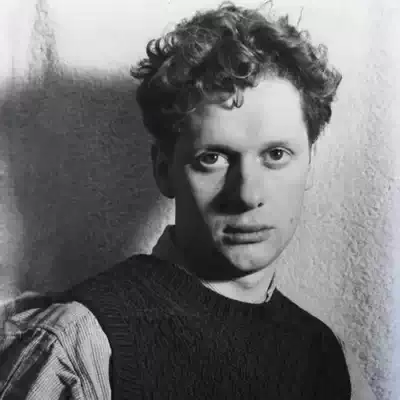
Dylan Thomas was a celebrated Welsh poet whose vivid imagery, lyrical intensity, and unique use of language captivated readers worldwide. His work, often characterized by its passionate exploration of life, death, love, and nature, combined a deep connection to his Welsh heritage with a modernist sensibility. Despite a tragically short and often tumultuous life, his poems possess an enduring power and musicality that have secured his place as one of the 20th century's most important poets.
n. 1914-10-27, Swansea·m. 1953-11-09, Nova Iorque
24,700Views
Do Not Go Gentle Into That Good Night
Do not go gentle into that good night, Old age should burn and rave at close of day; Rage, rage against the dying of the light.
Though wise men at their end know dark is right, Because their words had forked no lightning they Do not go gentle into that good night.
Good men, the last wave by, crying how bright Their frail deeds might have danced in a green bay, Rage, rage against the dying of the light.
Wild men who caught and sang the sun in flight, And learn, too late, they grieved it on its way, Do not go gentle into that good night.
Grave men, near death, who see with blinding sight Blind eyes could blaze like meteors and be gay, Rage, rage against the dying of the light.
And you, my father, there on that sad height, Curse, bless, me now with your fierce tears, I pray. Do not go gentle into that good night. Rage, rage against the dying of the light.
Dylan Marlais Thomas was a Welsh poet and writer. He is widely regarded as one of the most important poets of the 20th century, celebrated for his lyrical intensity, innovative use of language, and exploration of themes of life, death, love, and nature. He wrote primarily in English.
Childhood and education
Born and raised in Swansea, Wales, Thomas grew up in a predominantly Welsh-speaking household, though his father, a fluent Welsh speaker, also taught English literature. Thomas's formal education was somewhat limited, as he left school at sixteen. However, he was a voracious reader and possessed an exceptional natural talent for language and poetry from a young age. He was deeply influenced by the Bible, Welsh folklore, and the works of poets like Wilfred Owen and T.S. Eliot.
Literary trajectory
Thomas began writing poetry in his early teens, and his first collection, "18 Poems," was published in 1934, quickly earning him critical acclaim. This was followed by "20 Poems," "Deaths and Entrances" (1946), and "Collected Poems, 1934–1952" (1952). He also wrote short stories, radio plays (most famously "Under Milk Wood"), and film scripts. His career was marked by a prolific output of poetry, though his personal life was often turbulent, characterized by frequent travel and a struggle with alcoholism.
Works, style, and literary characteristics
Thomas's major works include "Do not go gentle into that good night," "Fern Hill," "The Force That Through the Green Fuse Drives the Flower," and "Death Shall Have No Dominion." His dominant themes include the life cycle, love, sexuality, death, the passage of time, childhood innocence, and the natural world, often imbued with a sense of Welsh landscape and myth. His style is characterized by its lush, sensuous imagery, powerful rhythms, and a unique, often ecstatic, use of language. He experimented with form, but often worked within or adapted traditional structures, infusing them with a modern sensibility. His poetic voice is often passionate, confessional, and incantatory, with a strong musicality that draws the reader in. His language is dense with metaphor, alliteration, and assonance, creating a rich and evocative texture.
Cultural and historical context
Thomas emerged as a poet in the interwar period and achieved prominence during and after World War II. He was part of a generation of writers grappling with the profound social and political changes of the time. While not formally aligned with any specific literary movement, his work shares certain affinities with modernism and surrealism in its exploration of the subconscious and its innovative use of language. His Welsh identity was a significant aspect of his life and work, though he wrote in English.
Personal life
Thomas's personal life was famously tumultuous, marked by his heavy drinking, financial struggles, and a passionate but often strained relationship with his wife, Caitlin Macnamara. His friendships and rivalries were intense, and his bohemian lifestyle often took a toll on his health and his creative output. His relationships and experiences undoubtedly fueled the emotional intensity and raw honesty found in his poetry.
Recognition and reception
Thomas gained international recognition during his lifetime, particularly following his successful reading tours in the United States. His powerful voice and charismatic stage presence made him a captivating performer. While some critics lauded his genius, others found his work overly ornate or self-indulgent. However, his posthumous reputation has grown significantly, solidifying his status as a major poet.
Influences and legacy
Thomas was influenced by the Bible, Welsh mythology, and poets such as Gerard Manley Hopkins, Walt Whitman, and the English Romantics. He, in turn, influenced a generation of poets with his distinctive voice, his lyrical power, and his innovative approach to language. His work continues to be studied and performed, and his poems remain among the most popular and enduring of the 20th century.
Interpretation and critical analysis
Thomas's poetry is often analyzed for its exploration of the tension between life and death, the sacred and the profane, and the individual's relationship with the universe. Critics have debated the extent to which his work is autobiographical, philosophical, or simply a masterful manipulation of language. His themes of mortality and the celebration of life's vitality continue to provoke discussion.
Curiosities and lesser-known aspects
Thomas was known for his public readings, which were often electrifying performances. His work on "Under Milk Wood" was a significant achievement in radio drama. Despite his fame, he often struggled financially, relying on patrons and performing to make ends meet.
Death and memory
Dylan Thomas died in New York City in 1953 at the age of 39, under circumstances often attributed to his heavy drinking and declining health. His death was a significant loss to the literary world. His "Collected Poems, 1934–1952" remains a seminal work, and his legacy as a poet of extraordinary talent and passionate voice continues to thrive.
Poems
51
Do Not Go Gentle Into That Good Night
Do not go gentle into that good night, Old age should burn and rave at close of day; Rage, rage against the dying of the light.
Though wise men at their end know dark is right, Because their words had forked no lightning they Do not go gentle into that good night.
Good men, the last wave by, crying how bright Their frail deeds might have danced in a green bay, Rage, rage against the dying of the light.
Wild men who caught and sang the sun in flight, And learn, too late, they grieved it on its way, Do not go gentle into that good night.
Grave men, near death, who see with blinding sight Blind eyes could blaze like meteors and be gay, Rage, rage against the dying of the light.
And you, my father, there on that sad height, Curse, bless, me now with your fierce tears, I pray. Do not go gentle into that good night. Rage, rage against the dying of the light.
3,460
Why East Wind Chills
Why East Wind Chills
Why east wind chills and south wind cools Shall not be known till windwell dries And west's no longer drowned In winds that bring the fruit and rind Of many a hundred falls; Why silk is soft and the stone wounds The child shall question all his days, Why night-time rain and the breast's blood Both quench his thirst he'll have a black reply.
When cometh Jack Frost? the children ask. Shall they clasp a comet in their fists? Not till, from high and low, their dust Sprinkles in children's eyes a long-last sleep And dusk is crowded with the children's ghosts, Shall a white answer echo from the rooftops.
All things are known: the stars' advice Calls some content to travel with the winds, Though what the stars ask as they round Time upon time the towers of the skies Is heard but little till the stars go out. I hear content, and 'Be Content' Ring like a handbell through the corridors, And 'Know no answer,' and I know No answer to the children's cry Of echo's answer and the man of frost And ghostly comets over the raised fists.
305
When, Like a Running Grave
When, Like a Running Grave
When, like a running grave, time tracks you down, Your calm and cuddled is a scythe of hairs, Love in her gear is slowly through the house, Up naked stairs, a turtle in a hearse, Hauled to the dome,
Comes, like a scissors stalking, tailor age, Deliver me who timid in my tribe, Of love am barer than Cadaver's trap Robbed of the foxy tongue, his footed tape Of the bone inch
Deliver me, my masters, head and heart, Heart of Cadaver's candle waxes thin, When blood, spade-handed, and the logic time Drive children up like bruises to the thumb, From maid and head,
For, sunday faced, with dusters in my glove, Chaste and the chaser, man with the cockshut eye, I, that time's jacket or the coat of ice May fail to fasten with a virgin o In the straight grave,
Stride through Cadaver's country in my force, My pickbrain masters morsing on the stone Despair of blood faith in the maiden's slime, Halt among eunuchs, and the nitric stain On fork and face.
Time is a foolish fancy, time and fool. No, no, you lover skull, descending hammer Descends, my masters, on the entered honour. You hero skull, Cadaver in the hangar Tells the stick, 'fail.'
Joy is no knocking nation, sir and madam, The cancer's fashion, or the summer feather Lit on the cuddled tree, the cross of fever, Not city tar and subway bored to foster Man through macadam.
I dump the waxlights in your tower dome. Joy is the knock of dust, Cadaver's shoot Of bud of Adam through his boxy shift, Love's twilit nation and the skull of state, Sir, is your doom.
Everything ends, the tower ending and, (Have with the house of wind), the leaning scene, Ball of the foot depending from the sun, (Give, summer, over), the cemented skin,
The actions' end.
All, men my madmen, the unwholesome wind With whistler's cough contages, time on track Shapes in a cinder death; love for his trick, Happy Cadaver's hunger as you take The kissproof world.
459
We Lying By Seasand
We Lying By Seasand
We lying by seasand, watching yellow And the grave sea, mock who deride Who follow the red rivers, hollow Alcove of words out of cicada shade, For in this yellow grave of sand and sea A calling for colour calls with the wind That's grave and gay as grave and sea Sleeping on either hand. The lunar silences, the silent tide Lapping the still canals, the dry tide-master Ribbed between desert and water storm, Should cure our ills of the water With a one-coloured calm; The heavenly music over the sand Sounds with the grains as they hurry Hiding the golden mountains and mansions Of the grave, gay, seaside land. Bound by a sovereign strip, we lie, Watch yellow, wish for wind to blow away The strata of the shore and drown red rock; But wishes breed not, neither Can we fend off rock arrival, Lie watching yellow until the golden weather Breaks, O my heart's blood, like a heart and hill.
651
When I Woke
When I Woke
When I woke, the town spoke. Birds and clocks and cross bells Dinned aside the coiling crowd, The reptile profligates in a flame, Spoilers and pokers of sleep, The next-door sea dispelled Frogs and satans and woman-luck, While a man outside with a billhook, Up to his head in his blood, Cutting the morning off, The warm-veined double of Time And his scarving beard from a book, Slashed down the last snake as though It were a wand or subtle bough, Its tongue peeled in the wrap of a leaf.
Every morning I make, God in bed, good and bad, After a water-face walk, The death-stagged scatter-breath Mammoth and sparrowfall Everybody's earth. Where birds ride like leaves and boats like ducks I heard, this morning, waking, Crossly out of the town noises A voice in the erected air, No prophet-progeny of mine, Cry my sea town was breaking. No Time, spoke the clocks, no God, rang the bells, I drew the white sheet over the islands And the coins on my eyelids sang like shells.
437
Twenty Four Years
Twenty Four Years
Twenty-four years remind the tears of my eyes. (Bury the dead for fear that they walk to the grave in labour.) In the groin of the natural doorway I crouched like a tailor Sewing a shroud for a journey By the light of the meat-eating sun. Dressed to die, the sensual strut begun, With my red veins full of money, In the final direction of the elementary town I advance as long as forever is.
446
Vision and Prayer
Vision and Prayer
Who Are you Who is born
In the next room So loud to my own That I can hear the womb Opening and the dark run
Over the ghost and the dropped son Behind the wall thin as a wren's bone? In the birth bloody room unknown
To the burn and turn of time And the heart print of man Bows no baptism But dark alone
Blessing on The wild Child.
432
To Others Than You
To Others Than You
Friend by enemy I call you out. You with a bad coin in your socket, You my friend there with a winning air Who palmed the lie on me when you looked Brassily at my shyest secret, Enticed with twinkling bits of the eye Till the sweet tooth of my love bit dry, Rasped at last, and I stumbled and sucked, Whom now I conjure to stand as thief In the memory worked by mirrors, With unforgettably smiling act, Quickness of hand in the velvet glove And my whole heart under your hammer, Were once such a creature, so gay and frank A desireless familiar I never thought to utter or think While you displaced a truth in the air,
That though I loved them for their faults As much as for their good, My friends were enemies on stilts With their heads in a cunning cloud.
472
This Bread I Break
This Bread I Break
This bread I break was once the oat, This wine upon a foreign tree Plunged in its fruit; Man in the day or wine at night Laid the crops low, broke the grape's joy.
Once in this time wine the summer blood Knocked in the flesh that decked the vine, Once in this bread The oat was merry in the wind; Man broke the sun, pulled the wind down.
This flesh you break, this blood you let Make desolation in the vein, Were oat and grape Born of the sensual root and sap; My wine you drink, my bread you snap.
388
Then Was My Neophyte
Then Was My Neophyte
Then was my neophyte, Child in white blood bent on its knees Under the bell of rocks, Ducked in the twelve, disciple seas The winder of the water-clocks Calls a green day and night. My sea hermaphrodite, Snail of man in His ship of fires That burn the bitten decks, Knew all His horrible desires The climber of the water sex Calls the green rock of light.
Who in these labyrinths, This tidethread and the lane of scales, Twine in a moon-blown shell, Escapes to the flat cities' sails Furled on the fishes' house and hell, Nor falls to His green myths? Stretch the salt photographs, The landscape grief, love in His oils Mirror from man to whale That the green child see like a grail Through veil and fin and fire and coil Time on the canvas paths.
He films my vanity. Shot in the wind, by tilted arcs, Over the water come Children from homes and children's parks Who speak on a finger and thumb, And the masked, headless boy. His reels and mystery The winder of the clockwise scene Wound like a ball of lakes Then threw on that tide-hoisted screen Love's image till my heartbone breaks By a dramatic sea.
Who kills my history? The year-hedged row is lame with flint, Blunt scythe and water blade. 'Who could snap off the shapeless print From your to-morrow-treading shade With oracle for eye?' Time kills me terribly. 'Time shall not murder you,' He said, 'Nor the green nought be hurt; Who could hack out your unsucked heart, O green and unborn and undead?' I saw time murder me.