escritas.org since 1996
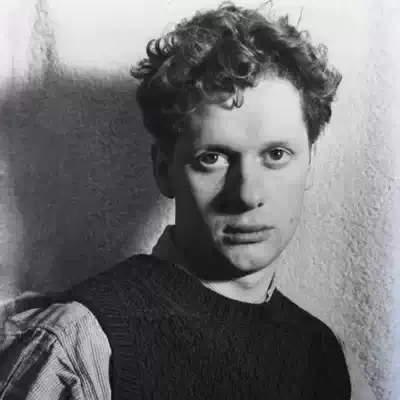
Dylan Thomas

Dylan Thomas

1914–1953 · lived 39 years GB GB

Dylan Thomas was a celebrated Welsh poet whose vivid imagery, lyrical intensity, and unique use of language captivated readers worldwide. His work, often characterized by its passionate exploration of life, death, love, and nature, combined a deep connection to his Welsh heritage with a modernist sensibility. Despite a tragically short and often tumultuous life, his poems possess an enduring power and musicality that have secured his place as one of the 20th century's most important poets.

n. 1914-10-27, Swansea · m. 1953-11-09, Nova Iorque

24,746 Views

Do Not Go Gentle Into That Good Night

Do not go gentle into that good night, 
Old age should burn and rave at close of day; 
Rage, rage against the dying of the light. 

Though wise men at their end know dark is right, 
Because their words had forked no lightning they 
Do not go gentle into that good night. 

Good men, the last wave by, crying how bright 
Their frail deeds might have danced in a green bay, 
Rage, rage against the dying of the light. 

Wild men who caught and sang the sun in flight, 
And learn, too late, they grieved it on its way, 
Do not go gentle into that good night. 

Grave men, near death, who see with blinding sight 
Blind eyes could blaze like meteors and be gay, 
Rage, rage against the dying of the light. 

And you, my father, there on that sad height, 
Curse, bless, me now with your fierce tears, I pray. 
Do not go gentle into that good night. 
Rage, rage against the dying of the light.
Read full poem
Bio

Identification and basic context

Dylan Marlais Thomas was a Welsh poet and writer. He is widely regarded as one of the most important poets of the 20th century, celebrated for his lyrical intensity, innovative use of language, and exploration of themes of life, death, love, and nature. He wrote primarily in English.

Childhood and education

Born and raised in Swansea, Wales, Thomas grew up in a predominantly Welsh-speaking household, though his father, a fluent Welsh speaker, also taught English literature. Thomas's formal education was somewhat limited, as he left school at sixteen. However, he was a voracious reader and possessed an exceptional natural talent for language and poetry from a young age. He was deeply influenced by the Bible, Welsh folklore, and the works of poets like Wilfred Owen and T.S. Eliot.

Literary trajectory

Thomas began writing poetry in his early teens, and his first collection, "18 Poems," was published in 1934, quickly earning him critical acclaim. This was followed by "20 Poems," "Deaths and Entrances" (1946), and "Collected Poems, 1934–1952" (1952). He also wrote short stories, radio plays (most famously "Under Milk Wood"), and film scripts. His career was marked by a prolific output of poetry, though his personal life was often turbulent, characterized by frequent travel and a struggle with alcoholism.

Works, style, and literary characteristics

Thomas's major works include "Do not go gentle into that good night," "Fern Hill," "The Force That Through the Green Fuse Drives the Flower," and "Death Shall Have No Dominion." His dominant themes include the life cycle, love, sexuality, death, the passage of time, childhood innocence, and the natural world, often imbued with a sense of Welsh landscape and myth. His style is characterized by its lush, sensuous imagery, powerful rhythms, and a unique, often ecstatic, use of language. He experimented with form, but often worked within or adapted traditional structures, infusing them with a modern sensibility. His poetic voice is often passionate, confessional, and incantatory, with a strong musicality that draws the reader in. His language is dense with metaphor, alliteration, and assonance, creating a rich and evocative texture.

Cultural and historical context

Thomas emerged as a poet in the interwar period and achieved prominence during and after World War II. He was part of a generation of writers grappling with the profound social and political changes of the time. While not formally aligned with any specific literary movement, his work shares certain affinities with modernism and surrealism in its exploration of the subconscious and its innovative use of language. His Welsh identity was a significant aspect of his life and work, though he wrote in English.

Personal life

Thomas's personal life was famously tumultuous, marked by his heavy drinking, financial struggles, and a passionate but often strained relationship with his wife, Caitlin Macnamara. His friendships and rivalries were intense, and his bohemian lifestyle often took a toll on his health and his creative output. His relationships and experiences undoubtedly fueled the emotional intensity and raw honesty found in his poetry.

Recognition and reception

Thomas gained international recognition during his lifetime, particularly following his successful reading tours in the United States. His powerful voice and charismatic stage presence made him a captivating performer. While some critics lauded his genius, others found his work overly ornate or self-indulgent. However, his posthumous reputation has grown significantly, solidifying his status as a major poet.

Influences and legacy

Thomas was influenced by the Bible, Welsh mythology, and poets such as Gerard Manley Hopkins, Walt Whitman, and the English Romantics. He, in turn, influenced a generation of poets with his distinctive voice, his lyrical power, and his innovative approach to language. His work continues to be studied and performed, and his poems remain among the most popular and enduring of the 20th century.

Interpretation and critical analysis

Thomas's poetry is often analyzed for its exploration of the tension between life and death, the sacred and the profane, and the individual's relationship with the universe. Critics have debated the extent to which his work is autobiographical, philosophical, or simply a masterful manipulation of language. His themes of mortality and the celebration of life's vitality continue to provoke discussion.

Curiosities and lesser-known aspects

Thomas was known for his public readings, which were often electrifying performances. His work on "Under Milk Wood" was a significant achievement in radio drama. Despite his fame, he often struggled financially, relying on patrons and performing to make ends meet.

Death and memory

Dylan Thomas died in New York City in 1953 at the age of 39, under circumstances often attributed to his heavy drinking and declining health. His death was a significant loss to the literary world. His "Collected Poems, 1934–1952" remains a seminal work, and his legacy as a poet of extraordinary talent and passionate voice continues to thrive.

Poems

49

Twenty Four Years

Twenty-four years remind the tears of my eyes.
(Bury the dead for fear that they walk to the grave in labour.)
In the groin of the natural doorway I crouched like a tailor
Sewing a shroud for a journey
By the light of the meat-eating sun.
Dressed to die, the sensual strut begun,
With my red veins full of money,
In the final direction of the elementary town
I advance as long as forever is.
449

When I Woke

When I woke, the town spoke.
Birds and clocks and cross bells
Dinned aside the coiling crowd,
The reptile profligates in a flame,
Spoilers and pokers of sleep,
The next-door sea dispelled
Frogs and satans and woman-luck,
While a man outside with a billhook,
Up to his head in his blood,
Cutting the morning off,
The warm-veined double of Time
And his scarving beard from a book,
Slashed down the last snake as though
It were a wand or subtle bough,
Its tongue peeled in the wrap of a leaf.


Every morning I make,
God in bed, good and bad,
After a water-face walk,
The death-stagged scatter-breath
Mammoth and sparrowfall
Everybody's earth.
Where birds ride like leaves and boats like ducks
I heard, this morning, waking,
Crossly out of the town noises
A voice in the erected air,
No prophet-progeny of mine,
Cry my sea town was breaking.
No Time, spoke the clocks, no God, rang the bells,
I drew the white sheet over the islands
And the coins on my eyelids sang like shells.
439

Vision and Prayer

Who
Are you
Who is born

In the next room
So loud to my own
That I can hear the womb
Opening and the dark run


Over the ghost and the dropped son
Behind the wall thin as a wren's bone?
In the birth bloody room unknown


To the burn and turn of time
And the heart print of man
Bows no baptism
But dark alone


Blessing on
The wild
Child.
435

All That I Owe the Fellows of the Grave

All that I owe the fellows of the grave
And all the dead bequeathed from pale estates
Lies in the fortuned bone, the flask of blood,
Like senna stirs along the ravaged roots.
O all I owe is all the flesh inherits,
My fathers' loves that pull upon my nerves,
My sisters tears that sing upon my head
My brothers' blood that salts my open wounds


Heir to the scalding veins that hold love's drop,
My fallen filled, that had the hint of death,
Heir to the telling senses that alone
Acquaint the flesh with a remembered itch,
I round this heritage as rounds the sun
His winy sky, and , as the candles moon,
Cast light upon my weather. I am heir
To women who have twisted their last smile,
To children who were suckled on a plague,
To young adorers dying on a kiss.
All such disease I doctor in my blood,
And all such love's a shrub sown in the breath.


Then look, my eyes, upon this bonehead fortune
And browse upon the postures of the dead;
All night and day I eye the ragged globe
Through periscopes rightsighted from the grave;
All night and day I wander in these same
Wax clothes that wax upon the ageing ribs;
All night my fortune slumbers in its sheet.
Then look, my heart, upon the scarlet trove,
And look, my grain, upon the falling wheat;
All night my fortune slumbers in its sheet.
435

On a Wedding Anniversary

The sky is torn across
This ragged anniversary of two
Who moved for three years in tune
Down the long walks of their vows.


Now their love lies a loss
And Love and his patients roar on a chain;
From every tune or crater
Carrying cloud, Death strikes their house.


Too late in the wrong rain
They come together whom their love parted:
The windows pour into their heart
And the doors burn in their brain.
394

This Bread I Break

This bread I break was once the oat,
This wine upon a foreign tree
Plunged in its fruit;
Man in the day or wine at night
Laid the crops low, broke the grape's joy.


Once in this time wine the summer blood
Knocked in the flesh that decked the vine,
Once in this bread
The oat was merry in the wind;
Man broke the sun, pulled the wind down.


This flesh you break, this blood you let
Make desolation in the vein,
Were oat and grape
Born of the sensual root and sap;
My wine you drink, my bread you snap.
389

Poem In October

It was my thirtieth year to heaven
Woke to my hearing from harbour and neighbour wood
And the mussel pooled and the heron
Priested shore
The morning beckon
With water praying and call of seagull and rook
And the knock of sailing boats on the net webbed wall
Myself to set foot
That second
In the still sleeping town and set forth.

My birthday began with the water-
Birds and the birds of the winged trees flying my name
Above the farms and the white horses
And I rose
In rainy autumn
And walked abroad in a shower of all my days.
High tide and the heron dived when I took the road
Over the border
And the gates
Of the town closed as the town awoke.

A springful of larks in a rolling
Cloud and the roadside bushes brimming with whistling
Blackbirds and the sun of October
Summery
On the hill's shoulder,
Here were fond climates and sweet singers suddenly
Come in the morning where I wandered and listened
To the rain wringing
Wind blow cold
In the wood faraway under me.

Pale rain over the dwindling harbour
And over the sea wet church the size of a snail
With its horns through mist and the castle
Brown as owls
But all the gardens
Of spring and summer were blooming in the tall tales
Beyond the border and under the lark full cloud.
There could I marvel
My birthday
Away but the weather turned around.

It turned away from the blithe country
And down the other air and the blue altered sky
Streamed again a wonder of summer
With apples
Pears and red currants
And I saw in the turning so clearly a child's
Forgotten mornings when he walked with his mother
Through the parables


Of sun light
And the legends of the green chapels

And the twice told fields of infancy
That his tears burned my cheeks and his heart moved in mine.
These were the woods the river and sea
Where a boy
In the listening
Summertime of the dead whispered the truth of his joy
To the trees and the stones and the fish in the tide.
And the mystery
Sang alive
Still in the water and singingbirds.

And there could I marvel my birthday
Away but the weather turned around. And the true
Joy of the long dead child sang burning
In the sun.
It was my thirtieth
Year to heaven stood there then in the summer noon
Though the town below lay leaved with October blood.
O may my heart's truth
Still be sung
On this high hill in a year's turning.
372

Here In This spring

Here in this spring, stars float along the void;
Here in this ornamental winter
Down pelts the naked weather;
This summer buries a spring bird.


Symbols are selected from the years'
Slow rounding of four seasons' coasts,
In autumn teach three seasons' fires
And four birds' notes.


I should tell summer from the trees, the worms
Tell, if at all, the winter's storms
Or the funeral of the sun;
I should learn spring by the cuckooing,
And the slug should teach me destruction.


A worm tells summer better than the clock,
The slug's a living calendar of days;
What shall it tell me if a timeless insect
Says the world wears away?
364

Ghosts whooed like owls in the long nights when I dared not look over my shoulder

Ghosts whooed like owls in the long nights when I dared not look over my shoulder;
animals lurked in the cubbyhole under the stairs and the gas meter ticked. And I
remember that we went singing carols once, when there wasn't the shaving of a moon
to light the flying streets. At the end of a long road was a drive that led to a large
house, and we stumbled up the darkness of the drive that night, each one of us afraid,
each one holding a stone in his hand in case, and all of us too brave to say a word. The
wind through the trees made noises as of old and unpleasant and maybe webfooted
men wheezing in caves. We reached the black bulk of the house. "What shall we give
them? Hark the Herald?"
"No," Jack said, "Good King Wencelas. I'll count three." One, two three, and we began
to sing, our voices high and seemingly distant in the snow-felted darkness round the
house that was occupied by nobody we knew. We stood close together, near the dark
door. Good King Wencelas looked out On the Feast of Stephen ... And then a small, dry
voice, like the voice of someone who has not spoken for a long time, joined our
singing: a small, dry, eggshell voice from the other side of the door: a small dry voice
through the keyhole. And when we stopped running we were outside our house; the
front room was lovely; balloons floated under the hot-water-bottle-gulping gas;
everything was good again and shone over the town.
"Perhaps it was a ghost," Jim said.
"Perhaps it was trolls," Dan said, who was always reading.
"Let's go in and see if there's any jelly left," Jack said. And we did that.

Always on Christmas night there was music. An uncle played the fiddle, a cousin sang
"Cherry Ripe," and another uncle sang "Drake's Drum." It was very warm in the little
house. Auntie Hannah, who had got on to the parsnip wine, sang a song about
Bleeding Hearts and Death, and then another in which she said her heart was like a
Bird's Nest; and then everybody laughed again; and then I went to bed. Looking
through my bedroom window, out into the moonlight and the unending smoke-colored
snow, I could see the lights in the windows of all the other houses on our hill and hear
the music rising from them up the long, steady falling night. I turned the gas down, I
got into bed. I said some words to the close and holy darkness, and then I slept.
362

How Soon The Servant Sun

How soon the servant sun,
(Sir morrow mark),
Can time unriddle, and the cupboard stone,
(Fog has a bone
He'll trumpet into meat),
Unshelve that all my gristles have a gown
And the naked egg stand straight,


Sir morrow at his sponge,
(The wound records),
The nurse of giants by the cut sea basin,
(Fog by his spring
Soaks up the sewing tides),
Tells you and you, my masters, as his strange
Man morrow blows through food.


All nerves to serve the sun,
The rite of light,
A claw I question from the mouse's bone,
The long-tailed stone
Trap I with coil and sheet,
Let the soil squeal I am the biting man
And the velvet dead inch out.


How soon my level, lord,
(Sir morrow stamps
Two heels of water on the floor of seed),
Shall raise a lamp
Or spirit up a cloud,
Erect a walking centre in the shroud,
Invisible on the stump


A leg as long as trees,
This inward sir,
Mister and master, darkness for his eyes,
The womb-eyed, cries,
And all sweet hell, deaf as an hour's ear,
Blasts back the trumpet voice.
360

Quotes

40

Videos

50

Comments (0)

Share
Log in to post a comment.

No comments yet. Be the first to comment.