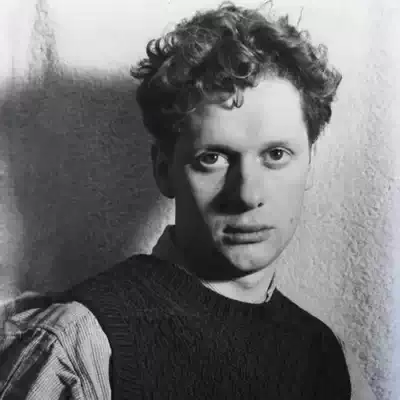
I, In My Intricate Image
I, In My Intricate Image
I
I, in my intricate image, stride on two levels,
Forged in man's minerals, the brassy orator
Laying my ghost in metal,
The scales of this twin world tread on the double,
My half ghost in armour hold hard in death's corridor,
To my man-iron sidle.
Beginning with doom in the bulb, the spring unravels,
Bright as her spinning-wheels, the colic season
Worked on a world of petals;
She threads off the sap and needles, blood and bubble
Casts to the pine roots, raising man like a mountain
Out of the naked entrail.
Beginning with doom in the ghost, and the springing marvels,
Image of images, my metal phantom
Forcing forth through the harebell,
My man of leaves and the bronze root, mortal, unmortal,
I, in my fusion of rose and male motion,
Create this twin miracle.
This is the fortune of manhood: the natural peril,
A steeplejack tower, bonerailed and masterless,
No death more natural;
Thus the shadowless man or ox, and the pictured devil,
In seizure of silence commit the dead nuisance.
The natural parallel.
My images stalk the trees and the slant sap's tunnel,
No tread more perilous, the green steps and spire
Mount on man's footfall,
I with the wooden insect in the tree of nettles,
In the glass bed of grapes with snail and flower,
Hearing the weather fall.
Intricate manhood of ending, the invalid rivals,
Voyaging clockwise off the symboled harbour,
Finding the water final,
On the consumptives' terrace taking their two farewells,
Sail on the level, the departing adventure,
To the sea-blown arrival.
II
They climb the country pinnacle,
Twelve winds encounter by the white host at pasture,
Corner the mounted meadows in the hill corral;
They see the squirrel stumble,
The haring snail go giddily round the flower,
A quarrel of weathers and trees in the windy spiral.
As they dive, the dust settles,
The cadaverous gravels, falls thick and steadily,
The highroad of water where the seabear and mackerel
Turn the long sea arterial
Turning a petrol face blind to the enemy
Turning the riderless dead by the channel wall.
(Death instrumental,
Splitting the long eye open, and the spiral turnkey,
Your corkscrew grave centred in navel and nipple,
The neck of the nostril,
Under the mask and the ether, they making bloody
The tray of knives, the antiseptic funeral;
Bring out the black patrol,
Your monstrous officers and the decaying army,
The sexton sentinel, garrisoned under thistles,
A cock-on-a-dunghill
Crowing to Lazarus the morning is vanity,
Dust be your saviour under the conjured soil.)
As they drown, the chime travels,
Sweetly the diver's bell in the steeple of spindrift
Rings out the Dead Sea scale;
And, clapped in water till the triton dangles,
Strung by the flaxen whale-weed, from the hangman's raft,
Hear they the salt glass breakers and the tongues of burial.
(Turn the sea-spindle lateral,
The grooved land rotating, that the stylus of lightning
Dazzle this face of voices on the moon-turned table,
Let the wax disk babble
Shames and the damp dishonours, the relic scraping.
These are your years' recorders. The circular world stands still.)
III
They suffer the undead water where the turtle nibbles,
Come unto sea-stuck towers, at the fibre scaling,
The flight of the carnal skull
And the cell-stepped thimble;
Suffer, my topsy-turvies, that a double angel
Sprout from the stony lockers like a tree on Aran.
Be by your one ghost pierced, his pointed ferrule,
Brass and the bodiless image, on a stick of folly
Star-set at Jacob's angle,
Smoke hill and hophead's valley,
And the five-fathomed Hamlet on his father's coral
Thrusting the tom-thumb vision up the iron mile.
Suffer the slash of vision by the fin-green stubble,
Be by the ships' sea broken at the manstring anchored
The stoved bones' voyage downward
In the shipwreck of muscle;
Give over, lovers, locking, and the seawax struggle,
Love like a mist or fire through the bed of eels.
And in the pincers of the boiling circle,
The sea and instrument, nicked in the locks of time,
My great blood's iron single
In the pouring town,
I, in a wind on fire, from green Adam's cradle,
No man more magical, clawed out the crocodile.
Man was the scales, the death birds on enamel,
Tail, Nile, and snout, a saddler of the rushes,
Time in the hourless houses
Shaking the sea-hatched skull,
And, as for oils and ointments on the flying grail,
All-hollowed man wept for his white apparel.
Man was Cadaver's masker, the harnessing mantle,
Windily master of man was the rotten fathom,
My ghost in his metal neptune
Forged in man's mineral.
This was the god of beginning in the intricate seawhirl,
And my images roared and rose on heaven's hill.
I Make This In A Warring Absence
I Make This In A Warring Absence
I make this in a warring absence when
Each ancient, stone-necked minute of love's season
Harbours my anchored tongue, slips the quaystone,
When, praise is blessed, her pride in mast and fountain
Sailed and set dazzling by the handshaped ocean,
In that proud sailing tree with branches driven
Through the last vault and vegetable groyne,
And this weak house to marrow-columned heaven,
Is corner-cast, breath's rag, scrawled weed, a vain
And opium head, crow stalk, puffed, cut, and blown,
Or like the tide-looped breastknot reefed again
Or rent ancestrally the roped sea-hymen,
And, pride is last, is like a child alone
By magnet winds to her blind mother drawn,
Bread and milk mansion in a toothless town.
She makes for me a nettle's innocence
And a silk pigeon's guilt in her proud absence,
In the molested rocks the shell of virgins,
The frank, closed pearl, the sea-girls' lineaments
Glint in the staved and siren-printed caverns,
Is maiden in the shameful oak, omens
Whalebed and bulldance, the gold bush of lions,
Proud as a sucked stone and huge as sandgrains.
These are her contraries: the beast who follows
With priest's grave foot and hand of five assassins
Her molten flight up cinder-nesting columns,
Calls the starved fire herd, is cast in ice,
Lost in a limp-treed and uneating silence,
Who scales a hailing hill in her cold flintsteps
Falls on a ring of summers and locked noons.
I make a weapon of an ass's skeleton
And walk the warring sands by the dead town.
Cudgel great air, wreck east, and topple sundown,
Storm her sped heart, hang with beheaded veins
Its wringing shell, and let her eyelids fasten.
Destruction, picked by birds, brays through the jaw-bone,
And, for that murder's sake, dark with contagion
Like an approaching wave I sprawl to ruin.
Ruin, the room of errors, one rood dropped
Down the stacked sea and water-pillared shade,
Weighed in rock shroud, is my proud pyramid;
Where, wound in emerald linen and sharp wind,
The hero's head lies scraped of every legend,
Comes love's anatomist with sun-gloved hand
Who picks the live heart on a diamond.
'His mother's womb had a tongue that lapped up mud,'
Cried the topless, inchtaped lips from hank and hood
In that bright anchorground where I lay linened,
'A lizard darting with black venom's thread
Doubled, to fork him back, through the lockjaw bed
And the breath-white, curtained mouth of seed.'
'See,' drummed the taut masks, 'how the dead ascend:
In the groin's endless coil a man is tangled.'
These once-blind eyes have breathed a wind of visions,
The cauldron's root through this once-rindless hand
Fumed like a tree, and tossed a burning bird;
With loud, torn tooth and tail and cobweb drum
The crumpled packs fled past this ghost in bloom,
And, mild as pardon from a cloud of pride,
The terrible world my brother bares his skin.
Now in the cloud's big breast lie quiet countries,
Delivered seas my love from her proud place
Walks with no wound, nor lightning in her face,
A calm wind blows that raised the trees like hair
Once where the soft snow's blood was turned to ice.
And though my love pulls the pale, nippled air,
Prides of to-morrow suckling in her eyes,
Yet this I make in a forgiving presence.
I Fellowed Sleep
I Fellowed Sleep
I fellowed sleep who kissed me in the brain,
Let fall the tear of time; the sleeper's eye,
Shifting to light, turned on me like a moon.
So, planning-heeled, I flew along my man
And dropped on dreaming and the upward sky.
I fled the earth and, naked, climbed the weather,
Reaching a second ground far from the stars;
And there we wept I and a ghostly other,
My mothers-eyed, upon the tops of trees;
I fled that ground as lightly as a feather.
'My fathers' globe knocks on its nave and sings.'
'This that we tread was, too, your father's land.'
'But this we tread bears the angelic gangs
Sweet are their fathered faces in their wings.'
'These are but dreaming men. Breathe, and they fade.'
Faded my elbow ghost, the mothers-eyed,
As, blowing on the angels, I was lost
On that cloud coast to each grave-grabbing shade;
I blew the dreaming fellows to their bed
Where still they sleep unknowing of their ghost.
Then all the matter of the living air
Raised up a voice, and, climbing on the words,
I spelt my vision with a hand and hair,
How light the sleeping on this soily star,
How deep the waking in the worlded clouds.
There grows the hours' ladder to the sun,
Each rung a love or losing to the last,
The inches monkeyed by the blood of man.
And old, mad man still climbing in his ghost,
My fathers' ghost is climbing in the rain.
Holy Spring
Holy Spring
O
Out of a bed of love
When that immortal hospital made one more moove to soothe
The curless counted body,
And ruin and his causes
Over the barbed and shooting sea assumed an army
And swept into our wounds and houses,
I climb to greet the war in which I have no heart but only
That one dark I owe my light,
Call for confessor and wiser mirror but there is none
To glow after the god stoning night
And I am struck as lonely as a holy marker by the sun
No
Praise that the spring time is all
Gabriel and radiant shrubbery as the morning grows joyful
Out of the woebegone pyre
And the multitude's sultry tear turns cool on the weeping wall,
My arising prodgidal
Sun the father his quiver full of the infants of pure fire,
But blessed be hail and upheaval
That uncalm still it is sure alone to stand and sing
Alone in the husk of man's home
And the mother and toppling house of the holy spring,
If only for a last time.
How Soon The Servant Sun
How Soon The Servant Sun
How soon the servant sun,
(Sir morrow mark),
Can time unriddle, and the cupboard stone,
(Fog has a bone
He'll trumpet into meat),
Unshelve that all my gristles have a gown
And the naked egg stand straight,
Sir morrow at his sponge,
(The wound records),
The nurse of giants by the cut sea basin,
(Fog by his spring
Soaks up the sewing tides),
Tells you and you, my masters, as his strange
Man morrow blows through food.
All nerves to serve the sun,
The rite of light,
A claw I question from the mouse's bone,
The long-tailed stone
Trap I with coil and sheet,
Let the soil squeal I am the biting man
And the velvet dead inch out.
How soon my level, lord,
(Sir morrow stamps
Two heels of water on the floor of seed),
Shall raise a lamp
Or spirit up a cloud,
Erect a walking centre in the shroud,
Invisible on the stump
A leg as long as trees,
This inward sir,
Mister and master, darkness for his eyes,
The womb-eyed, cries,
And all sweet hell, deaf as an hour's ear,
Blasts back the trumpet voice.
From Love's First Fever to Her Plague
From Love's First Fever to Her Plague
From love's first fever to her plague, from the soft second
And to the hollow minute of the womb,
From the unfolding to the scissored caul,
The time for breast and the green apron age
When no mouth stirred about the hanging famine,
All world was one, one windy nothing,
My world was christened in a stream of milk.
And earth and sky were as one airy hill.
The sun and mood shed one white light.
From the first print of the unshodden foot, the lifting
Hand, the breaking of the hair,
From the first scent of the heart, the warning ghost,
And to the first dumb wonder at the flesh,
The sun was red, the moon was grey,
The earth and sky were as two mountains meeting.
The body prospered, teeth in the marrowed gums,
The growing bones, the rumour of the manseed
Within the hallowed gland, blood blessed the heart,
And the four winds, that had long blown as one,
Shone in my ears the light of sound,
Called in my eyes the sound of light.
And yellow was the multiplying sand,
Each golden grain spat life into its fellow,
Green was the singing house.
The plum my mother picked matured slowly,
The boy she dropped from darkness at her side
Into the sided lap of light grew strong,
Was muscled, matted, wise to the crying thigh,
And to the voice that, like a voice of hunger,
Itched in the noise of wind and sun.
And from the first declension of the flesh
I learnt man's tongue, to twist the shapes of thoughts
Into the stony idiom of the brain,
To shade and knit anew the patch of words
Left by the dead who, in their moonless acre,
Need no word's warmth.
The root of tongues ends in a spentout cancer,
That but a name, where maggots have their X.
I learnt the verbs of will, and had my secret;
The code of night tapped on my tongue;
What had been one was many sounding minded.
One wound, one mind, spewed out the matter,
One breast gave suck the fever's issue;
From the divorcing sky I learnt the double,
The two-framed globe that spun into a score;
A million minds gave suck to such a bud
As forks my eye;
Youth did condense; the tears of spring
Dissolved in summer and the hundred seasons;
One sun, one manna, warmed and fed.
Here In This spring
Here In This spring
Here in this spring, stars float along the void;
Here in this ornamental winter
Down pelts the naked weather;
This summer buries a spring bird.
Symbols are selected from the years'
Slow rounding of four seasons' coasts,
In autumn teach three seasons' fires
And four birds' notes.
I should tell summer from the trees, the worms
Tell, if at all, the winter's storms
Or the funeral of the sun;
I should learn spring by the cuckooing,
And the slug should teach me destruction.
A worm tells summer better than the clock,
The slug's a living calendar of days;
What shall it tell me if a timeless insect
Says the world wears away?
Find Meat On Bones
Find Meat On Bones
'Find meat on bones that soon have none,
And drink in the two milked crags,
The merriest marrow and the dregs
Before the ladies' breasts are hags
And the limbs are torn.
Disturb no winding-sheets, my son,
But when the ladies are cold as stone
Then hang a ram rose over the rags.
'Rebel against the binding moon
And the parliament of sky,
The kingcrafts of the wicked sea,
Autocracy of night and day,
Dictatorship of sun.
Rebel against the flesh and bone,
The word of the blood, the wily skin,
And the maggot no man can slay.'
'The thirst is quenched, the hunger gone,
And my heart is cracked across;
My face is haggard in the glass,
My lips are withered with a kiss,
My breasts are thin.
A merry girl took me for man,
I laid her down and told her sin,
And put beside her a ram rose.
'The maggot that no man can kill
And the man no rope can hang
Rebel against my father's dream
That out of a bower of red swine
Howls the foul fiend to heel.
I cannot murder, like a fool,
Season and sunshine, grace and girl,
Nor can I smother the sweet waking.'
Black night still ministers the moon,
And the sky lays down her laws,
The sea speaks in a kingly voice,
Light and dark are no enemies
But one companion.
'War on the spider and the wren!
War on the destiny of man!
Doom on the sun!'
Before death takes you, O take back this.
Especially When the October Wind
Especially When the October Wind
Especially when the October wind
With frosty fingers punishes my hair,
Caught by the crabbing sun I walk on fire
And cast a shadow crab upon the land,
By the sea's side, hearing the noise of birds,
Hearing the raven cough in winter sticks,
My busy heart who shudders as she talks
Sheds the syllabic blood and drains her words.
Shut, too, in a tower of words, I mark
On the horizon walking like the trees
The wordy shapes of women, and the rows
Of the star-gestured children in the park.
Some let me make you of the vowelled beeches,
Some of the oaken voices, from the roots
Of many a thorny shire tell you notes,
Some let me make you of the water's speeches.
Behind a pot of ferns the wagging clock
Tells me the hour's word, the neural meaning
Flies on the shafted disk, declaims the morning
And tells the windy weather in the cock.
Some let me make you of the meadow's signs;
The signal grass that tells me all I know
Breaks with the wormy winter through the eye.
Some let me tell you of the raven's sins.
Especially when the October wind
(Some let me make you of autumnal spells,
The spider-tongued, and the loud hill of Wales)
With fists of turnips punishes the land,
Some let me make you of the heartless words.
The heart is drained that, spelling in the scurry
Of chemic blood, warned of the coming fury.
By the sea's side hear the dark-vowelled birds.
Ears in the Turrets Hear
Ears in the Turrets Hear
Ears in the turrets hear
Hands grumble on the door,
Eyes in the gables see
The fingers at the locks.
Shall I unbolt or stay
Alone till the day I die
Unseen by stranger-eyes
In this white house?
Hands, hold you poison or grapes?
Beyond this island bound
By a thin sea of flesh
And a bone coast,
The land lies out of sound
And the hills out of mind.
No birds or flying fish
Disturbs this island’s rest.
Ears in this island hear
The wind pass like a fire,
Eyes in this island see
Ships anchor off the bay.
Shall I run to the ships
With the wind in my hair,
Or stay till the day I die
And welcome no sailor?
Ships, hold you poison or grapes?
Hands grumble on the door,
Ships anchor off the bay,
Rain beats the sand and slates.
Shall I let in the stranger,
Shall I welcome the sailor,
Or stay till the day I die?
Hands of the stranger and holds of the ships,
Hold you poison or grapes?