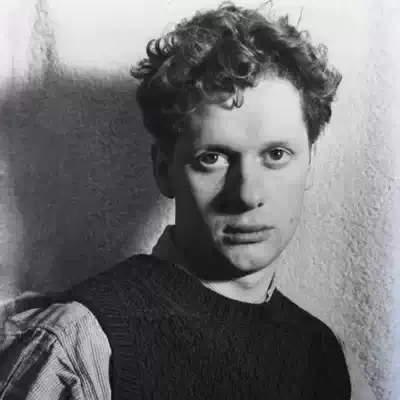
I, In My Intricate Image
I
I, in my intricate image, stride on two levels,
Forged in man's minerals, the brassy orator
Laying my ghost in metal,
The scales of this twin world tread on the double,
My half ghost in armour hold hard in death's corridor,
To my man-iron sidle.
Beginning with doom in the bulb, the spring unravels,
Bright as her spinning-wheels, the colic season
Worked on a world of petals;
She threads off the sap and needles, blood and bubble
Casts to the pine roots, raising man like a mountain
Out of the naked entrail.
Beginning with doom in the ghost, and the springing marvels,
Image of images, my metal phantom
Forcing forth through the harebell,
My man of leaves and the bronze root, mortal, unmortal,
I, in my fusion of rose and male motion,
Create this twin miracle.
This is the fortune of manhood: the natural peril,
A steeplejack tower, bonerailed and masterless,
No death more natural;
Thus the shadowless man or ox, and the pictured devil,
In seizure of silence commit the dead nuisance.
The natural parallel.
My images stalk the trees and the slant sap's tunnel,
No tread more perilous, the green steps and spire
Mount on man's footfall,
I with the wooden insect in the tree of nettles,
In the glass bed of grapes with snail and flower,
Hearing the weather fall.
Intricate manhood of ending, the invalid rivals,
Voyaging clockwise off the symboled harbour,
Finding the water final,
On the consumptives' terrace taking their two farewells,
Sail on the level, the departing adventure,
To the sea-blown arrival.
II
They climb the country pinnacle,
Twelve winds encounter by the white host at pasture,
Corner the mounted meadows in the hill corral;
They see the squirrel stumble,
The haring snail go giddily round the flower,
A quarrel of weathers and trees in the windy spiral.
As they dive, the dust settles,
The cadaverous gravels, falls thick and steadily,
The highroad of water where the seabear and mackerel
Turn the long sea arterial
Turning a petrol face blind to the enemy
Turning the riderless dead by the channel wall.
(Death instrumental,
Splitting the long eye open, and the spiral turnkey,
Your corkscrew grave centred in navel and nipple,
The neck of the nostril,
Under the mask and the ether, they making bloody
The tray of knives, the antiseptic funeral;
Bring out the black patrol,
Your monstrous officers and the decaying army,
The sexton sentinel, garrisoned under thistles,
A cock-on-a-dunghill
Crowing to Lazarus the morning is vanity,
Dust be your saviour under the conjured soil.)
As they drown, the chime travels,
Sweetly the diver's bell in the steeple of spindrift
Rings out the Dead Sea scale;
And, clapped in water till the triton dangles,
Strung by the flaxen whale-weed, from the hangman's raft,
Hear they the salt glass breakers and the tongues of burial.
(Turn the sea-spindle lateral,
The grooved land rotating, that the stylus of lightning
Dazzle this face of voices on the moon-turned table,
Let the wax disk babble
Shames and the damp dishonours, the relic scraping.
These are your years' recorders. The circular world stands still.)
III
They suffer the undead water where the turtle nibbles,
Come unto sea-stuck towers, at the fibre scaling,
The flight of the carnal skull
And the cell-stepped thimble;
Suffer, my topsy-turvies, that a double angel
Sprout from the stony lockers like a tree on Aran.
Be by your one ghost pierced, his pointed ferrule,
Brass and the bodiless image, on a stick of folly
Star-set at Jacob's angle,
Smoke hill and hophead's valley,
And the five-fathomed Hamlet on his father's coral
Thrusting the tom-thumb vision up the iron mile.
Suffer the slash of vision by the fin-green stubble,
Be by the ships' sea broken at the manstring anchored
The stoved bones' voyage downward
In the shipwreck of muscle;
Give over, lovers, locking, and the seawax struggle,
Love like a mist or fire through the bed of eels.
And in the pincers of the boiling circle,
The sea and instrument, nicked in the locks of time,
My great blood's iron single
In the pouring town,
I, in a wind on fire, from green Adam's cradle,
No man more magical, clawed out the crocodile.
Man was the scales, the death birds on enamel,
Tail, Nile, and snout, a saddler of the rushes,
Time in the hourless houses
Shaking the sea-hatched skull,
And, as for oils and ointments on the flying grail,
All-hollowed man wept for his white apparel.
Man was Cadaver's masker, the harnessing mantle,
Windily master of man was the rotten fathom,
My ghost in his metal neptune
Forged in man's mineral.
This was the god of beginning in the intricate seawhirl,
And my images roared and rose on heaven's hill.
Now
Now
Say nay,
Man dry man,
Dry lover mine
The deadrock base and blow the flowered anchor,
Should he, for centre sake, hop in the dust,
Forsake, the fool, the hardiness of anger.
Now
Say nay,
Sir no say,
Death to the yes,
the yes to death, the yesman and the answer,
Should he who split his children with a cure
Have brotherless his sister on the handsaw.
Now
Say nay,
No say sir
Yea the dead stir,
And this, nor this, is shade, the landed crow,
He lying low with ruin in his ear,
The cockrel's tide upcasting from the fire.
Now
Say nay,
So star fall,
So the ball fail,
So solve the mystic sun, the wife of light,
The sun that leaps on petals through a nought,
the come-a-cropper rider of the flower.
Now
Say nay
A fig for
The seal of fire,
Death hairy-heeled and the tapped ghost in wood,
We make me mystic as the arm of air,
The two-a-vein, the foreskin, and the cloud.
From Love's First Fever to Her Plague
From love's first fever to her plague, from the soft second
And to the hollow minute of the womb,
From the unfolding to the scissored caul,
The time for breast and the green apron age
When no mouth stirred about the hanging famine,
All world was one, one windy nothing,
My world was christened in a stream of milk.
And earth and sky were as one airy hill.
The sun and mood shed one white light.
From the first print of the unshodden foot, the lifting
Hand, the breaking of the hair,
From the first scent of the heart, the warning ghost,
And to the first dumb wonder at the flesh,
The sun was red, the moon was grey,
The earth and sky were as two mountains meeting.
The body prospered, teeth in the marrowed gums,
The growing bones, the rumour of the manseed
Within the hallowed gland, blood blessed the heart,
And the four winds, that had long blown as one,
Shone in my ears the light of sound,
Called in my eyes the sound of light.
And yellow was the multiplying sand,
Each golden grain spat life into its fellow,
Green was the singing house.
The plum my mother picked matured slowly,
The boy she dropped from darkness at her side
Into the sided lap of light grew strong,
Was muscled, matted, wise to the crying thigh,
And to the voice that, like a voice of hunger,
Itched in the noise of wind and sun.
And from the first declension of the flesh
I learnt man's tongue, to twist the shapes of thoughts
Into the stony idiom of the brain,
To shade and knit anew the patch of words
Left by the dead who, in their moonless acre,
Need no word's warmth.
The root of tongues ends in a spentout cancer,
That but a name, where maggots have their X.
I learnt the verbs of will, and had my secret;
The code of night tapped on my tongue;
What had been one was many sounding minded.
One wound, one mind, spewed out the matter,
One breast gave suck the fever's issue;
From the divorcing sky I learnt the double,
The two-framed globe that spun into a score;
A million minds gave suck to such a bud
As forks my eye;
Youth did condense; the tears of spring
Dissolved in summer and the hundred seasons;
One sun, one manna, warmed and fed.
After the Funeral (In memory of Ann Jones)
After the funeral, mule praises, brays,
Windshake of sailshaped ears, muffle-toed tap
Tap happily of one peg in the thick
Grave's foot, blinds down the lids, the teeth in black,
The spittled eyes, the salt ponds in the sleeves,
Morning smack of the spade that wakes up sleep,
Shakes a desolate boy who slits his throat
In the dark of the coffin and sheds dry leaves,
That breaks one bone to light with a judgment clout'
After the feast of tear-stuffed time and thistles
In a room with a stuffed fox and a stale fern,
I stand, for this memorial's sake, alone
In the snivelling hours with dead, humped Ann
Whose hodded, fountain heart once fell in puddles
Round the parched worlds of Wales and drowned each sun
(Though this for her is a monstrous image blindly
Magnified out of praise; her death was a still drop;
She would not have me sinking in the holy
Flood of her heart's fame; she would lie dumb and deep
And need no druid of her broken body).
But I, Ann's bard on a raised hearth, call all
The seas to service that her wood-tongud virtue
Babble like a bellbuoy over the hymning heads,
Bow down the walls of the ferned and foxy woods
That her love sing and swing through a brown chapel,
Blees her bent spirit with four, crossing birds.
Her flesh was meek as milk, but this skyward statue
With the wild breast and blessed and giant skull
Is carved from her in a room with a wet window
In a fiercely mourning house in a crooked year.
I know her scrubbed and sour humble hands
Lie with religion in their cramp, her threadbare
Whisper in a damp word, her wits drilled hollow,
Her fist of a face died clenched on a round pain;
And sculptured Ann is seventy years of stone.
These cloud-sopped, marble hands, this monumental
Argument of the hewn voice, gesture and psalm
Storm me forever over her grave until
The stuffed lung of the fox twitch and cry Love
And the strutting fern lay seeds on the black sill.
On The Marriage Of A Virgin
Waking alone in a multitude of loves when morning's light
Surprised in the opening of her nightlong eyes
His golden yesterday asleep upon the iris
And this day's sun leapt up the sky out of her thighs
Was miraculous virginity old as loaves and fishes,
Though the moment of a miracle is unending lightning
And the shipyards of Galilee's footprints hide a navy of doves.
No longer will the vibrations of the sun desire on
Her deepsea pillow where once she married alone,
Her heart all ears and eyes, lips catching the avalanche
Of the golden ghost who ringed with his streams her mercury bone,
Who under the lids of her windows hoisted his golden luggage,
For a man sleeps where fire leapt down and she learns through his arm
That other sun, the jealous coursing of the unrivalled blood.
The Seed-At-Zero
The seed-at-zero shall not storm
That town of ghosts, the trodden womb,
With her rampart to his tapping,
No god-in-hero tumble down
Like a tower on the town
Dumbly and divinely stumbling
Over the manwaging line.
The seed-at-zero shall not storm
That town of ghosts, the manwaged tomb
With her rampart to his tapping,
No god-in-hero tumble down
Like a tower on the town
Dumbly and divinely leaping
Over the warbearing line.
Through the rampart of the sky
Shall the star-flanked seed be riddled,
Manna for the rumbling ground,
Quickening for the riddled sea;
Settled on a virgin stronghold
He shall grapple with the guard
And the keeper of the key.
May a humble village labour
And a continent deny?
A hemisphere may scold him
And a green inch be his bearer;
Let the hero seed find harbour,
Seaports by a drunken shore
Have their thirsty sailors hide him.
May be a humble planet labour
And a continent deny?
A village green may scold him
And a high sphere be his bearer;
Let the hero seed find harbour,
Seaports by a thirsty shore
Have their drunken sailors hide him.
Man-in-seed, in seed-at-zero,
From the foreign fields of space,
Shall not thunder on the town
With a star-flanked garrison,
Nor the cannons of his kingdom
Shall the hero-in-tomorrow
Range on the sky-scraping place.
Man-in-seed, in seed-at-zero,
From the star-flanked fields of space,
Thunders on the foreign town
With a sand-bagged garrison,
Nor the cannons of his kingdom
Shall the hero-in-to-morrow
Range from the grave-groping place.
Then Was My Neophyte
Then was my neophyte,
Child in white blood bent on its knees
Under the bell of rocks,
Ducked in the twelve, disciple seas
The winder of the water-clocks
Calls a green day and night.
My sea hermaphrodite,
Snail of man in His ship of fires
That burn the bitten decks,
Knew all His horrible desires
The climber of the water sex
Calls the green rock of light.
Who in these labyrinths,
This tidethread and the lane of scales,
Twine in a moon-blown shell,
Escapes to the flat cities' sails
Furled on the fishes' house and hell,
Nor falls to His green myths?
Stretch the salt photographs,
The landscape grief, love in His oils
Mirror from man to whale
That the green child see like a grail
Through veil and fin and fire and coil
Time on the canvas paths.
He films my vanity.
Shot in the wind, by tilted arcs,
Over the water come
Children from homes and children's parks
Who speak on a finger and thumb,
And the masked, headless boy.
His reels and mystery
The winder of the clockwise scene
Wound like a ball of lakes
Then threw on that tide-hoisted screen
Love's image till my heartbone breaks
By a dramatic sea.
Who kills my history?
The year-hedged row is lame with flint,
Blunt scythe and water blade.
'Who could snap off the shapeless print
From your to-morrow-treading shade
With oracle for eye?'
Time kills me terribly.
'Time shall not murder you,' He said,
'Nor the green nought be hurt;
Who could hack out your unsucked heart,
O green and unborn and undead?'
I saw time murder me.
A Process in the Weather of the Heart
A process in the weather of the heart
Turns damp to dry; the golden shot
Storms in the freezing tomb.
A weather in the quarter of the veins
Turns night to day; blood in their suns
Lights up the living worm.
A process in the eye forwarns
The bones of blindness; and the womb
Drives in a death as life leaks out.
A darkness in the weather of the eye
Is half its light; the fathomed sea
Breaks on unangled land.
The seed that makes a forest of the loin
Forks half its fruit; and half drops down,
Slow in a sleeping wind.
A weather in the flesh and bone
Is damp and dry; the quick and dead
Move like two ghosts before the eye.
A process in the weather of the world
Turns ghost to ghost; each mothered child
Sits in their double shade.
A process blows the moon into the sun,
Pulls down the shabby curtains of the skin;
And the heart gives up its dead.
Once It Was the Colour of Saying
Once it was the colour of saying
Soaked my table the uglier side of a hill
With a capsized field where a school sat still
And a black and white patch of girls grew playing;
The gentle seaslides of saying I must undo
That all the charmingly drowned arise to cockcrow and kill.
When I whistled with mitching boys through a reservoir park
Where at night we stoned the cold and cuckoo
Lovers in the dirt of their leafy beds,
The shade of their trees was a word of many shades
And a lamp of lightning for the poor in the dark;
Now my saying shall be my undoing,
And every stone I wind off like a reel.