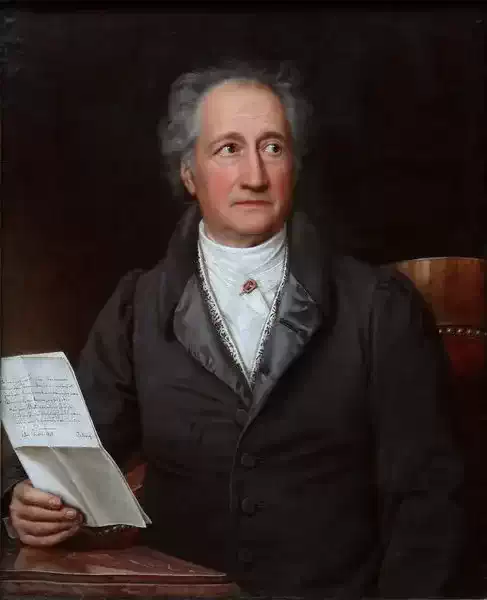
Identification and basic context
Johann Wolfgang von Goethe was a central figure in German literature and a polymath whose work spanned poetry, drama, novels, scientific inquiry, and political theory. Born into a prominent family in Frankfurt, he was a key figure of the Weimar Classicism movement. Goethe's writings are characterized by their depth, philosophical inquiry, and exploration of human nature, often infused with a blend of Romantic sensibility and Neoclassical form. He was also a minister of state in the Duchy of Weimar, demonstrating a profound engagement with civic and political life. His national and linguistic identity were deeply rooted in Germany, and his work was primarily written in German, though its impact transcended linguistic boundaries.
Childhood and education
Goethe received an excellent education, benefiting from private tutors and the intellectual stimulation of his household, which included his father's library. He was exposed to classical literature, languages, and the arts from an early age. His formal education included studies at the University of Leipzig and the University of Strasbourg, where he studied law but also delved into literature and alchemy. He was influenced by the burgeoning Sturm und Drang movement, which emphasized individual emotion and rebellion against artistic conventions, as well as by Enlightenment ideals and the rediscovery of classical antiquity. His early experiences and readings laid the foundation for his multifaceted literary and intellectual development.
Literary trajectory
Goethe's literary career began in his youth with the Sturm und Drang movement, marked by works like "The Sorrows of Young Werther." This period was characterized by intense emotional expression and a focus on individual experience. His move to Weimar marked a shift towards Weimar Classicism, characterized by a more balanced, harmonious, and ethically focused approach, exemplified by "Iphigenia in Tauris" and "Torquato Tasso." The creation of "Faust," which occupied him for much of his life, represents the apex of his philosophical and dramatic achievement, evolving through different phases and reflecting his mature contemplation of human existence. He was also actively involved in periodicals and collaborated with other writers, contributing significantly to the literary landscape of his time.
Works, style, and literary characteristics
Goethe's major works include the epistolary novel "The Sorrows of Young Werther" (1774), the dramas "Iphigenia in Tauris" (1787) and "Egmont" (1788), the novel "Wilhelm Meister's Apprenticeship" (1795-96), and his monumental dramatic poem "Faust" (Part I, 1808; Part II, 1832). His themes are vast, encompassing love, nature, science, art, religion, the human condition, and the pursuit of knowledge and self-realization. His style evolved from the passionate and individualistic Sturm und Drang to the balanced, formal elegance of Weimar Classicism, and later, a more complex, symbolic, and philosophical mode in "Faust Part II." He masterfully employed various forms, including lyric poetry, dramatic verse, and prose, often experimenting with meter and structure. His poetic voice ranged from intensely personal and lyrical to philosophical and universal. Goethe's language is rich, precise, and evocative, utilizing powerful imagery and rhetorical devices to explore profound ideas. He is credited with significant innovations in German literature, bridging Romanticism and Classicism, and profoundly influencing the development of the European novel and drama.
Cultural and historical context
Goethe lived through a period of immense upheaval in European history, including the French Revolution and the Napoleonic Wars, which profoundly shaped his worldview and writings. He was a central figure of the Weimar Classicism movement, alongside Friedrich Schiller, representing a peak of German cultural achievement during a time when Germany was politically fragmented. His engagement with Enlightenment thought, the rediscovery of Greek and Roman antiquity, and the rise of Romanticism placed him at the intersection of major intellectual currents. His positions in Weimar gave him insight into political affairs, and his work often reflected on societal structures, the role of the individual, and the nature of governance.
Personal life
Goethe's personal life was rich and complex. His relationships, particularly with Charlotte von Stein, had a significant impact on his emotional and creative life. His later relationship with Christiane Vulpius, whom he eventually married, brought him domestic stability. He maintained friendships with many leading intellectuals of his time, including Schiller and Herder, and also experienced literary rivalries. Goethe's scientific pursuits, particularly in botany and optics, were not merely academic but intertwined with his poetic vision, reflecting a holistic view of knowledge. His philosophical and spiritual beliefs evolved throughout his life, moving from a pantheistic view of nature to a more nuanced engagement with Christian themes, particularly in his later works.
Recognition and reception
Goethe achieved immense fame and recognition during his lifetime, both within Germany and internationally. He was revered as a literary genius and a national icon. His works were widely translated and admired, and he received numerous honors and distinctions. The reception of his work has remained consistently high, with "Faust" considered one of the greatest works of world literature. While he enjoyed immense popularity and academic respect during his life, his complex philosophical and literary achievements continue to be subjects of intensive scholarly study and critical analysis.
Influences and legacy
Goethe was influenced by a wide array of sources, including classical Greek and Roman literature, the Bible, Shakespeare, and the emerging Sturm und Drang and Enlightenment philosophies. His legacy is immeasurable; he profoundly influenced German literature and culture, shaping the development of Romanticism, Realism, and subsequent literary movements. His concepts, such as the "eternal feminine" in "Faust," and his exploration of the human drive for self-fulfillment, have resonated across generations. He is a cornerstone of the German literary canon and a globally recognized literary figure. His works have been translated into virtually every major language and have inspired countless adaptations in music, theater, and film.
Interpretation and critical analysis
Goethe's work, particularly "Faust," has been subjected to endless interpretation and critical analysis. Themes of good versus evil, the pursuit of knowledge, the nature of progress, and the relationship between the spiritual and material worlds are central to scholarly debate. His complex philosophical outlook, blending elements of Romanticism, Classicism, and humanism, continues to provoke discussion. The tension between individual freedom and societal responsibility, and the search for meaning in a complex world, remain enduring aspects of his critical legacy.
Curiosities and lesser-known aspects
Goethe's fascination with science extended to empirical studies, including his theory of colors, which, though controversial, demonstrated his rigorous approach to observation. His personal life contained elements of both conventionality and unconventionality; his long-term relationship with Christiane Vulpius, who came from a lower social class, was unusual for a man of his stature. He maintained a disciplined writing routine, often working in the early hours of the morning. Anecdotes abound about his charismatic presence and his ability to engage with people from all walks of life. His extensive correspondence provides invaluable insights into his thoughts and daily life.
Death and memory
Johann Wolfgang von Goethe died in Weimar at the age of 82. His death was a significant national event, marking the end of an era in German culture. His memory is celebrated through numerous institutions, monuments, and cultural events dedicated to his life and work. His literary and scientific contributions continue to be studied and revered, ensuring his enduring place in the annals of world culture. His collected works are vast and continue to be published and re-edited, testifying to his lasting impact.