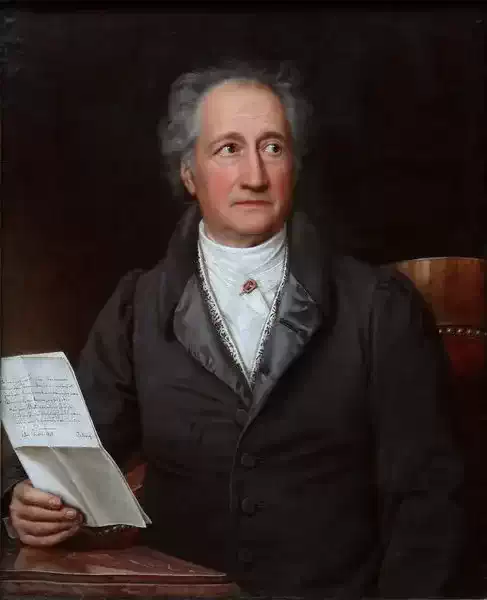
Johann Wolfgang von Goethe

Johann Wolfgang von Goethe

1749–1832 · lived 82 years DE DE

Johann Wolfgang von Goethe was a prolific German writer, poet, playwright, and statesman whose vast body of work significantly impacted European literature and thought. His writings explored profound themes of nature, humanity, science, and the human condition, often blending romantic idealism with classical restraint. Goethe's influence extended beyond literature; he was also a respected figure in science and politics, embodying the ideal of the well-rounded Renaissance man. His literary creations, such as "Faust," remain cornerstones of world literature.

n. 1749-08-28, Frankfurt am Main · m. 1832-03-22, Weimar

112,689 Views

With A Painted Ribbon

With A Painted Ribbon

LITTLE leaves and flow'rets too,

Scatter we with gentle hand,
Kind young spring-gods to the view,
Sporting on an airy band.
Zephyr, bear it on the wing,
Twine it round my loved one's dress;


To her glass then let her spring,
Full of eager joyousness.
Roses round her let her see,
She herself a youthful rose.


Grant, dear life, one look to me!
'Twill repay me all my woes,
What this bosom feels, feel thou.
Freely offer me thy hand;


Let the band that joins us now
Be no fragile rosy band!
Read full poem
Bio

Identification and basic context

Johann Wolfgang von Goethe was a central figure in German literature and a polymath whose work spanned poetry, drama, novels, scientific inquiry, and political theory. Born into a prominent family in Frankfurt, he was a key figure of the Weimar Classicism movement. Goethe's writings are characterized by their depth, philosophical inquiry, and exploration of human nature, often infused with a blend of Romantic sensibility and Neoclassical form. He was also a minister of state in the Duchy of Weimar, demonstrating a profound engagement with civic and political life. His national and linguistic identity were deeply rooted in Germany, and his work was primarily written in German, though its impact transcended linguistic boundaries.

Childhood and education

Goethe received an excellent education, benefiting from private tutors and the intellectual stimulation of his household, which included his father's library. He was exposed to classical literature, languages, and the arts from an early age. His formal education included studies at the University of Leipzig and the University of Strasbourg, where he studied law but also delved into literature and alchemy. He was influenced by the burgeoning Sturm und Drang movement, which emphasized individual emotion and rebellion against artistic conventions, as well as by Enlightenment ideals and the rediscovery of classical antiquity. His early experiences and readings laid the foundation for his multifaceted literary and intellectual development.

Literary trajectory

Goethe's literary career began in his youth with the Sturm und Drang movement, marked by works like "The Sorrows of Young Werther." This period was characterized by intense emotional expression and a focus on individual experience. His move to Weimar marked a shift towards Weimar Classicism, characterized by a more balanced, harmonious, and ethically focused approach, exemplified by "Iphigenia in Tauris" and "Torquato Tasso." The creation of "Faust," which occupied him for much of his life, represents the apex of his philosophical and dramatic achievement, evolving through different phases and reflecting his mature contemplation of human existence. He was also actively involved in periodicals and collaborated with other writers, contributing significantly to the literary landscape of his time.

Works, style, and literary characteristics

Goethe's major works include the epistolary novel "The Sorrows of Young Werther" (1774), the dramas "Iphigenia in Tauris" (1787) and "Egmont" (1788), the novel "Wilhelm Meister's Apprenticeship" (1795-96), and his monumental dramatic poem "Faust" (Part I, 1808; Part II, 1832). His themes are vast, encompassing love, nature, science, art, religion, the human condition, and the pursuit of knowledge and self-realization. His style evolved from the passionate and individualistic Sturm und Drang to the balanced, formal elegance of Weimar Classicism, and later, a more complex, symbolic, and philosophical mode in "Faust Part II." He masterfully employed various forms, including lyric poetry, dramatic verse, and prose, often experimenting with meter and structure. His poetic voice ranged from intensely personal and lyrical to philosophical and universal. Goethe's language is rich, precise, and evocative, utilizing powerful imagery and rhetorical devices to explore profound ideas. He is credited with significant innovations in German literature, bridging Romanticism and Classicism, and profoundly influencing the development of the European novel and drama.

Cultural and historical context

Goethe lived through a period of immense upheaval in European history, including the French Revolution and the Napoleonic Wars, which profoundly shaped his worldview and writings. He was a central figure of the Weimar Classicism movement, alongside Friedrich Schiller, representing a peak of German cultural achievement during a time when Germany was politically fragmented. His engagement with Enlightenment thought, the rediscovery of Greek and Roman antiquity, and the rise of Romanticism placed him at the intersection of major intellectual currents. His positions in Weimar gave him insight into political affairs, and his work often reflected on societal structures, the role of the individual, and the nature of governance.

Personal life

Goethe's personal life was rich and complex. His relationships, particularly with Charlotte von Stein, had a significant impact on his emotional and creative life. His later relationship with Christiane Vulpius, whom he eventually married, brought him domestic stability. He maintained friendships with many leading intellectuals of his time, including Schiller and Herder, and also experienced literary rivalries. Goethe's scientific pursuits, particularly in botany and optics, were not merely academic but intertwined with his poetic vision, reflecting a holistic view of knowledge. His philosophical and spiritual beliefs evolved throughout his life, moving from a pantheistic view of nature to a more nuanced engagement with Christian themes, particularly in his later works.

Recognition and reception

Goethe achieved immense fame and recognition during his lifetime, both within Germany and internationally. He was revered as a literary genius and a national icon. His works were widely translated and admired, and he received numerous honors and distinctions. The reception of his work has remained consistently high, with "Faust" considered one of the greatest works of world literature. While he enjoyed immense popularity and academic respect during his life, his complex philosophical and literary achievements continue to be subjects of intensive scholarly study and critical analysis.

Influences and legacy

Goethe was influenced by a wide array of sources, including classical Greek and Roman literature, the Bible, Shakespeare, and the emerging Sturm und Drang and Enlightenment philosophies. His legacy is immeasurable; he profoundly influenced German literature and culture, shaping the development of Romanticism, Realism, and subsequent literary movements. His concepts, such as the "eternal feminine" in "Faust," and his exploration of the human drive for self-fulfillment, have resonated across generations. He is a cornerstone of the German literary canon and a globally recognized literary figure. His works have been translated into virtually every major language and have inspired countless adaptations in music, theater, and film.

Interpretation and critical analysis

Goethe's work, particularly "Faust," has been subjected to endless interpretation and critical analysis. Themes of good versus evil, the pursuit of knowledge, the nature of progress, and the relationship between the spiritual and material worlds are central to scholarly debate. His complex philosophical outlook, blending elements of Romanticism, Classicism, and humanism, continues to provoke discussion. The tension between individual freedom and societal responsibility, and the search for meaning in a complex world, remain enduring aspects of his critical legacy.

Curiosities and lesser-known aspects

Goethe's fascination with science extended to empirical studies, including his theory of colors, which, though controversial, demonstrated his rigorous approach to observation. His personal life contained elements of both conventionality and unconventionality; his long-term relationship with Christiane Vulpius, who came from a lower social class, was unusual for a man of his stature. He maintained a disciplined writing routine, often working in the early hours of the morning. Anecdotes abound about his charismatic presence and his ability to engage with people from all walks of life. His extensive correspondence provides invaluable insights into his thoughts and daily life.

Death and memory

Johann Wolfgang von Goethe died in Weimar at the age of 82. His death was a significant national event, marking the end of an era in German culture. His memory is celebrated through numerous institutions, monuments, and cultural events dedicated to his life and work. His literary and scientific contributions continue to be studied and revered, ensuring his enduring place in the annals of world culture. His collected works are vast and continue to be published and re-edited, testifying to his lasting impact.

Poems

182

The Godlike

The Godlike

NOBLE be man,
Helpful and good!
For that alone
Distinguisheth him
From all the beings
Unto us known.


Hail to the beings,
Unknown and glorious,
Whom we forebode!
From his example
Learn we to know them!


For unfeeling
Nature is ever:
On bad and on good
The sun alike shineth;
And on the wicked,
As on the best,
The moon and stars gleam.


Tempest and torrent,
Thunder and hail,
Roar on their path,
Seizing the while,
As they haste onward,
One after another.


Even so, fortune
Gropes 'mid the throng--
Innocent boyhood's
Curly head seizing,--
Seizing the hoary
Head of the sinner.


After laws mighty,
Brazen, eternal,
Must all we mortals
Finish the circuit
Of our existence.


Man, and man only
Can do the impossible;
He 'tis distinguisheth,
Chooseth and judgeth;
He to the moment
Endurance can lend.


He and he only
The good can reward,
The bad can he punish,
Can heal and can save;


All that wanders and strays
Can usefully blend.
And we pay homage
To the immortals
As though they were men,
And did in the great,
What the best, in the small,
Does or might do.


Be the man that is noble,
Both helpful and good.
Unweariedly forming
The right and the useful,
A type of those beings
Our mind hath foreshadow'd!
469

The Garlands

The Garlands

KLOPSTOCK would lead us away from Pindus; no longer for laurel
May we be eager--the homely acorn alone must content us;
Yet he himself his more-than-epic crusade is conducting
High on Golgotha's summit, that foreign gods he may honour!
Yet, on what hill he prefers, let him gather the angels together,
Suffer deserted disciples to weep o'er the grave of the just one:
There where a hero and saint hath died, where a bard breath'd his numbers,
Both for our life and our death an ensample of courage resplendent
And of the loftiest human worth to bequeath,--ev'ry nation
There will joyously kneel in devotion ecstatic, revering
Thorn and laurel garland, and all its charms and its tortures.
450

The Goblet

The Goblet

ONCE I held a well-carved brimming goblet,--
In my two hands tightly clasp'd I held it,
Eagerly the sweet wine sipp'd I from it,
Seeking there to drown all care and sorrow.


Amor enter'd in, and found me sitting,
And he gently smiled in modest fashion,
Smiled as though the foolish one he pitied.


"Friend, I know a far more beauteous vessel,
One wherein to sink thy spirit wholly;
Say, what wilt thou give me, if I grant it,
And with other nectar fill it for thee?"


Oh, how kindly hath he kept his promise!
For to me, who long had yearn'd, he granted
Thee, my Lida, fill'd with soft affection.


When I clasp mine arms around thee fondly,
When I drink in love's long-hoarded balsam
From thy darling lips so true, so faithful,
Fill'd with bliss thus speak I to my spirit
"No! a vessel such as this, save Amor
Never god hath fashion'd or been lord of!
Such a form was ne'er produced by Vulcan
With his cunning, reason-gifted hammers!
On the leaf-crown'd mountains may Lyaeus
Bid his Fauns, the oldest and the wisest,
Pass the choicest clusters through the winepress,
And himself watch o'er the fermentation:
Such a draught no toil can e'er procure him!"
374

The Friendly Meeting

The Friendly Meeting

IN spreading mantle to my chin concealed,
I trod the rocky path, so steep and grey,
Then to the wintry plain I bent my way
Uneasily, to flight my bosom steel'd.
But sudden was the newborn day reveal'd:
A maiden came, in heavenly bright array,
Like the fair creatures of the poet's lay
In realms of song. My yearning heart was heal'd.
Yet turn'd I thence, till she had onward pass'd,
While closer still the folds to draw I tried,
As though with heat self-kindled to grow warm;
But follow'd her. She stood. The die was cast!
No more within my mantle could I hide;
I threw it off,--she lay within mine arm.
299

The Freebooter

The Freebooter

No door has my house,

No house has my door;
And in and out ever
I carry my store.
No grate has my kitchen,
No kitchen my grate;


Yet roasts it and boils it
Both early and late.
My bed has no trestles,
My trestles no bed;


Yet merrier moments
No mortal e'er led.
My cellar is lofty,
My barn is full deep,


From top to the bottom,--
There lie I and sleep.
And soon as I waken,
All moves on its race;


My place has no fixture,
My fixture no place.
369

The Fox And The Crane

The Fox And The Crane

ONCE two persons uninvited

Came to join my dinner table;
For the nonce they lived united,
Fox and crane yclept in fable.
Civil greetings pass'd between us
Then I pluck'd some pigeons tender


For the fox of jackal-genius,
Adding grapes in full-grown splendour.
Long-neck'd flasks I put as dishes
For the crane, without delaying,


Fill'd with gold and silver fishes,
In the limpid water playing.
Had ye witness'd Reynard planted
At his flat plate, all demurely,


Ye with envy must have granted:
"Ne'er was such a gourmand, surely!"
While the bird with circumspection
On one foot, as usual, cradled,


From the flasks his fish-refection
With his bill and long neck ladled.
One the pigeons praised,--the other,
As they went, extoll'd the fishes,


Each one scoffing at his brother
For preferring vulgar dishes.


*
If thou wouldst preserve thy credit,
When thou askest folks to guzzle

At thy hoard, take care to spread it
Suited both for bill and muzzle.
391

The Fisherman

The Fisherman

THE waters rush'd, the waters rose,

A fisherman sat by,
While on his line in calm repose
He cast his patient eye.


And as he sat, and hearken'd there,


The flood was cleft in twain,
And, lo! a dripping mermaid fair
Sprang from the troubled main.
She sang to him, and spake the while:
"Why lurest thou my brood,


With human wit and human guile


From out their native flood?
Oh, couldst thou know how gladly dart
The fish across the sea,


Thou wouldst descend, e'en as thou art,
And truly happy be!
"Do not the sun and moon with grace
Their forms in ocean lave?


Shines not with twofold charms their face,


When rising from the wave?
The deep, deep heavens, then lure thee not,--
The moist yet radiant blue,--

Not thine own form,--to tempt thy lot
'Midst this eternal dew?"
The waters rush'd, the waters rose,
Wetting his naked feet;


As if his true love's words were those,


His heart with longing beat.
She sang to him, to him spake she,
His doom was fix'd, I ween;


Half drew she him, and half sank he,
And ne'er again was seen.
489

The Exchange

The Exchange

THE stones in the streamlet I make my bright pillow,
And open my arms to the swift-rolling billow,


That lovingly hastens to fall on my breast.
Then fickleness soon bids it onwards be flowing;
A second draws nigh, its caresses bestowing,--


And so by a twofold enjoyment I'm blest.


And yet thou art trailing in sorrow and sadness
The moments that life, as it flies, gave for gladness,


Because by thy love thou'rt remember'd no more!
Oh, call back to mind former days and their blisses!
The lips of the second will give as sweet kisses


As any the lips of the first gave before!
428

The Farewell

The Farewell

LET mine eye the farewell say,

That my lips can utter ne'er;
Fain I'd be a man to-day,
Yet 'tis hard, oh, hard to bear!
Mournful in an hour like this
Is love's sweetest pledge, I ween;


Cold upon thy mouth the kiss,
Faint thy fingers' pressure e'en.
Oh what rapture to my heart
Used each stolen kiss to bring!


As the violets joy impart,
Gather'd in the early spring.
Now no garlands I entwine,
Now no roses pluck. for thee,


Though 'tis springtime, Fanny mine,
Dreary autumn 'tis to me!
380

The Epochs

The Epochs

ON Petrarch's heart, all other days before,
In flaming letters written, was impress d
GOOD FRIDAY. And on mine, be it confess'd,
Is this year's ADVENT, as it passeth o'er.
I do not now begin,--I still adore
Her whom I early cherish'd in my breast;,
Then once again with prudence dispossess'd,
And to whose heart I'm driven back once more.
The love of Petrarch, that all-glorious love,
Was unrequited, and, alas, full sad;
One long Good Friday 'twas, one heartache drear
But may my mistress' Advent ever prove,
With its palm-jubilee, so sweet and glad,
One endless Mayday, through the livelong year!
465

Quotes

40

Videos

50

Comments (0)

Share
Log in to post a comment.

No comments yet. Be the first to comment.