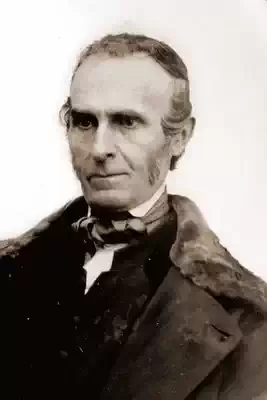
Kossuth
Kossuth
Type of two mighty continents!--combining
The strength of Europe with the warmth and glow
Of Asian song and prophecy,--the shining
Of Orient splendors over Northern snow!
Who shall receive him? Who, unblushing, speak
Welcome to him, who, while he strove to break
The Austrian yoke from Magyar necks, smote off
At the same blow the fetters of the serf,
Rearing the altar of his Fatherland
On the firm base of freedom, and thereby
Lifting to Heaven a patriot's stainless hand,
Mocked not the God of Justice with a lie!
Who shall be Freedom's mouthpiece? Who shall give
Her welcoming cheer to the great fugitive?
Not he who, all her sacred trusts betraying,
Is scourging back to slavery's hell of pain
The swarthy Kossuths of our land again!
Not he whose utterance now from lips designed
The bugle-march of Liberty to wind,
And call her hosts beneath the breaking light,
The keen reveille of her morn of fight,
Is but the hoarse note of the blood-hound's baying,
The wolf's long howl behind the bondman's flight!
Oh for the tongue of him who lies at rest
In Quincy's shade of patrimonial trees,
Last of the Puritan tribunes and the best,
To lend a voice to Freedom's sympathies,
And hail the coming of the noblest guest
The Old World's wrong has given the New World of the West!
Kallundborg Church ( From The Tent on the Beach)
Kallundborg Church ( From The Tent on the Beach)
"Tie stille, barn min!
Imorgen kommer Fin,
Fa'er din,
Og gi'er dich Esbern Snares öine og hjerte at lege med!"
Zealand Rhyme.
"BUILD at Kallundborg by the sea
A church as stately as church may be,
And there shalt thou wed my daughter fair,"
Said the Lord of Nesvek to Esbern Snare.
And the Baron laughed. But Esbern said,
"Though I lose my soul, I will Helva wed!"
And off he strode, in his pride of will,
To the Troll who dwelt in Ulshoi hill.
"Build, O Troll, a church for me
At Kallundborg by the mighty sea;
Build it stately, and build it fair,
Build it quickly," said Esbern Snare.
But the sly Dwarf said, "No work is wrought
By Trolls of the Hills, O man, for naught.
What wilt thou give for thy church so fair?"
"Set thy own price," quoth Esbern Snare.
"When Kallundborg church is builded well,
Thou must the name of its builder tell,
Or thy heart and thy eyes must be my boon."
"Build," said Esbern, "and build it soon."
By night and by day the Troll wrought on;
He hewed the timbers, he piled the stone;
But day by day, as the walls rose fair,
Darker and sadder grew Esbern Snare.
He listened by night, he watched by day,
He sought and thought, but he dared not pray;
In vain he called on the Elle-maids shy,
And the Neck and the Nis gave no reply.
Of his evil bargain far and wide
A rumor ran through the country-side;
And Helva of Nesvek, young and fair,
Prayed for the soul of Esbern Snare.
And now the church was wellnigh done;
One pillar it lacked, and one alone;
And the grim Troll muttered, "Fool thou art!
To-morrow gives me thy eyes and heart!"
By Kallundborg in black despair,
Through wood and meadow, walked Esbern Snare,
Till, worn and weary, the strong man sank
Under the birches on Ulshoi bank.
At his last day's work he heard the Troll
Hammer and delve in the quarry's hole;
Before him the church stood large and fair:
"I have builded my tomb," said Esbern Snare.
And he closed his eyes the sight to hide,
When he heard a light step at his side:
"O Esbern Snare! a sweet voice said,
"Would I might die now in thy stead!"
With a grasp by love and by fear made strong,
He held her fast, and he held her long;
With the beating heart of a bird afeard,
She hid her face in his flame-red beard.
"O love!" he cried, "let me look to-day
In thine eyes ere mine are plucked away;
Let me hold thee close, let me feel thy heart
Ere mine by the Troll is torn apart!
"I sinned, O Helva, for love of thee!
Pray that the Lord Christ pardon me!"
But fast as she prayed, and faster still,
Hammered the Troll in Ulshoi hill.
He knew, as he wrought, that a loving heart
Was somehow baffling his evil art;
For more than spell of Elf or Troll
Is a maiden's prayer for her lover's soul.
And Esbern listened, and caught the sound
Of a Troll-wife singing underground:
"To-morrow comes Fine, father thine:
Lie still and hush thee, baby mine!
"Lie still, my darling! next sunrise
Thou'lt play with Esbern Snare's heart and eyes!"
"Ho! ho!" quoth Esbern, "is that your game?
Thanks to the Troll-wife, I know his name!"
The Troll he heard him, and hurried on
To Kallundborg church with the lacking stone.
"Too late, Gaffer Fine!" cried Esbern Snare;
And Troll and pillar vanished in air!
That night the harvesters heard the sound
Of a woman sobbing underground,
And the voice of the Hill-Troll loud with blame
Of the careless singer who told his name.
Of the Troll of the Church they sing the rune
By the Northern Sea in the harvest moon;
And the fishers of Zealand hear him still
Scolding his wife in Ulshoi hill.
And seaward over its groves of birch
Still looks the tower of Kallundborg church
Where, first at its altar, a wedded pair,
Stood Helva of Nesvek and Esbern Snare!
Kenoza Lake
Kenoza Lake
As Adam did in Paradise,
To-day the primal right we claim
Fair mirror of the woods and skies,
We give to thee a name.
Lake of the pickerel!--let no more
The echoes answer back, 'Great Pond,'
But sweet Kenoza, from thy shore
And watching hills beyond,
Let Indian ghosts, if such there be
Who ply unseen their shadowy lines,
Call back the ancient name to thee,
As with the voice of pines.
The shores we trod as barefoot boys,
The nutted woods we wandered through,
To friendship, love, and social joys
We consecrate anew.
Here shall the tender song be sung,
And memory's dirges soft and low,
And wit shall sparkle on the tongue,
And mirth shall overflow,
Harmless as summer lightning plays
From a low, hidden cloud by night,
A light to set the hills ablaze,
But not a bolt to smite.
In sunny South and prairied West
Are exiled hearts remembering still,
As bees their hive, as birds their nest,
The homes of Haverhill.
They join us in our rites to-day;
And, listening, we may hear, erelong,
From inland lake and ocean bay,
The echoes of our song.
Kenoza! o'er no sweeter lake
Shall morning break or noon-cloud sail,-No
fairer face than thine shall take
The sunset's golden veil.
Long be it ere the tide of trade
Shall break with harsh-resounding din
The quiet of thy banks of shade,
And hills that fold thee in.
Still let thy woodlands hide the hare,
The shy loon sound his trumpet-note,
Wing-weary from his fields of air,
The wild-goose on thee float.
Thy peace rebuke our feverish stir,
Thy beauty our deforming strife;
Thy woods and waters minister
The healing of their life.
And sinless Mirth, from care released,
Behold, unawed, thy mirrored sky,
Smiling as smiled on Cana's feast
The Master's loving eye.
And when the summer day grows dim,
And light mists walk thy mimic sea,
Revive in us the thought of Him
Who walked on Galilee!
John Underhill
John Underhill
A score of years had come and gone
Since the Pilgrims landed on Plymouth stone,
When Captain Underhill, bearing scars
From Indian ambush and Flemish wars,
Left three-hilled Boston and wandered down,
East by north, to Cocheco town.
With Vane the younger, in counsel sweet,
He had sat at Anna Hutchinson's feet,
And, when the bolt of banishment fell
On the head of his saintly oracle,
He had shared her ill as her good report,
And braved the wrath of the General Court.
He shook from his feet as he rode away
The dust of the Massachusetts Bay.
The world might bless and the world might ban,
What did it matter the perfect man,
To whom the freedom of earth was given,
Proof against sin, and sure of heaven?
He cheered his heart as he rode along
With screed of Scripture and holy song,
Or thought how he rode with his lances free
By the Lower Rhine and the Zuyder-Zee,
Till his wood-path grew to a trodden road,
And Hilton Point in the distance showed.
He saw the church with the block-house nigh,
The two fair rivers, the flakes thereby,
And, tacking to windward, low and crank,
The little shallop from Strawberry Bank;
And he rose in his stirrups and looked abroad
Over land and water, and praised the Lord.
Goodly and stately and grave to see,
Into the clearing's space rode he,
With the sun on the hilt of his sword in sheath,
And his silver buckles and spurs beneath,
And the settlers welcomed him, one and all,
From swift Quampeagan to Gonic Fall.
And he said to the elders: 'Lo, I come
As the way seemed open to seek a home.
Somewhat the Lord hath wrought by my hands
In the Narragansett and Netherlands,
And if here ye have work for a Christian man,
I will tarry, and serve ye as best I can.
'I boast not of gifts, but fain would own
The wonderful favor God hath shown,
The special mercy vouchsafed one day
On the shore of Narragansett Bay,
As I sat, with my pipe, from the camp aside,
And mused like Isaac at eventide.
'A sudden sweetness of peace I found,
A garment of gladness wrapped me round;
I felt from the law of works released,
The strife of the flesh and spirit ceased,
My faith to a full assurance grew,
And all I had hoped for myself I knew.
'Now, as God appointeth, I keep my way,
I shall not stumble, I shall not stray;
He hath taken away my fig-leaf dress,
I wear the robe of His righteousness;
And the shafts of Satan no more avail
Than Pequot arrows on Christian mail.'
'Tarry with us,' the settlers cried,
'Thou man of God, as our ruler and guide.'
And Captain Underhill bowed his head.
'The will of the Lord be done!' he said.
And the morrow beheld him sitting down
In the ruler's seat in Cocheco town.
And he judged therein as a just man should;
His words were wise and his rule was good;
He coveted not his neighbor's land,
From the holding of bribes he shook his hand;
And through the camps of the heathen ran
A wholesome fear of the valiant man.
But the heart is deceitful, the good Book saith,
And life hath ever a savor of death.
Through hymns of triumph the tempter calls,
And whoso thinketh he standeth falls.
Alas! ere their round the seasons ran,
There was grief in the soul of the saintly man.
The tempter's arrows that rarely fail
Had found the joints of his spiritual mail;
And men took note of his gloomy air,
The shame in his eye, the halt in his prayer,
The signs of a battle lost within,
The pain of a soul in the coils of sin.
Then a whisper of scandal linked his name
With broken vows and a life of blame;
And the people looked askance on him
As he walked among them sullen and grim,
Ill at ease, and bitter of word,
And prompt of quarrel with hand or sword.
None knew how, with prayer and fasting still,
He strove in the bonds of his evil will;
But he shook himself like Samson at length,
And girded anew his loins of strength,
And bade the crier go up and down
And call together the wondering town.
Jeer and murmur and shaking of head
Ceased as he rose in his place and said
'Men, brethren, and fathers, well ye know
How I came among you a year ago,
Strong in the faith that my soul was freed
From sin of feeling, or thought, or deed.
'I have sinned, I own it with grief and shame,
But not with a lie on my lips I came.
In my blindness I verily thought my heart
Swept and garnished in every part.
He chargeth His angels with folly; He sees
The heavens unclean. Was I more than these?
'I urge no plea. At your feet I lay
The trust you gave me, and go my way.
Hate me or pity me, as you will,
The Lord will have mercy on sinners still;
And I, who am chiefest, say to all,
Watch and pray, lest ye also fall.'
No voice made answer: a sob so low
That only his quickened ear could know
Smote his heart with a bitter pain,
As into the forest he rode again,
And the veil of its oaken leaves shut down
On his latest glimpse of Cocheco town.
Crystal-clear on the man of sin
The streams flashed up, and the sky shone in;
On his cheek of fever the cool wind blew,
The leaves dropped on him their tears of dew,
And angels of God, in the pure, sweet guise
Of flowers, looked on him with sad surprise.
Was his ear at fault that brook and breeze
Sang in their saddest of minor keys?
What was it the mournful wood-thrush said?
What whispered the pine-trees overhead?
Did he hear the Voice on his lonely way
That Adam heard in the cool of day?
Into the desert alone rode he,
Alone with the Infinite Purity;
And, bowing his soul to its tender rebuke,
As Peter did to the Master's look,
He measured his path with prayers of pain
For peace with God and nature again.
And in after years to Cocheco came
The bruit of a once familiar name;
How among the Dutch of New Netherlands,
From wild Danskamer to Haarlem sands,
A penitent soldier preached the Word,
And smote the heathen with Gideon's sword!
And the heart of Boston was glad to hear
How he harried the foe on the long frontier,
And heaped on the land against him barred
The coals of his generous watch and ward.
Frailest and bravest! the Bay State still
Counts with her worthies John Underhill.
Italy
Italy
ACROSS the sea I heard the groans
Of nations in the intervals
Of wind and wave. Their blood and bones
Cried out in torture, crushed by thrones,
And sucked by priestly cannibals.
I dreamed of Freedom slowly gained
By martyr meekness, patience, faith,
And lo! an athlete grimly stained,
With corded muscles battle-strained,
Shouting it from the fields of death!
I turn me, awe-struck, from the sight,
Among the clamoring thousands mute,
I only know that God is right,
And that the children of the light
Shall tread the darkness under foot.
I know the pent fire heaves its crust,
That sultry skies the bolt will form
To smite them clear; that Nature must
The balance of her powers adjust,
Though with the earthquake and the storm.
God reigns, and let the earth rejoice!
I bow before His sterner plan.
Dumb are the organs of my choice;
He speaks in battle's stormy voice,
His praise is in the wrath of man!
Yet, surely as He lives, the day
Of peace He promised shall be ours,
To fold the flags of war, and lay
Its sword and spear to rust away,
And sow its ghastly fields with flowers!
Inscriptions on a Sun-Dial
Inscriptions on a Sun-Dial
For Dr Henry L Bowditch
With warning hand I mark Time's rapid
flight
From life's glad morning to it's solemn
night;
Yet through thee dear God's love, I also
show
There's Light above me by the shade
below.
Inscription On A Fountain
Inscription On A Fountain
FOR DOROTHEA L. DIX.
Stranger and traveller,
Drink freely and bestow
A kindly thought on her
Who bade this fountain flow,
Yet hath no other claim
Than as the minister
Of blessing in God's name.
Drink, and in His peace go
In The
In The
She came and stood in the Old South Church,
A wonder and a sign,
With a look the old-time sibyls wore,
Half-crazed and half-divine.
Save the mournful sackcloth about her wound,
Unclothed as the primal mother,
With limbs that trembled and eyes that blazed
With a fire she dare not smother.
Loose on her shoulders fell her hair,
With sprinkled ashes gray;
She stood in the broad aisle strange and weird
As a soul at the judgment day.
And the minister paused in his sermon's midst,
And the people held their breath,
For these were the words the maiden spoke
Through lips as the lips of death:
'Thus saith the Lord, with equal feet
All men my courts shall tread,
And priest and ruler no more shall eat
My people up like bread!
'Repent! repent! ere the Lord shall speak
In thunder and breaking seals
Let all souls worship Him in the way
His light within reveals.'
She shook the dust from her naked feet,
And her sackcloth closer drew,
And into the porch of the awe-hushed church
She passed like a ghost from view.
They whipped her away at the tail o' the cart
Through half the streets of the town,
But the words she uttered that day nor fire
Could burn nor water drown.
And now the aisles of the ancient church
By equal feet are trod,
And the bell that swings in its belfry rings
Freedom to worship God!
And now whenever a wrong is done
It thrills the conscious walls;
The stone from the basement cries aloud
And the beam from the timber calls.
There are steeple-houses on every hand,
And pulpits that bless and ban,
And the Lord will not grudge the single church
That is set apart for man.
For in two commandments are all the law
And the prophets under the sun,
And the first is last and the last is first,
And the twain are verily one.
So, long as Boston shall Boston be,
And her bay-tides rise and fall,
Shall freedom stand in the Old South Church
And plead for the rights of all!
In Remembrance Of Joseph Sturge
In Remembrance Of Joseph Sturge
In the fair land o'erwatched by Ischia's mountains,
Across the charmed bay
Whose blue waves keep with Capri's silver fountains
Perpetual holiday,
A king lies dead, his wafer duly eaten,
His gold-bought masses given;
And Rome's great altar smokes with gums to sweeten
Her foulest gift to Heaven.
And while all Naples thrills with mute thanksgiving,
The court of England's queen
For the dead monster so abhorred while living
In mourning garb is seen.
With a true sorrow God rebukes that feigning;
By lone Edgbaston's side
Stands a great city in the sky's sad raining,
Bareheaded and wet-eyed!
Silent for once the restless hive of labor,
Save the low funeral tread,
Or voice of craftsman whispering to his neighbor
The good deeds of the dead.
For him no minster's chant of the immortals
Rose from the lips of sin;
No mitred priest swung back the heavenly portals
To let the white soul in.
But Age and Sickness framed their tearful faces
In the low hovel's door,
And prayers went up from all the dark by-places
And Ghettos of the poor.
The pallid toiler and the negro chattel,
The vagrant of the street,
The human dice wherewith in games of battle
The lords of earth compete,
Touched with a grief that needs no outward draping,
All swelled the long lament,
Of grateful hearts, instead of marble, shaping
His viewless monument!
For never yet, with ritual pomp and splendor,
In the long heretofore,
A heart more loyal, warm, and true, and tender,
Has England's turf closed o'er.
And if there fell from out her grand old steeples
No crash of brazen wail,
The murmurous woe of kindreds, tongues, and peoples
Swept in on every gale.
It came from Holstein's birchen-belted meadows,
And from the tropic calms
Of Indian islands in the sunlit shadows
Of Occidental palms;
From the locked roadsteads of the Bothniaii peasants,
And harbors of the Finn,
Where war's worn victims saw his gentle presence
Come sailing, Christ-like, in,
To seek the lost, to build the old waste places,
To link the hostile shores
Of severing seas, and sow with England's daisies
The moss of Finland's moors.
Thanks for the good man's beautiful example,
Who in the vilest saw
Some sacred crypt or altar of a temple
Still vocal with God's law;
And heard with tender ear the spirit sighing
As from its prison cell,
Praying for pity, like the mournful crying
Of Jonah out of hell.
Not his the golden pen's or lip's persuasion,
But a fine sense of right,
And Truth's directness, meeting each occasion
Straight as a line of light.
His faith and works, like streams that intermingle,
In the same channel ran
The crystal clearness of an eye kept single
Shamed all the frauds of man.
The very gentlest of all human natures
He joined to courage strong,
And love outreaching unto all God's creatures
With sturdy hate of wrong.
Tender as woman, manliness and meekness
In him were so allied
That they who judged him by his strength or weakness
Saw but a single side.
Men failed, betrayed him, but his zeal seemed nourished
By failure and by fall;
Still a large faith in human-kind he cherished,
And in God's love for all.
And now he rests: his greatness and his sweetness
No more shall seem at strife,
And death has moulded into calm completeness
The statue of his life.
Where the dews glisten and the songbirds warble,
His dust to dust is laid,
In Nature's keeping, with no pomp of marble
To shame his modest shade.
The forges glow, the hammers all are ringing;
Beneath its smoky vale,
Hard by, the city of his love is swinging
Its clamorous iron flail.
But round his grave are quietude and beauty,
And the sweet heaven above,-The
fitting symbols of a life of duty
Transfigured into love!
In Peace
In Peace
A track of moonlight on a quiet lake,
Whose small waves on a silver-sanded shore
Whisper of peace, and with the low winds make
Such harmonies as keep the woods awake,
And listening all night long for their sweet sake
A green-waved slope of meadow, hovered o'er
By angel-troops of lilies, swaying light
On viewless stems, with folded wings of white;
A slumberous stretch of mountain-land, far seen
Where the low westering day, with gold and green,
Purple and amber, softly blended, fills
The wooded vales, and melts among the hills;
A vine-fringed river, winding to its rest
On the calm bosom of a stormless sea,
Bearing alike upon its placid breast,
With earthly flowers and heavenly' stars impressed,
The hues of time and of eternity
Such are the pictures which the thought of thee,
O friend, awakeneth,--charming the keen pain
Of thy departure, and our sense of loss
Requiting with the fullness of thy gain.
Lo! on the quiet grave thy life-borne cross,
Dropped only at its side, methinks doth shine,
Of thy beatitude the radiant sign!
No sob of grief, no wild lament be there,
To break the Sabbath of the holy air;
But, in their stead, the silent-breathing prayer
Of hearts still waiting for a rest like thine.
O spirit redeemed! Forgive us, if henceforth,
With sweet and pure similitudes of earth,
We keep thy pleasant memory freshly green,
Of love's inheritance a priceless part,
Which Fancy's self, in reverent awe, is seen
To paint, forgetful of the tricks of art,
With pencil dipped alone in colors of the heart.