
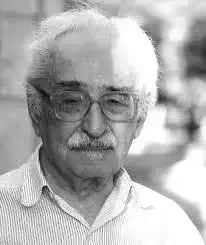
Manoel de Barros
1916–2014
· lived 97 years
 BR
BR
BR
Manoel de Barros was a Brazilian poet whose verses explored childhood, nature, and daily life with a unique and inventive language. His work is marked by a deep sensibility towards the rural world and the simple elements of life, which he elevated to a lyrical and philosophical level. His ability to reinvent words and create surprising images from the mundane made him one of the most beloved and original figures in contemporary Brazilian poetry.
n. 1916-12-19, Cuiabá · m. 2014-11-13, Campo Grande
68
Views
Bio
Identification and basic context
**Full name:** Manoel de Barros **Date and place of birth:** December 19, 1916, Cuiabá, Mato Grosso **Date and place of death:** November 13, 2014, Campo Grande, Mato Grosso do Sul **Family origin, social class, and cultural context of origin:** Born into a family of ranchers, in the heart of the Pantanal. His rural origin and deep connection to the land shaped his worldview and, consequently, his poetic work. **Nationality and language(s) of writing:** Brazilian, wrote in Portuguese. **Historical context in which he lived:** Lived through most of the 20th century and early 21st century, a period of intense social, political, and cultural transformations in Brazil and the world, including the Vargas Era, the military dictatorship, and the redemocratization. However, his work maintained a particular thematic and aesthetic focus, distant from major historical events.Childhood and education
**Family origin and social environment:** Grew up on a farm, which provided him with intimate and privileged contact with nature, animals, and the simple life of the countryside. This experience profoundly marked his formation and poetic vision. **Formal education and self-teaching:** Attended school in Recife and studied Law for a period in Rio de Janeiro. However, his literary education was largely self-taught, nourished by reading and lived experience. **Initial influences (readings, culture, religion, politics):** Although his poetry has a very personal and original character, the landscapes of the Pantanal, popular culture, oral narratives, and attentive observation of the natural world were his primary influences. The reading of authors such as Henri Michaux and Saint-John Perse is also cited as important. **Literary, philosophical, or artistic movements absorbed:** His work dialogues with Brazilian Modernism, especially in its search for a new language and the appreciation of the everyday and the regional. However, he transcends labels, creating an unmistakable style. **Significant events in youth:** Childhood and youth spent in the Pantanal, the experience of rural life, and the subsequent move to Rio de Janeiro to study.Literary journey
**Beginning of writing (when and how he started):** Began writing poetry at a young age, motivated by the landscape and experiences of his childhood and youth in the Pantanal. His initial publication occurred in newspapers and literary magazines. **Evolution over time (phases, style changes):** His work is marked by remarkable thematic and stylistic consistency. Although there was natural maturation, the central elements of his poetry – the reinvention of words, the exploration of the childhood universe and nature – remained present throughout his career. **Chronological evolution of work:** Published his first book, "Poemas," in 1935. This was followed by works such as "O Guardador de Águas" (1941), "Poemas Plumários" (1952), "Livro sobre Nada" (1956), "Gramática de Deus" (1981), "O Poeta da Roda Gigante" (1987), among many others. **Contributions to magazines, newspapers, and anthologies:** Participated in various literary publications throughout his life, publishing his poems and consolidating his poetic voice. **Activity as critic, translator, or editor:** Did not distinguish himself in these areas, concentrating his production on poetry.Work, style, and literary characteristics
Work, style, and literary characteristics **Main works with dates and production context:** - "Poemas" (1935): Early poetic explorations. - "O Guardador de Águas" (1941): Lyrical exploration of the Pantanal universe. - "Livro sobre Nada" (1956): A landmark in his work, consolidating a unique style. - "Gramática de Deus" (1981): Poetry reflecting on the world and existence. - "O Poeta da Roda Gigante" (1987): Title reflecting his playfulness and childlike view of the world. **Dominant themes — love, death, time, nature, identity, homeland, spirituality, etc.:** Nature (especially the Pantanal), childhood, time, everyday objects, language itself, poetry, existence, and being. There is a constant search for the meaning of simple things. **Form and structure — use of sonnet, free verse, fixed form, metric experimentation:** Predominantly free verse, with great formal and structural freedom. His experimentation lies more in the lexical and semantic field than in traditional meter. **Poetic devices (metaphor, rhythm, musicality):** Intensive use of unusual metaphors, neologisms, reinvention of words and syntactic structures. The rhythm is peculiar, often broken and surprising, and musicality arises from the sonority of words and the cadence of verse. **Tone and poetic voice — lyrical, satirical, elegiac, epic, ironic, confessional:** Predominantly lyrical, contemplative, with a tone of discovery and wonder. There are also moments of philosophical reflection and a dose of subtle irony. **Poetic voice (personal, universal, fragmented, etc.):** His voice is markedly personal and confessional, but by addressing the universal through the particular, it achieves public and existential resonance. **Language and style — vocabulary, imagery density, preferred rhetorical devices:** Apparently simple language, but profoundly elaborate. Vocabulary rich in regional terms, neologisms, and recreated words. Vivid and original imagery. His preferred devices include metaphor, metonymy, and personification. **Formal or thematic innovations introduced in literature:** Reinvented the way of seeing and describing the everyday and nature, re-signifying banal objects and elements. Created a poetics of the fragment, of the word that unfolds into multiple meanings. **Relationship with tradition and modernity:** Dialogues with tradition through lyrical depth and contemplation of nature, but radically innovates in language and form, aligning with poetic modernity through experimentation and the search for an authentic register. **Associated literary movements (e.g., symbolism, modernism):** Modernism, especially in its more experimental and Brazil-focused aspects. **Lesser-known or unpublished works:** Several poems were published posthumously or in special editions, but his main body of work is widely known.Work, style, and literary characteristics
Cultural and historical context **Relationship with historical events (wars, revolutions, regimes):** His work remained relatively detached from Brazil's major political and social events, focusing on existential themes and the contemplation of nature. He lived through periods of political instability, but his poetry was not a direct reflection of these events. **Relationship with other writers or literary circles:** Although he interacted with other writers and intellectuals, he maintained a somewhat reclusive and independent stance, developing a very personal poetic universe, with little adherence to specific groups or movements. **Generation or movement to which he belongs (e.g., Romanticism, Modernism, Surrealism):** Frequently associated with the Generation of '45 or Brazilian Post-Modernism, but his work is considered unique, transcending period classifications. **Political or philosophical position:** Did not express explicit political positions in his work. His philosophy was one of contemplation, valuing being and existence, and a deep connection with the natural world. **Influence of society and culture on work:** Pantanal culture, rural customs, and the natural landscape of Mato Grosso are the foundation of his work. He absorbed what was local and universalized it. **Dialogues and tensions with contemporaries:** His originality and creative independence placed him in a unique dialogue with the literary production of his time. **Critical reception during life vs. posthumous recognition:** Received critical recognition during his lifetime, being one of the most celebrated poets of his generation. Posthumous recognition only consolidated his importance and placed him in the canon of Brazilian literature.Work, style, and literary characteristics
Personal life **Significant affective and family relationships and how they shaped the work:** His relationship with the land and childhood was central. Marriage and fatherhood also inspired reflections on time and existence. **Friendships and literary rivalries:** Maintained friendships with figures like Adélia Prado, but was known for his reserved temperament and his almost exclusive dedication to poetry. **Personal experiences and crises, illnesses, or conflicts:** Suffered from glaucoma, which left him partially blind at one stage of his life, but which did not prevent him from continuing to write and observe the world in a peculiar way. **Parallel professions (if he did not live solely from poetry):** He was a rancher, agricultural producer, and also worked in the cattle industry. **Religious, spiritual, or philosophical beliefs:** His work reveals a deep spirituality linked to nature and existence, more pantheistic than dogmatic. There is a search for transcendence in simple things. **Political positions and civic involvement:** Had no direct or explicit political involvement.Work, style, and literary characteristics
Recognition and reception **Place in national and international literature:** One of the most important and original Brazilian poets of the 20th and 21st centuries. His work has been increasingly translated and disseminated internationally. **Awards, distinctions, and institutional recognition:** Received several literary awards throughout his career, including the Prêmio Jabuti, Brazil's most important literary award, on multiple occasions. **Critical reception at the time and over time:** Was widely praised by critics for his originality and lyrical depth from the beginning of his career. Critical reception remained positive and growing over time. **Popularity vs. academic recognition:** Enjoys great popularity among readers of all ages, being an author frequently studied in schools and universities, which attests to his dual recognition.Work, style, and literary characteristics
Influences and legacy **Authors who influenced him:** Henri Michaux, Saint-John Perse, as well as popular culture, orality, and the Pantanal landscape itself. **Poets and movements he influenced:** Influenced generations of Brazilian poets who sought a more authentic language, a deeper dialogue with the everyday and nature, and a reinvention of the possibilities of words. **Impact on national and world literature and subsequent generations of poets:** His impact on Brazilian literature is immense, consolidating poetry of the everyday and nature as important strands. His work is seen as an example of originality and creative strength. **Entry into the literary canon:** He is a firmly established figure in the canon of Brazilian literature, being required reading in many school and university curricula. **Translations and international dissemination:** His work has been translated into several languages, broadening its international reach. **Adaptations (music, theater, film):** Some of his poems have been set to music, and his work has been the subject of studies and adaptations. **Academic studies dedicated to the work:** Numerous academic studies analyze his poetry, his language, his themes, and his place in Brazilian literature.Work, style, and literary characteristics
Interpretation and critical analysis **Possible readings of the work:** Manoel de Barros's work can be read as a celebration of simplicity, a meditation on time and memory, a rediscovery of the childlike gaze upon the world, or a profound reflection on language and the human capacity to create and name reality. **Philosophical and existential themes:** The ephemerality of life, the hidden beauty in simple things, man's relationship with nature, the search for meaning amidst the everyday, the substance of time, the fragility of existence. **Controversies or critical debates:** Few significant controversies. The debate revolves around the classification of his work and its relationship with avant-garde movements, but his originality is widely recognized.Work, style, and literary characteristics
Curiosities and lesser-known aspects **Lesser-known aspects of his personality:** Despite his often playful and accessible poetry, Manoel de Barros was a poet of profound seriousness and creative rigor. He was described as a reserved man, averse to fanfare. **Contradictions between life and work:** The apparent simplicity and lyricism of his work contrast with the linguistic complexity and experimentation he employed, showing that simplicity is often the result of arduous and sophisticated work. **Striking or anecdotal episodes that illuminate the author's profile:** His ability to invent words and give new meanings to common objects was a hallmark of his creative process, inspired by careful observation of the world. **Objects, places, or rituals associated with poetic creation:** The farm, the Pantanal, everyday objects (stones, water, trees, animals), meticulous observation. His rituals were those of contemplation and the reinvention of language. **Writing habits:** Wrote very selectively, spending long periods in contemplation and observation before recording his ideas on paper. The work of polishing words was intense. **Curious episodes:** The invention of words like "ininnerApiCalls" (useless, but beautiful) and "despropósito" (something that makes no sense, but has beauty) exemplifies his unique relationship with language. **Manuscripts, diaries, or correspondence:** His correspondence and manuscripts are valuable for understanding his creative process and the genesis of his poems.Work, style, and literary characteristics
Death and memory **Circumstances of death:** Died peacefully at his home in Campo Grande at the age of 97. **Posthumous publications:** Various collections and editions of his work continue to be published and reissued, keeping his memory and poetic legacy alive.Poems
0No poems found
Videos
50
Comments (0)
Log in
to post a comment.
No comments yet. Be the first to comment.