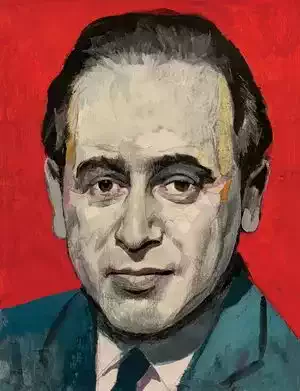
Identification and basic context
Paul Celan, born Paul Antschel, was a major 20th-century poet, writing in German. His distinctive use of language and profound thematic concerns positioned him as a significant voice in post-war European literature. Celan's work grapples intensely with the legacy of the Holocaust, the loss of his parents, and the subsequent exile and displacement he experienced. His poetry is noted for its linguistic density, allusiveness, and its confrontation with the unspeakable. He is considered one of the most important German-language poets of his generation, and his work continues to provoke critical discussion and inspire readers worldwide. His writing is deeply rooted in the European intellectual and cultural landscape of his time.
Childhood and education
Celan was born to Jewish parents in Czernowitz, Bukovina, then part of Romania. His early life was shaped by the multicultural environment of Czernowitz, a city with significant German, Romanian, Ukrainian, and Jewish populations. He received a Jewish upbringing and education, alongside attending Romanian public schools. His early exposure to German literature and culture, particularly through his father's involvement in Zionist activities and his mother's passion for poetry, laid the groundwork for his literary future. Despite the growing political tensions and anti-Semitism in the region, his formative years were characterized by a rich intellectual and cultural milieu. He pursued medical studies briefly before focusing on literature and translation.
Literary trajectory
Celan's literary journey began in earnest after the immense personal tragedy of the Holocaust, which claimed the lives of his parents and devastated his community. The immense trauma and loss profoundly shaped his poetic voice and subject matter. His early poems, often dealing with themes of loss and memory, began to gain recognition in post-war literary circles. He worked as a translator and editor, which honed his linguistic skills and deepened his engagement with diverse literary traditions. His poetry evolved through distinct phases, marked by increasing linguistic experimentation and a relentless exploration of the boundaries of language in the face of unspeakable historical events. His move to Paris in 1952 and his subsequent career there solidified his international reputation, though his work often remained challenging and demanding for readers.
Works, style, and literary characteristics
Celan's major works include "Mohn und Gedächtnis" (Poppy and Memory, 1952), "Von Schwelle zu Schwelle" (From Threshold to Threshold, 1955), "Sprachgitter" (Speech-Grille, 1959), "Niemandsrose" (No-one's Rose, 1963), "Atemkristall" (Breath Crystal, 1965), and "Lichtzwang" (Light-Compulsion, 1968). His poetry is characterized by its intense focus on themes of memory, loss, exile, identity, and the aftermath of the Holocaust. He grappled with the question of how to speak or write after such atrocity, leading to a profound interrogation of language itself. His style is marked by fragmentation, elliptical phrasing, neologisms, and a dense, allusive imagery, often creating a "speech-grille" through which meaning can only be painstakingly deciphered. The tone is often elegiac, mournful, and deeply introspective, yet also fiercely determined to bear witness. Celan's innovations lie in his creation of a post-Holocaust poetic language that is both deeply personal and universally resonant, pushing the boundaries of lyricism and exploring the ethical dimensions of language.
Cultural and historical context
Celan wrote in the shadow of Nazism and the Holocaust, a context that profoundly shaped his identity and his art. He was part of a generation of European writers grappling with the moral and linguistic fallout of World War II. His work engaged with the existentialist currents of the post-war period, but he forged his own unique path, deeply rooted in Jewish experience and the specific trauma of the Shoah. He maintained relationships with a variety of literary figures, though his often intense and demanding personality sometimes led to strained interactions. He was associated with the post-war German literary scene, particularly with the Gruppe 47, though his work often stood apart from its more conventional aesthetics. His writings are a testament to the struggle to find meaning and express truth in a world profoundly scarred by historical violence.
Personal life
Celan's personal life was marked by profound loss and trauma. The loss of his parents in Nazi labor camps and his own period of forced labor left indelible scars. His marriage to Gisèle de Courten and their children was a significant relationship, though his intense psychological struggles and periods of depression often strained these connections. He had a complex relationship with his mother, Ruth, whose poetry he admired and whose fate he mourned deeply. His friendships with other writers, such as Nelly Sachs and Ilse Aichinger, were important, but his often volatile temperament and deep-seated anxieties sometimes led to isolation. His belief in the power of poetry as a form of witness and a means of preserving memory was central to his existence, even as his personal demons often threatened to overwhelm him.
Recognition and reception
While Celan achieved significant recognition during his lifetime, particularly in literary circles, his work's challenging nature meant it was not always widely embraced. He received prestigious awards such as the Georg Büchner Prize (1960), which cemented his status as a major literary figure. However, his reputation grew substantially after his death, as critics and scholars increasingly recognized the depth, complexity, and enduring relevance of his poetry. His work is now considered essential reading for understanding 20th-century poetry and the impact of historical trauma on artistic expression. His influence extends internationally, with his poems widely translated and studied.
Influences and legacy
Celan was influenced by a range of poets, including German Expressionists, Symbolists like Stefan George, and fellow Jewish writers. He was also deeply engaged with philosophy, particularly that of Martin Heidegger, though their relationship was complex and fraught. Celan's legacy is immense; he fundamentally altered the landscape of German-language poetry, demonstrating how language could be reconfigured to confront unspeakable historical realities. He influenced generations of poets who sought to grapple with trauma, memory, and the ethical responsibility of the writer. His work is a cornerstone of post-Holocaust literature and a vital part of the global literary canon, continually studied for its linguistic mastery and profound human insights.
Interpretation and critical analysis
Interpretations of Celan's work often focus on his wrestling with the Holocaust and the concept of "after Auschwitz." Critics debate the extent to which his poetry can or should attempt to represent such unimaginable suffering, and the ethical implications of linguistic representation. His complex use of imagery, neologisms, and fragmentation has led to varied readings, with some seeing his work as a testament to the resilience of the human spirit, while others emphasize its profound engagement with despair and the limits of communication. His dialogue with philosophers like Heidegger has also been a subject of extensive critical analysis.
Curiosities and lesser-known aspects
Celan was known for his meticulous approach to language, often spending days crafting a single poem. He was also a skilled translator, rendering works by poets like Arthur Rimbaud and Osip Mandelstam into German. His personality was often described as intense and solitary, reflecting the deep emotional and psychological burdens he carried. He was deeply concerned with the Jewish tradition and its mystical elements, which subtly inform his work. Despite his profound poetic achievements, he struggled with mental health issues throughout his life.
Death and memory
Paul Celan died by suicide in 1970. His death was a tragic end to a life marked by immense creative output and profound personal suffering. His legacy, however, endures through his poetry, which continues to be read, studied, and revered. Posthumous publications and critical editions of his work have further solidified his place as one of the most important poets of the 20th century.