Poem of the day

Do Not Go Gentle Into That Good Night

Dylan Thomas
Do not go gentle into that good night, 
Old age should burn and rave at close of day; 
Rage, rage against the dying of the light. 

Though wise men at their end know dark is right, 
Because their words had forked no lightning they 
Do not go gentle into that good night. 

Good men, the last wave by, crying how bright 
Their frail deeds might have danced in a green bay, 
Rage, rage against the dying of the light. 

Wild men who caught and sang the sun in flight, 
And learn, too late, they grieved it on its way, 
Do not go gentle into that good night. 

Grave men, near death, who see with blinding sight 
Blind eyes could blaze like meteors and be gay, 
Rage, rage against the dying of the light. 

And you, my father, there on that sad height, 
Curse, bless, me now with your fierce tears, I pray. 
Do not go gentle into that good night. 
Rage, rage against the dying of the light.
Read full poem

Born on this day

11
José Gomes Ferreira

José Gomes Ferreira was a Portuguese poet, novelist, and journalist, known for his social and political intervention poetry, strongly marked by anti-fascism and criticism of injustice. His work is characterized by a vigorous, ironic, and sometimes colloquial language, which seeks to bring poetry closer to the reality of the people and social struggles. A central figure of Portuguese Modernism, especially the second generation, Gomes Ferreira was also a prolific chronicler and an intellectual committed to the ideals of freedom and progress. His poetry, which covers themes such as war, exploitation, hope, and resistance, consolidated him as one of the most combative and popular voices in 20th-century Portuguese literature.

Barros Alves

Barros Alves was a Portuguese poet whose work is part of the modernist context. He stood out for his lyrical writing and for exploring universal themes through a careful and imagistic language.

Sousândrade

Luís Xavier de Jesus Sousândrade was a Brazilian poet and journalist, notable for his work which stands out for its originality, strong influence of French poetry, and social and political themes. His poetry is marked by intense lyricism, exploration of themes such as love, homeland, and the human condition, as well as a critical view of the society of his time. Considered a precursor of modernism in Brazil, Sousândrade introduced formal and thematic innovations in his work, breaking with the literary conventions of his time. His life, marked by travels and political and social engagement, was reflected in poetry that sought to express the anxieties and aspirations of his time, with a rich and innovative language that makes him a unique figure in Brazilian literature.

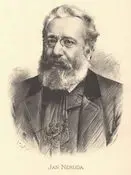
Jan Neruda

Jan Neruda was a prominent Czech writer, journalist, and poet, considered one of the central figures of the Czech literary movement in the second half of the 19th century. His work portrays the daily life, customs, and social transformations of Prague, with a sharp eye for the nuances of the human soul.

Joaquim Marrão

Joaquim Marrão was a Portuguese poet whose work was characterized by the exploration of universal themes such as love, death, time, and nature, often from a lyrical and introspective perspective. His poetry is distinguished by the musicality of its verses, the richness of its imagery, and the delicacy in its exploration of human feelings. Marrão demonstrated particular mastery in the use of traditional poetic forms, such as the sonnet, without abandoning a language that, while refined, proved accessible and emotive. His literary contribution lies in his ability to evoke the beauty of the world and the complexity of the human soul through a pure and sensitive poetic expression.

Maria de Lourdes Belchior

Maria de Lourdes Belchior was a Portuguese writer, journalist, and activist, known for her active participation in the cultural and political life of her time. Her literary work, although not extensive, addresses social and existential themes, reflecting a keen sensitivity to human and feminine issues. She was a prominent figure in the Portuguese intellectual scene, participating in debates and publishing in various media outlets, where she demonstrated a critical and interventionist thinking.

Luís Cardim

Luís Cardim was a Portuguese poet, known for his work within the context of contemporary poetry, exploring existential and social themes with rigorous and introspective language. His writing, sometimes marked by formal experimentation, reflects a deep contemplation of the human condition, the passage of time, and the search for meaning. Cardim left a unique mark on recent Portuguese poetry.

João Pedro Grabato Dias

João Pedro Grabato Dias is a Portuguese poet whose work is part of the contemporary poetry landscape. His writing is often marked by a strong lyrical and introspective component, exploring themes such as memory, identity, the passage of time, and the individual's relationship with the world. He uses careful language, sometimes dense and imagistic, that invites reflection. His poetry seeks to establish a dialogue with the reader through the exploration of emotions and existential anxieties. Grabato Dias is recognized for his sensitivity and his ability to articulate, in verse, the complexities of human experience, reflecting on the fragility of existence and the search for meaning.

John Heath-Stubbs

John Heath-Stubbs was an English poet whose work is known for its erudition, ironic humor, and deep connection to the literary tradition. He explored themes such as mythology, religion, and the search for meaning in a modern world, often using classical poetic forms with a contemporary touch. His poetry reflects a complex worldview, balancing skepticism with a longing for transcendence.

Matthew Gregory

Matthew Gregory is an author who stands out for his ability to weave stories that combine elements of suspense and psychological depth. His writing is engaging, transporting the reader to universes where the emotions and internal conflicts of the characters are central. Gregory has a special talent for creating unexpected twists and keeping the reader in suspense.

Alí Chumacero

Alí Chumacero was a distinguished Mexican poet, essayist, and literary critic, whose work is characterized by a deep reflection on the human condition, the passage of time, and the beauty of language. His poetry, often marked by a melancholic and contemplative tone, explores universal themes with great formal mastery and a particular lyrical sensibility. He was an influential figure in 20th-century Mexican literature, not only for his poetic work but also for his role as a cultural promoter and editor, leaving a significant legacy in Hispanic letters.

Died on this day

4
Vinicius de Moraes

Vinicius de Moraes was a Brazilian poet, playwright, journalist, and composer, considered one of the greatest exponents of lyric poetry in the Portuguese language. His work is marked by deep lyricism, exploring themes such as love, beauty, melancholy, and everyday life, with an accessible and musical language. He is also remembered as one of the fathers of Bossa Nova, having composed several songs that became classics of Brazilian popular music.

Josephine Jacobsen

Josephine Jacobsen was an American poet and short story writer recognized for her lyrical and insightful voice. Her work frequently explores the complexity of human relationships, memory, and the existential condition, with a depth that resonates with many readers. She stood out for her ability to capture moments of introspection and for her elegant and meditative prose.

Pedro J. de la Peña

Pedro J. de la Peña is a writer whose work focuses on the investigation of historical and social themes, with a critical look at the development of societies and their implications. His writing is known for the depth of research and the ability to present narratives that clarify complex periods and relevant characters, contributing to a better understanding of the past and present.