
Ethics and Morality

Henry Wadsworth Longfellow
Tales Of A Wayside Inn : Part 1. The Theologian's Tale; Torquemada
In the heroic days when Ferdinand
And Isabella ruled the Spanish land,
And Torquemada, with his subtle brain,
Ruled them, as Grand Inquisitor of Spain,
In a great castle near Valladolid,
Moated and high and by fair woodlands hid,
There dwelt, as from the chronicles we learn,
An old Hidalgo proud and taciturn,
Whose name has perished, with his towers of stone,
And all his actions save this one alone;
This one, so terrible, perhaps 't were best
If it, too, were forgotten with the rest;
Unless, perchance, our eyes can see therein
The martyrdom triumphant o'er the sin;
A double picture, with its gloom and glow,
The splendor overhead, the death below.
This sombre man counted each day as lost
On which his feet no sacred threshold crossed;
And when he chanced the passing Host to meet,
He knelt and prayed devoutly in the street;
Oft he confessed; and with each mutinous thought,
As with wild beasts at Ephesus, he fought.
In deep contrition scourged himself in Lent,
Walked in processions, with his head down bent,
At plays of Corpus Christi oft was seen,
And on Palm Sunday bore his bough of green.
His sole diversion was to hunt the boar
Through tangled thickets of the forest hoar,
Or with his jingling mules to hurry down
To some grand bull-fight in the neighboring town,
Or in the crowd with lighted taper stand,
When Jews were burned, or banished from the land.
Then stirred within him a tumultuous joy;
The demon whose delight is to destroy
Shook him, and shouted with a trumpet tone,
Kill! kill! and let the Lord find out his own!'
And now, in that old castle in the wood,
His daughters, in the dawn of womanhood,
Returning from their convent school, had made
Resplendent with their bloom the forest shade,
Reminding him of their dead mother's face,
When first she came into that gloomy place,--
A memory in his heart as dim and sweet
As moonlight in a solitary street,
Where the same rays, that lift the sea, are thrown
Lovely but powerless upon walls of stone.
These two fair daughters of a mother dead
Were all the dream had left him as it fled.
A joy at first, and then a growing care,
As if a voice within him cried, 'Beware!?
A vague presentiment of impending doom,
Like ghostly footsteps in a vacant room,
Haunted him day and night; a formless fear
That death to some one of his house was near,
With dark surmises of a hidden crime,
Made life itself a death before its time.
Jealous, suspicious, with no sense of shame,
A spy upon his daughters he became;
With velvet slippers, noiseless on the floors,
He glided softly through half-open doors;
Now in the room, and now upon the stair,
He stood beside them ere they were aware;
He listened in the passage when they talked,
He watched them from the casement when they walked,
He saw the gypsy haunt the river's side,
He saw the monk among the cork-trees glide;
And, tortured by the mystery and the doubt
Of some dark secret, past his finding out,
Baffled he paused; then reassured again
Pursued the flying phantom of his brain.
He watched them even when they knelt in church;
And then, descending lower in his search,
Questioned the servants, and with eager eyes
Listened incredulous to their replies;
The gypsy? none had seen her in the wood!
The monk? a mendicant in search of food!
At length the awful revelation came,
Crushing at once his pride of birth and name;
The hopes his yearning bosom forward cast,
And the ancestral glories of the past,
All fell together, crumbling in disgrace,
A turret rent from battlement to base.
His daughters talking in the dead of night
In their own chamber, and without a light,
Listening, as he was wont, he overheard,
And learned the dreadful secret, word by word;
And hurrying from his castle, with a cry
He raised his hands to the unpitying sky,
Repeating one dread word, till bush and tree
Caught it, and shuddering answered, 'Heresy!'
Wrapped in his cloak, his hat drawn o'er his face,
Now hurrying forward, now with lingering pace,
He walked all night the alleys of his park,
With one unseen companion in the dark,
The demon who within him lay in wait,
And by his presence turned his love to hate,
Forever muttering in an undertone,
'Kill! kill! and let the Lord find out his own!'
Upon the morrow, after early Mass,
While yet the dew was glistening on the grass,
And all the woods were musical with birds,
The old Hidalgo, uttering fearful words,
Walked homeward with the Priest, and in his room
Summoned his trembling daughters to their doom.
When questioned, with brief answers they replied,
Nor when accused evaded or denied;
Expostulations, passionate appeals,
All that the human heart most fears or feels,
In vain the Priest with earnest voice essayed;
In vain the father threatened, wept, and prayed;
Until at last he said, with haughty mien,
'The Holy Office, then, must intervene!'
And now the Grand Inquisitor of Spain,
With all the fifty horsemen of his train,
His awful name resounding, like the blast
Of funeral trumpets, as he onward passed,
Came to Valladolid, and there began
To harry the rich Jews with fire and ban.
To him the Hidalgo went, and at the gate
Demanded audience on affairs of state,
And in a secret chamber stood before
A venerable graybeard of fourscore,
Dressed in the hood and habit of a friar;
Out of his eyes flashed a consuming fire,
And in his hand the mystic horn he held,
Which poison and all noxious charms dispelled.
He heard in silence the Hidalgo's tale,
Then answered in a voice that made him quail:
'Son of the Church! when Abraham of old
To sacrifice his only son was told,
He did not pause to parley nor protest,
But hastened to obey the Lord's behest.
In him it was accounted righteousness;
The Holy Church expects of thee no less!'
A sacred frenzy seized the father's brain,
And Mercy from that hour implored in vain.
Ah! who will e'er believe the words I say?
His daughters he accused, and the same day
They both were cast into the dungeon's gloom,
That dismal antechamber of the tomb,
Arraigned, condemned, and sentenced to the flame,
The secret torture and the public shame.
Then to the Grand Inquisitor once more
The Hidalgo went, more eager than before,
And said: 'When Abraham offered up his son,
He clave the wood wherewith it might be done.
By his example taught, let me too bring
Wood from the forest for my offering!'
And the deep voice, without a pause, replied:
'Son of the Church! by faith now justified,
Complete thy sacrifice, even as thou wilt;
The Church absolves thy conscience from all guilt!'
Then this most wretched father went his way
Into the woods, that round his castle lay,
Where once his daughters in their childhood played
With their young mother in the sun and shade.
Now all the leaves had fallen; the branches bare
Made a perpetual moaning in the air,
And screaming from their eyries overhead
The ravens sailed athwart the sky of lead.
With his own hands he lopped the boughs and bound
Fagots, that crackled with foreboding sound,
And on his mules, caparisoned and gay
With bells and tassels, sent them on their way.
Then with his mind on one dark purpose bent,
Again to the Inquisitor he went,
And said: 'Behold, the fagots I have brought,
And now, lest my atonement be as naught,
Grant me one more request, one last desire,--
With my own hand to light the funeral fire!'
And Torquemada answered from his seat,
'Son of the Church! Thine offering is complete;
Her servants through all ages shall not cease
To magnify thy deed. Depart in peace!'
Upon the market-place, builded of stone
The scaffold rose, whereon Death claimed his own.
At the four corners, in stern attitude,
Four statues of the Hebrew Prophets stood,
Gazing with calm indifference in their eyes
Upon this place of human sacrifice,
Round which was gathering fast the eager crowd,
With clamor of voices dissonant and loud,
And every roof and window was alive
With restless gazers, swarming like a hive.
The church-bells tolled, the chant of monks drew near,
Loud trumpets stammered forth their notes of fear,
A line of torches smoked along the street,
There was a stir, a rush, a tramp of feet,
And, with its banners floating in the air,
Slowly the long procession crossed the square,
And, to the statues of the Prophets bound,
The victims stood, with fagots piled around.
Then all the air a blast of trumpets shook,
And louder sang the monks with bell and book,
And the Hidalgo, lofty, stern, and proud,
Lifted his torch, and, bursting through the crowd,
Lighted in haste the fagots, and then fled,
Lest those imploring eyes should strike him dead!
O pitiless skies! why did your clouds retain
For peasants' fields their floods of hoarded rain?
O pitiless earth! why open no abyss
To bury in its chasm a crime like this?
That night a mingled column of fire and smoke
From the dark thickets of the forest broke,
And, glaring o'er the landscape leagues away,
Made all the fields and hamlets bright as day.
Wrapped in a sheet of flame the castle blazed,
And as the villagers in terror gazed,
They saw the figure of that cruel knight
Lean from a window in the turret's height,
His ghastly face illumined with the glare,
His hands upraised above his head in prayer,
Till the floor sank beneath him, and he fell
Down the black hollow of that burning well.
Three centuries and more above his bones
Have piled the oblivious years like funeral stones;
His name has perished with him, and no trace
Remains on earth of his afflicted race;
But Torquemada's name, with clouds o'ercast,
Looms in the distant landscape of the Past,
Like a burnt tower upon a blackened heath,
Lit by the fires of burning woods beneath!
313
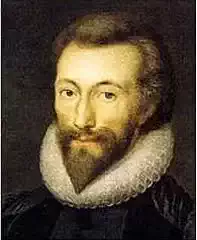
John Donne
Holy Sonnet XVI: Father
Father, part of his double interest
Unto thy kingdome, thy Sonne gives to mee,
His joynture in the knottie Trinitie
Hee keepes, and gives to me his deaths conquest.
This Lambe, whose death, with life the world hath blest,
Was from the worlds beginning slaine, and he
Hath made two Wills, which with the Legacie
Of his and thy kingdome, doe thy Sonnes invest.
Yet such are thy laws, that men argue yet
Whether a man those statutes can fulfill;
None doth; but all-healing grace and spirit
Revive againe what law and letter kill.
Thy lawes abridgement, and thy last command
Is all but love; Oh let this last Will stand!
314

James Whitcomb Riley
Iry And Billy Jo
Iry an' Billy an' Jo!--
Iry an' Billy's _the boys_,
An' _Jo's_ their _dog_, you know,--
Their pictures took all in a row.
Bet they kin kick up a noise--
Iry and Billy, the boys,
And that-air little dog Jo!
_Iry's_ the one 'at stands
Up there a-lookin' so mild
An' meek--with his hat in his hands,
Like such a 'bediant child-(_
Sakes-alive_!)--An' _Billy_ he sets
In the cheer an' holds onto Jo an' _sweats_
Hisse'f, a-lookin' so good! Ho-ho!
Iry an' Billy an' Jo!
Yit the way them boys, you know,
Usen to jes turn in
An' fight over that dog Jo
Wuz a burnin'-shame-an'-a-sin !--
Iry _he'd_ argy 'at, by gee-whizz!
That-air little Jo-dog wuz _his_!--
An' Billy _he'd_ claim it wuzn't so-'
Cause the dog wuz _his'n_!--An' at it they'd go,
Nip-an'-tugg, tooth-an'-toenail, you know--
Iry an' Billy an' Jo!
But their Pa--(He wuz the marshal then)
He 'tended-like 'at he _jerked 'em up_;
An' got a jury o' Brickyard men
An' helt a _trial_ about the pup:
An' _he_ says _he_ jes like to a-died
When the rest o' us town-boys _testified_--
Regardin', you know,
Iry an' Billy an' Jo.-
'Cause we all knowed, when _the Gypsies_ they
Camped down here by the crick last Fall,
They brung Jo with 'em, an' give him away
To Iry an' Billy fer nothin' at all!--
So the jury fetched in the _verdick_ so
Jo he ain't _neether_ o' theirn fer _shore_-He's
_both_ their dog, an' jes no more!
An' so
They've quit quarrelin' long ago,
Iry an' Billy an' Jo.
314

John Greenleaf Whittier
Mithridates At Chios
KNOW'ST thou, O slave-cursed land!
How, when the Chian's cup of guilt
Was full to overflow, there came
God's justice in the sword of flame
That, red with slaughter to its hilt,
Blazed in the Cappadocian victor's hand?
The heavens are still and far;
But, not unheard of awful Jove,
The sighing of the island slave
Was answered, when the Ægean wave
The keels of Mithridates clove,
And the vines shrivelled in the breath of war.
'Robbers of Chios! hark,'
The victor cried, 'to Heaven's decree!
Pluck your last cluster from the vine,
Drain your last cup of Chian wine;
Slaves of your slaves, your doom shall be,
In Colchian mines by Phasis rolling dark.'
Then rose the long lament
From the hoar sea-god's dusky caves:
The priestess rent her hair and cried,
'Woe! woe! The gods are sleepless-eyed!'
And, chained and scourged, the slaves of slaves,
The lords of Chios into exile went.
'The gods at last pay well,'
So Hellas sang her taunting song,
'The fisher in his net is caught,
The Chian hath his master bought;'
And isle from isle, with laughter long,
Took up and sped the mocking parable.
Once more the slow, dumb years
Bring their avenging cycle round,
And, more than Hellas taught of old,
Our wiser lesson shall be told,
Of slaves uprising, freedom-crowned,
To break, not wield, the scourge wet with their blood and tears.
312

Henry Lawson
My Father-in-Law and I
MY father-in-law is a careworn man,
And a silent man is he;
But he summons a smile as well as he can
Whenever he meets with me.
The sign we make with a silent shake
That speaks of the days gone by—
Like men who meet at a funeral—
My father-in-law and I.
My father-in-law is a sober man
(And a virtuous man, I think);
But we spare a shilling whenever we can,
And we both drop in for a drink.
Our pints they fill, and we say, “Ah, well!”
With the sound of the world-old sigh—
Like the drink that comes after a funeral—
My father-in-law and I.
My father-in-law is a kindly man—
A domestic man is he.
He tries to look cheerful as well as he can
Whenever he meets with me.
But we stand and think till the second drink
In a silence that might imply
That we’d both get over a funeral,
My father-in-law and I.
311
John Donne
Holy Sonnet XI: Spit In My Face You Jewes
Spit in my face you Jewes, and pierce my side,
Buffet, and scoffe, scourge, and crucifie mee,
For I have sinn'd, and sinn'd, and onely hee,
Who could do no iniquitie, hath dyed:
But by my death can not be satisfied
My sinnes, which passe the Jewes impiety:
They kill'd once an inglorious man, but I
Crucifie him daily, being now glorified.
Oh let mee then, his strange love still admire:
Kings pardon, but he bore our punishment.
And Jacob came cloth'd in vile harsh attire
But to supplant, and with gainfull intent:
God cloth'd himselfe in vile mans flesh, that so
Hee might be weake enough to suffer woe.
312

Jonathan Swift
To Stella, Who Collected and Transcribed His Poems
As, when a lofty pile is raised,
We never hear the workmen praised,
Who bring the lime, or place the stones;
But all admire Inigo Jones:
So, if this pile of scattered rhymes
Should be approved in aftertimes;
If it both pleases and endures,
The merit and the praise are yours.
Thou, Stella, wert no longer young,
When first for thee my harp was strung,
Without one word of Cupid's darts,
Of killing eyes, or bleeding hearts;
With friendship and esteem possest,
I ne'er admitted Love a guest.
In all the habitudes of life,
The friend, the mistress, and the wife,
Variety we still pursue,
In pleasure seek for something new;
Or else, comparing with the rest,
Take comfort that our own is best;
The best we value by the worst,
As tradesmen show their trash at first;
But his pursuits are at an end,
Whom Stella chooses for a friend.
A poet starving in a garret,
Invokes his mistress and his Muse,
And stays at home for want of shoes:
Should but his Muse descending drop
A slice of bread and mutton-chop;
Or kindly, when his credit's out,
Surprise him with a pint of stout;
Or patch his broken stocking soles;
Or send him in a peck of coals;
Exalted in his mighty mind,
He flies and leaves the stars behind;
Counts all his labours amply paid,
Adores her for the timely aid.
Or, should a porter make inquiries
For Chloe, Sylvia, Phillis, Iris;
Be told the lodging, lane, and sign,
The bowers that hold those nymphs divine;
Fair Chloe would perhaps be found
With footmen tippling under ground;
The charming Sylvia beating flax,
Her shoulders marked with bloody tracks;
Bright Phyllis mending ragged smocks:
And radiant Iris in the pox.
These are the goddesses enrolled
In Curll's collection, new and old,
Whose scoundrel fathers would not know 'em,
If they should meet them in a poem.
True poets can depress and raise,
Are lords of infamy and praise;
They are not scurrilous in satire,
Nor will in panegyric flatter.
Unjustly poets we asperse;
Truth shines the brighter clad in verse,
And all the fictions they pursue
Do but insinuate what is true.
Now, should my praises owe their truth
To beauty, dress, or paint, or youth,
What stoics call without our power,
They could not be ensured an hour;
'Twere grafting on an annual stock,
That must our expectation mock,
And, making one luxuriant shoot,
Die the next year for want of root:
Before I could my verses bring,
Perhaps you're quite another thing.
So Maevius, when he drained his skull
To celebrate some suburb trull,
His similes in order set,
And every crambo he could get;
Had gone through all the common-places
Worn out by wits, who rhyme on faces;
Before he could his poem close,
The lovely nymph had lost her nose.
Your virtues safely I commend;
They on no accidents depend:
Let malice look with all her eyes,
She dare not say the poet lies.
Stella, when you these lines transcribe,
Lest you should take them for a bribe,
Resolved to mortify your pride,
I'll here expose your weaker side.
Your spirits kindle to a flame,
Moved by the lightest touch of blame;
And when a friend in kindness tries
To show you where your error lies,
Conviction does but more incense;
Perverseness is your whole defence;
Truth, judgment, wit, give place to spite,
Regardless both of wrong and right;
Your virtues all suspended wait,
Till time has opened reason's gate;
And, what is worse, your passion bends
Its force against your nearest friends,
Which manners, decency, and pride,
Have taught from you the world to hide;
In vain; for see, your friend has brought
To public light your only fault;
And yet a fault we often find
Mixed in a noble, generous mind:
And may compare to Etna's fire,
Which, though with trembling, all admire;
The heat that makes the summit glow,
Enriching all the vales below.
Those who, in warmer climes, complain
From Phoebus' rays they suffer pain,
Must own that pain is largely paid
By generous wines beneath a shade.
Yet, when I find your passions rise,
And anger sparkling in your eyes,
I grieve those spirits should be spent,
For nobler ends by nature meant.
One passion, with a different turn,
Makes wit inflame, or anger burn:
So the sun's heat, with different powers,
Ripens the grape, the liquor sours:
Thus Ajax, when with rage possest,
By Pallas breathed into his breast,
His valour would no more employ,
Which might alone have conquered Troy;
But, blinded be resentment, seeks
For vengeance on his friends the Greeks.
You think this turbulence of blood
From stagnating preserves the flood,
Which, thus fermenting by degrees,
Exalts the spirits, sinks the lees.
Stella, for once your reason wrong;
For, should this ferment last too long,
By time subsiding, you may find
Nothing but acid left behind;
From passion you may then be freed,
When peevishness and spleen succeed.
Say, Stella, when you copy next,
Will you keep strictly to the text?
Dare you let these reproaches stand,
And to your failing set your hand?
Or, if these lines your anger fire,
Shall they in baser flames expire?
Whene'er they burn, if burn they must,
They'll prove my accusation just.
311
Henry Lawson
The Day Before I Die
There's such a lot of work to do, for such a troubled head!
I’m scribbling this against a book, with foolscap round, in bed.
It strikes me that I’ll scribble much in this way by and by,
And write my last lines so perchance the day before I die.
There’s lots of things to come and go, and I, in careless rhyme,
And drink and love (it wastes the most) have wasted lots of time.
There’s so much good work to be done it makes me sure that I
Will be the sorriest for my death, the day before I die.
But, lift me dear, for I am tired, and let me taste the wine—
And lay your cheek a little while on this lined cheek of mine.
I want to say I love you so—your patient love is why
I’ll have such little time, you know, the day before I die.
310

William Shakespeare
Sonnet 138: When my love swears that she is made of truth
When my love swears that she is made of truth
I do believe her, though I know she lies,
That she might think me some untutor'd youth,
Unlearned in the world's false subtleties.
Thus vainly thinking that she thinks me young,
Although she knows my days are past the best,
Simply I credit her false speaking tongue:
On both sides thus is simple truth suppress'd.
But wherefore says she not she is unjust?
And wherefore say not I that I am old?
O, love's best habit is in seeming trust,
And age in love loves not to have years told:
Therefore I lie with her and she with me,
And in our faults by lies we flatter'd be.
311
Henry Wadsworth Longfellow
By The Seaside : Sir Humphrey Gilbert
Southward with fleet of ice
Sailed the corsair Death;
Wild and gast blew the blast,
And the east-wind was his breath.
His lordly ships of ice
Glisten in the sun;
On each side, like pennons wide,
Flashing crystal streamlets run.
His sails of white sea-mist
Dripped with silver rain;
But where he passed there were cast
Leaden shadows o'er the main.
Eastward from Campobello
Sir Humphrey Gilbert sailed;
Three days or more seaward he bore,
Then, alas! the land-wind failed.
Alas! the land-wind failed,
And ice-cold grew the night;
And nevermore, on sea or shore,
Should Sir Humphrey see the light.
He sat upon the deck,
The Book was in his hand;
'Do not fear! Heaven is as near,'
He said, 'by water as by land!'
In the first watch of the night,
Without a signal's sound,
Out of the sea, mysteriously,
The fleet of Death rose all around.
The moon and the evening star
Were hanging in the shrouds;
Every mast, as it passed,
Seemed to rake the passing clouds.
They grappled with their prize,
At midnight black and cold!
As of a rock was the shock;
Heavily the ground-swell rolled.
Southward through day and dark,
They drift in cold embrace,
With mist and rain, o'er the open main;
Yet there seems no change of place.
Southward, forever southward,
They drift through dark and day;
And like a dream, in the Gulf-Stream
Sinking, vanish all away.
312
Henry Lawson
The Ghost
Down the street as I was drifting with the city's human tide,
Came a ghost, and for a moment walked in silence by my side --
Now my heart was hard and bitter, and a bitter spirit he,
So I felt no great aversion to his ghostly company.
Said the Shade: `At finer feelings let your lip in scorn be curled,
`Self and Pelf', my friend, has ever been the motto for the world.'
And he said: `If you'd be happy, you must clip your fancy's wings,
Stretch your conscience at the edges to the size of earthly things;
Never fight another's battle, for a friend can never know
When he'll gladly fly for succour to the bosom of the foe.
At the power of truth and friendship let your lip in scorn be curled -`
Self and Pelf', my friend, remember, is the motto of the world.
`Where Society is mighty, always truckle to her rule;
Never send an `i' undotted to the teacher of a school;
Only fight a wrong or falsehood when the crowd is at your back,
And, till Charity repay you, shut the purse, and let her pack;
At the fools who would do other let your lip in scorn be curled,
`Self and Pelf', my friend, remember, that's the motto of the world.
`Ne'er assail the shaky ladders Fame has from her niches hung,
Lest unfriendly heels above you grind your fingers from the rung;
Or the fools who idle under, envious of your fair renown,
Heedless of the pain you suffer, do their worst to shake you down.
At the praise of men, or censure, let your lip in scorn be curled,
`Self and Pelf', my friend, remember, is the motto of the world.
`Flowing founts of inspiration leave their sources parched and dry,
Scalding tears of indignation sear the hearts that beat too high;
Chilly waters thrown upon it drown the fire that's in the bard;
And the banter of the critic hurts his heart till it grows hard.
At the fame your muse may offer let your lip in scorn be curled,
`Self and Pelf', my friend, remember, that's the motto of the world.
`Shun the fields of love, where lightly, to a low and mocking tune,
Strong and useful lives are ruined, and the broken hearts are strewn.
Not a farthing is the value of the honest love you hold;
Call it lust, and make it serve you! Set your heart on nought but gold.
At the bliss of purer passions let your lip in scorn be curled -`
Self and Pelf', my friend, shall ever be the motto of the world.'
Then he ceased and looked intently in my face, and nearer drew;
But a sudden deep repugnance to his presence thrilled me through;
Then I saw his face was cruel, by the look that o'er it stole,
Then I felt his breath was poison, by the shuddering of my soul,
Then I guessed his purpose evil, by his lip in sneering curled,
And I knew he slandered mankind, by my knowledge of the world.
But he vanished as a purer brighter presence gained my side -`
Heed him not! there's truth and friendship
in this wondrous world,' she cried,
And of those who cleave to virtue in their climbing for renown,
Only they who faint or falter from the height are shaken down.
At a cynic's baneful teaching let your lip in scorn be curled!
`Brotherhood and Love and Honour!' is the motto for the world.'
311

Oscar Wilde
Ballade De Marguerite
(NORMANDE.)
I AM weary of lying within the chase
When the knights are meeting in market-place.
Nay, go not thou to the red-roofed town
Lest the hooves of the war-horse tread thee down.
But I would not go where the Squires ride,
I would only walk by my Lady's side.
Alack! and alack! thou art over bold,
A Forester's son may not eat off gold.
Will she love me the less that my Father is seen,
Each Martinmas day in a doublet green?
Perchance she is sewing at tapestrie,
Spindle and loom are not meet for thee.
Ah, if she is working the arras bright
I might ravel the threads by the fire-light.
Perchance she is hunting of the deer,
How could you follow o'er hill and meer?
Ah, if she is riding with the court,
I might run beside her and wind the morte.
Perchance she is kneeling in S. Denys,
(On her soul may our Lady have gramercy!)
Ah, if she is praying in lone chapelle,
I might swing the censer and ring the bell.
Come in my son, for you look sae pale,
The father shall fill thee a stoup of ale.
But who are these knights in bright array?
Is it a pageant the rich folks play?
'Tis the King of England from over sea,
Who has come unto visit our fair countrie.
But why does the curfew toll sae low
And why do the mourners walk a-row?
O 'tis Hugh of Amiens my sister's son
Who is lying stark, for his day is done.
Nay, nay, for I see white lilies clear,
It is no strong man who lies on the bier.
O 'tis old Dame Jeannette that kept the hall,
I knew she would die at the autumn fall.
Dame Jeannette had not that gold-brown hair,
Old Jeannette was not a maiden fair.
O 'tis none of our kith and none of our kin,
(Her soul may our Lady assoil from sin!)
But I hear the boy's voice chaunting sweet,
'Elle est morte, la Marguerite.'
Come in my son and lie on the bed,
And let the dead folk bury their dead.
O mother, you know I loved her true:
O mother, hath one grave room for two?
311
Henry Wadsworth Longfellow
The Saga of King Olaf: III. Thora Of Rimol
'Thora of Rimol! hide me! hide me!
Danger and shame and death betide me!
For Olaf the King is hunting me down
Through field and forest, through thorp and town!'
Thus cried Jarl Hakon
To Thora, the fairest of women.
?Hakon Jarl! for the love I bear thee
Neither shall shame nor death come near thee!
But the hiding-place wherein thou must lie
Is the cave underneath the swine in the sty.'
Thus to Jarl Hakon
Said Thora, the fairest of women.
So Hakon Jarl and his base thrall Karker
Crouched in the cave, than a dungeon darker,
As Olaf came riding, with men in mail,
Through the forest roads into Orkadale,
Demanding Jarl Hakon
Of Thorn, the fairest of women.
'Rich and honored shall be whoever
The head of Hakon Jarl shall dissever!'
Hakon heard him, and Karker the slave,
Through the breathing-holes of the darksome cave.
Alone in her chamber
Wept Thora, the fairest of women.
Said Karker, the crafty, 'I will not slay thee!
For all the king's gold I will never betray thee!'
'Then why dost thou turn so pale, O churl,
And then again black as the earth?' said the Earl.
More pale and more faithful
Was Thora, the fairest of women.
From a dream in the night the thrall started, saying,
'Round my neck a gold ring King Olaf was laying!'
And Hakon answered, 'Beware of the king!
He will lay round thy neck a blood-red ring.'
At the ring on her finger
Gazed Thora, the fairest of women.
At daybreak slept Hakon, with sorrows encumbered,
But screamed and drew up his feet as he slumbered;
The thrall in the darkness plunged with his knife,
And the Earl awakened no more in this life.
But wakeful and weeping
Sat Thora, the fairest of women.
At Nidarholm the priests are all singing,
Two ghastly heads on the gibbet are swinging;
One is Jarl Hakon's and one is his thrall's,
And the people are shouting from windows and walls;
While alone in her chamber
Swoons Thora, the fairest of women.
308
James Whitcomb Riley
Johnson's Boy
The world is turned ag'in' me,
And people says, 'They guess
That nothin' else is in me
But pure maliciousness!'
I git the blame for doin'
What other chaps destroy,
And I'm a-goin' to ruin
Because I'm 'Johnson's boy.'
THAT ain't my name--I'd ruther
They'd call me IKE or PAT--
But they've forgot the other--
And so have _I_, for that!
I reckon it's as handy,
When Nibsy breaks his toy,
Or some one steals his candy,
To say 'twas 'JOHNSON'S BOY!'
You can't git any water
At the pump, and find the spout
So durn chuck-full o' mortar
That you have to bore it out;
You tackle any scholar
In Wisdom's wise employ,
And I'll bet you half a dollar
He'll say it's 'Johnson's boy!'
Folks don't know how I suffer
In my uncomplainin' way--
They think I'm gittin' tougher
And tougher every day.
Last Sunday night, when Flinder
Was a-shoutin' out for joy,
And some one shook the winder,
He prayed for 'Johnson's boy.'
I'm tired of bein' follered
By farmers every day,
And then o' bein' collared
For coaxin' hounds away;
Hounds always plays me double-It's
a trick they all enjoy--
To git me into trouble,
Because I'm 'Johnson's boy.'
But if I git to Heaven,
I hope the Lord'll see
SOME boy has been perfect,
And lay it on to me;
I'll swell the song sonorous,
And clap my wings for joy,
And sail off on the chorus-
'Hurrah for 'Johnson's boy!''
308
Jonathan Swift
The Virtues Of Sid Hamet The Magician’s Rod
The rod was but a harmless wand,
While Moses held it in his hand;
But, soon as e'er he laid it down,
Twas a devouring serpent grown.
Our great magician, Hamet Sid,
Reverses what the prophet did:
His rod was honest English wood,
That senseless in a corner stood,
Till metamorphos'd by his grasp,
It grew an all-devouring asp;
Would hiss, and sting, and roll, and twist.
By the mere virtue of his fist:
But, when he laid it down, as quick
Resum'd the figure of a stick.
So, to her midnight feasts, the hag
Rides on a broomstick for a nag,
That, rais'd by magic of her breech,
O'er sea and land conveys the witch;
But with the morning dawn resumes
The peaceful state of common brooms.
They tell us something strange and odd,
About a certain magic rod,
That, bending down its top, divines
Whene'er the soil has golden mines;
Where there are none, it stands erect,
Scorning to show the least respect:
As ready was the wand of Sid
To bend where golden mines were hid:
In Scottish hills found precious ore,
Where none e'er look'd for it before;
And by a gentle bow divine
How well a cully's purse was lined;
To a forlorn and broken rake,
Stood without motion like a stake.
The rod of Hermes was renown'd
For charms above and under ground;
To sleep could mortal eyelids fix,
And drive departed souls to Styx.
That rod was a just type of Sid's,
Which o'er a British senate's lids
Could scatter opium full as well,
And drive as many souls to hell.
Sid's rod was slender, white, and tall,
Which oft he used to fish withal;
A PLACE was fasten'd to the hook,
And many score of gudgeons took;
Yet still so happy was his fate,
He caught his fish and sav'd his bait.
Sid's brethren of the conj'ring tribe,
A circle with their rod describe,
Which proves a magical redoubt,
To keep mischievous spirits out.
Sid's rod was of a larger stride,
And made a circle thrice as wide,
Where spirits throng'd with hideous din,
And he stood there to take them in;
But when th'enchanted rod was broke,
They vanish'd in a stinking smoke.
Achilles' sceptre was of wood,
Like Sid's, but nothing near so good;
Though down from ancestors divine
Transmitted to the heroes line;
Thence, thro' a long descent of kings,
Came an HEIRLOOM, as Homer sings.
Though this description looks so big,
That sceptre was a sapless twig,
Which, from the fatal day, when first
It left the forest where 'twas nurs'd,
As Homer tells us o'er and o'er,
Nor leaf, nor fruit, nor blossom bore.
Sid's sceptre, full of juice, did shoot
In golden boughs, and golden fruit;
And he, the dragon never sleeping,
Guarded each fair Hesperian Pippin.
No hobby-horse, with gorgeous top,
The dearest in Charles Mather's shop,
Or glittering tinsel of May Fair,
Could with this rod of Sid compare.
Dear Sid, then why wert thou so mad
To break thy rod like naughty lad?
You should have kiss'd it in your distress,
And then return'd it to your mistress;
Or made it a Newmarket switch,
And not a rod for thine own breech.
But since old Sid has broken this,
His next may be a rod in piss.
311
Henry Wadsworth Longfellow
The Black Knight. (From The German Of Uhland)
'Twas Pentecost, the Feast of Gladness,
When woods and fields put off all sadness,
Thus began the King and spake:
So from the halls
Of ancient Hofburgh's walls,
A luxuriant Spring shall break.
Drums and trumpets echo loudly,
Wave the crimson banners proudly,
From balcony the King looked on;
In the play of spears,
Fell all the cavaliers,
Before the monarch's stalwart son.
To the barrier of the fight
Rode at last a sable Knight.
Sir Knight! your name and scutcheon say!
Should I speak it here,
Ye would stand aghast with fear;
I am a Prince of mighty sway!
When he rode into the lists,
The arch of heaven grew black with mists,
And the castle 'gan to rock.
At the first blow,
Fell the youth from saddle-bow,
Hardly rises from the shock.
Pipe and viol call the dances,
Torch-light through the high hall glances;
Waves a mighty shadow in;
With manner bland
Doth ask the maiden's hand,
Doth with her the dance begin;
Danced in sable iron sark,
Danced a measure weird and dark,
Coldly clasped her limbs around.
From breast and hair
Down fall from her the fair
Flowerets, faded, to the ground.
To the sumptuous banquet came
Every Knight and every Dame.
'Twixt son and daughter all distraught,
With mournful mind
The ancient King reclined,
Gazed at them in silent thought.
Pale the children both did look,
But the guest a beaker took;
Golden wine will make you whole!
The children drank,
Gave many a courteous thank;
Oh, that draught was very cool!
Each the father's breast embraces,
Son and daughter; and their faces
Colourless grow utterly.
Whichever way
Looks the fear-struck father grey,
He beholds his children die.
Woe! the blessed children both
Takest thou in the joy of youth;
Take me, too, the joyless father!
Spake the grim Guest,
From his hollow, cavernous breast,
Roses in the spring I gather!
309

Johann Wolfgang von Goethe
Thoughts On Jesus Christ's Decent Into Hell
WHAT wondrous noise is heard around!
Through heaven exulting voices sound,
A mighty army marches on
By thousand millions follow'd, lo,
To yon dark place makes haste to go
God's Son, descending from His throne!
He goes--the tempests round Him break,
As Judge and Hero cometh He;
He goes--the constellations quake,
The sun, the world quake fearfully.
I see Him in His victor-car,
On fiery axles borne afar,
Who on the cross for us expired.
The triumph to yon realms He shows,--
Remote from earth, where star ne'er glows,
The triumph He for us acquired.
He cometh, Hell to extirpate,
Whom He, by dying, wellnigh kill'd;
He shall pronounce her fearful fate
Hark! now the curse is straight fulfill'd.
Hell sees the victor come at last,
She feels that now her reign is past,
She quakes and fears to meet His sight;
She knows His thunders' terrors dread,
In vain she seeks to hide her head,
Attempts to fly, but vain is flight;
Vainly she hastes to 'scape pursuit
And to avoid her Judge's eye;
The Lord's fierce wrath restrains her foot
Like brazen chains,--she cannot fly.
Here lies the Dragon, trampled down,
He lies, and feels God's angry frown,
He feels, and grinneth hideously;
He feels Hell's speechless agonies,
A thousand times he howls and sighs:
"Oh, burning flames! quick, swallow me!"
There lies he in the fiery waves,
By torments rack'd and pangs infernal,
Instant annihilation craves,
And hears, those pangs will be eternal.
Those mighty squadrons, too, are here,
The partners of his cursed career,
Yet far less bad than he were they.
Here lies the countless throng combined,
In black and fearful crowds entwined,
While round him fiery tempests play;
He sees how they the Judge avoid,
He sees the storm upon them feed,
Yet is not at the sight o'erjoy'd,
Because his pangs e'en theirs exceed.
The Son of Man in triumph passes
Down to Hell's wild and black morasses,
And there unfolds His majesty.
Hell cannot bear the bright array,
For, since her first created day.
Darkness alone e'er govern'd she.
She lay remote from ev'ry light
With torments fill'd in Chaos here;
God turn'd for ever from her sight
His radiant features' glory clear.
Within the realms she calls her own,
She sees the splendour of the Son,
His dreaded glories shining forth;
She sees Him clad in rolling thunder,
She sees the rocks all quake with wonder,
When God before her stands in wrath.
She sees He comes her Judge to be,
She feels the awful pangs inside her,
Herself to slay endeavours she,
But e'en this comfort is denied her.
Now looks she back, with pains untold,
Upon those happy times of old,
When those glories gave her joy;
When yet her heart revered the truth,
When her glad soul, in endless youth
And rapture dwelt, without alloy.
She calls to mind with madden'd thought
How over man her wiles prevail'd;
To take revenge on God she sought,
And feels the vengeance it entail'd.
God was made man, and came to earth.
Then Satan cried with fearful mirth:
"E'en He my victim now shall be!"
He sought to slay the Lord Most High,
The world's Creator now must die;
But, Satan, endless woe to thee!
Thou thought'st to overcome Him then,
Rejoicing in His suffering;
But he in triumph comes again
To bind thee: Death! where is thy sting?
Speak, Hell! where is thy victory?
Thy power destroy'd and scatter'd see!
Know'st thou not now the Highest's might?
See, Satan, see thy rule o'erthrown!
By thousand-varying pangs weigh'd down,
Thou dwell'st in dark and endless night.
As though by lightning struck thou liest,
No gleam of rapture far or wide;
In vain! no hope thou there decriest,--
For me alone Messiah died!
A howling rises through the air,
A trembling fills each dark vault there,
When Christ to Hell is seen to come.
She snarls with rage, but needs must cower
Before our mighty hero's power;
He signs--and Hell is straightway dumb.
Before his voice the thunders break,
On high His victor-banner blows;
E'en angels at His fury quake,
When Christ to the dread judgment goes.
Now speaks He, and His voice is thunder,
He speaks, the rocks are rent in sunder,
His breath is like devouring flames.
Thus speaks He: "Tremble, ye accurs'd!
He who from Eden hurl'd you erst,
Your kingdom's overthrow proclaims.
Look up! My children once were ye,
Your arms against Me then ye turn'd,
Ye fell, that ye might sinners be,
Ye've now the wages that ye earn'd.
"My greatest foeman from that day,
Ye led my dearest friends astray,--
As ye had fallen, man must fall.
To kill him evermore ye sought,
'They all shall die the death,' ye thought;
But howl! for Me I won them all.
For them alone did I descend,
For them pray'd, suffer'd, perish'd I.
Ye ne'er shall gain your wicked end;
Who trusts in Me shall never die.
"In endless chains here lie ye now,
Nothing can save you from the slough.
Not boldness, not regret for crime.
Lie, then, and writhe in brimstone fire!
'Twas ye yourselves drew down Mine ire,
Lie and lament throughout all time!
And also ye, whom I selected,
E'en ye forever I disown,
For ye My saving grace rejected
Ye murmur? blame yourselves alone!
"Ye might have lived with Me in bliss,
For I of yore had promis'd this;
Ye sinn'd, and all My precepts slighted
Wrapp'd in the sleep of sin ye dwelt,
Now is My fearful judgment felt,
By a just doom your guilt requited."--
Thus spake He, and a fearful storm
From Him proceeds, the lightnings glow,
The thunders seize each wicked form,
And hurl them in the gulf below.
The God-man closeth Hell's sad doors,
In all His majesty He soars
From those dark regions back to light.
He sitteth at the Father's side;
Oh, friends, what joy doth this betide!
For us, for us He still will fight!
The angels sacred quire around
Rejoice before the mighty Lord,
So that all creatures hear the sound:
"Zebaoth's God be aye ador'd!"
309
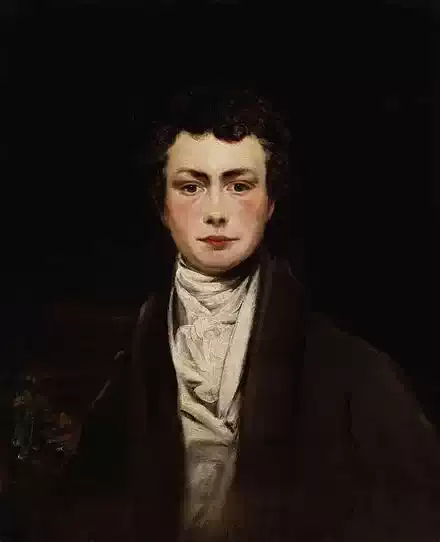
Thomas Moore
Cotton and Corn
Said Cotton to Corn, t'other day,
As they met and exchang'd salute--
(Squire Corn in his carriage so gay,
Poor Cotton, half famish'd on foot):
"Great Squire, if it isn't uncivil
To hint at starvation before you,
Look down on a poor hungry devil,
And give him some bread, I implore you!"
Quoth Corn, then, in answer to Cotton,
Perceiving he meant to make free --
"Low fellow, you've surely forgotten
The distance between you and me!
To expect that we, Peers of high birth,
Should waste our illustrious acres,
For no other purpose on earth
Than to fatten curst calico-makers! --
That Biships to hobbins should bend --
Should stoop from their Bench's sublimity,
Great dealers in lawn, to befriend
Such contemptible dealers in dimity!
"No -- vile Manufacture! ne'er harbour
A hope to be fed at our boards; --
Base offspring of Arkwright the barber,
What claim canst thou have upon Lords?
"No -- thanks to the taxes and debt,
And the triumph of paper o'er guineas,
Our race of Lord Jemmys, as yet,
May defy your whole rabble of Jennys!"
So saying -- whip, crack and away
Went Corn in his chaise through the throng,
So headlong, I heard them all say,
"Squire Corn would be down, before long."
309
John Greenleaf Whittier
Seed-Time And Harvest
As o'er his furrowed fields which lie
Beneath a coldly dropping sky,
Yet chill with winter's melted snow,
The husbandman goes forth to sow,
Thus, Freedom, on the bitter blast
The ventures of thy seed we cast,
And trust to warmer sun and rain
To swell the germs and fill the grain.
Who calls thy glorious service hard?
Who deems it not its own reward?
Who, for its trials, counts it less
A cause of praise and thankfulness?
It may not be our lot to wield
The sickle in the ripened field;
Nor ours to hear, on summer eves,
The reaper's song among the sheaves.
Yet where our duty's task is wrought
In unison with God's great thought,
The near and future blend in one,
And whatsoe'er is willed, is done!
And ours the grateful service whence
Comes day by day the recompense;
The hope, the trust, the purpose stayed,
The fountain and the noonday shade.
And were this life the utmost span,
The only end and aim of man,
Better the toil of fields like these
Than waking dream and slothful ease.
But life, though falling like our grain,
Like that revives and springs again;
And, early called, how blest are they
Who wait in heaven their harvest-day!
309
James Whitcomb Riley
Mylo Jones's Wife
'Mylo Jones's wife' was all
I heerd, mighty near, last Fall--
Visitun relations down
T'other side of Morgantown!
Mylo Jones's wife she does
This and that, and 'those' and 'thus'!-Can't
'bide babies in her sight--
Ner no childern, day and night,
Whoopin' round the premises--
NER NO NOTHIN' ELSE, I guess!
Mylo Jones's wife she 'lows
She's the boss of her own house!-Mylo--
consequences is--
Stays whare things seem SOME like HIS,--
Uses, mostly, with the stock--
Coaxin' 'Old Kate' not to balk,
Ner kick hoss-flies' branes out, ner
Act, I s'pose, so much like HER!
Yit the wimmern-folks tells you
She's PERFECTION.--Yes they do!
Mylo's wife she says she's found
Home hain't home with MEN-FOLKS round
When they's work like HERN to do-
Picklin' pears and BUTCHERN, too,
And a-rendern lard, and then
Cookin' fer a pack of men
To come trackin' up the flore
SHE'S scrubbed TEL she'll scrub no MORE!--
Yit she'd keep things clean ef they
Made her scrub tel Jedgmunt Day!
Mylo Jones's wife she sews
Carpet-rags and patches clothes
Jest year IN and OUT!--and yit
Whare's the livin' use of it?
She asts Mylo that.--And he
Gits back whare he'd ruther be,
With his team;--jest PLOWS--and don't
Never sware--like some folks won't!
Think ef HE'D CUT LOOSE, I gum!
'D he'p his heavenly chances some!
Mylo's wife don't see no use,
Ner no reason ner excuse
Fer his pore relations to
Hang round like they allus do!
Thare 'bout onc't a year--and SHE--
She jest GA'NTS 'em, folks tells me,
On spiced pears!--Pass Mylo one,
He says 'No, he don't chuse none!'
Workin'men like Mylo they
'D ort to have MEAT ev'ry day!
Dad-burn Mylo Jones's wife!
Ruther rake a blame caseknife
'Crost my wizzen than to see
Sich a womern rulin' ME!--
Ruther take and turn in and
Raise a fool mule-colt by hand'
MYLO, though--od-rot the man!--
Jest keeps ca'm--like some folks CAN--
And 'lows sich as her, I s'pose,
Is MAN'S HE'PMEET'--Mercy knows!
308
James Whitcomb Riley
A Good Man
I
A good man never dies--
In worthy deed and prayer
And helpful hands, and honest eyes,
If smiles or tears be there:
Who lives for you and me--
Lives for the world he tries
To help--he lives eternally.
A good man never dies.
II
Who lives to bravely take
His share of toil and stress,
And, for his weaker fellows' sake,
Makes every burden less,--
He may, at last, seem worn--
Lie fallen--hands and eyes
Folded--yet, though we mourn and mourn,
A good man never dies.
309

Robert W. Service
Munition Maker
I am the Cannon King, behold!
I perish on a throne of gold.
With forest far and turret high,
Renowned and rajah-rich am I.
My father was, and his before,
With wealth we owe to war on war;
But let no potentate be proud . . .
There are no pockets in a shroud.
By nature I am mild and kind,
To gentleness and ruth inclined;
And though the pheasants over-run
My woods I will not touch a gun.
Yet while each monster that I forge
Thunders destruction form its gorge.
Death's whisper is, I vow, more loud . . .
There are no pockets in a shroud.
My time is short, my ships at sea
Already seem like ghosts to me;
My millions mock me I am poor
As any beggar at my door.
My vast dominion I resign,
Six feet of earth to claim is mine,
Brooding with shoulders bitter-bowed . . .
There are no pockets in a shroud.
Dear God, let me purge my heart,
And be of heaven's hope a part!
Flinging my fortune's foul increase
To fight for pity, love and peace.
Oh that I could with healing fare,
And pledged to poverty and prayer
Cry high above the cringing crowd:
"Ye fools! Be not Mammon cowed . . .
There are no pockets in a shroud."
308

Robert Louis Stevenson
Let Love Go, If Go She Will
LET love go, if go she will.
Seek not, O fool, her wanton flight to stay.
Of all she gives and takes away
The best remains behind her still.
The best remains behind; in vain
Joy she may give and take again,
Joy she may take and leave us pain,
If yet she leave behind
The constant mind
To meet all fortunes nobly, to endure
All things with a good heart, and still be pure,
Still to be foremost in the foremost cause,
And still be worthy of the love that was.
Love coming is omnipotent indeed,
But not Love going. Let her go. The seed
Springs in the favouring Summer air, and grows,
And waxes strong; and when the Summer goes,
Remains, a perfect tree.
Joy she may give and take again,
Joy she may take and leave us pain.
O Love, and what care we?
For one thing thou hast given, O Love, one thing
Is ours that nothing can remove;
And as the King discrowned is still a King,
The unhappy lover still preserves his love.
310
John Donne
Elegy VI
Oh, let me not serve so, as those men serve
Whom honour's smokes at once fatten and starve;
Poorly enrich't with great men's words or looks;
Nor so write my name in thy loving books
As those idolatrous flatterers, which still
Their Prince's styles, with many realms fulfil
Whence they no tribute have, and where no sway.
Such services I offer as shall pay
Themselves, I hate dead names: Oh then let me
Favourite in Ordinary, or no favourite be.
When my soul was in her own body sheathed,
Nor yet by oaths betrothed, nor kisses breathed
Into my Purgatory, faithless thee,
Thy heart seemed wax, and steel thy constancy:
So, careless flowers strowed on the waters face
The curled whirlpools suck, smack, and embrace,
Yet drown them; so, the taper's beamy eye
Amorously twinkling beckons the giddy fly,
Yet burns his wings; and such the devil is,
Scarce visiting them who are entirely his.
When I behold a stream which, from the spring,
Doth with doubtful melodious murmuring,
Or in a speechless slumber, calmly ride
Her wedded channels' bosom, and then chide
And bend her brows, and swell if any bough
Do but stoop down, or kiss her upmost brow:
Yet, if her often gnawing kisses win
The traiterous bank to gape, and let her in,
She rusheth violently, and doth divorce
Her from her native, and her long-kept course,
And roars, and braves it, and in gallant scorn,
In flattering eddies promising retorn,
She flouts the channel, who thenceforth is dry;
Then say I, That is she, and this am I.
Yet let not thy deep bitterness beget
Careless despair in me, for that will whet
My mind to scorn; and Oh, love dulled with pain
Was ne'er so wise, nor well armed as disdain.
Then with new eyes I shall survey thee, and spy
Death in thy cheeks, and darkness in thine eye.
Though hope bred faith and love: thus taught, I shall,
As nations do from Rome, from thy love fall.
My hate shall outgrow thine, and utterly
I will renounce thy dalliance: and when I
Am the recusant, in that resolute state,
What hurts it me to be excommunicate?
308