
Art

Emily Dickinson
When Diamonds are a Legend
When Diamonds are a Legend,
And Diadems-a Tale-
I Brooch and Earrings for Myself,
Do sow, and Raise for sale-
And tho' I'm scarce accounted,
My Art, a Summer Day-had PatronsOnce-
it was a Queen-
And once-a Butterfly-
And Diadems-a Tale-
I Brooch and Earrings for Myself,
Do sow, and Raise for sale-
And tho' I'm scarce accounted,
My Art, a Summer Day-had PatronsOnce-
it was a Queen-
And once-a Butterfly-
292

Carl Sandburg
Last Answers
I wrote a poem on the mist
And a woman asked me what I meant by it.
I had thought till then only of the beauty of the mist,
how pearl and gray of it mix and reel,
And change the drab shanties with lighted lamps at evening
into points of mystery quivering with color.
I answered:
The whole world was mist once long ago and some day
it will all go back to mist,
Our skulls and lungs are more water than bone and tissue
And all poets love dust and mist because all the last answers
Go running back to dust and mist.
292

William Shakespeare
Sonnets to the Sundry Notes of Music
I.
IT was a lording's daughter, the fairest one of three,
That liked of her master as well as well might be,
Till looking on an Englishman, the fair'st that eye could see,
Her fancy fell a-turning.
Long was the combat doubtful that love with love did fight,
To leave the master loveless, or kill the gallant knight:
To put in practise either, alas, it was a spite
Unto the silly damsel!
But one must be refused; more mickle was the pain
That nothing could be used to turn them both to gain,
For of the two the trusty knight was wounded with disdain:
Alas, she could not help it!
Thus art with arms contending was victor of the day,
Which by a gift of learning did bear the maid away:
Then, lullaby, the learned man hath got the lady gay;
For now my song is ended.
II.
On a day, alack the day!
Love, whose month was ever May,
Spied a blossom passing fair,
Playing in the wanton air:
Through the velvet leaves the wind
All unseen, gan passage find;
That the lover, sick to death,
Wish'd himself the heaven's breath,
'Air,' quoth he, 'thy cheeks may blow;
Air, would I might triumph so!
But, alas! my hand hath sworn
Ne'er to pluck thee from thy thorn:
Vow, alack! for youth unmeet:
Youth, so apt to pluck a sweet.
Thou for whom Jove would swear
Juno but an Ethiope were;
Turning mortal for thy love.'
III.
My flocks feed not,
My ewes breed not,
My rams speed not,
All is amiss:
Love's denying,
Faith's defying,
Heart's renying,
Causer of this.
All my merry jigs are quite forgot,
All my lady's love is lost, God wot:
Where her faith was firmly fix'd in love,
There a nay is placed without remove.
One silly cross
Wrought all my loss;
O frowning Fortune, cursed, fickle dame!
For now I see
Inconstancy
More in women than in men remain.
In black mourn I,
All fears scorn I,
Love hath forlorn me,
Living in thrall:
Heart is bleeding,
All help needing,
O cruel speeding,
Fraughted with gall.
My shepherd's pipe can sound no deal;
My wether's bell rings doleful knell;
My curtail dog, that wont to have play'd
Plays not at all, but seems afraid;
My sighs so deep
Procure to weep,
In howling wise, to see my doleful plight.
How sighs resound
Through heartless ground,
Like a thousand vanquish'd men in bloody fight!
Clear wells spring not,
Sweet birds sing not,
Green plants bring not
Forth their dye;
Herds stand weeping,
Flocks all sleeping,
Nymphs back peeping
Fearfully:
All our pleasure known to us poor swains,
All our merry meetings on the plains,
All our evening sport from us is fled,
All our love is lost, for Love is dead
Farewell, sweet lass,
Thy like ne'er was
For a sweet content, the cause of all my moan:
Poor Corydon
Must live alone;
Other help for him I see that there is none.
IV.
When as thine eye hath chose the dame,
And stall'd the deer that thou shouldst strike,
Let reason rule things worthy blame,
As well as fancy partial might:
Take counsel of some wiser head,
Neither too young nor yet unwed.
And when thou comest thy tale to tell,
Smooth not thy tongue with filed talk,
Lest she some subtle practise smell,--
A cripple soon can find a halt;--
But plainly say thou lovest her well,
And set thy person forth to sell.
What though her frowning brows be bent,
Her cloudy looks will calm ere night:
And then too late she will repent
That thus dissembled her delight;
And twice desire, ere it be day,
That which with scorn she put away.
What though she strive to try her strength,
And ban and brawl, and say thee nay,
Her feeble force will yield at length,
When craft hath taught her thus to say,
'Had women been so strong as men,
In faith, you had not had it then.'
And to her will frame all thy ways;
Spare not to spend, and chiefly there
Where thy desert may merit praise,
By ringing in thy lady's ear:
The strongest castle, tower, and town,
The golden bullet beats it down.
Serve always with assured trust,
And in thy suit be humble true;
Unless thy lady prove unjust,
Press never thou to choose anew:
When time shall serve, be thou not slack
To proffer, though she put thee back.
The wiles and guiles that women work,
Dissembled with an outward show,
The tricks and toys that in them lurk,
The cock that treads them shall not know.
Have you not heard it said full oft,
A woman's nay doth stand for nought?
Think women still to strive with men,
To sin and never for to saint:
There is no heaven, by holy then,
When time with age doth them attaint.
Were kisses all the joys in bed,
One woman would another wed.
But, soft! enough, too much, I fear
Lest that my mistress hear my song,
She will not stick to round me i' the ear,
To teach my tongue to be so long:
Yet will she blush, here be it said,
To hear her secrets so bewray'd.
V.
Live with me, and be my love,
And we will all the pleasures prove
That hills and valleys, dales and fields,
And all the craggy mountains yields.
There will we sit upon the rocks,
And see the shepherds feed their flocks,
By shallow rivers, by whose falls
Melodious birds sing madrigals.
There will I make thee a bed of roses,
With a thousand fragrant posies,
A cap of flowers, and a kirtle
Embroider'd all with leaves of myrtle.
A belt of straw and ivy buds,
With coral clasps and amber studs;
And if these pleasures may thee move,
Then live with me and be my love.
LOVE'S ANSWER.
If that the world and love were young,
And truth in every shepherd's tongue,
These pretty pleasures might me move
To live with thee and be thy love.
VI.
As it fell upon a day
In the merry month of May,
Sitting in a pleasant shade
Which a grove of myrtles made,
Beasts did leap, and birds did sing,
Trees did grow, and plants did spring;
Every thing did banish moan,
Save the nightingale alone:
She, poor bird, as all forlorn,
Lean'd her breast up-till a thorn
And there sung the dolefull'st ditty,
That to hear it was great pity:
'Fie, fie, fie,' now would she cry;
'Tereu, tereu!' by and by;
That to hear her so complain,
Scarce I could from tears refrain;
For her griefs, so lively shown,
Made me think upon mine own.
Ah, thought I, thou mourn'st in vain!
None takes pity on thy pain:
Senseless trees they cannot hear thee;
Ruthless beasts they will not cheer thee:
King Pandion he is dead;
All thy friends are lapp'd in lead;
All thy fellow birds do sing,
Careless of thy sorrowing.
Even so, poor bird, like thee,
None alive will pity me.
Whilst as fickle Fortune smiled,
Thou and I were both beguiled.
Every one that flatters thee
Is no friend in misery.
Words are easy, like the wind;
Faithful friends are hard to find:
Every man will be thy friend
Whilst thou hast wherewith to spend;
But if store of crowns be scant,
No man will supply thy want.
If that one be prodigal,
Bountiful they will him call,
And with such-like flattering,
'Pity but he were a king;'
If he be addict to vice,
Quickly him they will entice;
If to women he be bent,
They have at commandement:
But if Fortune once do frown,
Then farewell his great renown
They that fawn'd on him before
Use his company no more.
He that is thy friend indeed,
He will help thee in thy need:
If thou sorrow, he will weep;
If thou wake, he cannot sleep;
Thus of every grief in heart
He with thee doth bear a part.
These are certain signs to know
Faithful friend from flattering foe.
294

Jonathan Swift
The Fable Of Midas
Midas, we are in story told,
Turn'd every thing he touch'd to gold:
He chipp'd his bread; the pieces round
Glitter'd like spangles on the ground:
A codling, ere it went his lip in,
Would straight become a golden pippin.
He call'd for drink; you saw him sup
Potable gold in golden cup:
His empty paunch that he might fill,
He suck'd his victuals thro' a quill.
Untouch'd it pass'd between his grinders,
Or't had been happy for gold-finders:
He cock'd his hat, you would have said
Mambrino's helm adorn'd his head;
Whene'er he chanced his hands to lay
On magazines of corn or hay,
Gold ready coin'd appear'd instead
Of paltry provender and bread;
Hence, we are by wise farmers told
Old hay is equal to old gold:
And hence a critic deep maintains
We learn'd to weigh our gold by grains.
This fool had got a lucky hit;
And people fancied he had wit,
Two gods their skill in music tried
And both chose Midas to decide:
He against Ph[oelig]bus' harp decreed,
And gave it for Pan's oaten reed:
The god of wit, to show his grudge,
Clapt asses' ears upon the judge,
A goodly pair, erect and wide,
Which he could neither gild nor hide.
And now the virtue of his hands
Was lost among Pactolus' sands,
Against whose torrent while he swims
The golden scurf peels off his limbs:
Fame spreads the news, and people travel
From far, to gather golden gravel;
Midas, exposed to all their jeers,
Had lost his art, and kept his ears.
This tale inclines the gentle reader
To think upon a certain leader;
To whom, from Midas down, descends
That virtue in the fingers' ends.
What else by perquisites are meant,
By pensions, bribes, and three per cent.?
By places and commissions sold,
And turning dung itself to gold?
By starving in the midst of store,
As t'other Midas did before?
None e'er did modern Midas chuse
Subject or patron of his muse,
But found him thus their merit scan,
That Phoebus must give place to Pan:
He values not the poet's praise,
Nor will exchange his plums for bays.
To Pan alone rich misers call;
And there's the jest, for Pan is ALL.
Here English wits will be to seek,
Howe'er, 'tis all one in the Greek.
Besides, it plainly now appears
Our Midas, too, has ass's ears:
Where every fool his mouth applies,
And whispers in a thousand lies;
Such gross delusions could not pass
Thro' any ears but of an ass.
But gold defiles with frequent touch,
There's nothing fouls the hand so much;
And scholars give it for the cause
Of British Midas' dirty paws;
Which, while the senate strove to scour,
They wash'd away the chemic power.
While he his utmost strength applied,
To swim against this popular tide,
The golden spoils flew off apace,
Here fell a pension, there a place:
The torrent merciless imbibes
Commissions, perquisites, and bribes,
By their own weight sunk to the bottom;
Much good may't do 'em that have caught 'em!
And Midas now neglected stands,
With ass's ears, and dirty hands.
293

John Greenleaf Whittier
Lydia H. Sigourney
She sang alone, ere womanhood had known
The gift of song which fills the air to-day
Tender and sweet, a music all her own
May fitly linger where she knelt to pray.
The gift of song which fills the air to-day
Tender and sweet, a music all her own
May fitly linger where she knelt to pray.
293

Henry Wadsworth Longfellow
The Artist. (Sonnet I.)
Nothing the greatest artist can conceive
That every marble block doth not confine
Within itself; and only its design
The hand that follows intellect can achieve.
The ill I flee, the good that I believe,
In thee, fair lady, lofty and divine,
Thus hidden lie; and so that death be mine
Art, of desired success, doth me bereave.
Love is not guilty, then, nor thy fair face,
Nor fortune, cruelty, nor great disdain,
Of my disgrace, nor chance, nor destiny,
If in thy heart both death and love find place
At the same time, and if my humble brain,
Burning, can nothing draw but death from thee.
291
Henry Wadsworth Longfellow
Tales Of A Wayside Inn : Part 3. Interlude II.
Well pleased all listened to the tale,
That drew, the Student said, its pith
And marrow from the ancient myth
Of some one with an iron flail;
Or that portentous Man of Brass
Hephaestus made in days of yore,
Who stalked about the Cretan shore,
And saw the ships appear and pass,
And threw stones at the Argonauts,
Being filled with indiscriminate ire
That tangled and perplexed his thoughts;
But, like a hospitable host,
When strangers landed on the coast,
Heated himself red-hot with fire,
And hugged them in his arms, and pressed
Their bodies to his burning breast.
The Poet answered: 'No, not thus
The legend rose; it sprang at first
Out of the hunger and the thirst
In all men for the marvellous.
And thus it filled and satisfied
The imagination of mankind,
And this ideal to the mind
Was truer than historic fact.
Fancy enlarged and multiplied
The tenors of the awful name
Of Charlemagne, till he became
Armipotent in every act,
And, clothed in mystery, appeared
Not what men saw, but what they feared.
Besides, unless my memory fail,
Your some one with an iron flail
Is not an ancient myth at all,
But comes much later on the scene
As Talus in the Faerie Queene,
The iron groom of Artegall,
Who threshed out falsehood and deceit,
And truth upheld, and righted wrong,
As was, as is the swallow, fleet,
And as the lion is, was strong.'
The Theologian said: 'Perchance
Your chronicler in writing this
Had in his mind the Anabasis,
Where Xenophon describes the advance
Of Artaxerxes to the fight;
At first the low gray cloud of dust,
And then a blackness o'er the fields
As of a passing thunder-gust,
Then flash of brazen armor bright,
And ranks of men, and spears up-thrust,
Bowmen and troops with wicker shields,
And cavalry equipped in white,
And chariots ranged in front of these
With scythes upon their axle-trees.'
To this the Student answered: 'Well,
I also have a tale to tell
Of Charlemagne; a tale that throws
A softer light, more tinged with rose,
Than your grim apparition cast
Upon the darkness of the past.
Listen, and hear in English rhyme
What the good Monk of Lauresheim
Gives as the gossip of his time,
In mediaeval Latin prose.'
290
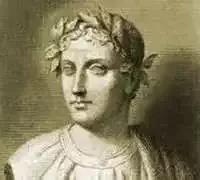
Horácio
BkI:XXXII To the Lyre
I’m called on. O Lyre, if I’ve ever played
idle things with you in the shade, that will live,
for a year or more, come and utter a song
now, of Italy:
you were first tuned by Alcaeus of Lesbos,
a man daring in war, yet still, amongst arms,
or after he’d moored his storm-driven boat
on a watery shore,
he sang of the Muses, Bacchus, and Venus
that boy of hers, Cupid, that hangs around her,
and that beautiful Lycus, with his dark eyes
and lovely dark hair.
O tortoiseshell, Phoebus’s glory, welcome
at the feasts of Jupiter, the almighty,
O sweet comfort and balm of our troubles, heal,
if I call you true!
289
Jonathan Swift
On A Shadow In A Glass
By something form'd, I nothing am,
Yet everything that you can name;
In no place have I ever been,
Yet everywhere I may be seen;
In all things false, yet always true,
I'm still the same—but ever new.
Lifeless, life's perfect form I wear,
Can show a nose, eye, tongue, or ear,
Yet neither smell, see, taste, or hear.
All shapes and features I can boast,
No flesh, no bones, no blood—no ghost:
All colours, without paint, put on,
And change like the cameleon.
Swiftly I come, and enter there,
Where not a chink lets in the air;
Like thought, I'm in a moment gone,
Nor can I ever be alone:
All things on earth I imitate
Faster than nature can create;
Sometimes imperial robes I wear,
Anon in beggar's rags appear;
A giant now, and straight an elf,
I'm every one, but ne'er myself;
Ne'er sad I mourn, ne'er glad rejoice,
I move my lips, but want a voice;
I ne'er was born, nor e'er can die,
Then, pr'ythee, tell me what am I?
Most things by me do rise and fall,
And, as I please, they're great and small;
Invading foes without resistance,
With ease I make to keep their distance:
Again, as I'm disposed, the foe
Will come, though not a foot they go.
Both mountains, woods, and hills, and rocks
And gamesome goats, and fleecy flocks,
And lowing herds, and piping swains,
Come dancing to me o'er the plains.
The greatest whale that swims the sea
Does instantly my power obey.
In vain from me the sailor flies,
The quickest ship I can surprise,
And turn it as I have a mind,
And move it against tide and wind.
Nay, bring me here the tallest man,
I'll squeeze him to a little span;
Or bring a tender child, and pliant,
You'll see me stretch him to a giant:
Nor shall they in the least complain,
Because my magic gives no pain.
286

Robert W. Service
A Verseman's Apology
Alas! I am only a rhymer,
I don't know the meaning of Art;
But I learned in my little school primer
To love Eugene Field and Bret Harte.
I hailed Hoosier Ryley with pleasure,
To John Hay I took off my hat;
These fellows were right to my measure,
And I've never gone higher than that.
The Classics! Well, most of them bore me,
The Moderns I don't understand;
But I keep Burns, my kinsman before me,
And Kipling, my friend, is at hand.
They taught me my trade as I know it,
Yet though at their feet I have sat,
For God-sake don't call me a poet,
For I've never been guilty of that.
A rhyme-rustler, rugged and shameless,
A Bab Balladeer on the loose;
Of saccarine sonnets I'm blameless,
My model has been - Mother Goose.
And I fancy my grave-digger griping
As he gives my last lodging a pat:
"This guy wrote McGrew;
'Twas the best he could do" . . .
So I'll go to my maker with that.
285
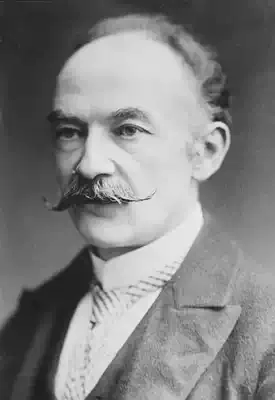
Thomas Hardy
Shelley's Skylark.
Somewhere afield here something lies
In Earth's oblivious eyeless trust
That moved a poet to prophecies -
A pinch of unseen, unguarded dust
The dust of the lark that Shelley heard,
And made immortal through times to be; -
Though it only lived like another bird,
And knew not its immortality.
Lived its meek life; then, one day, fell -
A little ball of feather and bone;
And how it perished, when piped farewell,
And where it wastes, are alike unknown.
Maybe it rests in the loam I view,
Maybe it throbs in a myrtle's green,
Maybe it sleeps in the coming hue
Of a grape on the slopes of yon inland scene.
Go find it, faeries, go and find
That tiny pinch of priceless dust,
And bring a casket silver-lined,
And framed of gold that gems encrust;
And we will lay it safe therein,
And consecrate it to endless time;
For it inspired a bard to win
Ecstatic heights in thought and rhyme.
284
Thomas Hardy
Cardinal Bembo's Epitaph on Raphael
Here's one in whom Nature feared--faint at such vying -
Eclipse while he lived, and decease at his dying.
Eclipse while he lived, and decease at his dying.
284
Henry Wadsworth Longfellow
Oliver Basselin. (Birds Of Passage. Flight The First)
In the Valley of the Vire
Still is seen an ancient mill,
With its gables quaint and queer,
And beneath the window-sill,
On the stone,
These words alone:
'Oliver Basselin lived here.'
Far above it, on the steep,
Ruined stands the old Chateau;
Nothing but the donjon-keep
Left for shelter or for show.
Its vacant eyes
Stare at the skies,
Stare at the valley green and deep.
Once a convent, old and brown,
Looked, but ah! it looks no more,
From the neighboring hillside down
On the rushing and the roar
Of the stream
Whose sunny gleam
Cheers the little Norman town.
In that darksome mill of stone,
To the water's dash and din,
Careless, humble, and unknown,
Sang the poet Basselin
Songs that fill
That ancient mill
With a splendor of its own.
Never feeling of unrest
Broke the pleasant dream he dreamed;
Only made to be his nest,
All the lovely valley seemed;
No desire
Of soaring higher
Stirred or fluttered in his breast.
True, his songs were not divine;
Were not songs of that high art,
Which, as winds do in the pine,
Find an answer in each heart;
But the mirth
Of this green earth
Laughed and revelled in his line.
From the alehouse and the inn,
Opening on the narrow street,
Came the loud, convivial din,
Singing and applause of feet,
The laughing lays
That in those days
Sang the poet Basselin.
In the castle, cased in steel,
Knights, who fought at Agincourt,
Watched and waited, spur on heel;
But the poet sang for sport
Songs that rang
Another clang,
Songs that lowlier hearts could feel.
In the convent, clad in gray,
Sat the monks in lonely cells,
Paced the cloisters, knelt to pray,
And the poet heard their bells;
But his rhymes
Found other chimes,
Nearer to the earth than they.
Gone are all the barons bold,
Gone are all the knights and squires,
Gone the abbot stern and cold,
And the brotherhood of friars;
Not a name
Remains to fame,
From those mouldering days of old!
But the poet's memory here
Of the landscape makes a part;
Like the river, swift and clear,
Flows his song through many a heart;
Haunting still
That ancient mill,
In the Valley of the Vire.
283
Robert W. Service
Old Trouper
I was Mojeska's leading man
And famous parts I used to play,
But now I do the best I can
To earn my bread from day to day;
Here in this Burg of Breaking Hears,
Where one wins as a thousand fail,
I play a score of scurvy parts
Till Time writes Finis to my tale.
My wife is dead, my daughter wed,
With heaps of trouble of their own;
And though I hold aloft my head
I'm humble, scared and all alone . . .
To-night I burn each photograph,
Each record of my former fame,
And oh, how bitterly I laugh
And feed them to the hungry flame!
Behold how handsome I was then -
What glowing eye, what noble mien;
I towered above my fellow men,
And proudly strode the painted scene.
Ah, Vanity! What fools are we,
With empty ends and foolish aims . . .
There now, I fling with savage glee
My David Garrick to the flames.
"Is this a dagger that I see":
Oh, how I used to love that speech;
We were old-fashioned - "hams" maybe,
Yet we Young Arrogance could teach.
"Out, out brief candle!" There are gone
My Lear, my Hamlet and MacBeth;
And now by ashes cold and wan
I wait my cue, my prompter Death.
This life of ours is just a play;
Its end is fashioned from the start;
Fate writes each word we have to say,
And puppet-like we strut our part.
Once I wore laurels on my brow,
But now I wait, a sorry clown,
To make my furtive, farewell bow . . .
Haste Time! Oh, ring the Curtain down.
282
Robert W. Service
Amateur Poet
You see that sheaf of slender books
Upon the topmost shelf,
At which no browser ever looks,
Because they're by . . . myself;
They're neatly bound in navy blue,
But no one ever heeds;
Their print is clear and candid too,
Yet no one ever reads.
Poor wistful books! How much they cost
To me in time and gold!
I count them now as labour lost,
For none I ever sold;
No copy could I give away,
For all my friends would shrink,
And look at me as if to say:
"What waste of printer's ink!"
And as I gaze at them on high,
Although my eyes are sad,
I cannot help but breathe a sigh
To think what joy I had -
What ecstasy as I would seek
To make my rhyme come right,
And find at last the phrase unique
Flash fulgent in my sight.
Maybe that rapture was my gain
Far more than cheap success;
So I'll forget my striving vain,
And blot out bitterness.
Oh records of my radiant youth,
No broken heart I'll rue,
For all my best of love and truth
Is there, alive in you.
281

James Whitcomb Riley
A Discouraging Model
Just the airiest, fairiest slip of a thing,
With a Gainsborough hat, like a butterfly's wing,
Tilted up at one side with the jauntiest air,
And a knot of red roses sown in under there
Where the shadows are lost in her hair.
Then a cameo face, carven in on a ground
Of that shadowy hair where the roses are wound;
And the gleam of a smile, O as fair and as faint
And as sweet as the master of old used to paint
Round the lips of their favorite saint!
And that lace at her throat-- and fluttering hands
Snowing there, with a grace that no art understands,
The flakes of their touches-- first fluttering at
The bow-- then the roses-- the hair and then that
Little tilt of the Gainsborough hat.
Ah, what artist on earth with a model like this,
Holding not on his palette the tint of a kiss,
Nor a pigment to hint of the hue of her hair
Nor the gold of her smile-- O what artist could dare
To expect a result half so fair?
281
Emily Dickinson
I've heard an Organ talk, sometimes
I've heard an Organ talk, sometimes
In a Cathedral Aisle,
And understood no word it said-
Yet held my breath, the while-
And risen up-and gone away,
A more Berdardine GirlYet-
know not what was done to me
In that old Chapel Aisle.
In a Cathedral Aisle,
And understood no word it said-
Yet held my breath, the while-
And risen up-and gone away,
A more Berdardine GirlYet-
know not what was done to me
In that old Chapel Aisle.
278

William Butler Yeats
To be Carved On A Stone At Thoor Ballylee
I, THE poet William Yeats,
With old mill boards and sea-green slates,
And smithy work from the Gort forge,
Restored this tower for my wife George;
And may these characters remain
When all is ruin once again.
With old mill boards and sea-green slates,
And smithy work from the Gort forge,
Restored this tower for my wife George;
And may these characters remain
When all is ruin once again.
278
Henry Wadsworth Longfellow
The Old Bridge At Florence
Taddeo Gaddi built me. I am old,
Five centuries old. I plant my foot of stone
Upon the Arno, as St. Michael's own
Was planted on the dragon. Fold by fold
Beneath me as it struggles. I behold
Its glistening scales. Twice hath it overthrown
My kindred and companions. Me alone
It moveth not, but is by me controlled.
I can remember when the Medici
Were driven from Florence; longer still ago
The final wars of Ghibelline and Guelf.
Florence adorns me with her jewelry;
And when I think that Michael Angelo
Hath leaned on me, I glory in myself.
277

Henry Lawson
When His Heart Is Growing Bitter
When his heart is growing bitter and his hair is growing grey,
And he hears the debt-collector knocking several times a day,
And the shrill voice of the Missus, blame, reiterate, accuse—
Then the poet who was famous feels inclined to damn the muse— .....
When he hears a sudden rapping—rapping at his chamber door,
Then he knows it's no good trying to write poems any more,
Then he bursts from out his chamber and he grabs his battered hat,
And he cadges Two Bob somewhere and gets beered up on his pat.
276
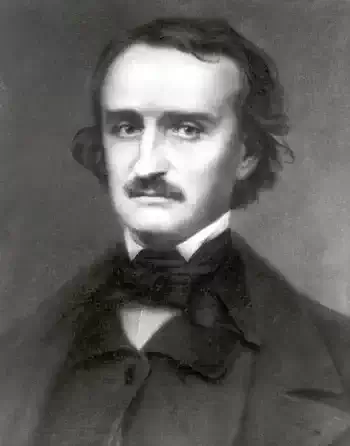
Edgar Allan Poe
An Enigma
"Seldom we find," says Solomon Don Dunce,
"Half an idea in the profoundest sonnet.
Through all the flimsy things we see at once
As easily as through a Naples bonnet
Trash
of all trash!- how can a lady don it?
Yet heavier far than your Petrarchan stuff
Owl-
downy nonsense that the faintest puff
Twirls into trunk-paper the while you con it."
And, veritably, Sol is right enough.
The general tuckermanities are arrant
Bubbles- ephemeral and so transparent
But this is, now- you may depend upon it
Stable,
opaque, immortal- all by dint
Of the dear names that he concealed within 't.
274
Horácio
BkIV:II Augustus’s Return
Iulus, whoever tries to rival Pindar,
flies on waxen wings, with Daedalean art,
and is doomed, like Icarus, to give a name
to glassy waters.
Like a river, rushing down from the mountains,
that the rain has filled above its usual banks,
so Pindar’s deep voice seethes, immeasurably,
and goes on flowing,
Pindar, deserving Apollo’s laurel crown,
whether he coins new phrases in audacious
dithyrambs, and is carried along in verse
that’s free of rules,
or whether he sings gods, and kings, the children
of gods, at whose hands the Centaurs, rightly, died,
and by whom the fearful Chimaera’s fires
were all extinguished,
or speaks of those godlike ones an Elean
palm, for boxing or riding, leads home again,
granting a tribute much more powerful than
a hundred statues,
or weeps for the young man snatched from his tearful
bride, praises his powers, to the stars, his spirit,
his golden virtue, begrudging all of them
to gloomy Orcus.
Son of Antony, a powerful breeze raises
the Dircean swan, whenever it’s carried
to cloudy heights. While I create my verses,
in the manner
of a humble Matinian bee, that goes
gathering pollen from all the pleasant thyme,
and labours among the many groves, on the banks
of flowing Tiber.
You, a poet of much greater power, will sing
Caesar, honoured with well-earned wreaths, as he climbs
the sacred slopes, drawing along in his wake
the savage Germans:
he, whom no greater and no better ruler
has Fate, and the true gods, given to the world,
nor ever will, though the centuries roll back
to that first age of gold.
You’ll sing of those happy days, and the City’s
public games, when our brave Augustus returns,
in answer to our prayers: you’ll sing the Forum
free of all quarrels.
Then, if what I utter’s worth hearing, the best
strains of my voice, thrilled by Caesar’s return,
will rise, and I will sing: ‘O lovely sun, O
worthy to be praised!’
While you lead us along: ‘Hail, God of Triumph!’
not once but many times: ‘Hail, God of Triumph!’
all the city will shout, and offer incense
to the kindly gods.
Ten bulls will acquit you, and as many cows:
me, a tender calf that has left its mother,
one that’s been fattened on wide pastures, one that
can fulfil my vow,
echoing, with its brow, those returning fires
of the crescent moon, at the third night’s rising,
appearing snow-white where it carries a mark,
and the rest tawny.
272

Muhammad Iqbal
Mirza Ghalib
Through you the secret was revealed to the human intellect
That innumerable enigmas are solved by human intellect
You were the complete soul, literary assembly was your body
You adorned as well as remained veiled from the assembly
Your eye is longing to witness that veiled Beauty
Which is veiled in everything as the pathos of life
The assemblage of existence is rich with your harp
As mountain's silence by the brook's melodious harp
The garden of your imagination bestows glory on the universe
From the field of your thought worlds grow like meadows
Life is concealed in the humor of your verse
Picture's lips move with your command of language
Speech is very proud of the elegance of your miraculous lips
Thurayyah is astonished at your style's elegance
Beloved of literature itself loves your style
Delhi's bud is mocking at the rose of Shiraz
Ah! You are resting in the midst of Delhi's ruins
Your counterpart is resting in the Weimar's garden
Matching you in literary elegance is not possible
Till maturity of thought and imagination are combined
Ah! What has befallen the land of India!
Ah! The inspirer of the super-critical eye!
The lock of Urdu's hair still craves for combing
This candle still craves for moth's heart-felt pathos
O Jahanabad! O cradle of learning and art
Your entire super-structure is a silent lament
The sun and the moon are asleep in every speck of your dust
Though innumerable other gems are also hidden in your dust
Does another world-famous person like him also lie buried in you?
Does another gem like him also lie concealed in you?
268
James Whitcomb Riley
A Wrangdillion
Dexery-tethery! down in the dike,
Under the ooze and the slime,
Nestles the wraith of a reticent Gryke,
Blubbering bubbles of rhyme:
Though the reeds touch him and tickle his teeth--
Though the Graigroll and the Cheest
Pluck at the leaves of his laureate-wreath,
Nothing affects him the least.
He sinks to the dregs in the dead o' the night,
And he shuffles the shadows about
As he gathers the stars in a nest of delight
And sets there and hatches them out:
The Zhederrill peers from his watery mine
In scorn with the Will-o'-the-wisp,
As he twinkles his eyes in a whisper of shine
That ends in a luminous lisp.
The Morning is born like a baby of gold,
And it lies in a spasm of pink,
And rallies the Cheest for the horrible cold
He has dragged to the willowy brink,
The Gryke blots his tears with a scrap of his grief,
And growls at the wary Graigroll
As he twunkers a tune on a Tiljicum leaf
And hums like a telegraph pole.
268