
Friendship

Emily Dickinson
I should not dare to leave my friend
I should not dare to leave my friend,
Because-because if he should die
While I was gone-and I-too late-
Should reach the Heart that wanted me-
If I should disappoint the eyes
That hunted-hunted so-to see-
And could not bear to shut until
They "noticed" me-they noticed me-
If I should stab the patient faith
So sure I'd come-so sure I'd come-
It listening-listening-went to sleep-
Telling my tardy name-
My Heart would wish it broke before-
Since breaking then-since breaking then-
Were useless as next morning's sun-
Where midnight frosts-had lain!
303
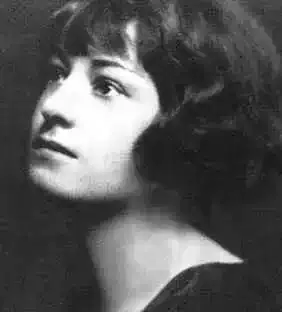
Dorothy Parker
They Part
And if, my friend, you'd have it end,
There's naught to hear or tell.
But need you try to black my eye
In wishing me farewell.
Though I admit an edged wit
In woe is warranted,
May I be frank? . . . Such words as "-"
Are better left unsaid.
There's rosemary for you and me;
But is it usual, dear,
To hire a man, and fill a van
By way of souvenir?
301

John Greenleaf Whittier
The Tent On The Beach
I would not sin, in this half-playful strain,-Too
light perhaps for serious years, though born
Of the enforced leisure of slow pain,-Against
the pure ideal which has drawn
My feet to follow its far-shining gleam.
A simple plot is mine: legends and runes
Of credulous days, old fancies that have lain
Silent, from boyhood taking voice again,
Warmed into life once more, even as the tunes
That, frozen in the fabled hunting-horn,
Thawed into sound:--a winter fireside dream
Of dawns and-sunsets by the summer sea,
Whose sands are traversed by a silent throng
Of voyagers from that vaster mystery
Of which it is an emblem;--and the dear
Memory of one who might have tuned my song
To sweeter music by her delicate ear.
When heats as of a tropic clime
Burned all our inland valleys through,
Three friends, the guests of summer time,
Pitched their white tent where sea-winds blew.
Behind them, marshes, seamed and crossed
With narrow creeks, and flower-embossed,
Stretched to the dark oak wood, whose leafy arms
Screened from the stormy East the pleasant inland farms.
At full of tide their bolder shore
Of sun-bleached sand the waters beat;
At ebb, a smooth and glistening floor
They touched with light, receding feet.
Northward a 'green bluff broke the chain
Of sand-hills; southward stretched a plain
Of salt grass, with a river winding down,
Sail-whitened, and beyond the steeples of the town,
Whence sometimes, when the wind was light
And dull the thunder of the beach,
They heard the bells of morn and night
Swing, miles away, their silver speech.
Above low scarp and turf-grown wall
They saw the fort-flag rise and fall;
And, the first star to signal twilight's hour,
The lamp-fire glimmer down from the tall light-house tower.
They rested there, escaped awhile
From cares that wear the life away,
To eat the lotus of the Nile
And drink the poppies of Cathay,-To
fling their loads of custom down,
Like drift-weed, on the sand-slopes brown,
And in the sea waves drown the restless pack
Of duties, claims, and needs that barked upon their track.
One, with his beard scarce silvered, bore
A ready credence in his looks,
A lettered magnate, lording o'er
An ever-widening realm of books.
In him brain-currents, near and far,
Converged as in a Leyden jar;
The old, dead authors thronged him round about,
And Elzevir's gray ghosts from leathern graves looked out.
He knew each living pundit well,
Could weigh the gifts of him or her,
And well the market value tell
Of poet and philosopher.
But if he lost, the scenes behind,
Somewhat of reverence vague and blind,
Finding the actors human at the best,
No readier lips than his the good he saw confessed.
His boyhood fancies not outgrown,
He loved himself the singer's art;
Tenderly, gently, by his own
He knew and judged an author's heart.
No Rhadamanthine brow of doom
Bowed the dazed pedant from his room;
And bards, whose name is legion, if denied,
Bore off alike intact their verses and their pride.
Pleasant it was to roam about
The lettered world as he had, done,
And see the lords of song without
Their singing robes and garlands on.
With Wordsworth paddle Rydal mere,
Taste rugged Elliott's home-brewed beer,
And with the ears of Rogers, at fourscore,
Hear Garrick's buskined tread and Walpole's wit once more.
And one there was, a dreamer born,
Who, with a mission to fulfil,
Had left the Muses' haunts to turn
The crank of an opinion-mill,
Making his rustic reed of song
A weapon in the war with wrong,
Yoking his fancy to the breaking-plough
That beam-deep turned the soil for truth to spring and grow.
Too quiet seemed the man to ride
The winged Hippogriff Reform;
Was his a voice from side to side
To pierce the tumult of the storm?
A silent, shy, peace-loving man,
He seemed no fiery partisan
To hold his way against the public frown,
The ban of Church and State, the fierce mob's hounding down.
For while he wrought with strenuous will
The work his hands had found to do,
He heard the fitful music still
Of winds that out of dream-land blew.
The din about him could not drown
What the strange voices whispered down;
Along his task-field weird processions swept,
The visionary pomp of stately phantoms stepped:
The common air was thick with dreams,-He
told them to the toiling crowd;
Such music as the woods and streams
Sang in his ear he sang aloud;
In still, shut bays, on windy capes,
He heard the call of beckoning shapes,
And, as the gray old shadows prompted him,
To homely moulds of rhyme he shaped their legends grim.
He rested now his weary hands,
And lightly moralized and laughed,
As, tracing on the shifting sands
A burlesque of his paper-craft,
He saw the careless waves o'errun
His words, as time before had done,
Each day's tide-water washing clean away,
Like letters from the sand, the work of yesterday.
And one, whose Arab face was tanned
By tropic sun and boreal frost,
So travelled there was scarce a land
Or people left him to exhaust,
In idling mood had from him hurled
The poor squeezed orange of the world,
And in the tent-shade, as beneath a palm,
Smoked, cross-legged like a Turk, in Oriental calm.
The very waves that washed the sand
Below him, he had seen before
Whitening the Scandinavian strand
And sultry Mauritanian shore.
From ice-rimmed isles, from summer seas
Palm-fringed, they bore him messages;
He heard the plaintive Nubian songs again,
And mule-bells tinkling down the mountain-paths of Spain.
His memory round the ransacked earth
On Puck's long girdle slid at ease;
And, instant, to the valley's girth
Of mountains, spice isles of the seas,
Faith flowered in minster stones, Art's guess
At truth and beauty, found access;
Yet loved the while, that free cosmopolite,
Old friends, old ways, and kept his boyhood's dreams in sight.
Untouched as yet by wealth and pride,
That virgin innocence of beach
No shingly monster, hundred-eyed,
Stared its gray sand-birds out of reach;
Unhoused, save where, at intervals,
The white tents showed their canvas walls,
Where brief sojourners, in the cool, soft air,
Forgot their inland heats, hard toil, and year-long care.
Sometimes along the wheel-deep sand
A one-horse wagon slowly crawled,
Deep laden with a youthful band,
Whose look some homestead old recalled;
Brother perchance, and sisters twain,
And one whose blue eyes told, more plain
Than the free language of her rosy lip,
Of the still dearer claim of love's relationship.
With cheeks of russet-orchard tint,
The light laugh of their native rills,
The perfume of their garden's mint,
The breezy freedom of the hills,
They bore, in unrestrained delight,
The motto of the Garter's knight,
Careless as if from every gazing thing
Hid by their innocence, as Gyges by his ring.
The clanging sea-fowl came and went,
The hunter's gun in the marshes rang;
At nightfall from a neighboring tent
A flute-voiced woman sweetly sang.
Loose-haired, barefooted, hand-in-hand,
Young girls went tripping down the sand;
And youths and maidens, sitting in the moon,
Dreamed o'er the old fond dream from which we wake too soon.
At times their fishing-lines they plied,
With an old Triton at the oar,
Salt as the sea-wind, tough and dried
As a lean cusk from Labrador.
Strange tales he told of wreck and storm,-Had
seen the sea-snake's awful form,
And heard the ghosts on Haley's Isle complain,
Speak him off shore, and beg a passage to old Spain!
And there, on breezy morns, they saw
The fishing-schooners outward run,
Their low-bent sails in tack and flaw
Turned white or dark to shade and sun.
Sometimes, in calms of closing day,
They watched the spectral mirage play,
Saw low, far islands looming tall and nigh,
And ships, with upturned keels, sail like a sea the sky.
Sometimes a cloud, with thunder black,
Stooped low upon the darkening main,
Piercing the waves along its track
With the slant javelins of rain.
And when west-wind and sunshine warm
Chased out to sea its wrecks of storm,
They saw the prismy hues in thin spray showers
Where the green buds of waves burst into white froth flowers.
And when along the line of shore
The mists crept upward chill and damp,
Stretched, careless, on their sandy floor
Beneath the flaring lantern lamp,
They talked of all things old and new,
Read, slept, and dreamed as idlers do;
And in the unquestioned freedom of the tent,
Body and o'er-taxed mind to healthful ease unbent.
Once, when the sunset splendors died,
And, trampling up the sloping sand,
In lines outreaching far and wide,
The white-waned billows swept to land,
Dim seen across the gathering shade,
A vast and ghostly cavalcade,
They sat around their lighted kerosene,
Hearing the deep bass roar their every pause between.
Then, urged thereto, the Editor
Within his full portfolio dipped,
Feigning excuse while seaching for
(With secret pride) his manuscript.
His pale face flushed from eye to beard,
With nervous cough his throat he cleared,
And, in a voice so tremulous it betrayed
The anxious fondness of an author's heart, he read:
302

Anonymous
Dominus Illuminatio Mea
IN the hour of death, after this life's whim,
When the heart beats low, and the eyes grow dim,
And pain has exhausted every limb--
The lover of the Lord shall trust in Him.
When the will has forgotten the lifelong aim,
And the mind can only disgrace its fame,
And a man is uncertain of his own name--
The power of the Lord shall fill this frame.
When the last sigh is heaved, and the last tear shed,
And the coffin is waiting beside the bed,
And the widow and child forsake the dead--
The angel of the Lord shall lift this head.
For even the purest delight may pall,
And power must fail, and the pride must fall,
And the love of the dearest friends grow small--
But the glory of the Lord is all in all.
301
John Greenleaf Whittier
R. S. S., At Deer Island On The Merrimac
Make, for he loved thee well, our Merrimac,
From wave and shore a low and long lament
For him, whose last look sought thee, as he went
The unknown way from which no step comes back.
And ye, O ancient pine-trees, at whose feet
He watched in life the sunset's reddening glow,
Let the soft south wind through your needles blow
A fitting requiem tenderly and sweet!
No fonder lover of all lovely things
Shall walk where once he walked, no smile more glad
Greet friends than his who friends in all men had,
Whose pleasant memory, to that Island clings,
Where a dear mourner in the home he left
Of love's sweet solace cannot be bereft.
301

Henry Wadsworth Longfellow
Tales Of A Wayside Inn : Part 3. Finale
These are the tales those merry guests
Told to each other, well or ill;
Like summer birds that lift their crests
Above the borders of their nests
And twitter, and again are still.
These are the tales, or new or old,
In idle moments idly told;
Flowers of the field with petals thin,
Lilies that neither toil nor spin,
And tufts of wayside weeds and gorse
Hung in the parlor of the inn
Beneath the sign of the Red Horse.
And still, reluctant to retire,
The friends sat talking by the fire
And watched the smouldering embers burn
To ashes, and flash up again
Into a momentary glow,
Lingering like them when forced to go,
And going when they would remain;
For on the morrow they must turn
Their faces homeward, and the pain
Of parting touched with its unrest
A tender nerve in every breast.
But sleep at last the victory won;
They must be stirring with the sun,
And drowsily good night they said,
And went still gossiping to bed,
And left the parlor wrapped in gloom,
The only live thing in the room
Was the old clock, that in its pace
Kept time with the revolving spheres
And constellations in their flight,
And struck with its uplifted mace
The dark, unconscious hours of night,
To senseless and unlistening ears.
Uprose the sun; and every guest,
Uprisen, was soon equipped and dressed
For journeying home and city-ward;
The old stage-coach was at the door,
With horses harnessed, long before
The sunshine reached the withered sward
Beneath the oaks, whose branches hoar
Murmured: ?Farewell forevermore.?
?Farewell!? the portly Landlord cried;
?Farewell!? the parting guests replied,
But little thought that nevermore
Their feet would pass that thershold o?er;
That nevermore together there
Would they assemble, free from care,
To hear the oaks? mysterious roar,
And breathe the wholesome country air.
Where are they now? What lands and skies
Paint pictures in their friendly eyes?
What hope deludes, what promise cheers,
What pleasant voices fill their ears?
Two are beyond the salt sea waves,
And three already in their graves.
Perchance the living still may look
Into the pages of this book,
And see the days of long ago
Floating and fleeting to and fro,
As in the well-remembered brook
They saw the inverted landscape gleam,
And their own faces like a dream
Look up upon them from below.
303
John Greenleaf Whittier
Daniel Neall
I.
FRIENDof the Slave, and yet the friend of all;
Lover of peace, yet ever foremost when
The need of battling Freedom called for men
To plant the banner on the outer wall;
Gentle and kindly, ever at distress
Melted to more than woman's tenderness,
Yet firm and steadfast, at his duty's post
Fronting the violence of a maddened host,
Like some-gray rock from which the waves are tossed!
Knowing his deeds of love, men questioned not
The faith of one whose walk and word were right;
Who tranquilly in Life's great task-field wrought,
And, side by side with evil, scarcely caught
A stain upon his pilgrim garb of white:
Prompt to redress another's wrong, his own
Leaving to Time and Truth and Penitence alone.
II.
Such was our friend. Formed on the good old plan,
A true and brave and downright honest man!
He blew no trumpet in the market-place,
Nor in the church with hypocritic face
Supplied with cant the lack of Christian grace;
Loathing pretence, he did with cheerful will
What others talked of while their hands were still;
And, while 'Lord, Lord!' the pious tyrants cried,
Who, in the poor, their Master crucified,
His daily prayer, far better understood.
In acts than words, was simply doing good.
So calm, so constant was his rectitude,
That by his loss alone we know its worth,
And feel how true a man has walked with us on earth.
301

Robert Louis Stevenson
To Mesdames Zassetsky And Garschine
THE wind may blaw the lee-gang way
And aye the lift be mirk an' gray,
An deep the moss and steigh the brae
Where a' maun gang -
There's still an hoor in ilka day
For luve and sang.
And canty hearts are strangely steeled.
By some dikeside they'll find a bield,
Some couthy neuk by muir or field
They're sure to hit,
Where, frae the blatherin' wind concealed,
They'll rest a bit.
An' weel for them if kindly fate
Send ower the hills to them a mate;
They'll crack a while o' kirk an' State,
O' yowes an' rain:
An' when it's time to take the gate,
Tak' ilk his ain.
- Sic neuk beside the southern sea
I soucht - sic place o' quiet lee
Frae a' the winds o' life. To me,
Fate, rarely fair,
Had set a freendly company
To meet me there.
Kindly by them they gart me sit,
An' blythe was I to bide a bit.
Licht as o' some hame fireside lit
My life for me.
- Ower early maun I rise an' quit
This happy lee.
301

William Shakespeare
Sonnet 110: Alas, 'tis true I have gone here and there
Alas, 'tis true I have gone here and there
And made myself a motley to the view,
Gored mine own thoughts, sold cheap what is most dear,
Made old offences of affections new;
Most true it is that I have look'd on truth
Askance and strangely: but, by all above,
These blenches gave my heart another youth,
And worse essays proved thee my best of love.
Now all is done, have what shall have no end:
Mine appetite I never more will grind
On newer proof, to try an older friend,
A god in love, to whom I am confined.
Then give me welcome, next my heaven the best,
Even to thy pure and most most loving breast.
301

Henry Lawson
Cameron's Heart
The diggings were just in their glory when Alister Cameron came,
With recommendations, he told me, from friends and a parson `at hame';
He read me his recommendations -- he called them a part of his plant --
The first one was signed by an Elder, the other by Cameron's aunt.
The meenister called him `ungodly -- a stray frae the fauld o' the Lord',
And his aunt set him down as a spendthrift, `a rebel at hame and abroad'.
He got drunk now and then and he gambled (such heroes are often the same);
That's all they could say in connection with Alister Cameron's name.
He was straight and he stuck to his country
and spoke with respect of his kirk;
He did his full share of the cooking, and more than his share of the work.
And many a poor devil then, when his strength and his money were spent,
Was sure of a lecture -- and tucker, and a shakedown in Cameron's tent.
He shunned all the girls in the camp,
and they said he was proof to the dart --
That nothing but whisky and gaming had ever a place in his heart;
He carried a packet about him, well hid, but I saw it at last,
And -- well, 'tis a very old story -- the story of Cameron's past:
A ring and a sprig o' white heather, a letter or two and a curl,
A bit of a worn silver chain, and the portrait of Cameron's girl.
. . . . .
It chanced in the first of the Sixties that Ally and I and McKean
Were sinking a shaft on Mundoorin, near Fosberry's puddle-machine.
The bucket we used was a big one, and rather a weight when 'twas full,
Though Alister wound it up easy, for he had the strength of a bull.
He hinted at heart-disease often, but, setting his fancy apart,
I always believed there was nothing the matter with Cameron's heart.
One day I was working below -- I was filling the bucket with clay,
When Alister cried, `Pack it on, mon! we ought to be bottomed to-day.'
He wound, and the bucket rose steady and swift to the surface until
It reached the first log on the top,
where it suddenly stopped, and hung still.
I knew what was up in a moment when Cameron shouted to me:
`Climb up for your life by the footholes.
I'LL STICK TAE TH' HAUN'LE -- OR DEE!'
And those were the last words he uttered.
He groaned, for I heard him quite plain -There's
nothing so awful as that when it's wrung from a workman in pain.
The strength of despair was upon me; I started, and scarcely drew breath,
But climbed to the top for my life in the fear of a terrible death.
And there, with his waist on the handle, I saw the dead form of my mate,
And over the shaft hung the bucket, suspended by Cameron's weight.
I wonder did Alister think of the scenes in the distance so dim,
When Death at the windlass that morning took cruel advantage of him?
He knew if the bucket rushed down it would murder or cripple his mate --
His hand on the iron was closed with a grip that was stronger than Fate;
He thought of my danger, not his, when he felt in his bosom the smart,
And stuck to the handle in spite of the Finger of Death on his heart.
297

James Whitcomb Riley
A Worn-Out Pencil
Welladay!
Here I lay
You at rest--all worn away,
O my pencil, to the tip
Of our old companionship!
Memory
Sighs to see
What you are, and used to be,
Looking backward to the time
When you wrote your earliest rhyme!--
When I sat
Filing at
Your first point, and dreaming that
Your initial song should be
Worthy of posterity.
With regret
I forget
If the song be living yet,
Yet remember, vaguely now,
It was honest, anyhow.
You have brought
Me a thought--
Truer yet was never taught,--
That the silent song is best,
And the unsung worthiest.
So if I,
When I die,
May as uncomplainingly
Drop aside as now you do,
Write of me, as I of you:--
Here lies one
Who begun
Life a-singing, heard of none;
And he died, satisfied,
With his dead songs by his side.
296
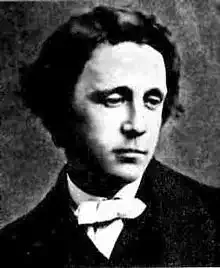
Lewis Carroll
Bessie's Song To Her Doll
Matilda Jane, you never look
At any toy or picturebook.
I show you pretty things in vain
You must be blind, Matilda Jane!
I ask you riddles, tell you tales,
But all our conversation fails.
You never answer me again
I fear you're dumb, Matilda Jane!
Matilda darling, when I call,
You never seem to hear at all.
I shout with all my might and main
But you're so deaf, Matilda Jane!
Matilda Jane, you needn't mind,
For, though you're deaf and dumb and blind,
There's some one loves you, it is plain
And that is me, Matilda Jane!
296
Henry Lawson
To Tom Bracken
O had you tracked where Kendall* trod
I think you would be kneelin’
Three times a week and thankin’ God
That you are of New Zealan’!
For this I’ll say, to make it short,
An’ keep my tongue from clacken—
The people are a kinder sort
You’re singin’ for, Tom Bracken.
I think you would be kneelin’
Three times a week and thankin’ God
That you are of New Zealan’!
For this I’ll say, to make it short,
An’ keep my tongue from clacken—
The people are a kinder sort
You’re singin’ for, Tom Bracken.
298

Robert W. Service
The Sewing-Girl
The humble garret where I dwell
Is in that Quarter called the Latin;
It isn't spacious -- truth to tell,
There's hardly room to swing a cat in.
But what of that! It's there I fight
For food and fame, my Muse inviting,
And all the day and half the night
You'll find me writing, writing, writing.
Now, it was in the month of May
As, wrestling with a rhyme rheumatic,
I chanced to look across the way,
And lo! within a neighbor attic,
A hand drew back the window shade,
And there, a picture glad and glowing,
I saw a sweet and slender maid,
And she was sewing, sewing, sewing.
So poor the room, so small, so scant,
Yet somehow oh, so bright and airy.
There was a pink geranium plant,
Likewise a very pert canary.
And in the maiden's heart it seemed
Some fount of gladness must be springing,
For as alone I sadly dreamed
I heard her singing, singing, singing.
God love her! how it cheered me then
To see her there so brave and pretty;
So she with needle, I with pen,
We slaved and sang above the city.
And as across my streams of ink
I watched her from a poet's distance,
She stitched and sang . . . I scarcely think
She was aware of my existence.
And then one day she sang no more.
That put me out, there's no denying.
I looked -- she labored as before,
But, bless me! she was crying, crying.
Her poor canary chirped in vain;
Her pink geranium drooped in sorrow;
"Of course," said I, "she'll sing again.
Maybe," I sighed, "she will to-morrow."
Poor child; 'twas finished with her song:
Day after day her tears were flowing;
And as I wondered what was wrong
She pined and peaked above her sewing.
And then one day the blind she drew,
Ah! though I sought with vain endeavor
To pierce the darkness, well I knew
My sewing-girl had gone for ever.
And as I sit alone to-night
My eyes unto her room are turning . . .
I'd give the sum of all I write
Once more to see her candle burning,
Once more to glimpse her happy face,
And while my rhymes of cheer I'm ringing,
Across the sunny sweep of space
To hear her singing, singing, singing.
295
John Greenleaf Whittier
Greeting
I spread a scanty board too late;
The old-time guests for whom I wait
Come few and slow, methinks, to-day.
Ah! who could hear my messages
Across the dim unsounded seas
On which so many have sailed away!
Come, then, old friends, who linger yet,
And let us meet, as we have met,
Once more beneath this low sunshine;
And grateful for the good we 've known,
The riddles solved, the ills outgrown,
Shake bands upon the border line.
The favor, asked too oft before,
From your indulgent ears, once more
I crave, and, if belated lays
To slower, feebler measures move,
The silent, sympathy of love
To me is dearer now than praise.
And ye, O younger friends, for whom
My hearth and heart keep open room,
Come smiling through the shadows long,
Be with me while the sun goes down,
And with your cheerful voices drown
The minor of my even-song.
For, equal through the day and night,
The wise Eternal oversight
And love and power and righteous will
Remain: the law of destiny
The best for each and all must be,
And life its promise shall fulfil.
292
Henry Lawson
A Prouder Man Than You
If you fancy that your people came of better stock than mine,
If you hint of higher breeding by a word or by a sign,
If you're proud because of fortune or the clever things you do --
Then I'll play no second fiddle: I'm a prouder man than you!
If you think that your profession has the more gentility,
And that you are condescending to be seen along with me;
If you notice that I'm shabby while your clothes are spruce and new --
You have only got to hint it: I'm a prouder man than you!
If you have a swell companion when you see me on the street,
And you think that I'm too common for your toney friend to meet,
So that I, in passing closely, fail to come within your view --
Then be blind to me for ever: I'm a prouder man than you!
If your character be blameless, if your outward past be clean,
While 'tis known my antecedents are not what they should have been,
Do not risk contamination, save your name whate'er you do -`
Birds o' feather fly together': I'm a prouder bird than you!
Keep your patronage for others! Gold and station cannot hide
Friendship that can laugh at fortune, friendship that can conquer pride!
Offer this as to an equal -- let me see that you are true,
And my wall of pride is shattered: I am not so proud as you!
290

Johann Wolfgang von Goethe
Book Of Love - The Types
LIST, and in memory bear
These six fond loving pair.
Love, when aroused, kept true
Rustan and Rad!
Strangers approach from far
Joseph and Suleika;
Love, void of hope, is in
Ferhad and Schirin.
Born for each other are
Medschnun and Lily;
Loving, though old and grey,
Dschemil saw Boteinah.
Love's sweet caprice anon,
Brown maid and Solomon!
If thou dost mark them well,
Stronger thy love will swell.
290
James Whitcomb Riley
A Song of the Road
O I will walk with you, my lad, whichever way you fare,
You'll have me, too, the side o' you, with heart as light as air;
No care for where the road you take's a-leadin' anywhere,--
It can but be a joyful ja'nt whilst you journey there.
The road you take's the path o' love, an' that's the bridth o' two--
An' I will walk with you, my lad -- O I will walk with you.
Ho! I will walk with you, my lad,
Be weather black or blue
Or roadsides frost or dew, my lad --
O I will walk with you.
Aye, glad, my lad, I'll walk with you, whatever winds may blow,
Or summer blossoms stay our steps, or blinding drifts of snow;
The way thay you set face an' foot 's the way that I will go,
An' brave I'll be, abreast o' ye, the Saints and Angels know!
With loyal hand in loyal hand, an' one heart made o' two,
Through summer's gold, or winter's cold, It's I will walk with you.
Sure, I will walk with you, my lad,
A love ordains me to,--
To Heaven's door, an' through, my lad.
O I will walk with you.
289
James Whitcomb Riley
A Voice From The Farm
It is my dream to have you here with me,
Out of the heated city's dust and din--
Here where the colts have room to gambol in,
And kine to graze, in clover to the knee.
I want to see your wan face happily
Lit with the wholesome smiles that have not been
In use since the old games you used to win
When we pitched horseshoes: And I want to be
At utter loaf with you in this dim land
Of grove and meadow, while the crickets make
Our own talk tedious, and the bat wields
His bulky flight, as we cease converse and
In a dusk like velvet smoothly take
Our way toward home across the dewy fields.
287
John Greenleaf Whittier
Remembrance
WITH COPIES OF THE AUTHOR'S WRITINGS.
Friend of mine! whose lot was cast
With me in the distant past;
Where, like shadows flitting fast,
Fact and fancy, thought and theme,
Word and work, begin to seem
Like a half-remembered dream!
Touched by change have all things been,
Yet I think of thee as when
We had speech of lip and pen.
For the calm thy kindness lent
To a path of discontent,
Rough with trial and dissent;
Gentle words where such were few,
Softening blame where blame was true,
Praising where small praise was due;
For a waking dream made good,
For an ideal understood,
For thy Christian womanhood;
For thy marvellous gift to cull
From our common life and dull
Whatsoe'er is beautiful;
Thoughts and fancies, Hybla's bees
Dropping sweetness; true heart's-ease
Of congenial sympathies;-
Still for these I own my debt;
Memory, with her eyelids wet,
Fain would thank thee even yet!
And as one who scatters flowers
Where the Queen of May's sweet hours
Sits, o'ertwined with blossomed bowers,
In superfluous zeal bestowing
Gifts where gifts are overflowing,
So I pay the debt I'm owing.
To thy full thoughts, gay or sad,
Sunny-hued or sober clad,
Something of my own I add;
Well assured that thou wilt take
Even the offering which I make
Kindly for the giver's sake.
286
Emily Dickinson
We talked as Girls do
We talked as Girls do-
Fond, and late-
We speculated fair, on every subject, but the Grave-
Of ours, none affair-
We handled Destinies, as cool-
As we-Disposers-be-
And God, a Quiet Party
To our Authority-
But fondest, dwelt upon Ourself
As we eventual-be-
When Girls to Women, softly raised
We-occupy-Degree-
We parted with a contract
To cherish, and to write
But Heaven made both, impossible
Before another night.
286
Henry Lawson
Before We Were Married
BLACKSOIL PLAINS were grey soil, grey soil in the drought.
Fifteen years away, and five hundred miles out;
Swag and bag and billy carried all our care
Before we were married, and I wish that I were there.
River banks were grassy—grassy in the bends,
Running through the land where mateship never ends;
We belled the lazy fishing lines and droned the time away
Before we were married, and I wish it were to-day.
Working down the telegraph—winters’ gales and rains
Cross the tumbled scenery of Marlborough “plains”,
Beach and bluff and cook’s tent—and the cook was a “cow”
Before we were married, but I wish that it was now.
The rolling road to Melbourne, and grey-eyed girl in fur—
One arm to a stanchion—and one round her;
Seat abaft the skylight when the moon had set—
Before she was married, and I wish it wasn’t yet.
283
Henry Lawson
The Glass On The Bar
Three bushmen one morning rode up to an inn,
And one of them called for the drinks with a grin;
They'd only returned from a trip to the North,
And, eager to greet them, the landlord came forth.
He absently poured out a glass of Three Star.
And set down that drink with the rest on the bar.
`There, that is for Harry,' he said, `and it's queer,
'Tis the very same glass that he drank from last year;
His name's on the glass, you can read it like print,
He scratched it himself with an old piece of flint;
I remember his drink -- it was always Three Star' --
And the landlord looked out through the door of the bar.
He looked at the horses, and counted but three:
`You were always together -- where's Harry?' cried he.
Oh, sadly they looked at the glass as they said,
`You may put it away, for our old mate is dead;'
But one, gazing out o'er the ridges afar,
Said, `We owe him a shout -- leave the glass on the bar.'
They thought of the far-away grave on the plain,
They thought of the comrade who came not again,
They lifted their glasses, and sadly they said:
`We drink to the name of the mate who is dead.'
And the sunlight streamed in, and a light like a star
Seemed to glow in the depth of the glass on the bar.
And still in that shanty a tumbler is seen,
It stands by the clock, ever polished and clean;
And often the strangers will read as they pass
The name of a bushman engraved on the glass;
And though on the shelf but a dozen there are,
That glass never stands with the rest on the bar.
280
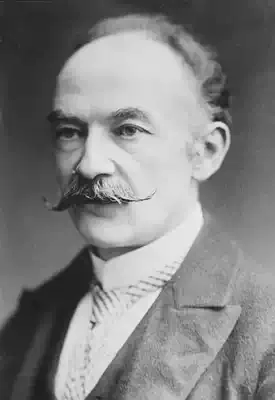
Thomas Hardy
She, To Him
I
WHEN you shall see me lined by tool of Time,
My lauded beauties carried off from me,
My eyes no longer stars as in their prime,
My name forgot of Maiden Fair and Free;
When in your being heart concedes to mind,
And judgment, though you scarce its process know,
Recalls the excellencies I once enshrined,
And you are irked that they have withered so:
Remembering that with me lies not the blame,
That Sportsman Time but rears his brood to kill,
Knowing me in my soul the very same--
One who would die to spare you touch of ill!--
Will you not grant to old affection's claim
The hand of friendship down Life's sunless hill?
280