
Hope and Optimism

Ella Wheeler Wilcox
The Tulip Bed At Greeley Square
You know that oasis, fresh and fair
In the city desert, as Greeley square?
That bright triangle of scented bloom
That lies surrounded by grime and gloom?
Right in the breast of the seething town
Like a gleaming gem or a wanton’s gown?
Ah, wonderful things that tulip bed
Unto my listening soul has said.
Over the rattle and roar of the street
I hear a chorus of voices sweet,
Day and night, when I pass that way,
And these are the things the voices say:
“Here, in the heart of the foolish strife,
We live a simple and natural life.
“Here, in the midst of the clash and din,
We know what it is to be calm within.
“Here, environed by sin and shame,
We do what we can with our pure white flame.
“We do what we can with our bloom and grace,
To make the city a fairer place.
“It is well to be good though the world is vile,
And so through the dust and the smoke we smile,
“We are but atoms in chaos tossed,
Yet never a purpose for truth was lost.”
Ah, many a sermon is uttered there
By the bed of blossoms in Greeley square.
And he who listens and hears aright,
Is better equipped for the world’s hard fight.
332

Emily Dickinson
Heaven-is what I cannot reach!
"Heaven"-is what I cannot reach!
The Apple on the Tree-
Provided it do hopeless-hang
That-"
Heaven" is-to Me!
The Color, on the Cruising Cloud-
The interdicted Land-
Behind the Hill-the House behind
There-
Paradise-is found!
Her teasing Purples-Afternoons-
The credulous-decoy
Enamored-
of the Conjuror-
That spurned us-Yesterday!
The Apple on the Tree-
Provided it do hopeless-hang
That-"
Heaven" is-to Me!
The Color, on the Cruising Cloud-
The interdicted Land-
Behind the Hill-the House behind
There-
Paradise-is found!
Her teasing Purples-Afternoons-
The credulous-decoy
Enamored-
of the Conjuror-
That spurned us-Yesterday!
332
Emily Dickinson
I sing to use the Waiting
I sing to use the Waiting
My Bonnet but to tie
And shut the Door unto my House
No more to do have I
Till His best step approaching
We journey to the Day
And tell each other how We sung
To Keep the Dark away.
My Bonnet but to tie
And shut the Door unto my House
No more to do have I
Till His best step approaching
We journey to the Day
And tell each other how We sung
To Keep the Dark away.
333

James Whitcomb Riley
The Watches Of The Night
O the waiting in the watches of the night!
In the darkness, desolation, and contrition and affright;
The awful hush that holds us shut away from all delight:
The ever weary memory that ever weary goes
Recounting ever over every aching loss it knows--
The ever weary eyelids gasping ever for repose--
In the dreary, weary watches of the night!
Dark--stifling dark--the watches of the night!
With tingling nerves at tension, how the blackness flashes white
With spectral visitations smitten past the inner sight!--
What shuddering sense of wrongs we've wrought
that may not be redressed--
Of tears we did not brush away--of lips we left unpressed,
And hands that we let fall, with all their loyalty unguessed!
Ah! the empty, empty watches of the night!
What solace in the watches of the night?--
What frailest staff of hope to stay--what faintest shaft of light?
Do we _dream_ and dare _believe_ it, that by never weight of right
Of our own poor weak deservings, we shall win the dawn at last--
Our famished souls find freedom from this penance for the past,
In a faith that leaps and lightens from the gloom
that flees aghast--
Shall we survive the watches of the night?
One leads us through the watches of the night--
By the ceaseless intercession of our loved ones lost to sight
He is with us through all trials, in His mercy and His might;--
With our mothers there about Him, all our sorrow disappears,
Till the silence of our sobbing is the prayer the Master hears,
And His hand is laid upon us with the tenderness of tears
In the waning of the watches of the night.
332
James Whitcomb Riley
The Rainy Morning
The dawn of the day was dreary,
And the lowering clouds o'erhead
Wept in a silent sorrow
Where the sweet sunshine lay dead;
And a wind came out of the eastward
Like an endless sigh of pain,
And the leaves fell down in the pathway
And writhed in the falling rain.
I had tried in a brave endeavor
To chord my harp with the sun,
But the strings would slacken ever,
And the task was a weary one:
And so, like a child impatient
And sick of a discontent,
I bowed in a shower of tear-drops
And mourned with the instrument.
And lo! as I bowed, the splendor
Of the sun bent over me,
With a touch as warm and tender
As a father's hand might be:
And, even as I felt its presence,
My clouded soul grew bright,
And the tears, like the rain of morning,
Melted in mists of light.
330
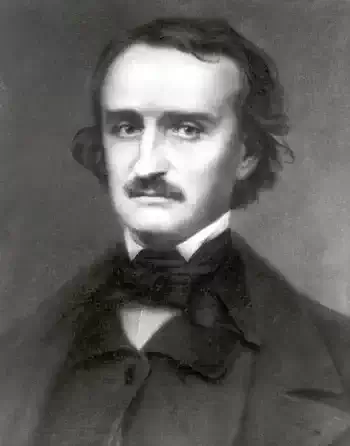
Edgar Allan Poe
For Annie
Thank Heaven! the crisis
The
danger is past,
And the lingering illness
Is over at last
And
the fever called "Living"
Is conquered at last.
Sadly, I know
I am shorn of my strength,
And no muscle I move
As I lie at full length
But
no matter!-I feel
I am better at length.
And I rest so composedly,
Now, in my bed
That any beholder
Might fancy me dead
Might
start at beholding me,
Thinking me dead.
The moaning and groaning,
The sighing and sobbing,
Are quieted now,
With that horrible throbbing
At heart:- ah, that horrible,
Horrible throbbing!
The sickness- the nausea
The
pitiless pain
Have
ceased, with the fever
That maddened my brain
With
the fever called "Living"
That burned in my brain.
And oh! of all tortures
That torture the worst
Has abated- the terrible
Torture of thirst
For the naphthaline river
Of Passion accurst:
I
have drunk of a water
That quenches all thirst:
Of a water that flows,
With a lullaby sound,
From a spring but a very few
Feet under ground
From
a cavern not very far
Down under ground.
And ah! let it never
Be foolishly said
That my room it is gloomy
And narrow my bed;
For man never slept
In a different bed
And,
to sleep, you must slumber
In just such a bed.
My tantalized spirit
Here blandly reposes,
Forgetting, or never
Regretting its roses
Its
old agitations
Of myrtles and roses:
For now, while so quietly
Lying, it fancies
A holier odor
About it, of pansies
A
rosemary odor,
Commingled with pansies
With
rue and the beautiful
Puritan pansies.
And so it lies happily,
Bathing in many
A dream of the truth
And the beauty of AnnieDrowned
in a bath
Of the tresses of Annie.
She tenderly kissed me,
She fondly caressed,
And then I fell gently
To sleep on her breast
Deeply
to sleep
From the heaven of her breast.
When the light was extinguished,
She covered me warm,
And she prayed to the angels
To keep me from harm
To
the queen of the angels
To shield me from harm.
And I lie so composedly,
Now, in my bed,
(Knowing her love)
That you fancy me dead
And
I rest so contentedly,
Now, in my bed,
(With her love at my breast)
That you fancy me dead
That
you shudder to look at me,
Thinking me dead.
But my heart it is brighter
Than all of the many
Stars in the sky,
For it sparkles with AnnieIt
glows with the light
Of the love of my AnnieWith
the thought of the light
Of the eyes of my Annie.
The
danger is past,
And the lingering illness
Is over at last
And
the fever called "Living"
Is conquered at last.
Sadly, I know
I am shorn of my strength,
And no muscle I move
As I lie at full length
But
no matter!-I feel
I am better at length.
And I rest so composedly,
Now, in my bed
That any beholder
Might fancy me dead
Might
start at beholding me,
Thinking me dead.
The moaning and groaning,
The sighing and sobbing,
Are quieted now,
With that horrible throbbing
At heart:- ah, that horrible,
Horrible throbbing!
The sickness- the nausea
The
pitiless pain
Have
ceased, with the fever
That maddened my brain
With
the fever called "Living"
That burned in my brain.
And oh! of all tortures
That torture the worst
Has abated- the terrible
Torture of thirst
For the naphthaline river
Of Passion accurst:
I
have drunk of a water
That quenches all thirst:
Of a water that flows,
With a lullaby sound,
From a spring but a very few
Feet under ground
From
a cavern not very far
Down under ground.
And ah! let it never
Be foolishly said
That my room it is gloomy
And narrow my bed;
For man never slept
In a different bed
And,
to sleep, you must slumber
In just such a bed.
My tantalized spirit
Here blandly reposes,
Forgetting, or never
Regretting its roses
Its
old agitations
Of myrtles and roses:
For now, while so quietly
Lying, it fancies
A holier odor
About it, of pansies
A
rosemary odor,
Commingled with pansies
With
rue and the beautiful
Puritan pansies.
And so it lies happily,
Bathing in many
A dream of the truth
And the beauty of AnnieDrowned
in a bath
Of the tresses of Annie.
She tenderly kissed me,
She fondly caressed,
And then I fell gently
To sleep on her breast
Deeply
to sleep
From the heaven of her breast.
When the light was extinguished,
She covered me warm,
And she prayed to the angels
To keep me from harm
To
the queen of the angels
To shield me from harm.
And I lie so composedly,
Now, in my bed,
(Knowing her love)
That you fancy me dead
And
I rest so contentedly,
Now, in my bed,
(With her love at my breast)
That you fancy me dead
That
you shudder to look at me,
Thinking me dead.
But my heart it is brighter
Than all of the many
Stars in the sky,
For it sparkles with AnnieIt
glows with the light
Of the love of my AnnieWith
the thought of the light
Of the eyes of my Annie.
329

John Greenleaf Whittier
Song Of The Negro Boatman
Oh, praise an' tanks! De Lord he come
To set de people free;
An' massa tink it day ob doom,
An' we ob jubilee.
De Lord dat heap de Red Sea waves
He jus' as 'trong as den;
He say de word: we las' night slaves;
To-day, de Lord's freemen.
De yam will grow, de cotton blow,
We'll hab de rice an' corn;
Oh nebber you fear, if nebber you hear
De driver blow his horn!
Ole massa on he trabbels gone;
He leaf de land behind:
De Lord's breff blow him furder on,
Like corn-shuck in de wind.
We own de hoe, we own de plough,
We own de hands dat hold;
We sell de pig, we sell de cow,
But nebber chile be sold.
De yam will grow, de cotton blow,
We'll hab de rice an' corn;
Oh nebber you fear, if nebber you hear
De driver blow his horn!
We pray de Lord: he gib us signs
Dat some clay we be free;
De norf-wind tell it to de pines,
De wild-duck to de sea;
We tink it when de church-bell ring,
We dream it in de dream;
De rice-bird mean it when he sing,
De eagle when he scream.
De yam will grow, de cotton blow,
We'll hab de rice an' corn:
Oh nebber you fear, if nebber you hear
De driver blow his horn!
We know de promise nebber fail,
An' nebber lie de word;
So like de 'postles in de jail,
We waited for de Lord
An' now he open ebery door,
An' trow away de key;
He tink we lub him so before,
We lub him better free.
De yam will grow, de cotton blow,
He'll gib de rice an' corn;
Oh nebber you fear, if nebber you hear
De driver blow his horn!
So sing our dusky gondoliers;
And with a secret pain,
And smiles that seem akin to tears,
We hear the wild refrain.
We dare not share the negro's trust,
Nor yet his hope deny;
We only know that God is just,
And every wrong shall die.
Rude seems the song; each swarthy face,
Flame-lighted, ruder still:
We start to think that hapless race
Must shape our good or ill;
That laws of changeless justice bind
Oppressor with oppressed;
And, close as sin and suffering joined,
We march to Fate abreast.
Sing on, poor hearts! your chant shall be
Our sign of blight or bloom,
The Vala-song of Liberty,
Or death-rune of our doom!
328
John Greenleaf Whittier
The Seeking Of The Waterfall
They left their home of summer ease
Beneath the lowland's sheltering trees,
To seek, by ways unknown to all,
The promise of the waterfall.
Some vague, faint rumor to the vale
Had crept--perchance a hunter's tale-Of
its wild mirth of waters lost
On the dark woods through which it tossed.
Somewhere it laughed and sang; somewhere
Whirled in mad dance its misty hair;
But who had raised its veil, or seen
The rainbow skirts of that Undine?
They sought it where the mountain brook
Its swift way to the valley took;
Along the rugged slope they clomb,
Their guide a thread of sound and foam.
Height after height they slowly won;
The fiery javelins of the sun
Smote the bare ledge; the tangled shade
With rock and vine their steps delayed.
But, through leaf-openings, now and then
They saw the cheerful homes of men,
And the great mountains with their wall
Of misty purple girdling all.
The leaves through which the glad winds blew
Shared. the wild dance the waters knew;
And where the shadows deepest fell
The wood-thrush rang his silver bell.
Fringing the stream, at every turn
Swung low the waving fronds of fern;
From stony cleft and mossy sod
Pale asters sprang, and golden-rod.
And still the water sang the sweet,
Glad song that stirred its gliding feet,
And found in rock and root the keys
Of its beguiling melodies.
Beyond, above, its signals flew
Of tossing foam the birch-trees through;
Now seen, now lost, but baffling still
The weary seekers' slackening will.
Each called to each: 'Lo here! Lo there!
Its white scarf flutters in the air!'
They climbed anew; the vision fled,
To beckon higher overhead.
So toiled they up the mountain-slope
With faint and ever fainter hope;
With faint and fainter voice the brook
Still bade them listen, pause, and look.
Meanwhile below the day was done;
Above the tall peaks saw the sun
Sink, beam-shorn, to its misty set
Behind the hills of violet.
'Here ends our quest!' the seekers cried,
'The brook and rumor both have lied!
The phantom of a waterfall
Has led us at its beck and call.'
But one, with years grown wiser, said
'So, always baffled, not misled,
We follow where before us runs
The vision of the shining ones.
'Not where they seem their signals fly,
Their voices while we listen die;
We cannot keep, however fleet,
The quick time of their winged feet.
'From youth to age unresting stray
These kindly mockers in our way;
Yet lead they not, the baffling elves,
To something better than themselves?
'Here, though unreached the goal we sought,
Its own reward our toil has brought:
The winding water's sounding rush,
The long note of the hermit thrush,
'The turquoise lakes, the glimpse of pond
And river track, and, vast, beyond
Broad meadows belted round with pines,
The grand uplift of mountain lines!
'What matter though we seek with pain
The garden of the gods in vain,
If lured thereby we climb to greet
Some wayside blossom Eden-sweet?
'To seek is better than to gain,
The fond hope dies as we attain;
Life's fairest things are those which seem,
The best is that of which we dream.
'Then let us trust our waterfall
Still flashes down its rocky wall,
With rainbow crescent curved across
Its sunlit spray from moss to moss.
'And we, forgetful of our pain,
In thought shall seek it oft again;
Shall see this aster-blossomed sod,
This sunshine of the golden-rod,
'And haply gain, through parting boughs,
Grand glimpses of great mountain brows
Cloud-turbaned, and the sharp steel sheen
Of lakes deep set in valleys green.
'So failure wins; the consequence
Of loss becomes its recompense;
And evermore the end shall tell
The unreached ideal guided well.
'Our sweet illusions only die
Fulfilling love's sure prophecy;
And every wish for better things
An undreamed beauty nearer brings.
'For fate is servitor of love;
Desire and hope and longing prove
The secret of immortal youth,
And Nature cheats us into truth.
'O kind allurers, wisely sent,
Beguiling with benign intent,
Still move us, through divine unrest,
To seek the loveliest and the best!
'Go with us when our souls go free,
And, in the clear, white light to be,
Add unto Heaven's beatitude
The old delight of seeking good!'
325

Henry Wadsworth Longfellow
Song Of The Silent Land. (From The German Of Salis)
Into the Silent Land!
Ah! who shall lead us thither?
Clouds in the evening sky more darkly gather,
And shattered wrecks lie thicker on the strand.
Who leads us with a gentle hand
Thither, O thither,
Into the Silent Land?
Into the Silent Land!
To you, ye boundless regions
Of all perfection! Tender morning-visions
Of beauteous souls! The Future's pledge and band!
Who in Life's battle firm doth stand,
Shall bear Hope's tender blossoms
Into the Silent Land!
O Land! O Land!
For all the broken-hearted
The mildest herald by our faith allotted,
Beckons, and with inverted torch doth stand
To lead us with a gentle hand
Into the land of the great Departed,
Into the Silent Land!
326
Ella Wheeler Wilcox
Searching
These quiet Autumn days,
My soul, like Noah's dove, on airy wings
Goes out and searches for the hidden things
Beyond the hills of haze.
With mournful, pleading cries,
Above the waters of the voiceless sea
That laps the shore of broad Eternity,
Day after day, it flies,
Searching, but all in vain,
For some stray leaf that it may light upon,
And read the future, as the days agone -
Its pleasures, and its pain.
Listening patiently
For some voice speaking from the mighty deep,
Revealing all the things that it doth keep
In secret there for me.
Come back and wait, my soul!
Day after day thy search has been in vain.
Voiceles and silent o'er the future's plain
Its mystic waters roll.
God, seeing, knoweth best,
And in His time the waters shall subside,
And thou shalt know what lies beneath the tide,
Then wait, my soul, and rest.
323
John Greenleaf Whittier
April
'T is the noon of the spring-time, yet never a bird
In the wind-shaken elm or the maple is heard;
For green meadow-grasses wide levels of snow,
And blowing of drifts where the crocus should blow;
Where wind-flower and violet, amber and white,
On south-sloping brooksides should smile in the light,
O'er the cold winter-beds of their late-waking roots
The frosty flake eddies, the ice-crystal shoots;
And, longing for light, under wind-driven heaps,
Round the boles of the pine-wood the ground-laurel creeps,
Unkissed of the sunshine, unbaptized of showers,
With buds scarcely swelled, which should burst into flowers
We wait for thy coming, sweet wind of the south!
For the touch of thy light wings, the kiss of thy mouth;
For the yearly evangel thou bearest from God,
Resurrection and life to the graves of the sod!
Up our long river-valley, for days, have not ceased
The wail and the shriek of the bitter northeast,
Raw and chill, as if winnowed through ices and snow,
All the way from the land of the wild Esquimau,
Until all our dreams of the land of the blest,
Like that red hunter's, turn to the sunny southwest.
O soul of the spring-time, its light and its breath,
Bring warmth to this coldness, bring life to this death;
Renew the great miracle; let us behold
The stone from the mouth of the sepulchre rolled,
And Nature, like Lazarus, rise, as of old!
Let our faith, which in darkness and coldness has lain,
Revive with the warmth and the brightness again,
And in blooming of flower and budding of tree
The symbols and types of our destiny see;
The life of the spring-time, the life of the whole,
And, as sun to the sleeping earth, love to the soul!
322
John Greenleaf Whittier
The Battle Autumn of 1862
The flags of war like storm birds fly,
The charging trumpets blow;
Yet rolls no thunder in the sky,
No earthquake strives below.
And, calm and patient, Nature keeps
Her ancient promises well,
Though o'er her bloom and greenness sweeps,
The battle's breath of hell.
And still she walks in golden hours,
Through harvest-happy farms,
And still she wears her fruits and flowers
Like jewels on her arms.
What means the gladness of the plain,
This joy of eve and morn,
The mirth that shakes the bread of grain
And yellow locks of corn?
Ah! eyes may well be full of tears,
And hearts with hate are hot;
But even-paced come round the years,
And nature changes not.
She meets with smiles our bitter grief,
With songs our groans of pain;
She mocks with tints of flowers and leaf,
The war-field's crimson stain.
Still, in the cannon's pause, we hear
Her sweet thanksgiving psalm;
Too near to God for doubt or fear,
She shares the eternal calm.
She knows the seed lies safe below
The fires that blast and burn;
For all the tears of blood we sow
She waits the rich return.
She sees with clearer eye than ours
The good of suffering born,
The hearts that blossom like her flowers
And ripen like her corn.
Oh, give to us, in times like these,
The vision of her eyes;
And make her fields and fruited trees
Our golden prophecies.
Oh, give to us her finer ear;
Above this stormy din,
We, too, would hear the bells of cheer
Ring peace and freedom in.
319

William Wordsworth
The Birth of Love
When Love was born of heavenly line,
What dire intrigues disturbed Cythera's joy!
Till Venus cried, "A mother's heart is mine;
None but myself shall nurse my boy,"
But, infant as he was, the child
In that divine embrace enchanted lay;
And, by the beauty of the vase beguiled,
Forgot the beverage--and pined away.
"And must my offspring languish in my sight?"
(Alive to all a mother's pain,
The Queen of Beauty thus her court addressed)
"No: Let the most discreet of all my train
Receive him to her breast:
Think all, he is the God of young delight."
Then TENDERNESS with CANDOUR joined,
And GAIETY the charming office sought;
Nor even DELICACY stayed behind:
But none of those fair Graces brought
Wherewith to nurse the child--and still he pined.
Some fond hearts to COMPLIANCE seemed inclined;
But she had surely spoiled the boy:
And sad experience forbade a thought
On the wild Goddess of VOLUPTUOUS JOY.
Long undecided lay th' important choice,
Till of the beauteous court, at length, a voice
Pronounced the name of HOPE:--The conscious child
Stretched forth his little arms, and smiled.
'Tis said ENJOYMENT (who averred
The charge belonged to her alone)
Jealous that HOPE had been preferred
Laid snares to make the babe her own.
Of INNOCENCE the garb she took,
The blushing mien and downcast look;
And came her services to proffer:
And HOPE (what has not Hope believed!)
By that seducing air deceived,
Accepted of the offer.
It happened that, to sleep inclined,
Deluded HOPE: for one short hour
To that false INNOCENCE'S power
Her little charge consigned.
The Goddess then her lap with sweetmeats filled
And gave, in handfuls gave, the treacherous store:
A wild delirium first the infant thrilled;
But soon upon her breast he sunk--to wake no more.
319
John Greenleaf Whittier
What the Birds Said
The birds against the April wind
Flew northward, singing as they flew;
They sang, "The land we leave behind
Has swords for corn-blades, blood for dew."
"O wild-birds, flying from the South,
What saw and heard ye, gazing down?"
"We saw the mortar's upturned mouth,
The sickened camp, the blazing town!
"Beneath the bivouac's starry lamps,
We saw your march-worn children die;
In shrouds of moss, in cypress swamps,
We saw your dead uncoffined lie.
"We heard the starving prisoner's sighs
And saw, from line and trench, your sons
Follow our flight with home-sick eyes
Beyond the battery's smoking guns."
"And heard and saw ye only wrong
And pain," I cried, "O wing-worn flocks?"
"We heard," they sang, "the freedman's song,
The crash of Slavery's broken locks!
"We saw from new, uprising States
The treason-nursing mischief spurned,
As, crowding Freedom's ample gates,
The long-estranged and lost returned.
"O'er dusky faces, seamed and old,
And hands horn-hard with unpaid toil,
With hope in every rustling fold,
We saw your star-dropt flag uncoil.
"And struggling up through sounds accursed,
A grateful murmur clomb the air;
A whisper scarcely heard at first,
It filled the listening heavens with prayer.
"And sweet and far, as from a star,
Replied a voice which shall not cease,
Till, drowning all the noise of war,
It sings the blessed song of peace!"
So to me, in a doubtful day
Of chill and slowly greening spring,
Low stooping from the cloudy gray,
The wild-birds sang or seemed to sing.
They vanished in the misty air,
The song went with them in their flight;
But lo! they left the sunset fair,
And in the evening there was light.
319
James Whitcomb Riley
We to Sigh Instead of Sing
"Rain and Rain! and rain and rain!"
Yesterday we muttered
Grimly as the grim refrain
That the thunders uttered:
All the heavens under cloud --
All the sunshine sleeping;
All the grasses limply bowed
With their weight of weeping.
Sigh and sigh! and sigh and sigh!
Never end of sighing;
Rain and rain for our reply --
Hopes half-drowned and dying;
Peering through the window-pane,
Naught but endless raining --
Endless sighing, and, as vain,
Endlessly conmplaining.
Shine and shine! and shine and shine!
Ah! to-day the splendor!--
All this glory yours and mine --
God! but God is tender!
We to sigh instead of sing,
Yesterday in sorrow,
While the lord was fashioning
This for our To-morrow!
318
Emily Dickinson
If pain for peace prepares
If pain for peace prepares
Lo, what "Augustan" years
Our feet await!
If springs from winter rise,
Can the Anemones
Be reckoned up?
If night stands fast-then noon
To gird us for the sun,
What gaze!
When from a thousand skies
On our developed eyes
Noons blaze!
Lo, what "Augustan" years
Our feet await!
If springs from winter rise,
Can the Anemones
Be reckoned up?
If night stands fast-then noon
To gird us for the sun,
What gaze!
When from a thousand skies
On our developed eyes
Noons blaze!
319
James Whitcomb Riley
A Brave Refrain
When snow is here, and the trees look weird,
And the knuckled twigs are gloved with frost;
When the breath congeals in the drover's beard,
And the old pathway to the barn is lost;
When the rooster's crow is sad to hear,
And the stamp of the stabled horse is vain,
And the tone of the cow-bell grieves the ear--
O then is the time for a brave refrain!
When the gears hang stiff on the harness-peg,
And the tallow gleams in frozen streaks;
And the old hen stands on a lonesome leg,
And the pump sounds hoarse and the handle squeaks;
When the woodpile lies in a shrouded heap,
And the frost is scratched from the window-pane
And anxious eyes from the inside peep--
O then is the time for a brave refrain!
When the ax-helve warms at the chimney-jamb,
And hob-nailed shoes on the hearth below,
And the house-cat curls in a slumber calm,
And the eight-day clock ticks loud and slow;
When the harsh broom-handle jabs the ceil
'Neath the kitchen-loft, and the drowsy brain
Sniffs the breath of the morning meal--
O then is the time for a brave refrain!
ENVOI
When the skillet seethes, and a blubbering hot
Tilts the lid of the coffee-pot,
And the scent of the buckwheat cake grows plain--
O then is the time for a brave refrain!
316
Ella Wheeler Wilcox
Guerdon
Upon the white cheek of the Cherub Year
I saw a tear.
Alas! I murmured, that the Year should borrow
So soon a sorrow.
Just then the sunlight fell with sudden flame:
A tear became
A wondrous diamond sparkling in the light –
A beautiful sight.
Upon my soul there fell such woeful loss,
I said, ‘The Cross
Is grievous for a life as young as mine.’
Just then, like wine,
God’s sunlight shone from His high Heavens down;
And lo! a crown
Gleamed in the place of what I thought a burden –
My sorrow’s guerdon.
316
Ella Wheeler Wilcox
Does It Pay?
If one poor burdened toiler o’er life’s road,
Who meets us by the way,
Goes on less conscious of his galling load,
Then life, indeed, does pay.
If we can show the troubled heart the gain
That lies always in loss,
Why, then, we too are paid for all the pain
Of bearing life’s hard cross.
If some despondent soul to hope is stirred,
Some sad lip made to smile,
By any act of ours, or any word,
Then, life has been worth while.
315

Anonymous
God Rest You Merry, Gentlemen
God rest you merry, gentlemen,
Let nothing you dismay,
For Jesus Christ our Saviour
Was born upon this day,
To save us all from Satan's power
When we were gone astray.
O tidings of comfort and joy,
For Jesus Christ our Saviour was born on Christmas day.
In Bethlehem in Jury
This blessed babe was born,
And laid within a manger
Upon this blessed morn;
The which his mother Mary
Nothing did take in scorn.
O tidings of comfort and joy,
Jesus Christ our Saviour was born on Christmas day.
From God our Heavenly Father
A blessed Angel came,
And unto certain Shepherds
Brought tidings of the same,
How that in Bethlehem was born
The Son of God by name.
O tidings of comfort and joy,
Jesus Christ our Saviour was born on Christmas day.
Fear not, then said the Angel,
Let nothing you affright,
This day is born a Saviour
Of virtue, power and might;
So frequently to vanquish all
The friends of Satan quite.
O tidings of comfort and joy,
Jesus Christ our Saviour was born on Christmas day.
The Shepherds at those tidings
Rejoiced much in mind,
And left their flocks a feeding
In tempest, storm and wind,
And went to Bethlehem straightway,
This blessed babe to find.
O tidings of comfort and joy,
Jesus Christ our Saviour was born on Christmas day.
But when to Bethlehem they came,
Whereas this infant lay,
They found him in a manger
Where oxen feed on hay,
His mother Mary kneeling
Unto the Lord did pray.
O tidings of comfort and joy,
Jesus Christ our Saviour was born on Christmas day.
Now to the Lord sing praises,
All you within this place,
And with true love and brotherhood
Each other now embrace;
This holy tide of Christmas
All others doth deface.
O tidings of comfort and joy,
Jesus Christ our Saviour was born on Christmas day.
315

Robert Browning
Epilogue
At the midnight in the silence of the sleep-time,
When you set your fancies free,
Will they pass to where--by death, fools think, imprisoned--
Low he lies who once so loved you, whom you loved so,
--Pity me?
Oh to love so, be so loved, yet so mistaken!
What had I on earth to do
With the slothful, with the mawkish, the unmanly?
Like the aimless, helpless, hopeless, did I drivel
--Being--who?
One who never turned his back but marched breast forward,
Never doubted clouds would break,
Never dreamed, though right were worsted, wrong would triumph,
Held we fall to rise, are baffled to fight better,
Sleep to wake.
No, at noonday in the bustle of man's work-time
Greet the unseen with a cheer!
Bid him forward, breast and back as either should be,
"Strive and thrive!" cry "Speed,--fight on, fare ever
There as here!"
317
John Greenleaf Whittier
The Cry Of A Lost Soul
In that black forest, where, when day is done,
With a snake's stillness glides the Amazon
Darkly from sunset to the rising sun,
A cry, as of the pained heart of the wood,
The long, despairing moan of solitude
And darkness and the absence of all good,
Startles the traveller, with a sound so drear,
So full of hopeless agony and fear,
His heart stands still and listens like his ear.
The guide, as if he heard a dead-bell toll,
Starts, drops his oar against the gunwale's thole,
Crosses himself, and whispers, 'A lost soul!'
'No, Senor, not a bird. I know it well,-It
is the pained soul of some infidel
Or cursed heretic that cries from hell.
'Poor fool! with hope still mocking his despair,
He wanders, shrieking on the midnight air
For human pity and for Christian prayer.
'Saints strike him dumb! Our Holy Mother hath
No prayer for him who, sinning unto death,
Burns always in the furnace of God's wrath!'
Thus to the baptized pagan's cruel lie,
Lending new horror to that mournful cry,
The voyager listens, making no reply.
Dim burns the boat-lamp: shadows deepen round,
From giant trees with snake-like creepers wound,
And the black water glides without a sound.
But in the traveller's heart a secret sense
Of nature plastic to benign intents,
And an eternal good in Providence,
Lifts to the starry calm of heaven his eyes;
And to! rebuking all earth's ominous cries,
The Cross of pardon lights the tropic skies!
'Father of all!' he urges his strong plea,
'Thou lovest all: Thy erring child may be
Lost to himself, but never lost to Thee!
'All souls are Thine; the wings of morning bear
None from that Presence which is everywhere,
Nor hell itself can hide, for Thou art there.
'Through sins of sense, perversities of will,
Through doubt and pain, through guilt and shame and ill,
Thy pitying eye is on Thy creature still.
'Wilt thou not make, Eternal Source and Goal!
In Thy long years, life's broken circle whole,
And change to praise the cry of a lost soul?'
313
Emily Dickinson
I felt my life with both my hands
I felt my life with both my hands
To see if it was there-
I held my spirit to the Glass,
To prove it possibler-
I turned my Being round and round
And paused at every pound
To ask the Owner's name-
For doubt, that I should know the Sound-
I judged my features-jarred my hair-
I pushed my dimples by, and waited-
If they-twinkled back-
Conviction might, of me-
I told myself, "Take Courage, FriendThat-
was a former time-
But we might learn to like the Heaven,
As well as our Old Home!"
314
Robert Browning
Life in a Bottle
Escape me?
Never--
Beloved!
While I am I, and you are you,
So long as the world contains us both,
Me the loving and you the loth,
While the one eludes, must the other pursue.
My life is a fault at last, I fear:
It seems too much like a fate, indeed!
Though I do my best I shall scarce succeed.
But what if I fail of my purpose here?
It is but to keep the nerves at strain,
To dry one's eyes and laugh at a fall,
And, baffled, get up and begin again,--
So the chace takes up one's life, that's all.
While, look but once from your farthest bound
At me so deep in the dust and dark,
No sooner the old hope goes to ground
Than a new one, straight to the self-same mark,
I shape me--
Ever
Removed!
312