
Animals and Nature

James Whitcomb Riley
Dead Leaves
DAWN
As though a gipsy maiden with dim look,
Sat crooning by the roadside of the year,
So, Autumn, in thy strangeness, thou art here
To read dark fortunes for us from the book
Of fate; thou flingest in the crinkled brook
The trembling maple's gold, and frosty-clear
Thy mocking laughter thrills the atmosphere,
And drifting on its current calls the rook
To other lands. As one who wades, alone,
Deep in the dusk, and hears the minor talk
Of distant melody, and finds the tone,
In some wierd way compelling him to stalk
The paths of childhood over,--so I moan,
And like a troubled sleeper, groping, walk.
DUSK
The frightened herds of clouds across the sky
Trample the sunshine down, and chase the day
Into the dusky forest-lands of gray
And somber twilight. Far, and faint, and high
The wild goose trails his harrow, with a cry
Sad as the wail of some poor castaway
Who sees a vessel drifting far astray
Of his last hope, and lays him down to die.
The children, riotous from school, grow bold
And quarrel with the wind, whose angry gust
Plucks off the summer hat, and flaps the fold
Of many a crimson cloak, and twirls the dust
In spiral shapes grotesque, and dims the gold
Of gleaming tresses with the blur of rust.
NIGHT
Funereal Darkness, drear and desolate,
Muffles the world. The moaning of the wind
Is piteous with sobs of saddest kind;
And laughter is a phantom at the gate
Of memory. The long-neglected grate
Within sprouts into flame and lights the mind
With hopes and wishes long ago refined
To ashes,--long departed friends await
Our words of welcome: and our lips are dumb
And powerless to greet the ones that press
Old kisses there. The baby beats its drum,
And fancy marches to the dear caress
Of mother-arms, and all the gleeful hum
Of home intrudes upon our loneliness.
304
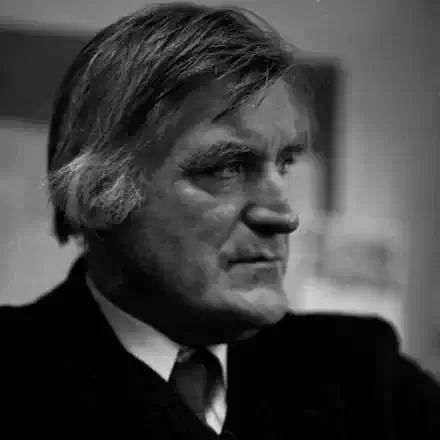
Ted Hughes
Lineage
In the beginning was Scream
Who begat Blood
Who begat Eye
Who begat Fear
Who begat Wing
Who begat Bone
Who begat Granite
Who begat Violet
Who begat Guitar
Who begat Sweat
Who begat Adam
Who begat Mary
Who begat God
Who begat Nothing
Who begat Never
Never Never Never
Who begat Crow
Screaming for Blood
Grubs, crusts
Anything
Trembling featherless elbows in the nest's filth
305

George Herbert
Providence
O Sacred Providence, who from end to end
Strongly and sweetly movest! shall I write,
And not of thee, through whom my fingers bend
To hold my quill? shall they not do thee right?
Of all the creatures both in sea and land
Onely to Man thou hast made known thy wayes,
And put the penne alone into his hand,
And made him Secretarie of thy praise.
Beasts fain would sing; birds dittie to their notes;
Trees would be tuning on their native lute
To thy renown: but all their hands and throats
Are brought to Man, while they are lame and mute.
Man is the worlds high Priest: he doth present
The sacrifice for all; while they below
Unto the service mutter an assent,
Such as springs use that fall, and windes that blow.
He that to praise and laud thee doth refrain,
Doth not refrain unto himself alone,
But robs a thousand who would praise thee fain,
And doth commit a world of sinne in one.
The beasts say, Eat me: but, if beasts must teach,
The tongue is yours to eat, but mine to praise.
The trees say, Pull me: but the hand you stretch,
Is mine to write, as it is yours to raise.
Wherefore, most sacred Spirit, I here present
For me and all my fellows praise to thee:
And just it is that I should pay the rent,
Because the benefit accrues to me.
We all acknowledge both thy power and love
To be exact, transcendent, and divine;
Who dost so strongly and so sweetly move,
While all things have their will, yet none but thine.
For either thy command, or thy permission
Lay hands on all: they are thy right and left.
The first puts on with speed and expedition;
The other curbs sinnes stealing pace and theft.
Nothing escapes them both; all must appeare,
And be dispos'd, and dress'd, and tun'd by thee,
Who sweetly temper'st all. If we could heare
Thy skill and art, what musick would it be!
Thou art in small things great, not small in any:
Thy even praise can neither rise, nor fall.
Thou art in all things one, in each thing many:
For thou art infinite in one and all.
Tempests are calm to thee; they know thy hand,
And hold it fast, as children do their fathers,
Which crie and follow. Thou hast made poore sand
Check the proud sea, ev'n when it swells and gathers.
Thy cupboard serves the world: the meat is set,
Where all may reach: no beast but knows his feed.
Birds teach us hawking; fishes have their net:
The great prey on the lesse, they on some weed.
Nothing ingendred doth prevent his meat:
Flies have their table spread, ere they appeare.
Some creatures have in winter what to eat;
Others do sleep, and envie not their cheer.
How finely dost thou times and seasons spin.
And make a twist checker'd with night and day!
Which as it lengthens windes, and windes us in,
As bouls go on, but turning all the way.
Each creature hath a wisdome for his good.
The pigeons feed their tender off-spring, crying,
When they are callow; but withdraw their food
When they are fledge, that need may teach them flying.
Bees work for man; and yet they never bruise
Their masters flower, but leave it, having done,
As fair as ever, and as fit to use;
So both the flower doth stay, and hony run.
Sheep eat the grasse, and dung the ground for more:
Trees after bearing drop their leaves for soil:
Springs vent their streams, and by expense get store:
Clouds cool by heat, and baths by cooling boil.
Who hath the vertue to expresse the rare
And curious vertues both of herbs and stones?
Is there a herb for that? O that thy care
Would show a root, that gives expressions!
And if an herb hath power, what have the starres?
A rose, besides his beautie, is a cure.
Doubtlesse our plagues and plentie, peace and warres
Are there much surer then our art is sure.
Thou hast hid metals: man may take them thence;
But at his peril: when he digs the place,
He makes a grave; as if the thing had sense,
And threatned man, that he should fill the space.
Ev'n poysons praise thee. Should a thing be lost?
Should creatures want for want of heed their due?
Since where are poysons, antidots are most:
The help stands close, and keeps the fear in view.
The sea, which seems to stop the traveller,
Is by a ship the speedier passage made.
The windes, who think they rule the mariner,
Are rul'd by him, and taught to serve his trade.
And as thy house is full, so I adore
Thy curious art in marshalling thy goods.
The hills and health abound; the vales with store;
The South with marble; North with furres & woods.
Hard things are glorious; easie things good cheap.
The common all men have; that which is rare,
Men therefore seek to have, and care to keep.
The healthy frosts with summer-fruits compare.
Light without winde is glasse: warm without weight
Is wooll and furres: cool without closenesse, shade:
Speed without pains, a horse: tall without height,
A servile hawk: low without losse, a spade.
All countreys have enough to serve their need:
If they seek fine things, thou dost make them run
For their offence; and then dost turn their speed
To be commerce and trade from sunne to sunne.
Nothing wears clothes, but Man; nothing doth need
But he to wear them. Nothing useth fire,
But Man alone, to show his heav'nly breed:
And onely he hath fuell in desire.
When th'earth was dry, thou mad'st a sea of wet:
When that lay gather'd, thou didst broach the mountains:
When yet some places could no moisture get,
The windes grew gard'ners, and the clouds good fountains.
Rain, do not hurt my flowers; but gently spend
Your hony drops: presse not to smell them here:
When they are ripe, their odour will ascend,
And at your lodging with their thanks appeare.
How harsh are thorns to pears! and yet they make
A better hedge, and need lesse reparation.
How smooth are silks compared with a stake,
Or with a stone! yet make no good foundation.
Sometimes thou dost divide thy gifts to man,
Sometimes unite. The Indian nut alone
Is clothing, meat and trencher, drink and kan,
Boat, cable, sail and needle, all in one.
Most herbs that grow in brooks, are hot and dry.
Cold fruits warm kernells help against the winde.
The lemmons juice and rinde cure mutually.
The whey of milk doth loose, the milk doth binde.
Thy creatures leap not, but expresse a feast,
Where all the guests sit close, and nothing wants.
Frogs marry fish and flesh; bats, bird and beast;
Sponges, non-sense and sense; mines, th'earth & plants.
To show thou art not bound, as if thy lot
Were worse then ours; sometimes thou shiftest hands.
Most things move th'under-jaw; the Crocodile not.
Most things sleep lying; th’ Elephant leans or stands.
But who hath praise enough? nay who hath any?
None can expresse thy works, but he that knows them:
And none can know thy works, which are so many,
And so complete, but onely he that owes them.
All things that are, though they have sev'rall wayes,
Yet in their being joyn with one advise
To honour thee: and so I give thee praise
In all my other hymnes, but in this twice.
Each thing that is, although in use and name
It go for one, hath many wayes in store
To honour thee; and so each hymne thy fame
Extolleth many wayes, yet this one more.
304
James Whitcomb Riley
When Old Jack Died
I.
When old Jack died, we staid from school (they said,
At home, we needn't go that day), and none
Of us ate any breakfast--only one,
And that was Papa--and his eyes were red
When he came round where we were, by the shed
Where Jack was lying, half way in the sun
And half way in the shade. When we begun
To cry out loud, Pa turned and dropped his head
And went away; and Mamma, she went back
Into the kitchen. Then, for a long while,
All to ourselves, like, we stood there and cried.
We thought so many good things of Old Jack,
And funny things--although we didn't smile--We
couldn't only cry when Old Jack died.
II.
When Old Jack died, it seemed a human friend
Had suddenly gone from us; that some face
That we had loved to fondle and embrace
From babyhood, no more would condescend
To smile on us forever. We might bend
With tearful eyes above him, interlace
Our chubby fingers o'er him, romp and race,
Plead with him, call and coax--aye, we might send
The old halloo up for him, whistle, hist,
(If sobs had let us) or, as wildly vain,
Snapped thumbs, called 'speak,' and he had not replied;
We might have gone down on our knees and kissed
The tousled ears, and yet they must remain
Deaf, motionless, we knew--when Old Jack died.
III.
When Old Jack died, it seemed to us, some way,
That all the other dogs in town were pained
With our bereavement, and some that were chained,
Even, unslipped their collars on that day
To visit Jack in state, as though to pay
A last, sad tribute there, while neighbors craned
Their heads above the high board fence, and deigned
To sigh 'Poor dog!' remembering how they
Had cuffed him, when alive, perchance, because,
For love of them he leaped to lick their hands--
Now, that he could not, were they satisfied?
We children thought that, as we crossed his paws,
And o'er his grave, 'way down the bottom-lands,
Wrote 'Our First Love Lies Here,' when Old Jack died.
305

Muhammad Iqbal
The Cloud On The Mountain
Elevation bestows the sky's nearness to my abode
I am the mountain's cloud, my skirt sprinkles roses
Now the wilderness, now the rose garden is my abode
City and wilderness are mine, ocean is mine, forest is mine
If I want to return to some valley for the night
The mountain's verdure is my carpet of velvet
Nature has taught me to be a pearl spreader
To chant the camel song for the camel of the Beloved of Mercy
To be the comforter of the dispirited farmer's heart
To be the elegance of the assembly of the garden's trees
I spread out over the face of the earth like the locks
I get arranged and adorned by the breeze's
I tantalize the expecting eye from a distance
As I pass silently over some habitation
As I approach strolling towards a brook's bank
I endow the brook with ear rings of whirlpools
I am the hope of the freshly grown field's verdure
I am the ocean's offspring, I am nourished by the sun
I gave ocean's tumult to the mountain spring
I charmed the birds into thrilling chants
I pronounced 'Rise' standing by the verdure's head
I conferred the taste for smile to the rose-bud
By my benevolence farmers' huts on the mountain side
Are converted into bed chambers of the opulent.
304

Robert W. Service
The Bulls
Six bulls I saw as black as jet,
With crimsoned horns and amber eyes
That chewed their cud without a fret,
And swished to brush away the flies,
Unwitting their soon sacrifice.
It is the Corpus Christi fête;
Processions crowd the bannered ways;
Before the alters women wait,
While men unite in hymns of praise,
And children look with angel gaze.
The bulls know naught of holiness,
To pious pomp their eyes are blind;
Their brutish brains will never guess
The sordid passions of mankind:
Poor innocents, they wait resigned.
Till in a black room each is penned,
While from above with cruel aim
Two torturers with lances bend
To goad their fieriness to flame,
To devil them to play the game.
The red with rage and mad with fear
They charge into the roaring ring;
Against the mockery most near
Of human might their hate they fling,
In futile, blind blood-boltering.
And so the day of unction ends;
Six bulls are dragged across the sand.
Ferocity and worship blends,
Religion and red thirst hold hands . . .
Dear Christ! 'Tis hard to understand!
304
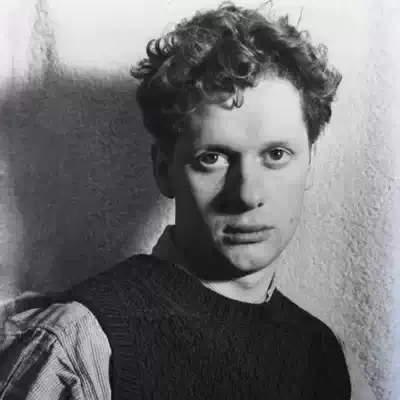
Dylan Thomas
Especially When the October Wind
Especially when the October wind
With frosty fingers punishes my hair,
Caught by the crabbing sun I walk on fire
And cast a shadow crab upon the land,
By the sea's side, hearing the noise of birds,
Hearing the raven cough in winter sticks,
My busy heart who shudders as she talks
Sheds the syllabic blood and drains her words.
Shut, too, in a tower of words, I mark
On the horizon walking like the trees
The wordy shapes of women, and the rows
Of the star-gestured children in the park.
Some let me make you of the vowelled beeches,
Some of the oaken voices, from the roots
Of many a thorny shire tell you notes,
Some let me make you of the water's speeches.
Behind a pot of ferns the wagging clock
Tells me the hour's word, the neural meaning
Flies on the shafted disk, declaims the morning
And tells the windy weather in the cock.
Some let me make you of the meadow's signs;
The signal grass that tells me all I know
Breaks with the wormy winter through the eye.
Some let me tell you of the raven's sins.
Especially when the October wind
(Some let me make you of autumnal spells,
The spider-tongued, and the loud hill of Wales)
With fists of turnips punishes the land,
Some let me make you of the heartless words.
The heart is drained that, spelling in the scurry
Of chemic blood, warned of the coming fury.
By the sea's side hear the dark-vowelled birds.
302

John Greenleaf Whittier
The Tent On The Beach
I would not sin, in this half-playful strain,-Too
light perhaps for serious years, though born
Of the enforced leisure of slow pain,-Against
the pure ideal which has drawn
My feet to follow its far-shining gleam.
A simple plot is mine: legends and runes
Of credulous days, old fancies that have lain
Silent, from boyhood taking voice again,
Warmed into life once more, even as the tunes
That, frozen in the fabled hunting-horn,
Thawed into sound:--a winter fireside dream
Of dawns and-sunsets by the summer sea,
Whose sands are traversed by a silent throng
Of voyagers from that vaster mystery
Of which it is an emblem;--and the dear
Memory of one who might have tuned my song
To sweeter music by her delicate ear.
When heats as of a tropic clime
Burned all our inland valleys through,
Three friends, the guests of summer time,
Pitched their white tent where sea-winds blew.
Behind them, marshes, seamed and crossed
With narrow creeks, and flower-embossed,
Stretched to the dark oak wood, whose leafy arms
Screened from the stormy East the pleasant inland farms.
At full of tide their bolder shore
Of sun-bleached sand the waters beat;
At ebb, a smooth and glistening floor
They touched with light, receding feet.
Northward a 'green bluff broke the chain
Of sand-hills; southward stretched a plain
Of salt grass, with a river winding down,
Sail-whitened, and beyond the steeples of the town,
Whence sometimes, when the wind was light
And dull the thunder of the beach,
They heard the bells of morn and night
Swing, miles away, their silver speech.
Above low scarp and turf-grown wall
They saw the fort-flag rise and fall;
And, the first star to signal twilight's hour,
The lamp-fire glimmer down from the tall light-house tower.
They rested there, escaped awhile
From cares that wear the life away,
To eat the lotus of the Nile
And drink the poppies of Cathay,-To
fling their loads of custom down,
Like drift-weed, on the sand-slopes brown,
And in the sea waves drown the restless pack
Of duties, claims, and needs that barked upon their track.
One, with his beard scarce silvered, bore
A ready credence in his looks,
A lettered magnate, lording o'er
An ever-widening realm of books.
In him brain-currents, near and far,
Converged as in a Leyden jar;
The old, dead authors thronged him round about,
And Elzevir's gray ghosts from leathern graves looked out.
He knew each living pundit well,
Could weigh the gifts of him or her,
And well the market value tell
Of poet and philosopher.
But if he lost, the scenes behind,
Somewhat of reverence vague and blind,
Finding the actors human at the best,
No readier lips than his the good he saw confessed.
His boyhood fancies not outgrown,
He loved himself the singer's art;
Tenderly, gently, by his own
He knew and judged an author's heart.
No Rhadamanthine brow of doom
Bowed the dazed pedant from his room;
And bards, whose name is legion, if denied,
Bore off alike intact their verses and their pride.
Pleasant it was to roam about
The lettered world as he had, done,
And see the lords of song without
Their singing robes and garlands on.
With Wordsworth paddle Rydal mere,
Taste rugged Elliott's home-brewed beer,
And with the ears of Rogers, at fourscore,
Hear Garrick's buskined tread and Walpole's wit once more.
And one there was, a dreamer born,
Who, with a mission to fulfil,
Had left the Muses' haunts to turn
The crank of an opinion-mill,
Making his rustic reed of song
A weapon in the war with wrong,
Yoking his fancy to the breaking-plough
That beam-deep turned the soil for truth to spring and grow.
Too quiet seemed the man to ride
The winged Hippogriff Reform;
Was his a voice from side to side
To pierce the tumult of the storm?
A silent, shy, peace-loving man,
He seemed no fiery partisan
To hold his way against the public frown,
The ban of Church and State, the fierce mob's hounding down.
For while he wrought with strenuous will
The work his hands had found to do,
He heard the fitful music still
Of winds that out of dream-land blew.
The din about him could not drown
What the strange voices whispered down;
Along his task-field weird processions swept,
The visionary pomp of stately phantoms stepped:
The common air was thick with dreams,-He
told them to the toiling crowd;
Such music as the woods and streams
Sang in his ear he sang aloud;
In still, shut bays, on windy capes,
He heard the call of beckoning shapes,
And, as the gray old shadows prompted him,
To homely moulds of rhyme he shaped their legends grim.
He rested now his weary hands,
And lightly moralized and laughed,
As, tracing on the shifting sands
A burlesque of his paper-craft,
He saw the careless waves o'errun
His words, as time before had done,
Each day's tide-water washing clean away,
Like letters from the sand, the work of yesterday.
And one, whose Arab face was tanned
By tropic sun and boreal frost,
So travelled there was scarce a land
Or people left him to exhaust,
In idling mood had from him hurled
The poor squeezed orange of the world,
And in the tent-shade, as beneath a palm,
Smoked, cross-legged like a Turk, in Oriental calm.
The very waves that washed the sand
Below him, he had seen before
Whitening the Scandinavian strand
And sultry Mauritanian shore.
From ice-rimmed isles, from summer seas
Palm-fringed, they bore him messages;
He heard the plaintive Nubian songs again,
And mule-bells tinkling down the mountain-paths of Spain.
His memory round the ransacked earth
On Puck's long girdle slid at ease;
And, instant, to the valley's girth
Of mountains, spice isles of the seas,
Faith flowered in minster stones, Art's guess
At truth and beauty, found access;
Yet loved the while, that free cosmopolite,
Old friends, old ways, and kept his boyhood's dreams in sight.
Untouched as yet by wealth and pride,
That virgin innocence of beach
No shingly monster, hundred-eyed,
Stared its gray sand-birds out of reach;
Unhoused, save where, at intervals,
The white tents showed their canvas walls,
Where brief sojourners, in the cool, soft air,
Forgot their inland heats, hard toil, and year-long care.
Sometimes along the wheel-deep sand
A one-horse wagon slowly crawled,
Deep laden with a youthful band,
Whose look some homestead old recalled;
Brother perchance, and sisters twain,
And one whose blue eyes told, more plain
Than the free language of her rosy lip,
Of the still dearer claim of love's relationship.
With cheeks of russet-orchard tint,
The light laugh of their native rills,
The perfume of their garden's mint,
The breezy freedom of the hills,
They bore, in unrestrained delight,
The motto of the Garter's knight,
Careless as if from every gazing thing
Hid by their innocence, as Gyges by his ring.
The clanging sea-fowl came and went,
The hunter's gun in the marshes rang;
At nightfall from a neighboring tent
A flute-voiced woman sweetly sang.
Loose-haired, barefooted, hand-in-hand,
Young girls went tripping down the sand;
And youths and maidens, sitting in the moon,
Dreamed o'er the old fond dream from which we wake too soon.
At times their fishing-lines they plied,
With an old Triton at the oar,
Salt as the sea-wind, tough and dried
As a lean cusk from Labrador.
Strange tales he told of wreck and storm,-Had
seen the sea-snake's awful form,
And heard the ghosts on Haley's Isle complain,
Speak him off shore, and beg a passage to old Spain!
And there, on breezy morns, they saw
The fishing-schooners outward run,
Their low-bent sails in tack and flaw
Turned white or dark to shade and sun.
Sometimes, in calms of closing day,
They watched the spectral mirage play,
Saw low, far islands looming tall and nigh,
And ships, with upturned keels, sail like a sea the sky.
Sometimes a cloud, with thunder black,
Stooped low upon the darkening main,
Piercing the waves along its track
With the slant javelins of rain.
And when west-wind and sunshine warm
Chased out to sea its wrecks of storm,
They saw the prismy hues in thin spray showers
Where the green buds of waves burst into white froth flowers.
And when along the line of shore
The mists crept upward chill and damp,
Stretched, careless, on their sandy floor
Beneath the flaring lantern lamp,
They talked of all things old and new,
Read, slept, and dreamed as idlers do;
And in the unquestioned freedom of the tent,
Body and o'er-taxed mind to healthful ease unbent.
Once, when the sunset splendors died,
And, trampling up the sloping sand,
In lines outreaching far and wide,
The white-waned billows swept to land,
Dim seen across the gathering shade,
A vast and ghostly cavalcade,
They sat around their lighted kerosene,
Hearing the deep bass roar their every pause between.
Then, urged thereto, the Editor
Within his full portfolio dipped,
Feigning excuse while seaching for
(With secret pride) his manuscript.
His pale face flushed from eye to beard,
With nervous cough his throat he cleared,
And, in a voice so tremulous it betrayed
The anxious fondness of an author's heart, he read:
302
Horácio
BkI:IV Spring
Fierce winter slackens its grip: it’s spring and the west wind’s sweet change:
the ropes are hauling dry hulls towards the shore,
The flock no longer enjoys the fold, or the ploughman the fire,
no more are the meadows white with hoary frost.
Now Cytherean Venus leads out her dancers, under the pendant moon,
and the lovely Graces have joined with the Nymphs,
treading the earth on tripping feet, while Vulcan, all on fire, visits
the tremendous Cyclopean forges.
Now its right to garland our gleaming heads, with green myrtle or flowers,
whatever the unfrozen earth now bears:
now it’s right to sacrifice to Faunus, in groves that are filled with shadow,
whether he asks a lamb, or prefers a kid.
Pale death knocks with impartial foot, at the door of the poor man’s cottage,
and at the prince’s gate. O Sestus, my friend,
the span of brief life prevents us from ever depending on distant hope.
Soon the night will crush you, the fabled spirits,
and Pluto’s bodiless halls: where once you’ve passed inside you’ll no longer
be allotted the lordship of wine by dice,
or marvel at Lycidas, so tender, for whom, already, the boys
are burning, and soon the girls will grow hotter.
302
James Whitcomb Riley
The Katydids
Sometimes I keep
From going to sleep,
To hear the katydids 'cheep-cheep!'
And think they say
Their prayers that way;
But _katydids_ don't have to _pray_!
I listen when
They cheep again
And so, I think, they're _singing_ then!
But, no; I'm wrong,--
The sound's too long
And all-alike to be a song!
I think, 'Well, there!
I do declare,
If it is neither song nor prayer,
It's _talk_--and quite
Too vain and light
For me to listen to all night!'
And so, I smile,
And think,--'Now I'll
Not listen for a little while!'--
Then, sweet and clear,
Next '_cheep_' I hear
'S a _kiss_.... Good morning, Mommy dear!
302

Robert Louis Stevenson
The Flowers
All the names I know from nurse:
Gardener's garters, Shepherd's purse,
Bachelor's buttons, Lady's smock,
And the Lady Hollyhock.
Fairy places, fairy things,
Fairy woods where the wild bee wings,
Tiny trees for tiny dames--
These must all be fairy names!
Tiny woods below whose boughs
Shady fairies weave a house;
Tiny tree-tops, rose or thyme,
Where the braver fairies climb!
Fair are grown-up people's trees,
But the fairest woods are these;
Where, if I were not so tall,
I should live for good and all.
303

Henry Lawson
Ballad Of The Drover
Across the stony ridges,
Across the rolling plain,
Young Harry Dale, the drover,
Comes riding home again.
And well his stock-horse bears him,
And light of heart is he,
And stoutly his old pack-horse
Is trotting by his knee.
Up Queensland way with cattle
He travelled regions vast;
And many months have vanished
Since home-folk saw him last.
He hums a song of someone
He hopes to marry soon;
And hobble-chains and camp-ware
Keep jingling to the tune.
Beyond the hazy dado
Against the lower skies
And yon blue line of ranges
The homestead station lies.
And thitherward the drover
Jogs through the lazy noon,
While hobble-chains and camp-ware
Are jingling to a tune.
An hour has filled the heavens
With storm-clouds inky black;
At times the lightning trickles
Around the drover's track;
But Harry pushes onward,
His horses' strength he tries,
In hope to reach the river
Before the flood shall rise.
The thunder from above him
Goes rolling o'er the plain;
And down on thirsty pastures
In torrents falls the rain.
And every creek and gully
Sends forth its little flood,
Till the river runs a banker,
All stained with yellow mud.
Now Harry speaks to Rover,
The best dog on the plains,
And to his hardy horses,
And strokes their shaggy manes;
`We've breasted bigger rivers
When floods were at their height
Nor shall this gutter stop us
From getting home to-night!'
The thunder growls a warning,
The ghastly lightnings gleam,
As the drover turns his horses
To swim the fatal stream.
But, oh! the flood runs stronger
Than e'er it ran before;
The saddle-horse is failing,
And only half-way o'er!
When flashes next the lightning,
The flood's grey breast is blank,
And a cattle dog and pack-horse
Are struggling up the bank.
But in the lonely homestead
The girl will wait in vain He'll
never pass the stations
In charge of stock again.
The faithful dog a moment
Sits panting on the bank,
And then swims through the current
To where his master sank.
And round and round in circles
He fights with failing strength,
Till, borne down by the waters,
The old dog sinks at length.
Across the flooded lowlands
And slopes of sodden loam
The pack-horse struggles onward,
To take dumb tidings home.
And mud-stained, wet, and weary,
Through ranges dark goes he;
While hobble-chains and tinware
Are sounding eerily.
The floods are in the ocean,
The stream is clear again,
And now a verdant carpet
Is stretched across the plain.
But someone's eyes are saddened,
And someone's heart still bleeds
In sorrow for the drover
Who sleeps among the reeds.
302
James Whitcomb Riley
At Crown Hill
Leave him here in the fresh
greening grasses and trees
And the symbols of love, and the solace of these-
The saintly white lilies and blossoms he keeps
In endless caress as
he breathlessly sleeps.
The tears of our eyes wrong the scene of his rest,
For the sky's at its clearest-the sun's at its best-
The earth at its greenest- its wild bud and bloom
At its sweetest-and sweetest its honey'd perfume.
Home! Home!-Leave him here in his lordly estate,
And with never a tear as we turn from the gate!
Turn back to the home that will know him no more,-
The vines at the window-the sun through the door,-
Nor sound of his voice, nor the light of his face!...
But the birds will sing on, and the rose, in his place,
Will tenderly smile til we daringly feign
He is home with us still, though the tremulous rain
Of our tears reappear, and again all is bloom,
And all prayerless we sob in the long-darkened room.
Heaven portions it thus-the old mystery dim,-
It is midnight to us-it is morning to him
301
John Greenleaf Whittier
The Lakeside
The shadows round the inland sea
Are deepening into night;
Slow up the slopes of Ossipee
They chase the lessening light.
Tired of the long day's blinding heat,
I rest my languid eye,
Lake of the Hills! where, cool and sweet,
Thy sunset waters lie!
Along the sky, in wavy lines,
O'er isle and reach and bay,
Green-belted with eternal pines,
The mountains stretch away.
Below, the maple masses sleep
Where shore with water blends,
While midway on the tranquil deep
The evening light descends.
So seemed it when yon hill's red crown,
Of old, the Indian trod,
And, through the sunset air, looked down
Upon the Smile of God.
To him of light and shade the laws
No forest skeptic taught;
Their living and eternal Cause
His truer instinct sought.
He saw these mountains in the light
Which now across them shines;
This lake, in summer sunset bright,
Walled round with sombering pines.
God near him seemed; from earth and skies
His loving voice he beard,
As, face to face, in Paradise,
Man stood before the Lord.
Thanks, O our Father! that, like him,
Thy tender love I see,
In radiant hill and woodland dim,
And tinted sunset sea.
For not in mockery dost Thou fill
Our earth with light and grace;
Thou hid'st no dark and cruel will
Behind Thy smiling face!
302
John Greenleaf Whittier
R. S. S., At Deer Island On The Merrimac
Make, for he loved thee well, our Merrimac,
From wave and shore a low and long lament
For him, whose last look sought thee, as he went
The unknown way from which no step comes back.
And ye, O ancient pine-trees, at whose feet
He watched in life the sunset's reddening glow,
Let the soft south wind through your needles blow
A fitting requiem tenderly and sweet!
No fonder lover of all lovely things
Shall walk where once he walked, no smile more glad
Greet friends than his who friends in all men had,
Whose pleasant memory, to that Island clings,
Where a dear mourner in the home he left
Of love's sweet solace cannot be bereft.
301
Robert Louis Stevenson
Time to Rise
A birdie with a yellow bill
Hopped upon my window sill,
Cocked his shining eye and said:
"Ain't you 'shamed, you sleepy-head!"
Hopped upon my window sill,
Cocked his shining eye and said:
"Ain't you 'shamed, you sleepy-head!"
301

William Butler Yeats
Gratitude To The Unknown Instructors
WHAT they undertook to do
They brought to pass;
All things hang like a drop of dew
Upon a blade of grass.
They brought to pass;
All things hang like a drop of dew
Upon a blade of grass.
300

Walter de la Mare
The Mocking Fairy
'Won't you look out of your window, Mrs. Gill?'
Quoth the Fairy, nidding, nodding in the garden;
'Can't you look out of your window, Mrs. Gill?'
Quoth the Fairy, laughing softly in the garden;
But the air was still, the cherry boughs were still,
And the ivy-tod neath the empty sill,
And never from her window looked out Mrs. Gill
On the Fairy shrilly mocking in the garden.
'What have they done with you, you poor Mrs. Gill?'
Quoth the Fairy brightly glancing in the garden;
'Where have they hidden you, you poor old Mrs. Gill?'
Quoth the Fairy dancing lightly in the garden;
But night's faint veil now wrapped the hill,
Stark 'neath the stars stood the dead-still Mill,
And out of her cold cottage never answered Mrs. Gill
The Fairy mimbling, mambling in the garden.
301

Emily Dickinson
Nobody knows this little Rose
Nobody knows this little Rose-
It might a pilgrim be
Did I not take it from the ways
And lift it up to thee.
Only a Bee will miss it-
Only a Butterfly,
Hastening from far journey-
On its breast to lie-
Only a Bird will wonder-
Only a Breeze will sigh-
Ah Little Rose-how easy
For such as thee to die!
It might a pilgrim be
Did I not take it from the ways
And lift it up to thee.
Only a Bee will miss it-
Only a Butterfly,
Hastening from far journey-
On its breast to lie-
Only a Bird will wonder-
Only a Breeze will sigh-
Ah Little Rose-how easy
For such as thee to die!
299
Robert W. Service
Winnie
When I went by the meadow gate
The chestnut mare would trot to meet me,
And as her coming I would wait,
She'd whinney high as if to greet me.
And I would kiss her silky nose,
And stroke her neck until it glistened,
And speak soft words: I don't suppose
She understand - but how she listened!
Then in the war-net I was caught,
Returning three black winters older;
And when the little mare I sought
The farmer told me he had sold her.
And so time passed - when in the street
One day I heard a plaintive whinney
That roused a recollection sweet,
So then I turned and there was Winnie.
I vow she knew me, mooning there.
She raised her nose for me to fondle,
And though I'd lost an arm I'll swear
She kissed the empty sleeve a-dangle.
But oh it cut me to the heart,
Though I was awful glad to meet her,
For lo! she dragged a tinker's cart
And stumbled weakly as he beat her.
Just skin and bone, a sorry hack!
Say, fellow, you may think it funny:
I made a deal and bought her back,
Though it took all my bonus money.
And she'll be in the meadow there,
As long as I have dough for spending . . .
Gee! I'll take care of that old mare "
Sweetheart! you'll have a happy ending."
299
James Whitcomb Riley
Find The Favorite
Our three cats is Maltese cats,
An' they's two that's white,--
An' bofe of 'em's _deef_--an' that's
'Cause their _eyes_ ain't right.--
Uncle say that _Huxley_ say
Eyes of _white_ Maltese--
When they don't match thataway-They're
deef as you please!
_Girls, they_ like our white cats best,
'Cause they're white as snow,
Yes, an' look the stylishest--
But they're deef, you know!
They don't know their names, an' don't
Hear us when we call
'Come in, Nick an' Finn!'--they won't
Come fer us at all!
But our _other_ cat, _he_ knows
Mister Nick an' Finn,-Mowg's
_his_ name,--an' when _he_ goes
Fer 'em, they come in!
Mowgli's _all_ his name--the same
Me an' Muvver took
Like the Wolf-Child's _other_ name,
In 'The Jungul Book.'
I bet Mowg's the smartest cat
In the world!--_He's_ not
_White_, but mousy-plush, with that
Smoky gloss he's got!
All's got little bells to ring,
Round their neck; but none
Only Mowg _knows_ anything-He's
the only one!
I ist 'spect sometimes he hate
White cats' stupid ways:--
He won't hardly 'sociate
With 'em, lots o' days!
Mowg wants in where _we_ air,--well,
He'll ist take his paw
An' ist ring an' ring his bell
There till me er Ma
Er _some_body lets him in
Nen an' shuts the door.-
An', when he wants out ag'in,
Nen he'll ring some more.
Ort to hear our Katy tell!
She sleeps 'way up-stairs;
An' last night she hear Mowg's bell
Ringin' round _some_wheres...
Trees grows by her winder.--So,
She lean out an' see
Mowg up there, 'way out, you know,
In the clingstone-tree;-
An'-sir! he ist _hint_ an' _ring_,--
Till she ketch an' plat
Them limbs;--nen he crawl an' spring
In where Katy's at!
299
Emily Dickinson
We—Bee and I—live by the quaffing
We—Bee and I—live by the quaffing—
'Tisn't all Hock—with us—
Life has its Ale—
But it's many a lay of the Dim Burgundy—
We chant—for cheer—when the Wines—fail—
Do we "get drunk"?
Ask the jolly Clovers!
Do we "beat" our "Wife"?
I—never wed—
Bee—pledges his—in minute flagons—
Dainty—as the trees—on our deft Head—
While runs the Rhine—
He and I—revel—
First—at the vat—and latest at the Vine—
Noon—our last Cup—
"Found dead"—"of Nectar"—
By a humming Coroner—
In a By-Thyme!
299

William Wordsworth
To The Daisy (third poem)
Bright Flower! whose home is everywhere,
Bold in maternal Nature's care,
And all the long year through the heir
Of joy or sorrow;
Methinks that there abides in thee
Some concord with humanity,
Given to no other flower I see
The forest thorough!
Is it that Man is soon deprest?
A thoughtless Thing! who, once unblest,
Does little on his memory rest,
Or on his reason,
And Thou would'st teach him how to find
A shelter under every wind,
A hope for times that are unkind
And every season?
Thou wander'st the wide world about,
Uncheck'd by pride or scrupulous doubt,
With friend to greet thee, or without,
Yet pleased and willing;
Meek, yielding to the occasion's call,
And all things suffering from all,
Thy function apostolical
In peace fulfilling.
297
Robert W. Service
Abandoned Dog
They dumped it on the lonely road,
Then like a streak they sped;
And as along the way I strode
I thought that it was dead:
And then I saw that yelping pup
Rise, race to catch them up.
You know how silly wee dogs are.
It thought they were in fun.
Trying to overtake their car
I saw it run and run:
But as they faster, faster went,
It stumbled, sore and spent.
I found it prone upon the way;
Of life was little token.
As limply in the dust it lay
I thought its heart was broken:
Then one dim eye it opened and
It sought to like my hand.
Of course I took it gently up
And brought it to my wife
Who loves all dogs, and now that pup
Shares in our happy life:
Yet how I curse the bastards who
Its good luck never knew!
296