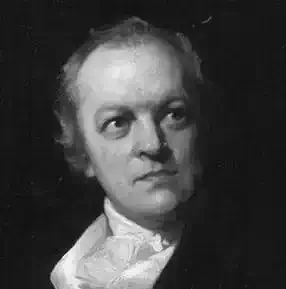
Identification and basic context
William Blake was an English poet, painter, and printmaker. He is widely regarded as a visionary artist and a key figure in the Romantic movement, though his work often defied conventional categorization and is characterized by its unique spiritual and philosophical depth. Blake's primary language of expression was English. His imaginative and often mystical worldview set him apart from many of his contemporaries. He is best known for his illuminated books, which combine his poetry with his own intricate illustrations.
Childhood and education
Born in London, Blake came from a modest background. His father was a hosier. He received little formal schooling, attending only a dame school. However, he was a voracious reader and possessed a remarkable natural talent for drawing and poetry from a young age. His parents recognized his artistic abilities and apprenticed him to an engraver at the age of ten. This apprenticeship provided him with crucial technical skills and exposed him to various artistic styles and historical prints, which would later inform his own work. His early education was thus largely practical and self-directed, fueled by an innate creative drive.
Literary trajectory
Blake began his literary career by writing poetry, including early works that would later be revised and published in collections like "Poetical Sketches" (1783). His true innovation came with the development of his "illuminated printing" technique, where he combined his poetry and illustrations into single plates, printed and colored by hand. This led to the creation of his prophetic books, beginning with "Songs of Innocence" (1789) and "Songs of Experience" (1794), which explore complex theological and philosophical ideas through allegorical poetry and vivid imagery. His literary trajectory was marked by a consistent development of his personal mythology and a relentless pursuit of spiritual and artistic expression, often in defiance of contemporary literary and artistic conventions.
Works, style, and literary characteristics
Blake's most famous works include "Songs of Innocence and of Experience," "The Marriage of Heaven and Hell," "Jerusalem," and "Milton." His dominant themes often revolve around the dualities of human existence: innocence and experience, good and evil, heaven and hell, reason and imagination, freedom and oppression. He developed a complex personal mythology populated by symbolic figures like Urizen (reason), Los (imagination), and Enitharmon (spirituality). His style is characterized by its visionary intensity, rich symbolism, and often paradoxical pronouncements. Blake employed a variety of forms, from lyrical songs to epic prophecies, often utilizing rhythmic structures and vivid, dreamlike imagery. His language can be both deceptively simple and profoundly complex, challenging conventional interpretations of morality and spirituality.
Cultural and historical context
Blake lived during a period of significant social and political upheaval in Britain, including the American and French Revolutions, which deeply influenced his thinking on liberty, tyranny, and social justice. He was part of a generation of artists and writers associated with Romanticism, which emphasized emotion, individualism, and the sublime in nature, though Blake's vision was often more overtly spiritual and prophetic. He was deeply critical of the established church, state, and industrialization, viewing them as forces that stifled human imagination and spiritual freedom. His radical religious and political views often led to his isolation from mainstream artistic and literary circles.
Personal life
Blake's personal life was marked by his deep devotion to his wife, Catherine Boucher, whom he taught to read and write and who became his artistic collaborator. They lived a relatively simple life, often facing financial hardship. Blake's intense inner world and visionary experiences sometimes led others to perceive him as eccentric or even insane, though he maintained a consistent creative output. His spiritual beliefs were central to his life and work, forming the basis of his unique cosmology.
Recognition and reception
During his lifetime, Blake was largely unrecognized for his poetic genius and was primarily known as a talented engraver. His visionary works were often misunderstood or dismissed by critics and the public. It was only in the 20th century, with the rise of modernist and postmodernist thought, that his work began to be re-evaluated and appreciated for its originality, depth, and prophetic power. Today, he is considered one of Britain's greatest poets and artists, with his work studied extensively in literature and art history.
Influences and legacy
Blake was influenced by the Bible, Milton, Shakespeare, and various mystical traditions. His radical ideas and unique artistic vision, in turn, influenced numerous artists, writers, and thinkers, including the Pre-Raphaelites, the Symbolists, and later figures in literature and art who embraced his emphasis on imagination and spiritual truth. His critique of industrial society and his celebration of individual vision continue to resonate. His inclusion in the literary and artistic canon is now firmly established, and his works are widely translated and studied internationally.
Interpretation and critical analysis
Blake's work is rich with layers of symbolic meaning, inviting diverse interpretations. Critics often analyze his complex mythology, his critique of established religious and political institutions, and his exploration of the human psyche. Debates frequently arise concerning the precise nature of his spiritual beliefs and the extent to which his visions should be understood literally or metaphorically. His exploration of the "contraries" of life remains a central theme for critical inquiry.
Curiosities and lesser-known aspects
Blake claimed to have seen visions from childhood, including seeing angels in a tree. He developed a unique method of printing his books, which he called "illuminated printing," involving etching both text and image onto copper plates. He was a vocal critic of the rationalism and materialism of his age. His personal notebooks contain numerous aphorisms and observations that reveal his independent and often provocative thinking.
Death and memory
William Blake died in relative obscurity in 1827. His memory was kept alive by a small circle of admirers, but his widespread recognition as a major artistic and literary figure only emerged much later. Posthumous publications and exhibitions have cemented his legacy as a unique and profoundly influential visionary artist and poet.