Identification and basic context
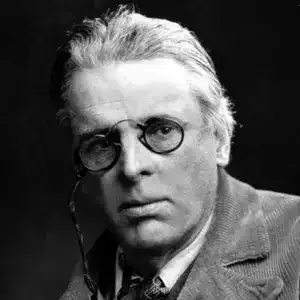
William Butler Yeats was an Irish poet, dramatist, and prose writer, and one of the foremost figures of 20th-century literature. He was born in Sandymount, County Dublin, Ireland. He wrote in English.
Childhood and education
Yeats's childhood was divided between County Sligo, a rural area of great natural beauty that deeply influenced his imagination, and Dublin. His father was a barrister and painter, and his mother came from a prosperous merchant family in Sligo. He attended the Godolphin School in Hammersmith, London, and then the Metropolitan School of Art in Dublin. His early intellectual and artistic development was influenced by the Aesthetic and Decadent movements, and by his deep interest in Irish mythology, folklore, and the occult.
Literary trajectory
Yeats's literary career began in his early twenties with the publication of his first poems. He became a central figure in the Irish Literary Revival, aiming to create a distinctly Irish national literature. His early poetry, such as 'The Wanderings of Usheen' (1889), was romantic and myth-laden. Throughout his life, his style evolved, becoming more personal, philosophical, and symbolically complex. He was also a prolific playwright and a co-founder of the Abbey Theatre in Dublin. His later works, including 'The Tower' (1928) and 'The Winding Stair and Other Poems' (1933), are considered masterpieces of modernist poetry.
Works, style, and literary characteristics
Yeats's major works include 'The Wanderings of Usheen' (1889), 'The Countess Cathleen' (1892), 'The Wild Swans at Coole' (1919), 'The Tower' (1928), and 'Last Poems and Two Plays' (1936). His poetry is renowned for its rich symbolism, often drawn from Irish myth, ancient religions, and his own esoteric system (A Vision). Key themes include love (often unrequited or complex), death, time, aging, Irish nationalism, art, the conflict between the spiritual and the material, and the cyclical nature of history. His style transitioned from a pre-Raphaelite romanticism to a more compressed, intellectually rigorous, and sometimes violent modernist idiom. He experimented with various forms but also developed a distinctive, powerful free verse and rhyming couplets. His poetic voice ranges from the elegiac and lyrical to the prophetic and satirical.
Cultural and historical context
Yeats lived through a period of intense political and social upheaval in Ireland, including the struggle for Home Rule, the Easter Rising of 1916, and the Irish Civil War. He was deeply involved with Irish cultural nationalism, though his relationship with political factions was often complex and critical. He was associated with the Symbolist movement in poetry and was influenced by philosophers like Nietzsche and scholars of mysticism. His work reflects the tensions between the pagan past and the Christian present, the individual and the state, and the forces of tradition and modernity.
Personal life
Yeats's personal life was marked by his passionate, often unrequited, love for Maud Gonne, an Irish nationalist and activist, who inspired many of his most famous poems. He was also involved in occult societies and developed a complex personal mythology. He married Georgie Hyde-Lees late in life, and they had two children. His later years were spent between Ireland and England, and he served as a Senator of the Irish Free State from 1922 to 1928.
Recognition and reception
Yeats achieved significant international recognition during his lifetime and was awarded the Nobel Prize in Literature in 1923. He is considered one of the most important poets of the English language. His work has been widely translated and studied, and he is a central figure in the canon of modern literature.
Influences and legacy
Yeats was influenced by William Blake, Shelley, the Pre-Raphaelite poets, and various esoteric traditions. He, in turn, profoundly influenced subsequent generations of poets, both in Ireland and internationally, particularly in his development of modernist techniques and his engagement with complex themes. His emphasis on symbolism and his unique blend of personal and public concerns set a new standard for poetic expression.
Interpretation and critical analysis
Critical analyses of Yeats's work often focus on his evolving symbolism, his relationship with Irish history and myth, and the philosophical and esoteric dimensions of his poetry. Debates have arisen regarding his political stances and his complex attitudes towards Irish identity and modernity.
Curiosities and lesser-known aspects
Yeats was deeply involved in spiritualism and theosophy, developing his own intricate system of philosophy and history known as A Vision, which he published in prose form. He was also a proponent of eugenics, a controversial aspect of his thought.
Death and memory
Yeats died in Roquebrune-Cap-Martin, France, in 1939. His body was initially buried there but was later exhumed and reburied in Drumcliffe, County Sligo, Ireland, as per his wishes, beneath the shadow of Ben Bulben mountain.