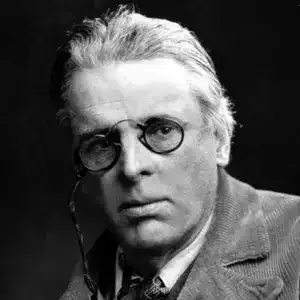
William Butler Yeats

William Butler Yeats

1865–1939 · lived 73 years IE IE

William Butler Yeats was a prominent Irish poet, playwright, and mystic, widely regarded as one of the greatest poets of the 20th century. His early work was deeply influenced by Irish mythology and folklore, and he was a key figure in the Irish Literary Revival. Over his career, his style evolved, becoming more personal, symbolic, and philosophical, grappling with themes of love, aging, politics, and the spiritual life. Yeats's poetry is characterized by its rich imagery, musicality, and intellectual depth. He explored the complexities of the human condition, the nature of art, and the turbulent history of Ireland. His later works, in particular, are known for their aphoristic power and profound meditations on life and mortality. He received the Nobel Prize in Literature in 1923, solidifying his international literary stature.

n. 1865-06-13, Sandymount · m. 1939-01-28, Menton

78,459 Views

Youth And Age

Youth And Age

MUCH did I rage when young,
Being by the world oppressed,
But now with flattering tongue
It speeds the parting guest.
Read full poem
Bio

Identification and basic context

William Butler Yeats was an Irish poet, dramatist, and prose writer, and one of the foremost figures of 20th-century literature. He was born in Sandymount, County Dublin, Ireland. He wrote in English.

Childhood and education

Yeats's childhood was divided between County Sligo, a rural area of great natural beauty that deeply influenced his imagination, and Dublin. His father was a barrister and painter, and his mother came from a prosperous merchant family in Sligo. He attended the Godolphin School in Hammersmith, London, and then the Metropolitan School of Art in Dublin. His early intellectual and artistic development was influenced by the Aesthetic and Decadent movements, and by his deep interest in Irish mythology, folklore, and the occult.

Literary trajectory

Yeats's literary career began in his early twenties with the publication of his first poems. He became a central figure in the Irish Literary Revival, aiming to create a distinctly Irish national literature. His early poetry, such as 'The Wanderings of Usheen' (1889), was romantic and myth-laden. Throughout his life, his style evolved, becoming more personal, philosophical, and symbolically complex. He was also a prolific playwright and a co-founder of the Abbey Theatre in Dublin. His later works, including 'The Tower' (1928) and 'The Winding Stair and Other Poems' (1933), are considered masterpieces of modernist poetry.

Works, style, and literary characteristics

Yeats's major works include 'The Wanderings of Usheen' (1889), 'The Countess Cathleen' (1892), 'The Wild Swans at Coole' (1919), 'The Tower' (1928), and 'Last Poems and Two Plays' (1936). His poetry is renowned for its rich symbolism, often drawn from Irish myth, ancient religions, and his own esoteric system (A Vision). Key themes include love (often unrequited or complex), death, time, aging, Irish nationalism, art, the conflict between the spiritual and the material, and the cyclical nature of history. His style transitioned from a pre-Raphaelite romanticism to a more compressed, intellectually rigorous, and sometimes violent modernist idiom. He experimented with various forms but also developed a distinctive, powerful free verse and rhyming couplets. His poetic voice ranges from the elegiac and lyrical to the prophetic and satirical.

Cultural and historical context

Yeats lived through a period of intense political and social upheaval in Ireland, including the struggle for Home Rule, the Easter Rising of 1916, and the Irish Civil War. He was deeply involved with Irish cultural nationalism, though his relationship with political factions was often complex and critical. He was associated with the Symbolist movement in poetry and was influenced by philosophers like Nietzsche and scholars of mysticism. His work reflects the tensions between the pagan past and the Christian present, the individual and the state, and the forces of tradition and modernity.

Personal life

Yeats's personal life was marked by his passionate, often unrequited, love for Maud Gonne, an Irish nationalist and activist, who inspired many of his most famous poems. He was also involved in occult societies and developed a complex personal mythology. He married Georgie Hyde-Lees late in life, and they had two children. His later years were spent between Ireland and England, and he served as a Senator of the Irish Free State from 1922 to 1928.

Recognition and reception

Yeats achieved significant international recognition during his lifetime and was awarded the Nobel Prize in Literature in 1923. He is considered one of the most important poets of the English language. His work has been widely translated and studied, and he is a central figure in the canon of modern literature.

Influences and legacy

Yeats was influenced by William Blake, Shelley, the Pre-Raphaelite poets, and various esoteric traditions. He, in turn, profoundly influenced subsequent generations of poets, both in Ireland and internationally, particularly in his development of modernist techniques and his engagement with complex themes. His emphasis on symbolism and his unique blend of personal and public concerns set a new standard for poetic expression.

Interpretation and critical analysis

Critical analyses of Yeats's work often focus on his evolving symbolism, his relationship with Irish history and myth, and the philosophical and esoteric dimensions of his poetry. Debates have arisen regarding his political stances and his complex attitudes towards Irish identity and modernity.

Curiosities and lesser-known aspects

Yeats was deeply involved in spiritualism and theosophy, developing his own intricate system of philosophy and history known as A Vision, which he published in prose form. He was also a proponent of eugenics, a controversial aspect of his thought.

Death and memory

Yeats died in Roquebrune-Cap-Martin, France, in 1939. His body was initially buried there but was later exhumed and reburied in Drumcliffe, County Sligo, Ireland, as per his wishes, beneath the shadow of Ben Bulben mountain.

Poems

201

He Wishes His Beloved Were Dead

He Wishes His Beloved Were Dead

WERE you but lying cold and dead,
And lights were paling out of the West,
You would come hither, and bend your head,
And I would lay my head on your breast;
And you would murmur tender words,
Forgiving me, because you were dead:
Nor would you rise and hasten away,
Though you have the will of the wild birds,
But know your hair was bound and wound
About the stars and moon and sun:
O would, beloved, that you lay
Under the dock-leaves in the ground,
While lights were paling one by one.
474

He Thinks Of Those Who Have Spoken Evil Of His Beloved

He Thinks Of Those Who Have Spoken Evil Of His Beloved

HALF close your eyelids, loosen your hair,
And dream about the great and their pride;
They have spoken against you everywhere,
But weigh this song with the great and their pride;
I made it out of a mouthful of air,
Their children's children shall say they have lied.
365

He Tells Of The Perfect Beauty

He Tells Of The Perfect Beauty

O CLOUD-PALE eyelids, dream-dimmed eyes,
The poets labouring all their days
To build a perfect beauty in rhyme
Are overthrown by a woman's gaze
And by the unlabouring brood of the skies:
And therefore my heart will bow, when dew
Is dropping sleep, until God burn time,
Before the unlabouring stars and you.
329

He Mourns For The Change That Has Come Upon Him And His Beloved, And

He Mourns For The Change That Has Come Upon Him And His Beloved, And
Longs For The End Of The World

DO you not hear me calling, white deer with no horns?
I have been changed to a hound with one red ear;
I have been in the Path of Stones and the Wood of Thorns,
For somebody hid hatred and hope and desire and fear
Under my feet that they follow you night and day.
A man with a hazel wand came without sound;
He changed me suddenly; I was looking another way;
And now my calling is but the calling of a hound;
And Time and Birth and Change are hurrying by.
I would that the Boar without bristles had come from the West
And had rooted the sun and moon and stars out of the sky
And lay in the darkness, grunting, and turning to his rest.
368

He Reproves The Curlew

He Reproves The Curlew

O CURLEW, cry no more in the air,
Or only to the water in the West;
Because your crying brings to my mind
passion-dimmed eyes and long heavy hair
That was shaken out over my breast:
There is enough evil in the crying of wind.
258

Gratitude To The Unknown Instructors

Gratitude To The Unknown Instructors

WHAT they undertook to do
They brought to pass;
All things hang like a drop of dew
Upon a blade of grass.
298

He Gives His Beloved Certain Rhymes

He Gives His Beloved Certain Rhymes

FASTEN your hair with a golden pin,
And bind up every wandering tress;
I bade my heart build these poor rhymes:
It worked at them, day out, day in,
Building a sorrowful loveliness
Out of the battles of old times.
You need but lift a pearl-pale hand,
And bind up your long hair and sigh;
And all men's hearts must burn and beat;
And candle-like foam on the dim sand,
And stars climbing the dew-dropping sky,
Live but to light your passing feet.
273

Friends

Friends


NOW must I these three praise --
Three women that have wrought
What joy is in my days:
One because no thought,
Nor those unpassing cares,
No, not in these fifteen
Many-times-troubled years,
Could ever come between
Mind and delighted mind;
And one because her hand
Had strength that could unbind
What none can understand,
What none can have and thrive,
Youth's dreamy load, till she
So changed me that I live
Labouring in ecstasy.
And what of her that took
All till my youth was gone
With scarce a pitying look?
How could I praise that one?
When day begins to break
I count my good and bad,
Being wakeful for her sake,
Remembering what she had,
What eagle look still shows,
While up from my heart's root
So great a sweetness flows
I shake from head to foot.
384

From The 'Antigone'

From The 'Antigone'

Overcome -- O bitter sweetness,
Inhabitant of the soft cheek of a girl --
The rich man and his affairs,
The fat flocks and the fields' fatness,
Mariners, rough harvesters;
Overcome Gods upon Parnassus;


Overcome the Empyrean; hurl
Heaven and Earth out of their places,
That in the Same calamity
Brother and brother, friend and friend,
Family and family,
City and city may contend,
By that great glory driven wild.


Pray I will and sing I must,
And yet I weep -- Oedipus' child
Descends into the loveless dust.
293

Form the Green Helmet And Other Poems

Form the Green Helmet And Other Poems

HIS DREAM
I SWAYED upon the gaudy stem
The butt-end of a steering-oar,
And saw wherever I could turn
A crowd upon a shore.
And though I would have hushed the crowd,
There was no mother's son but said,
'What is the figure in a shroud
Upon a gaudy bed?'
And after running at the brim
Cried out upon that thing beneath

-- It had such dignity of limb --
By the sweet name of Death.
Though I'd my finger on my lip,
What could I but take up the song?
And running crowd and gaudy ship
Cried out the whole night long,
Crying amid the glittering sea,
Naming it with ecstatic breath,
Because it had such dignity,
By the sweet name of Death.
369

Quotes

40

Videos

50

Comments (0)

Share
Log in to post a comment.

No comments yet. Be the first to comment.