
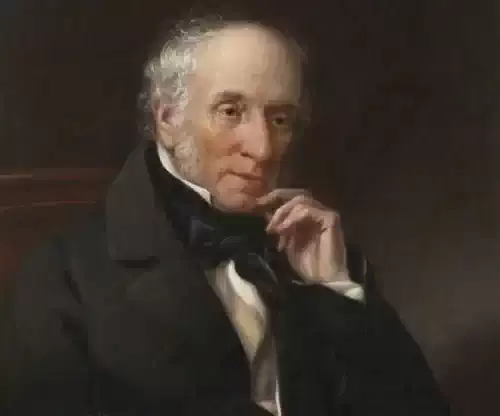
William Wordsworth

William Wordsworth

1770–1850 · lived 80 years GB GB

William Wordsworth was a pivotal English poet who, along with Samuel Taylor Coleridge, helped launch the Romantic Age in English literature. His poetry is deeply rooted in the natural world, often exploring themes of memory, imagination, and the spiritual connection between humanity and nature. He is celebrated for his lyrical intensity, his profound empathy, and his ability to find extraordinary beauty and meaning in the ordinary experiences of life.

n. 1770-04-07, Cockermouth · m. 1850-04-23, Rydal Mount

29,030 Views

Written With a Pencil Upon a Stone In The Wall of The House, On The Island

Written With a Pencil Upon a Stone In The Wall of The House, On The Island
at Grasmere
Rude is this Edifice, and Thou hast seen
Buildings, albeit rude, that have maintained
Proportions more harmonious, and approached
To closer fellowship with ideal grace.
But take it in good part:--alas! the poor
Vitruvius of our village had no help
From the great City; never, upon leaves
Of red Morocco folio, saw displayed,
In long succession, pre-existing ghosts
Of Beauties yet unborn--the rustic Lodge
Antique, and Cottage with verandah graced,
Nor lacking, for fit company, alcove,
Green-house, shell-grot, and moss-lined hermitage.
Thou see'st a homely Pile, yet to these walls
The heifer comes in the snow-storm, and here
The new-dropped lamb finds shelter from the wind.
And hither does one Poet sometimes row
His pinnace, a small vagrant barge, up-piled
With plenteous store of heath and withered fern,
(A lading which he with his sickle cuts,
Among the mountains) and beneath this roof
He makes his summer couch, and here at noon
Spreads out his limbs, while, yet unshorn, the Sheep,
Panting beneath the burthen of their wool,
Lie round him, even as if they were a part
Of his own Household: nor, while from his bed
He looks, through the open door-place, toward the lake
And to the stirring breezes, does he want
Creations lovely as the work of sleep--
Fair sights, and visions of romantic joy!
Read full poem
Bio

Identification and basic context

William Wordsworth was an English poet who was a key figure in the Romantic movement. He was born in Cockermouth, Cumberland, England. He wrote primarily in English.

Childhood and education

Wordsworth's childhood was marked by the beauty of the Lake District, which profoundly influenced his later poetry. He received a formal education at Hawkshead Grammar School and later attended St John's College, Cambridge. His early exposure to nature and his rigorous education laid the foundation for his literary career.

Literary trajectory

Wordsworth's literary career began with early poems and collaborative works. His collaboration with Samuel Taylor Coleridge on "Lyrical Ballads" (1798) is considered a landmark event, ushering in the Romantic era. He continued to write prolifically throughout his life, publishing major works such as "The Prelude," an autobiographical epic poem.

Works, style, and literary characteristics

Major works include "Lyrical Ballads" (1798), "The Prelude" (completed 1805, published 1850), "Ode: Intimations of Immortality" (1807), and "The Excursion" (1814). His poetry explores themes of nature, memory, childhood, the human mind, and the sublime. Wordsworth's style is characterized by its focus on the language of ordinary people, his deep emotional response to nature, and his philosophical musings. He often used blank verse and lyrical forms, emphasizing sincerity and spontaneity. His innovations included elevating the commonplace and everyday to the level of high art, and exploring the psychological impact of nature.

Cultural and historical context

Wordsworth lived during a period of significant social and political upheaval in Europe, including the French Revolution and the Napoleonic Wars. He was part of the generation of poets that included Coleridge, Byron, Shelley, and Keats. His work often reflected a tension between the revolutionary ideals of his youth and the more conservative political climate that followed.

Personal life

Wordsworth experienced personal tragedies, including the death of his father and the loss of his wife, Mary Hutchinson. His deep love for his sister, Dorothy Wordsworth, is evident in his correspondence and poetry. He lived a relatively secluded life, deeply connected to the landscape of the Lake District, but he also engaged in intellectual and political discussions.

Recognition and reception

While initially met with mixed reviews, Wordsworth's reputation grew steadily throughout his life and posthumously. He was appointed Poet Laureate in 1843. His work came to be recognized for its profound insight into human nature and its celebration of the natural world.

Influences and legacy

Wordsworth was influenced by the poets of the English Renaissance and by the philosophical ideas of his time. He, in turn, profoundly influenced subsequent generations of poets, shaping the trajectory of English Romanticism and beyond. His emphasis on nature and the individual's experience of it remains a powerful legacy.

Interpretation and critical analysis

Wordsworth's poetry is often interpreted through the lens of his Pantheistic leanings, his theories of poetic diction, and his exploration of the development of the poet's mind. Critics have analyzed his complex relationship with memory and imagination, and his philosophical engagement with the ideas of Rousseau and Kant.

Curiosities and lesser-known aspects

Wordsworth was known for his methodical and often solitary habits of composition. He would often pace extensively while composing, sometimes accompanied by his sister Dorothy. He had a strong sense of his own poetic mission and was deeply committed to his principles.

Death and memory

Wordsworth died at Rydal Mount, Ambleside, in 1850. His final great work, "The Prelude," was published posthumously and is now considered his masterpiece. He is buried in Grasmere churchyard.

Poems

114

I Wandered Lonely as a Cloud

"I Wandered Lonely as a Cloud"
I wandered lonely as a cloud
That floats on high o'er vales and hills,
When all at once I saw a crowd,
A host, of golden daffodils;
Beside the lake, beneath the trees,
Fluttering and dancing in the breeze.
Continuous as the stars that shine
And twinkle on the milky way,
They stretched in never-ending line
Along the margin of a bay:
Ten thousand saw I at a glance,
Tossing their heads in sprightly dance.
The waves beside them danced; but they
Out-did the sparkling waves in glee:
A poet could not but be gay,
In such a jocund company:
I gazed---and gazed---but little thought
What wealth the show to me had brought:
For oft, when on my couch I lie
In vacant or in pensive mood,
They flash upon that inward eye
Which is the bliss of solitude;
And then my heart with pleasure fills,
And dances with the daffodils.
221

She Dwelt Among Untrodden Ways

"She Dwelt Among Untrodden Ways"
She dwelt among the untrodden ways
Beside the springs of Dove,
Maid whom there were none to praise
And very few to love:
A violet by a mosy tone
Half hidden from the eye!
---Fair as a star, when only one
Is shining in the sky.
She lived unknown, and few could know
When Lucy ceased to be;
But she is in her grave, and, oh,
The difference to me!
450

Is ample, and some little might be stored

Is ample, and some little might be stored
Wherewith to cheer him in the winter time."
Thus talking of that Peasant, we approached
Close to the spot where with his rod and line
He stood alone; whereat he turned his head
To greet us--and we saw a Mam worn down
By sickness, gaunt and lean, with sunken cheeks
And wasted limbs, his legs so long and lean
That for my single self I looked at them,
Forgetful of the body they sustained.--
Too weak to labour in the harvest field,
The Man was using his best skill to gain
A pittance from the dead unfeeling lake
That knew not of his wants. I will not say
What thoughts immediately were ours, nor how
The happy idleness of that sweet morn,
With all its lovely images, was changed
To serious musing and to self-reproach.
Nor did we fail to see within ourselves
What need there is to be reserved in speech,
And temper all our thoughts with charity.
--Therefore, unwilling to forget that day,
My Friend, Myself, and She who then received
The same admonishment, have called the place
By a memorial name, uncouth indeed
As e'er by mariner was given to bay
Or foreland, on a new-discovered coast;
And POINT RASH-JUDGMENT is the name it bears.
226

A Whirl-Blast from Behind the Hill

"A Whirl-Blast from Behind the Hill"
A Whirl-Blast from behind the hill
Rushed o'er the wood with startling sound;
Then--all at once the air was still,
And showers of hailstones pattered round.
Where leafless oaks towered high above,
I sat within an undergrove
Of tallest hollies, tall and green;
A fairer bower was never seen.
From year to year the spacious floor
With withered leaves is covered o'er,
And all the year the bower is green.
But see! where'er the hailstones drop
The withered leaves all skip and hop;
There's not a breeze--no breath of air--
Yet here, and there, and everywhere
Along the floor, beneath the shade
By those embowering hollies made,
The leaves in myriads jump and spring,
As if with pipes and music rare
Some Robin Good-fellow were there,
And all those leaves, in festive glee,
Were dancing to the minstrelsy.
197

Quotes

40

Videos

50

Comments (0)

Share
Log in to post a comment.

No comments yet. Be the first to comment.