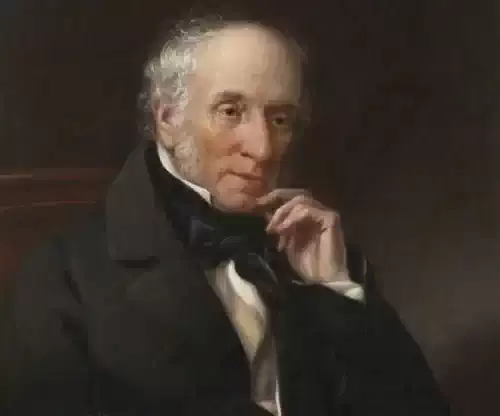
To The Daisy (first poem)
To The Daisy (first poem)
"Her divine skill taught me this,
That from every thing I saw
I could some instruction draw,
And raise pleasure to the height
Through the meanest objects sight.
By the murmur of a spring,
Or the least bough's rustelling;
By a Daisy whose leaves spread
Shut when Titan goes to bed;
Or a shady bush or tree;
She could more infuse in me
Than all Nature's beauties can
In some other wiser man.'
G. Wither. * His muse.
IN youth from rock to rock I went,
From hill to hill in discontent
Of pleasure high and turbulent,
Most pleased when most uneasy;
But now my own delights I make,--
My thirst at every rill can slake,
And gladly Nature's love partake,
Of Thee, sweet Daisy!
Thee Winter in the garland wears
That thinly decks his few grey hairs;
Spring parts the clouds with softest airs,
That she may sun thee;
Whole Summer-fields are thine by right;
And Autumn, melancholy Wight!
Doth in thy crimson head delight
When rains are on thee.
In shoals and bands, a morrice train,
Thou greet'st the traveller in the lane;
Pleased at his greeting thee again;
Yet nothing daunted,
Nor grieved if thou be set at nought:
And oft alone in nooks remote
We meet thee, like a pleasant thought,
When such are wanted.
Be violets in their secret mews
The flowers the wanton Zephyrs choose;
Proud be the rose, with rains and dews
Her head impearling,
Thou liv'st with less ambitious aim,
Yet hast not gone without thy fame;
Thou art indeed by many a claim
The Poet's darling.
If to a rock from rains he fly,
�
Or, some bright day of April sky,
Imprisoned by hot sunshine lie
Near the green holly,
And wearily at length should fare;
He needs but look about, and there
Thou art!--a friend at hand, to scare
His melancholy.
A hundred times, by rock or bower,
Ere thus I have lain couched an hour,
Have I derived from thy sweet power
Some apprehension;
Some steady love; some brief delight;
Some memory that had taken flight;
Some chime of fancy wrong or right;
Or stray invention.
If stately passions in me burn,
And one chance look to Thee should turn,
I drink out of an humbler urn
A lowlier pleasure;
The homely sympathy that heeds
The common life, our nature breeds;
A wisdom fitted to the needs
Of hearts at leisure.
Fresh-smitten by the morning ray,
When thou art up, alert and gay,
Then, cheerful Flower! my spirits play
With kindred gladness:
And when, at dusk, by dews opprest
Thou sink'st, the image of thy rest
Hath often eased my pensive breast
Of careful sadness.
And all day long I number yet,
All seasons through, another debt,
Which I, wherever thou art met,
To thee am owing;
An instinct call it, a blind sense;
A happy, genial influence,
Coming one knows not how, nor whence,
Nor whither going.
Child of the Year! that round dost run
Thy pleasant course,--when day's begun
As ready to salute the sun
As lark or leveret,
Thy long-lost praise thou shalt regain;
Nor be less dear to future men
Than in old time;--thou not in vain
Art Nature's favourite.
�
To The Daisy
To The Daisy
IN youth from rock to rock I went
From hill to hill in discontent
Of pleasure high and turbulent,
Most pleased when most uneasy;
But now my own delights I make,---
Thirst at every rill can slake,
And gladly Nature's love partake,
Of Thee, sweet Daisy!
Thee Winter in the garland wears
That thinly decks his few gray hairs;
Spring parts the clouds with softest airs,
That she may sun thee;
Whole Summer-fields are thine by right;
And Autumn, melancholy Wight!
Doth in thy crimson head delight
When rains are on thee.
In shoals and bands, a morrice train,
Thou greet'st the traveller in the lane;
Pleased at his greeting thee again;
Yet nothing daunted,
Nor grieved if thou be set at nought:
And oft alone in nooks remote
We meet thee, like a pleasant thought,
When such are wanted.
Be violets in their secret mews
The flowers the wanton Zephyrs choose;
Proud be the rose, with rains and dew
Her head impearling,
Thou liv'st with less ambitious aim,
Yet hast not gone without thy fame;
Thou art indeed by many a claim
The Poet's darling.
If to a rock from rain he fly,
Or, some bright day of April sky,
Imprisoned by hot sunshine lie
Near the green holly,
And wearily at length should fare;
He need but look about, and there
Thou art!---a friend at hand, to care
His melancholy.
A hundred times, by rock or bower,
Ere thus I have lain couched an hour,
Have I derived from thy sweet power
Some apprehension
Some steady love; some brief delight;
Some memory that had taken flight;
Some chime of fancy wrong or right;
�
Of stray invention.
If stately passions in me burn,
And one chance look to Thee should turn,
I drink out of an humbler urn
A lowlier pleasure;
The homely sympathy that heeds
The common life, our nature breeds;
A wisdom fitted to the needs
Of hearts at leisure.
Fresh-smitten by the morning ray,
When thou art up, alert and gay,
Then, cheerful Flower! my spirits play
With kindred gladness:
And when, at dusk, by dews opprest
Thou sink'st, the image of thy rest
Hath often eased my pensive breast
Of careful sadness.
And all day long I number yet,
All seasons through, another debt,
Which I, wherever thou art met,
To thee am owing;
An instinct call it, a blind sense;
A happy, genial influence,
Coming one knows not how, nor whence,
Nor whither going.
Child of the Year! that round dost run
Thy pleasant course,---when day's begun
As ready to salute the sun
As lark or leveret,
Thy long-lost praise thou shalt regain;
Nor be less dear to future men
Than in old time;---thou not in vain
Art Nature's favourite.
To My Sister
To My Sister
It is the first mild day of March:
Each minute sweeter than before
The redbreast sings from the tall larch
That stands beside our door.
There is a blessing in the air,
Which seems a sense of joy to yield
To the bare trees, and mountains bare,
And grass in the green field.
My sister! ('tis a wish of mine)
Now that our morning meal is done,
Make haste, your morning task resign;
Come forth and feel the sun.
Edward will come with you;--and, pray,
Put on with speed your woodland dress;
And bring no book: for this one day
We'll give to idleness.
No joyless forms shall regulate
Our living calendar:
We from to-day, my Friend, will date
The opening of the year.
Love, now a universal birth,
From heart to heart is stealing,
From earth to man, from man to earth:
--It is the hour of feeling.
One moment now may give us more
Than years of toiling reason:
Our minds shall drink at every pore
The spirit of the season.
Some silent laws our hearts will make,
Which they shall long obey:
We for the year to come may take
Our temper from to-day.
And from the blessed power that rolls
About, below, above,
We'll frame the measure of our souls:
They shall be tuned to love.
Then come, my Sister! come, I pray,
With speed put on your woodland dress;
And bring no book: for this one day
We'll give to idleness.
To a Sky-Lark
To a Sky-Lark
Up with me! up with me into the clouds!
For thy song, Lark, is strong;
Up with me, up with me into the clouds!
Singing, singing,
With clouds and sky about thee ringing,
Lift me, guide me till I find
That spot which seems so to thy mind!
I have walked through wildernesses dreary
And to-day my heart is weary;
Had I now the wings of a Faery,
Up to thee would I fly.
There is madness about thee, and joy divine
In that song of thine;
Lift me, guide me high and high
To thy banqueting-place in the sky.
Joyous as morning
Thou art laughing and scorning;
Thou hast a nest for thy love and thy rest,
And, though little troubled with sloth,
Drunken Lark! thou would'st be loth
To be such a traveller as I.
Happy, happy Liver,
With a soul as strong as a mountain river
Pouring out praise to the Almighty Giver,
Joy and jollity be with us both!
Alas! my journey, rugged and uneven,
Through prickly moors or dusty ways must wind;
But hearing thee, or others of thy kind,
As full of gladness and as free of heaven,
I, with my fate contented, will plod on,
And hope for higher raptures, when life's day is done.
To M.H.
To M.H.
Our walk was far among the ancient trees:
There was no road, nor any woodman's path;
But a thick umbrage--checking the wild growth
Of weed and sapling, along soft green turf
Beneath the branches--of itself had made
A track, that brought us to a slip of lawn,
And a small bed of water in the woods.
All round this pool both flocks and herds might drink
On its firm margin, even as from a well,
Or some stone-basin which the herdsman's hand
Had shaped for their refreshment; nor did sun,
Or wind from any quarter, ever come,
But as a blessing to this calm recess,
This glade of water and this one green field.
The spot was made by Nature for herself;
The travellers know it not, and 'twill remain
Unknown to them; but it is beautiful;
And if a man should plant his cottage near,
Should sleep beneath the shelter of its trees,
And blend its waters with his daily meal,
He would so love it, that in his death-hour
Its image would survive among his thoughts:
And therefore, my sweet MARY, this still Nook,
With all its beeches, we have named from You!
To A Butterfly (second poem)
To A Butterfly (second poem)
I've watched you now a full half-hour,
Self-poised upon that yellow flower;
And, little Butterfly! indeed
I know not if you sleep or feed.
How motionless!---not frozen seas
More motionless! and then
What joy awaits you, when the breeze
Hath found you out among the trees,
And calls you forth again !
This plot of orchard-ground is ours;
My trees they are, my Sister's flowers;
Here rest your wing when they are weary;
Here lodge as in a sanctuary!
Come often to us, fear no wrong;
Sit near us on the bough!
We'll talk of sunshine and of song,
And summer days, when we were young;
Sweet childish days, that were as long
As twenty days are now.
To A Sexton
To A Sexton
Let thy wheel-barrow alone--
Wherefore, Sexton, piling still
In thy bone-house bone on bone?
'Tis already like a hill
In a field of battle made,
Where three thousand skulls are laid;
These died in peace each with the other,--
Father, sister, friend, and brother.
Mark the spot to which I point!
From this platform, eight feet square,
Take not even a finger-joint:
Andrew's whole fire-side is there.
Here, alone, before thine eyes,
Simon's sickly daughter lies,
From weakness now, and pain defended,
Whom he twenty winters tended.
Look but at the gardener's pride--
How he glories, when he sees
Roses, lilies, side by side,
Violets in families!
By the heart of Man, his tears,
By his hopes and by his fears,
Thou, too heedless, art the Warden
Of a far superior garden.
Thus then, each to other dear,
Let them all in quiet lie,
Andrew there, and Susan here,
Neighbours in mortality.
And, should I live through sun and rain
Seven widowed years without my Jane,
O Sexton, do not then remove her,
Let one grave hold the Loved and Lover!
'Tis Said, That Some Have Died For Love
'Tis Said, That Some Have Died For Love
'Tis said, that some have died for love:
And here and there a churchyard grave is found
In the cold north's unhallowed ground,
Because the wretched man himself had slain,
His love was such a grievous pain.
And there is one whom I five years have known;
He dwells alone
Upon Helvellyn's side:
He loved--the pretty Barbara died;
And thus he makes his moan:
Three years had Barbara in her grave been laid
When thus his moan he made:
"Oh, move, thou Cottage, from behind that oak!
Or let the aged tree uprooted lie,
That in some other way yon smoke
May mount into the sky!
The clouds pass on; they from the heavens depart.
I look--the sky is empty space;
I know not what I trace;
But when I cease to look, my hand is on my heart.
"Oh! what a weight is in these shades! Ye leaves,
That murmur once so dear, when will it cease?
Your sound my heart of rest bereaves,
It robs my heart of peace.
Thou Thrush, that singest loud--and loud and free,
Into yon row of willows flit,
Upon that alder sit;
Or sing another song, or choose another tree.
"Roll back, sweet Rill! back to thy mountain-bounds,
And there for ever be thy waters chained!
For thou dost haunt the air with sounds
That cannot be sustained;
If still beneath that pine-tree's ragged bough
Headlong yon waterfall must come,
Oh let it then be dumb!
Be anything, sweet Rill, but that which thou art now.
"Thou Eglantine, so bright with sunny showers,
Proud as a rainbow spanning half the vale,
Thou one fair shrub, oh! shed thy flowers,
And stir not in the gale.
For thus to see thee nodding in the air,
To see thy arch thus stretch and bend,
Thus rise and thus descend,--
Disturbs me till the sight is more than I can dear."
The Man who makes this feverish complaint
Is one of giant stature, who could dance
Equipped from head to foot in iron mail.
�
Ah gentle Love! if ever thought was thine
To store up kindred hours for me, thy face
Turn from me, gentle Love! nor let me walk
Within the sound of Emma's voice, nor know
Such happiness as I have known to-day.
To A Butterfly ()
To A Butterfly ()
I'VE watched you now a full half-hour,
Self-poised upon that yellow flower;
And, little Butterfly! indeed
I know not if you sleep or feed.
How motionless!---not frozen seas
More motionless! and then
What joy awaits you, when the breeze
Hath found you out among the trees,
And calls you forth again !
This plot of orchard-ground is ours;
My trees they are, my Sister's flowers;
Here rest your wing when they are weary;
Here lodge as in a sanctuary!
Come often to us, fear no wrong;
Sit near us on the bough!
We'll talk of sunshine and of song,
And summer days, when we were young;
Sweet childish days, that were as long
As twenty days are now.
There was a Boy
There was a Boy
There was a Boy; ye knew him well, ye cliffs
And islands of Winander!--many a time,
At evening, when the earliest stars began
To move along the edges of the hills,
Rising or setting, would he stand alone,
Beneath the trees, or by the glimmering lake;
And there, with fingers interwoven, both hands
Pressed closely palm to palm and to his mouth
Uplifted, he, as through an instrument,
Blew mimic hootings to the silent owls,
That they might answer him.--And they would shout
Across the watery vale, and shout again,
Responsive to his call,--with quivering peals,
And long halloos, and screams, and echoes loud
Redoubled and redoubled; concourse wild
Of jocund din! And, when there came a pause
Of silence such as baffled his best skill:
Then, sometimes, in that silence, while he hung
Listening, a gentle shock of mild surprise
Has carried far into his heart the voice
Of mountain-torrents; or the visible scene
Would enter unawares into his mind
With all its solemn imagery, its rocks,
Its woods, and that uncertain heaven received
Into the bosom of the steady lake.
This boy was taken from his mates, and died
In childhood, ere he was full twelve years old.
Pre-eminent in beauty is the vale
Where he was born and bred: the churchyard hangs
Upon a slope above the village-school;
And, through that church-yard when my way has led
On summer-evenings, I believe, that there
A long half-hour together I have stood
Mute--looking at the grave in which he lies!