
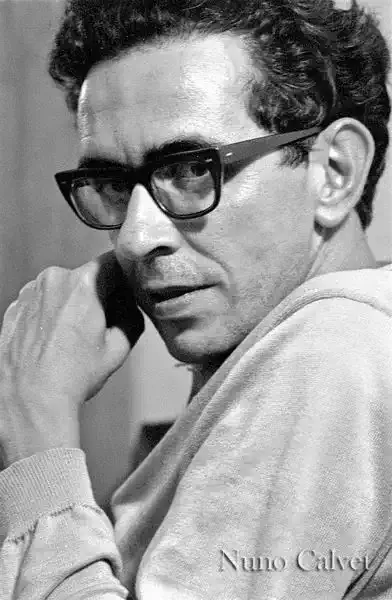
António Ramos Rosa
1924–2013
· lived 88 years
 PT
PT
PT
António Ramos Rosa was one of the most influential Portuguese poets of the 20th century, known for his dense, reflective poetry deeply connected to the human condition and language. His work is marked by a constant search for authentic expression, exploring themes such as existence, death, time, and poetry itself. His writing evolved over decades, maintaining thematic and stylistic coherence, but always open to new formal and lexical explorations. He is considered a pillar of contemporary Portuguese-language poetry.
n. 1924-10-17, Faro · m. 2013-09-23, Lisboa
154
Views
Bio
Identification and Basic Context
António Ramos Rosa, full name António Ramos Rosa, was born in 1924 and passed away in 2013. He was a Portuguese poet, essayist, and literary critic. He resided in Lisbon. He was known for his Portuguese nationality and for writing in the Portuguese language. The historical context in which he lived was marked by profound social, political, and cultural transformations in Portugal and the world, including the Salazar dictatorship and the transition to democracy.Childhood and Education
He spent his childhood and adolescence in Lourenço Marques (present-day Maputo), Mozambique, where his father was a civil servant. This African experience profoundly marked his sensibility and his work, introducing elements of exoticism and a unique perspective on identity and exile. His initial education took place in Mozambique, but he returned to Portugal to pursue his university studies in Coimbra, where he studied Law and Letters.Literary Career
His literary activity began in the 1940s. His poetic work was published from 1950 onwards, with "O Grito Amargo" (The Bitter Cry). Throughout his career, his poetry went through different phases, but maintained a line of deep investigation into language and existence. He was an active collaborator in various literary publications, such as the magazine "Távola Redonda" (Round Table), and developed important activity as a literary critic and translator.Work, Style, and Literary Characteristics
Among his most important works are "O Grito Amargo" (1950), "Viagem Através duma Neblina" (Journey Through a Mist) (1960), "A Nuvem" (The Cloud) (1962), "Ocupação do Espaço" (Occupation of Space) (1963), and "A Dança Inicial" (The Initial Dance) (1968). The dominant themes in his poetry include existential anguish, the passage of time, death, the search for identity, and reflection on language itself. Ramos Rosa explored various poetic forms, moving between free verse and more elaborate structures, with a striking use of metaphor and a dense, reflective rhythm. His poetic voice is often confessional and introspective, but with a universal dimension. His style is characterized by a rich vocabulary, powerful imagery, and precise, interrogative language. He is associated with the neorealist movement and, later, with a more personal and reflective line of modernism.Cultural and Historical Context
António Ramos Rosa lived under the Salazar dictatorship, which influenced his work with a tone of resistance and criticism, although often subtly and focused on inner freedom and language. He was a central figure in Portuguese cultural life, maintaining relationships with other writers and intellectuals of his generation, although he often maintained a solitary stance and deep reflection.Personal Life
His experiences in Mozambique and his return to Portugal shaped his worldview and his sense of identity. He maintained close relationships with other poets and intellectuals, actively participating in the cultural debates of the time. His life was marked by intense dedication to poetry and reflection, earning him respect and admiration as an intellectual.Recognition and Reception
António Ramos Rosa is widely recognized as one of the great contemporary Portuguese poets, holding a prominent place in national literature. He received several awards and distinctions throughout his career, and his work is the subject of academic study and greatly appreciated by readers and critics.Influences and Legacy
He was influenced by poets such as Fernando Pessoa, Walt Whitman, and Symbolist poetry. His legacy extends to several generations of poets who found in his work a benchmark of rigor, depth, and innovation. His poetry continues to be studied and inspire new creators in Portugal and the Portuguese-speaking world.Interpretation and Critical Analysis
Ramos Rosa's work is often interpreted as a profound meditation on the human condition, the fragility of existence, and the complexity of language as a tool for grasping reality. His existential and philosophical reflections invite a deep analysis of the meaning of life and art.Curiosities and Lesser-Known Aspects
A curiosity is his initial connection to Mozambique, which provided him with a unique perspective on African reality and colonial identity. His writing habits were marked by discipline and dedication, always seeking the exact word and the most authentic expression.Death and Memory
António Ramos Rosa passed away in 2013. His memory is preserved through his vast body of work, which continues to be published, studied, and admired, consolidating his place as one of the greatest figures in Portuguese-language poetry.Poems
0No poems found
Videos
50
Comments (0)
Log in
to post a comment.
No comments yet. Be the first to comment.