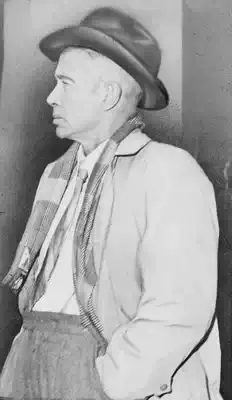
E. E. Cummings

E. E. Cummings

1894–1962 · lived 67 years US US

E. E. Cummings was an American poet, painter, essayist, author, and playwright, renowned for his unconventional style that defied traditional grammar, syntax, and punctuation. His poetry often celebrated individualism, nature, and love, expressed through playful experimentation with form and a distinctive visual arrangement of words on the page. Cummings's work is characterized by its lyrical intensity, its embrace of the simple and the sublime, and its critique of conformity and societal norms. He was a prolific artist whose unique voice continues to resonate, making him one of the most beloved and accessible poets of the 20th century.

n. 1894-10-14, Cambridge · m. 1962-09-03, Joy Farm

12,882 Views

I Am A Beggar Always

I Am A Beggar Always

i am a beggar always
who begs in your mind


(slightly smiling, patient, unspeaking
with a sign on his
chest
BLIND)yes i


am this person of whom somehow
you are never wholly rid(and who


does not ask for more than
just enough dreams to
live on)

after all, kid


you might as well
toss him a few thoughts


a little love preferably,
anything which you can't
pass off on other people: for
instance a
plugged promise


the he will maybe (hearing something
fall into his hat)go wandering
after it with fingers;till having


found
what was thrown away

himself
taptaptaps out of your brain, hopes, life
to(carefully turning a
corner)never bother you any more


Anonymous submission.
Read full poem
Bio

Identification and basic context

Full name: Edward Estlin Cummings. He often signed his name in lowercase, e.g., 'e. e. cummings,' as a deliberate stylistic choice to emphasize his rejection of traditional conventions and his focus on the individual. He was an American writer, poet, painter, essayist, author, and playwright. He wrote in English.

Childhood and education

Cummings was born in Cambridge, Massachusetts. His father, Edward Cummings, was a professor of English at Harvard University and later a minister. His mother, Rebecca Haseltine Clarke, was a writer. Cummings attended Cambridge School of C. J. of America and then Harvard University, where he studied English and Classics and began to experiment with poetry. He received his Master's degree from Harvard in 1915. His early influences included classical literature and the burgeoning modernist movements in art and literature.

Literary trajectory

Cummings's literary career began during his time at Harvard. His first collection of poems, *Tulips and Chimneys*, was published in 1923. Throughout his life, he continued to write prolifically, producing poetry, novels, plays, and essays. He was a highly original voice whose work evolved stylistically but remained committed to his core themes of love, nature, and individualism. He was also active as a painter, exhibiting his artwork throughout his career.

Works, style, and literary characteristics

Cummings's major works include *Tulips and Chimneys* (1923), *NoThanks* (1935), and *95 Poems* (1958). His poetry is instantly recognizable for its unique style: unconventional use of capitalization, punctuation, and spacing; invented words; and often a playful, lyrical tone. Common themes include romantic love, the beauty of nature, the individual's struggle against conformity, and a critique of mass society and political institutions. He often employed the sonnet form but radically adapted it to his experimental style. His language is rich with imagery, often celebrating the simple and the profound. He brought a fresh, modern sensibility to lyric poetry.

Cultural and historical context

Cummings lived through significant historical periods, including World War I and World War II, and the social and political changes of the 20th century. His experiences during WWI, particularly his imprisonment in France for alleged espionage, deeply impacted him and are reflected in his novel *The Enormous Room* (1922). He was often critical of what he perceived as the conformity and soullessness of modern industrial society. His work can be seen as a reaction against the prevailing social and political currents of his time, emphasizing individual freedom and authentic experience.

Personal life

Cummings had a complex personal life, marked by a passionate engagement with art and life. He was married twice. His time in Paris in the early 1920s was formative, exposing him to avant-garde artistic circles. He maintained a strong connection to his family and friends, and his personal relationships often found expression in his poetry.

Recognition and reception

While Cummings was not always embraced by mainstream literary critics during his lifetime, he achieved significant popularity among readers for his accessible themes and innovative style. He received several honors and awards for his poetry, including the Shelley Memorial Award and the National Medal for Literature. His work continues to be widely read and studied.

Influences and legacy

Cummings was influenced by traditional poets like William Blake and E. A. Robinson, as well as by modernist painters and poets. His legacy lies in his distinctive contribution to American poetry, demonstrating the power of linguistic and visual experimentation to convey profound human emotions and ideas. He inspired many poets to explore unconventional forms and to celebrate individuality.

Interpretation and critical analysis

Cummings's poetry is often interpreted as a celebration of romantic love, the natural world, and the inherent value of the individual consciousness. His experiments with form are seen not as mere gimmickry but as integral to his message of liberation from restrictive norms. His critique of conformity and his embrace of sincerity are recurring points of critical analysis.

Curiosities and lesser-known aspects

Cummings was a passionate visual artist in addition to being a poet and writer. He often integrated his paintings and drawings with his poems. He was also known for his strong opinions and his independent spirit, often refusing to compromise his artistic vision.

Death and memory

Edward Estlin Cummings died in North Conway, New Hampshire. His enduring legacy is secured by his unique and beloved body of work, which continues to captivate readers with its originality and emotional depth.

Poems

23

I Am A Beggar Always

I Am A Beggar Always

i am a beggar always
who begs in your mind


(slightly smiling, patient, unspeaking
with a sign on his
chest
BLIND)yes i


am this person of whom somehow
you are never wholly rid(and who


does not ask for more than
just enough dreams to
live on)

after all, kid


you might as well
toss him a few thoughts


a little love preferably,
anything which you can't
pass off on other people: for
instance a
plugged promise


the he will maybe (hearing something
fall into his hat)go wandering
after it with fingers;till having


found
what was thrown away

himself
taptaptaps out of your brain, hopes, life
to(carefully turning a
corner)never bother you any more


Anonymous submission.
1,430

ygUDuh

ygUDuh


ygUDuh

ydoan
yunnuhstan


ydoan o
yunnuhstand dem
yguduh ged

yunnuhstan dem doidee

yguduh ged riduh

ydoan o nudn


LISN bud LISN

dem
gud
am


lidl yelluh bas
tuds weer goin


duhSIVILEYEzum
722

this(let's remember)day died again and...

this(let's remember)day died again and...

this(let's remember)day died again and
again;whose golden,crimson dooms conceive


an oceaning abyss of orange dream


larger than sky times earth:a flame beyond
soul immemorially forevering amand
as collapsing that grey mind by wave
doom disappeared,out of perhaps(who knows?)


eternity floated a blossoming


(while anyone might slowly count to soon)
rose-did you see her?darling,did you(kiss
me)quickly count to never?you were wrong


-then all the way from perfect nowhere came


(as easily as we forget something)
livingest the imaginable moon
534

when serpents bargain

when serpents bargain

when serpents bargain for the right to squirm
and the sun strikes to gain a living wage when
thorns regard their roses with alarm
and rainbows are insured against old age


when every thrush may sing no new moon in
if all screech-owls have not okayed his voice


-and any wave signs on the dotted line
or else an ocean is compelled to close
when the oak begs permission of the birch
to make an acorn - valleys accuse their
mountains of having altitude - and march
denounces april as a saboteur


then we'll believe in that incredible
unanimal mankind (and not until)
594

Sometimes I Am Alive Because With

Sometimes I Am Alive Because With

sometimes i am alive because with
me her alert treelike body sleeps
which i will feel slowly sharpening
becoming distinct with love slowly,
who in my shoulder sinks sweetly teeth
until we shall attain the Springsmelling
intense large togethercoloured instant


the moment pleasantly frightful


when, her mouth suddenly rising, wholly
begins with mine fiercely to fool
(and from my thighs which shrug and pant
a murdering rain leapingly reaches the upward singular deepest flower which she
carries in a gesture of her hips)
571

Spring is like a perhaps hand

Spring is like a perhaps hand

Spring is like a perhaps hand
(which comes carefully
out of Nowhere)arranging
a window,into which people look(while
people stare
arranging and changing placing
carefully there a strange
thing and a known thing here)and


changing everything carefully


spring is like a perhaps
Hand in a window
(carefully to
and fro moving New and
Old things,while
people stare carefully
moving a perhaps
fraction of flower here placing
an inch of air there)and


without breaking anything.
642

Poem 42

Poem 42

n
OthI
n


g can


s
urPas
s


the m


y
SteR
y


of


s
tilLnes
s
614

of Ever-Ever Land i speak

of Ever-Ever Land i speak

(of Ever-Ever Land i speak
sweet morons gather roun'
who does not dare to stand or sit
may take it lying down)


down with the human soul
and anything else uncanned
for everyone carries canopeners
in Ever-Ever Land


(for Ever-Ever Land is a place
that's as simple as simple can be
and was built that way on purpose
by simple people like we)


down with hell and heaven
and all the religious fuss
infinity pleased our parents
one inch looks good to us


(and Ever-Ever Land is a place
that's measured and safe and known
where it's lucky to be unlucky
and the hitler lies down with the cohn)


down above all with love
and everything perverse
or which makes some feel more better
when all ought to feel less worse


(but only sameness is normal
in Ever-Ever Land
for a bad cigar is a woman
but a gland is only a gland)
804

my sweet old etcetera

my sweet old etcetera

my sweet old etcetera
aunt lucy during the recent


war could and what
is more did tell you just
what everybody was fighting


for,
my sister


Isabel created hundreds
(and
hundreds)of socks not to
mention fleaproof earwarmers
etcetera wristers etcetera, my
mother hoped that


i would die etcetera
bravely of course my father used
to become hoarse talking about how it was
a privilege and if only he
could meanwhile my


self etcetera lay quietly
in the deep mud et


cetera
(dreaming,
et
cetera, of
Your smile
eyes knees and of your Etcetera)
547

nobody loses all the time (X)

nobody loses all the time (X)

nobody loses all the time


i had an uncle named
Sol who was a born failure and
nearly everybody said he should have gone
into vaudeville perhaps because my Uncle Sol could
sing McCann He Was A Diver on Xmas Eve like Hell Itself which
may or may not account for the fact that my Uncle


Sol indulged in that possibly most inexcusable
of all to use a highfalootin phrase
luxuries that is or to
wit farming and be
it needlessly
added


my Uncle Sol's farm
failed because the chickens
ate the vegetables so
my Uncle Sol had a
chicken farm till the
skunks ate the chickens when


my Uncle Sol
had a skunk farm but
the skunks caught cold and
died so
my Uncle Sol imitated the
skunks in a subtle manner


or by drowning himself in the watertank
but somebody who'd given my Unde Sol a Victor
Victrola and records while he lived presented to
him upon the auspicious occasion of his decease a
scrumptious not to mention splendiferous funeral with
tall boys in black gloves and flowers and everything and


i remember we all cried like the Missouri
when my Uncle Sol's coffin lurched because
somebody pressed a button
(and down went
my Uncle
Sol


and started a worm farm)
577

Quotes

40

Videos

50

Comments (0)

Share
Log in to post a comment.

No comments yet. Be the first to comment.