
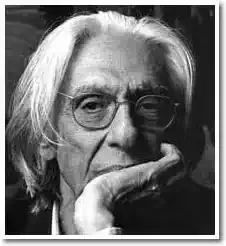
Ferreira Gullar
1930–2016
· lived 86 years
 BR
BR
BR
José Ribamar Ferreira de Araújo da Costa, known as Ferreira Gullar, was one of the most influential Brazilian poets and intellectuals. His work spans various phases, from concrete poetry to more existential and reflective poetry, always marked by a deep engagement with social and human reality. Gullar also stood out as a columnist, art critic, and essayist, leaving a multifaceted legacy in Brazilian culture.
n. 1930-09-10, São Luís · m. 2016-12-04, Rio de Janeiro
76
Views
Bio
Identification and basic context
Ferreira Gullar, birth name José Ribamar Ferreira de Araújo da Costa, was a Brazilian poet, essayist, art critic, and memoirist. He was born in São Luís, Maranhão, on September 10, 1933, and passed away in Rio de Janeiro on December 4, 2015. His work is considered a landmark in 20th-century Brazilian literature, spanning different movements and aesthetic phases.Childhood and education
Born into a lower-middle-class family in São Luís, Gullar had a childhood marked by economic difficulties, but also by an environment of cultural effervescence. He began his studies in religious schools and later enrolled in Law school, although his passion for literature was predominant. From an early age, he showed an interest in reading and writing, absorbing diverse influences, including Brazilian poetry and universal literature.Literary career
Ferreira Gullar's literary career began in the 1950s, with the publication of his first book, "Prisma," in 1952. He became one of the exponents of Neoconcretism, a movement that sought to break away from the rigidity of Concretism, proposing a more participatory art focused on human experience. Throughout his career, Gullar transitioned through various phases, exploring social poetry, existential poetry, and more lyrical poetry. He actively collaborated with newspapers and literary magazines, establishing himself as an important art critic and intellectual.Work, style, and literary characteristics
Gullar's main works include "A Luta Corporal" (1954), "Prêmio Jabuti" (1959), "Poemas Teatrais" (1960), "João Ternura" (1970), "Poema Sujo" (1975), and "Muitas Vozes" (2005). His recurring themes include love, death, time, the search for meaning, identity, social criticism, and human experience. His style evolved from more experimental and visual poetry to a more direct and profound language, with strong musicality and imagistic density. Gullar was an innovator in Brazilian poetry, especially with his contribution to Neoconcretism and the expressive force of poems like "Poema Sujo." His work dialogues with both tradition and modernity, presenting a poetic voice that is simultaneously personal and universal.Cultural and historical context
Ferreira Gullar lived in a period of intense political and social transformations in Brazil, including the military dictatorship, which led him to exile. His work reflects this context, with poems addressing repression, the struggle for freedom, and hope for a better future. He was part of the Brazilian poetry Generation of the 60s and maintained relationships with various artists and intellectuals of his time, such as Hélio Oiticica and Lygia Clark. His political stance, initially linked to the Brazilian Communist Party, marked his trajectory and influenced his literary production.Personal life
Ferreira Gullar's personal life was marked by his political activism and his dedication to art and literature. His marriage to architect Lygia Bojunga and his children played an important role in his life. The experiences lived during the military dictatorship and exile also shaped his worldview and his work. He was known for his sharp intellect, his humor, and his generosity.Recognition and reception
Ferreira Gullar is widely recognized as one of the greatest Brazilian poets of the 20th century. He received several awards, including the Camões Prize in 2010, the most important literary award in the Portuguese language. His work has been the subject of numerous academic studies and is a fundamental part of the Brazilian literary canon. His poetry is popular both in academic circles and among general readers.Influences and legacy
Gullar was influenced by poets such as Carlos Drummond de Andrade, João Cabral de Melo Neto, and Pablo Neruda. In turn, his work influenced generations of Brazilian and Latin American poets, especially those engaged with social poetry and the exploration of language possibilities. His legacy lies in the strength of his poetry, the depth of his reflections, and his commitment to art as a form of social intervention.Interpretation and critical analysis
Ferreira Gullar's work has been interpreted from various perspectives, highlighting the analysis of his social and political engagement, the exploration of existential issues, and the mastery with which he handled poetic language. The contradictions between lyricism and engagement, the search for meaning amidst chaos, and the relationship between art and life are constant themes in his poetry.Curiosities and lesser-known aspects
Few know that Ferreira Gullar, besides being a poet, was an excellent art critic, writing fundamental texts on Concretism and Neoconcretism. His passion for visual art was as intense as his passion for poetry. He also dedicated himself to translation and writing children's books. His writing habits were disciplined, but he was also known for his spontaneity and improvisational ability.Death and memory
Ferreira Gullar passed away on December 4, 2015, in Rio de Janeiro, at the age of 82, due to complications from a lung disease. His death caused great national commotion and reaffirmed his prominent place in Brazilian culture. Posthumous publications continue to keep his work alive and expand knowledge about his trajectory and thought.Poems
0No poems found
Videos
50
Comments (0)
Log in
to post a comment.
No comments yet. Be the first to comment.