
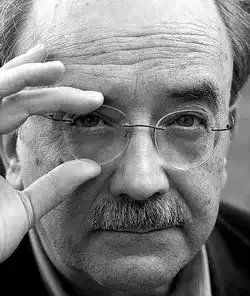
Manuel António Pina
1943–2012
· lived 68 years
 PT
PT
PT
Manuel António Pina was a Portuguese poet, writer, playwright, and essayist, a prominent figure in contemporary literature. His work, characterized by apparent simplicity, philosophical depth, and a keen eye on the human condition, explores themes such as childhood, memory, language, and transcendence. Recognized for his originality and his ability to reinvent poetic form, Pina left a significant legacy, marked by reflection on existence and the art of writing.
n. 1943-11-18, Sabugal · m. 2012-10-19, Porto
76
Views
Bio
Identification and basic context
Manuel António Pina was born in Coimbra, Portugal, on November 18, 1943, and died in the same city on October 19, 2012. He is widely recognized as one of the most important Portuguese poets of the second half of the 20th century, with a multifaceted work that includes poetry, prose, theater, and essays. He belonged to a generation of writers who, after the periods of Modernism and Neorealism, sought new forms of poetic and narrative expression, engaging with tradition and contemporaneity.Childhood and education
Manuel António Pina had a childhood in Coimbra, a city that profoundly marked his work and identity. He attended Colégio das Caldinhas and later studied Law at the University of Coimbra, although he did not complete the course. His education was rich in diverse readings, covering literature, philosophy, and visual arts. The intellectual environment of Coimbra, with its history and tradition, exerted a decisive influence on his sensibility and worldview, evident from an early stage in his literary production.Literary career
Manuel António Pina's literary career formally began in the 1970s with the publication of "Odxáleq'a" (1971). However, his work gained greater visibility and recognition from the 1980s onwards, with the publication of books such as "A Louva-a-Deus" (1980) and "Ter Lugares" (1982). Pina developed a unique career, marked by consistent production and continuous experimentation. In addition to being a poet, he was a playwright, having collaborated with Teatro O Bando, and an essayist, reflecting on language, creation, and literature. His work evolved towards a stylistic maturity that made him an unquestionable reference.Work, style, and literary characteristics
Work, style, and literary characteristics Manuel António Pina's work is marked by a deep reflection on language, memory, childhood, the city, and the human condition itself. His poetry is often described as of "apparent simplicity," but of great conceptual and emotional density. He frequently used free verse, with subtle musicality and a cadenced rhythm, and explored poetic prose with great mastery. Themes such as lost innocence, the transience of time, the search for meaning, and the relationship between the real and the imaginary are recurrent. His language is precise, lyrical, and at times fragmented, reflecting a complex view of existence. His style is unmistakable, evoking a confessional yet universal tone.Work, style, and literary characteristics
Cultural and historical context Manuel António Pina lived and produced most of his work after the 25th of April 1974, in a Portugal undergoing democratic transition. His work engages with the concerns of a society seeking new identities and forms of expression. He was part of a group of writers who, distancing themselves from grand manifestos, opted for a more intimate and formal investigation of language and experience. His work reflects the cultural and existential transformations of the late 20th and early 21st centuries.Work, style, and literary characteristics
Personal life Manuel António Pina maintained a deep connection with the city of Coimbra, where he lived and worked for much of his life. His discretion regarding his private life was notable, but his personal and familial relationships, as well as his lived experiences, are reflected in his work, often in subtle ways. His dedication to writing and reflection on art were central to his existence. There are no records of major controversies in his personal life, but rather an intense dedication to his literary craft.Work, style, and literary characteristics
Recognition and reception Manuel António Pina received several awards and distinctions throughout his career, both in Portugal and abroad, attesting to the recognition of his work. Notable among these are the Portuguese Writers Association (APE) Award and the Camões Prize in 2011, the most prestigious award in the Portuguese language. His critical reception has been consistently laudatory, valuing the originality, depth, and aesthetic quality of his poetry. He is considered one of the fundamental poets of contemporary Portuguese literature.Work, style, and literary characteristics
Influences and legacy The influences on Manuel António Pina are diverse, including poets such as Fernando Pessoa, Carlos Drummond de Andrade, Walt Whitman, and the Portuguese literary tradition in general. His legacy is marked by the renewal of poetic language, the depth of his reflections on existence, and his ability to convey a unique vision of the world. He influenced a generation of poets and writers through his authenticity and his exploration of the potentialities of the word. His work continues to be the subject of study and admiration, consolidating his place in the canon of Portuguese-language literature.Work, style, and literary characteristics
Interpretation and critical analysis Manuel António Pina's work invites multiple readings, exploring the relationship between time and memory, the ephemerality of life, and the permanence of art. Critical analyses highlight his ability to articulate the everyday with the transcendent, the concrete with the abstract. Language itself is a central theme, being questioned and reinvented in his poems. Philosophical interpretations of his work often address the search for meaning in a fragmented world, the importance of childhood as a primordial state, and the essence of artistic creation.Work, style, and literary characteristics
Curiosities and lesser-known aspects An interesting aspect of Pina's work is his relationship with childhood, viewed not just as a period of life, but as a dimension of consciousness. His writing style, sometimes fragmented and with an almost colloquial tone, hid a deep formal and conceptual labor. His essays on writing are equally revealing of his way of thinking about art. His diaries and correspondence, if they exist in large volume, could offer more insights into his creative process and personality.Work, style, and literary characteristics
Death and memory Manuel António Pina passed away in 2012 after a long illness. His death left a void in Portuguese literature, but his poetic and literary legacy remains alive. His works continue to be read, studied, and celebrated, confirming his importance in the history of Portuguese-language literature. Posthumous publications and critical editions of his work continue to emerge, ensuring the preservation and dissemination of his work for future generations.Poems
0No poems found
Comments (0)
Log in
to post a comment.
No comments yet. Be the first to comment.