
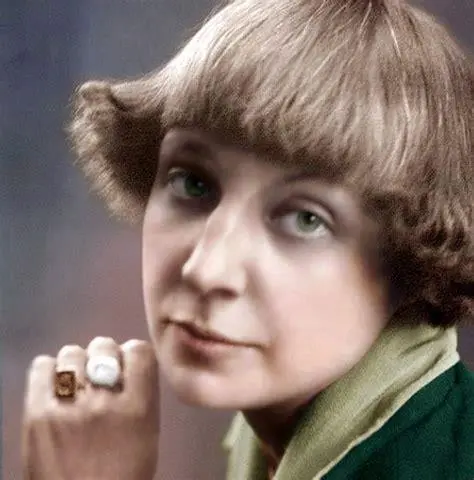
Marina Tsvetaeva
 RU
RU
Marina Tsvetaeva was one of the most prominent and original Russian poets of the 20th century, whose work is marked by an overwhelming emotional intensity, an impetuous lyricism, and an innovative language. Her poetry, deeply personal and universal at the same time, explores themes such as love, exile, solitude, the relationship with Russia, and the search for identity. Marked by the historical and personal turbulences of her time, Tsvetaeva developed a unique style, characterized by vigorous rhythms, formal experimentation, and an unmistakable poetic voice, which earned her a prominent place in Russian and world literature.
n. 1892-09-26, Moscovo · m. 1941-08-31, Ielabuga
Bio
Identification and basic context
Marina Ivanovna Tsvetaeva was born in 1892, in Moscow, Russia, and died in 1941, in Yelabuga, Soviet Union. She was one of the most important and influential Russian poets of the 20th century, known for her intense lyrical poetry and her life marked by exile and the political upheavals of her time. Her nationality was Russian and her main writing language was Russian.Childhood and education
The daughter of an art history professor and a pianist, Tsvetaeva grew up in an intellectual and artistic environment. From an early age, she showed literary talent, writing poetry in several languages (Russian, French, German). Her education included musical and literary studies, absorbing the cultural and artistic trends of her time, such as Russian Symbolism and European poetry.Literary career
Tsvetaeva's literary career began in her youth, with the publication of her first book, "The Evening Album," in 1910. Her work evolved in distinct phases, reflecting her life experiences, especially her exile after the Russian Revolution. She worked as a translator and actively participated in literary circles in Russia, Germany, France, and Czechoslovakia.Work, style, and literary characteristics
Work, style, and literary characteristics Tsvetaeva's major works include "The Craft of the Muses," "Poems to Blok," "The Mountain Wind," and "My Husband's Love." Her central themes are love (often tragic and intense), Russia, exile, solitude, identity, and the relationship between the artist and the world. Her style is notable for its lyrical force, vigorous rhythms, metric and syntactic experimentation, expressive use of punctuation and accentuation to create musical and emotional effects. Her language is dense, imagistic, and laden with pathos.Work, style, and literary characteristics
Cultural and historical context Tsvetaeva lived during a period of immense change: World War I, the Russian Revolution, the interwar period, and World War II. Exile separated her from her homeland for many years, but Russia remained a central theme in her work. Her generation, which included poets like Anna Akhmatova and Osip Mandelstam, is often associated with the period of effervescence and tragedy in Russian poetry.Work, style, and literary characteristics
Personal life Tsvetaeva's life was marked by intense passions, losses, and difficulties. Her romantic relationships were tumultuous and inspired many of her poems. The separation from her country, the death of her daughter Irina, the absence of her husband Sergei Efron, and political persecution added to an emotional burden that was reflected in her work. She lived in poverty and isolation during much of her exile.Work, style, and literary characteristics
Recognition and reception Although admired by many of her contemporaries, Tsvetaeva faced difficulties with publication and official recognition during her lifetime, especially during the Soviet period. Her work began to be widely rediscovered and celebrated after her death, consolidating her as one of the pillars of Russian and world poetry.Work, style, and literary characteristics
Influences and legacy Influenced by poets such as Blok and Baudelaire, Tsvetaeva, in turn, greatly influenced subsequent generations of Russian and international poets. Her expressive power, formal originality, and courage in exposing her emotions made her an icon of modern literature.Work, style, and literary characteristics
Interpretation and critical analysis Tsvetaeva's work is often analyzed from the perspective of her emotional intensity, her relationship with language, and her search for artistic and existential freedom. Critical interpretations explore the universality of her experience of exile and the complexity of her representations of love and identity.Work, style, and literary characteristics
Curiosities and lesser-known aspects A curiosity is that Tsvetaeva, in her exile, developed a strong friendship with the poet Rainer Maria Rilke. Her handwritten lyrics, with their characteristic capitalization and expressive punctuation, are a visual reflection of the power of her poetic voice.Work, style, and literary characteristics
Death and memory Marina Tsvetaeva committed suicide in 1941, in Yelabuga, while fleeing World War II and facing severe difficulties. Her works were gradually published and recognized in Russia and abroad, ensuring her literary immortality.Poems
0No poems found
Quotes
1No poems found
Comments (0)
No comments yet. Be the first to comment.