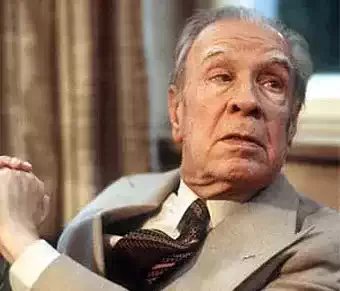
Jorge Luis Borges
Author of the day

Jorge Luis Borges

Jorge Luis Borges was an Argentine writer, poet, essayist, and translator. His work is characterized by its philosophical depth, intricate plots, and exploration of themes such as time, infinity, identity, and the nature of reality. Borges is considered one of the most significant literary figures of the 20th century, renowned for his innovative use of literary devices and his profound influence on postmodern literature.

Poem of the day

Do Not Go Gentle Into That Good Night

Dylan Thomas
Do not go gentle into that good night, 
Old age should burn and rave at close of day; 
Rage, rage against the dying of the light. 

Though wise men at their end know dark is right, 
Because their words had forked no lightning they 
Do not go gentle into that good night. 

Good men, the last wave by, crying how bright 
Their frail deeds might have danced in a green bay, 
Rage, rage against the dying of the light. 

Wild men who caught and sang the sun in flight, 
And learn, too late, they grieved it on its way, 
Do not go gentle into that good night. 

Grave men, near death, who see with blinding sight 
Blind eyes could blaze like meteors and be gay, 
Rage, rage against the dying of the light. 

And you, my father, there on that sad height, 
Curse, bless, me now with your fierce tears, I pray. 
Do not go gentle into that good night. 
Rage, rage against the dying of the light.
Read full poem

Born on this day

11
Maria da Felicidade do Couto Browne

Maria da Felicidade do Couto Browne was a poet and writer whose work, although less publicized, reflects sensitivity and a deep connection with literary expression. Her work, imbued with a particular lyricism, addresses interiority and the observation of the world around her, using careful language to express feelings and reflections. Her contribution, though discreet in the literary landscape, represents a unique voice in Portuguese-language poetry.

Robinson Jeffers

Robinson Jeffers was an American poet and environmentalist known for his poetry that frequently addresses themes such as nature, modern society, and the human condition. His work is marked by a powerful style and a philosophical pessimism.

Leónidas Lamborghini

Leónidas Lamborghini was an Argentine poet, a prominent figure in his country's literary avant-garde. His work is marked by a transgressive, experimental, and irreverent language that challenges social and literary conventions. He explored themes such as national identity, politics, the body, and sexuality, often with a provocative and critical tone.

Júlio Pomar

Júlio Pomar is an internationally renowned visual artist, known for his vast and diverse work that spans various phases and languages, from abstraction to figuration, with a critical eye on society and the human condition. His artistic career is marked by constant experimentation and deep reflection on art and life.

Nuno Gomes dos Santos

Nuno Gomes dos Santos is a poet whose work is part of Portuguese literary modernity, characterized by a refined language and the exploration of existential and social themes. His poetry frequently addresses the complexity of the human condition, the passage of time, and the search for meaning in a constantly changing world. Santos contributed to the renewal of Portuguese poetry with an innovative style and a critical view of reality.

Marià Villangómez

Marià Villangómez Llobet was a Spanish poet and writer, prominent in the literature of the Balearic Islands. His poetic work is recognized for its intimate lyricism, exploration of landscape, and reflection on the human condition. He is considered a central figure in contemporary Catalan poetry, especially in its insular strand.

Ángel Vargas

Ángel Vargas is recognized for his contribution as a writer and poet. His work is characterized by the exploration of deep and universal themes, approached with particular sensitivity and a remarkable command of language. Vargas is an important name in contemporary literature, whose verses and narratives invite reflection on existence, emotions, and society. His writing is marked by intensity and lyrical beauty.

Ariadna G. García

Ariadna G. García is a Spanish writer whose work focuses on the exploration of contemporary narratives with a strong introspective and social component. Her writing is known for addressing the complexities of human relationships and the challenges faced by the individual in today's society. With a careful prose and a remarkable ability to create engaging atmospheres, García has established herself as a relevant voice in Spanish-language literature, encouraging reflection on universal themes.

Vicente Huidobro

Chilean poet, a central figure of the 20th-century literary avant-garde. Huidobro was a bold innovator, creator of "creationism," a movement that proposed that the poet should create a new reality through words, independent of imitating the outside world. His work, vast and experimental, explored diverse forms and languages, notably influencing Latin American and universal poetry. He was a cultural agitator, editor, and promoter of the arts, leaving a legacy of creative boldness and aesthetic renewal.

The poet is a little god.

Died on this day

11
Gabriela Mistral

Gabriela Mistral was a Chilean poet, diplomat, educator, and feminist. She is the first Latin American to receive the Nobel Prize in Literature, in 1945. Her work is marked by themes such as love, motherhood, nature, pain, and the search for social justice, with a profound and emotional language.

Jônatas Batista

Jônatas Batista is a renowned poet whose works explore the complexity of the human condition, the search for meaning, and the individual's relationship with the world. His poetry, often marked by deep philosophical reflection and evocative language, has been acclaimed for its originality and its ability to touch upon universal existential themes. He is considered an important figure in contemporary poetry.

Judas Isgorogota

Judas Isgorogota is a complex literary figure, whose work fits within the tradition of mystical and metaphysical poetry. His compositions explore the duality between the sacred and the profane, light and shadow, the search for transcendence in a world permeated by suffering and disillusionment. He is characterized by a dense language, laden with symbolism, and by a profound introspection on the human condition.

Ascânio Lopes

Ascânio Lopes was a poet whose work is part of the panorama of contemporary Portuguese poetry. His writing is marked by a deep reflection on the human condition, exploring themes such as time, memory, and the ephemerality of existence. With a style that moves between lyricism and existential questioning, Lopes crafted dense and imagistic poetry, inviting the reader to immerse themselves in the complexities of the soul. His contribution to Portuguese-language poetry is notable for its originality and expressive force, consolidating him as a unique voice in the literary landscape.

João de Deus de Nogueira Ramos

João de Deus de Nogueira Ramos, better known as João de Deus, was a Portuguese poet of the 19th century, whose work is an exponent of Romanticism in Portugal. He distinguished himself by his lyricism with a strong sentimental and spiritual bent, exploring themes such as love, religion, and nature with a musical and melancholic language. His poetry, marked by deep religiosity and a yearning for the infinite, captivated generations of readers and established him as an important figure in Portuguese literature.

Marie-Joseph Chénier

Marie-Joseph Chénier was a French playwright and poet, known for his tragedies and patriotic poems. He was a prominent figure during the French Revolution and the Napoleonic era.

Jaroslav Seifert

Jaroslav Seifert was a prominent Czech poet, writer, and journalist, awarded the Nobel Prize in Literature in 1984. His work is recognized for its lyricism, humanism, and its ability to capture the essence of Czech life and culture, often in times of great political adversity. Seifert navigated the complexities of the 20th century, expressing love for his homeland, its traditions, and its ordinary people, in poetry that became a symbol of cultural resistance and hope. With a style that combined the everyday with the sublime, and the personal with the universal, Seifert left a lasting legacy as one of the most important European poets, whose voice resonates through its authenticity and its deep connection to national identity.

Charles Olson

Charles Olson was an American poet, essayist, and academic, a central figure in post-World War II poetry. His work is marked by an intense exploration of individual experience and history, integrating philosophy and anthropology into verses that seek to capture the totality of being. Olson is often associated with Black Mountain College, where he taught and developed many of his theories on poetry, proposition, and perception. His legacy lies in redefining poetic practice, encouraging a more direct and visceral approach to language and reality, profoundly influencing generations of experimental poets.

António Sardinha

António Sardinha was a prominent figure in Portuguese thought and literature, associated with the Neo-Templar movement and a restorationist vision of Portugal. His work, deeply marked by strong religiosity and patriotic idealism, sought to revive the nation's past glory and defend its traditional values. His writing is characterized by a vigorous style and passionate argumentation, reflecting his commitment to the national and spiritual cause that moved him. As an essayist, poet, and polemicist, Sardinha left a significant intellectual legacy, influencing conservative and nationalist currents of thought in Portugal. His figure evokes a period of intense reflection on national identity and Portugal's role in the world, seeking inspiration in historical figures and transcendent ideals to ground his vision of the future.

Maria da Cunha

Maria da Cunha was a distinguished Portuguese poet and writer, known for her lyrical prose and for exploring themes such as memory, identity, and the individual's relationship with the world. Her work, although sometimes discreet in the literary landscape, possesses a depth and sensitivity that make her a unique voice. With careful and introspective writing, Maria da Cunha made a valuable contribution to contemporary Portuguese literature.

Roddy Lumsden

Roddy Lumsden is a Scottish poet known for his contributions to contemporary poetry. He frequently explores themes such as daily life, human relationships, and the urban landscape, with an accessible and direct language. His work is marked by careful observation of details and a sensitivity to capturing common emotions and experiences.