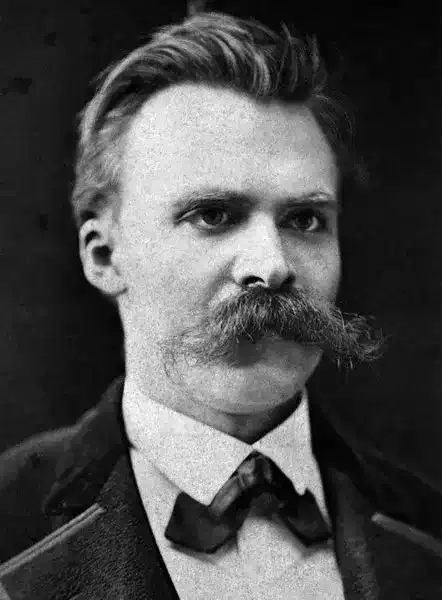
Friedrich Nietzsche
Author of the day

Friedrich Nietzsche

Friedrich Nietzsche was an influential German philosopher, philologist, and cultural critic. His work addresses themes such as morality, religion, truth, art, and the human condition, with a radical critique of traditional Western values. He is known for concepts such as the "death of God", the "superman" (Übermensch), and the "will to power" (Wille zur Macht). His writing is marked by an aphoristic and provocative style, which challenges the reader to rethink their beliefs and values.

Poem of the day

Do Not Go Gentle Into That Good Night

Dylan Thomas
Do not go gentle into that good night, 
Old age should burn and rave at close of day; 
Rage, rage against the dying of the light. 

Though wise men at their end know dark is right, 
Because their words had forked no lightning they 
Do not go gentle into that good night. 

Good men, the last wave by, crying how bright 
Their frail deeds might have danced in a green bay, 
Rage, rage against the dying of the light. 

Wild men who caught and sang the sun in flight, 
And learn, too late, they grieved it on its way, 
Do not go gentle into that good night. 

Grave men, near death, who see with blinding sight 
Blind eyes could blaze like meteors and be gay, 
Rage, rage against the dying of the light. 

And you, my father, there on that sad height, 
Curse, bless, me now with your fierce tears, I pray. 
Do not go gentle into that good night. 
Rage, rage against the dying of the light.
Read full poem

Born on this day

10
Torquato Tasso

Torquato Tasso was an Italian poet, playwright, and literary critic, renowned for his epic and lyrical poetry. His work is marked by deep religiosity, existential questioning, and the pursuit of an ideal of formal perfection. He faced several personal and intellectual crises throughout his life, which were reflected in his artistic production, oscillating between classical Renaissance and the spiritual tensions of his time. He is considered one of the greatest figures in Italian literature.

Moacyr Felix

Moacyr Felix was a Brazilian poet, playwright, and literary critic, associated with modernism. His work is marked by vigorous and colloquial language, exploring themes of everyday life, social criticism, and Brazilian popular culture. Felix also dedicated himself to theater and literary criticism, contributing to the dissemination and analysis of the literature of his time.

Raquel Naveira

Raquel Naveira is a Brazilian poet, columnist, and visual artist, known for her lyrical work and her strong presence in the cultural scene. Her poetry is marked by sensitivity, by the exploration of themes such as love, femininity, and the search for identity, with a language that is both accessible and profound. In addition to her literary production, Naveira also stands out for her work as an artist, integrating diverse languages into her work and promoting reflection on the human condition and art itself.

Gonçalves Crespo

António Feliciano de Castilho was a Portuguese poet and writer, a prominent figure of Romanticism in Portugal. His work is marked by tender and religious lyricism, exploring themes such as faith, nature, and saudade. He was a fervent defender of the Portuguese language and an influential mentor to generations of writers. His vast literary output encompasses poetry, prose, and translation, leaving a lasting legacy in Lusophone literature.

Tasso da Silveira

Tasso da Silveira was a Brazilian poet, essayist, literary critic, and professor, a prominent figure in Portuguese-language literature. His poetic work is marked by a deep reflection on existence, spirituality, and the human condition, often imbued with a mystical and transcendental tone. As an essayist and critic, he dedicated himself to exploring the intersections between literature, philosophy, and religion. Recognized for his erudition and the originality of his thought, Tasso da Silveira left a significant intellectual legacy, influencing generations of readers and scholars through his ability to link artistic expression to profound existential questions.

Sebastião Alba

Sebastião Alba was an Azorean poet and professor, known for his work marked by a strong connection to his homeland, island identity, and the human condition. His poetry, often melancholic and reflective, explores themes such as solitude, memory, the passage of time, and the search for meaning in an often adverse universe. With a refined style and a language that evokes the landscape and soul of the archipelago, Alba established himself as a unique voice in contemporary Portuguese poetry.

José António Silva Neto

José António Silva Neto is a poet who stands out for the depth of his reflections on life, death, and time, using a language rich in imagery and symbolism. His poetry is marked by a melancholic and introspective tone, exploring the human condition with a keen sensitivity to the nuances of feeling and existence. His works invite the reader on an inner journey, confronting them with the great existential questions in a lyrical and poignant way. His writing, while rooted in tradition, possesses a contemporary mark in how it addresses the fragility and beauty of the world, through a poetic discourse that favors musicality and the evocative power of words.

Cândido José Xavier

Cândido José Xavier was a Portuguese intellectual and writer, a notable figure of his time for his participation in various spheres of cultural and civic life. His work, in both prose and verse, reflects sharp thinking and a concern with social and existential issues. Xavier stood out not only as an author but also as an intervenor in the debates of his time, leaving a legacy of critical reflection and artistic expression.

Myriam Moscona

Myriam Moscona is a Mexican poet, translator, and essayist of Bulgarian origin. Her poetic work is recognized for its lyrical intensity, its exploration of memory and identity, and for the way it intertwines personal experiences with universal issues. Moscona is also an active figure in promoting literature, acting as a translator and critic. Her writing is marked by a deep sensibility and a language that seeks to capture the essence of human feelings and experiences.

Juan Meléndez Valdés

Spanish Enlightenment poet, Juan Meléndez Valdés is a representative figure of neoclassicism and preromanticism in Spanish literature. His work, marked by the influence of Horace and the sensibility of his time, addresses themes such as friendship, love, nature, and reflection on the human condition, with a style that evolves from classical serenity towards greater emotionality.

Died on this day

8
Rui Nogar

Rui Nogar was a Portuguese poet, a prominent figure in 20th-century poetry, known for his intense writing and exploration of themes such as the human condition, existential anguish, and the search for meaning. His work is marked by a strong lyrical charge and a refined language, reflecting a deep questioning of life and the universe. The poet developed a unique style, with poems that evoke powerful imagery and a singular musicality. His poetry, though sometimes somber, is also a hymn to the resilience and persistence of the human spirit in the face of adversity, leaving a significant legacy in Portuguese literature.

Manuel da Fonseca

Manuel da Fonseca was a Portuguese writer whose work was distinguished by its raw realism and profound attention to the living conditions of the rural populations of Alentejo, especially the working class and peasants. His writing, marked by a language steeped in the land and social denunciation, portrays the struggle for survival, exploitation, and human dignity amidst adversity. He was also a poet, with a lyrical work that complements his prose, exploring existential themes and the relationship between man and nature and the land.

Dunshee de Abranches

Dunshee de Abranches was a Portuguese poet, playwright, and journalist, known for his lyrical work and his involvement in literary movements of his time. His writing reflects a romantic sensibility and an interest in social and national issues. Although less prominent than other contemporaries, Dunshee de Abranches left a mark on the 19th-century Portuguese literary scene, with poems that explore themes such as nature, love, and the homeland, often with a melancholic and reflective tone.

Edmundo De Amicis

Edmundo De Amicis was an Italian writer, journalist, and teacher, known worldwide for his children's book "Heart". His work is characterized by strong sentimentalism and a pedagogical view of literature.

Joaquim Lagoeiro

Joaquim Lagoeiro was a poet whose work is distinguished by its deep connection to the land, tradition, and Portuguese identity. His poetry is an echo of rural landscapes, ancestral knowledge, and the soul of the people, expressed through a vernacular and authentic language. Lagoeiro celebrated simple life, the cycles of nature, and the values that shape a nation's character, leaving a legacy of love for the land and its roots.

Tomás da Rosa

Tomás da Rosa is a Portuguese poet, short story writer, and columnist, known for his lyrical and reflective poetry. His work frequently explores themes such as memory, time, the ephemerality of life, and the human condition, with a careful and musical language. Throughout his career, he has distinguished himself by his sensitivity in approaching universal feelings and his ability to evoke deep poetic images, consolidating himself as an important voice in contemporary Portuguese-language poetry.

Horace Gregory

Horace Gregory was an American poet, literary critic, and translator. His poetic work is known for its introspection, exploration of social and historical themes, and a style that often blends the lyrical with the narrative. He was also a long-time scholar of poetry, contributing critical analyses and important translations. As a critic, Gregory offered insightful reviews of modern and classical poets, while his translations, notably of Catullus, helped make ancient poetry more accessible to the contemporary audience.

Manuel José Quintana

Manuel José Quintana was a distinguished Spanish poet and politician of Neoclassicism and Pre-Romanticism. He is recognized for his civic and patriotic poetry, which exalted the ideals of freedom and progress in a context of political and social upheaval in Spain. His work, marked by a careful style and an elevated tone, reflected the concerns of his time, seeking to reconcile neoclassical reason with the new sensibilities that announced Romanticism. His figure was important in the literary and intellectual life of the early 19th century.