
Memories and Recollections

Henry Lawson
Watching The Crows
A bushman got lost in a scrub in the North,
And all the long morning the searchers went forth.
They swore at the rain that had washed out the tracks
And left not a trace for the eyes of the blacks;
But, trusting the signs that the blackfellow knows,
A quiet old darkey stood watching the crows.
The solemn old blackman stood silently by;
He stood like a statue, his face to the sky.
Black Billy was out of the bearings—we thought—
If he looked above for the bushman we sought;
For we rather suspected the spirit would go
In—well, quite another direction, you know.
Most bushmen on solemn occasions will joke,
And unto Black Bill ’twas the super who spoke.
He asked, as he cocked his red nose in the air—
“You think it old Harrison sit down up there?”
“I’m watching the crows. Where the white man lies dead
The crows will fly over,” the blackfellow said.
The blackfellow died, and long years have gone round
Since the day when old Harrison’s body was found;
But still do I see, in my vision at night,
A faint figure come like a shadow in sight,
And nearer and nearer it comes till it grows
Like the form of that blackfellow—“watching the crows”.
292

John Greenleaf Whittier
Marguerite
MASSACHUSETTS BAY, 1760.
THE robins sang in the orchard, the buds into
blossoms grew;
Little of human sorrow the buds and the robins
knew!
Sick, in an alien household, the poor French
neutral lay;
Into her lonesome garret fell the light of the April
day,
Through the dusty window, curtained by the spider's
warp and woof,
On the loose-laid floor of hemlock, on oaken ribs
of roof,
The bedquilt's faded patchwork, the teacups on the
stand,
The wheel with flaxen tangle, as it dropped from
her sick hand.
What to her was the song of the robin, or warm
morning light,
As she lay in the trance of the dying, heedless of
sound or sight?
Done was the work of her bands, she had eaten her
bitter bread;
The world of the alien people lay behind her dim
and dead.
But her soul went back to its child-time; she saw
the sun o'erflow
With gold the Basin of Minas, and set over
Gaspereau;
The low, bare flats at ebb-tide, the rush of the sea
at flood,
Through inlet and creek and river, from dike to
upland wood;
The gulls in the red of morning, the fish-hawk's
rise and fall,
The drift of the fog in moonshine, over the dark
coast-wall.
She saw the face of her mother, she heard the song
she sang;
And far off, faintly, slowly, the bell for vespers
rang.
By her bed the hard-faced mistress sat, smoothing
the wrinkled sheet,
Peering into the face, so helpless, and feeling the
ice-cold feet.
With a vague remorse atoning for her greed and
long abuse,
By care no longer heeded and pity too late for use.
Up the stairs of the garret softly the son of the
mistress stepped,
Leaned over the head-board, covering his face with
his hands, and wept.
Outspake the mother, who watched him sharply,
with brow a-frown
'What! love you the Papist, the beggar, the
charge of the town?'
Be she Papist or beggar who lies here, I know
and God knows
I love her, and fain would go with her wherever
she goes!
'O mother! that sweet face came pleading, for
love so athirst.
You saw but the town-charge; I knew her God's
angel at first.'
Shaking her gray head, the mistress hushed down
a bitter cry;
And awed by the silence and shadow of death
drawing nigh,
She murmured a psalm of the Bible; but closer
the young girl pressed,
With the last of her life in her fingers, the cross
to her breast.
'My son, come away,' cried the mother, her voice
cruel grown.
'She is joined to her idols, like Ephraim; let her
alone!'
But he knelt with his hand on her forehead, his
lips to her ear,
And he called back the soul that was passing
'Marguerite, do you hear?'
She paused on the threshold of Heaven; love, pity,
surprise,
Wistful, tender, lit up for an instant the cloud of
her eyes.
With his heart on his lips he kissed her, but never
her cheek grew red,
And the words the living long for he spake in the
ear of the dead.
And the robins sang in the orchard, where buds to
blossoms grew;
Of the folded hands and the still face never the
robins knew!
291
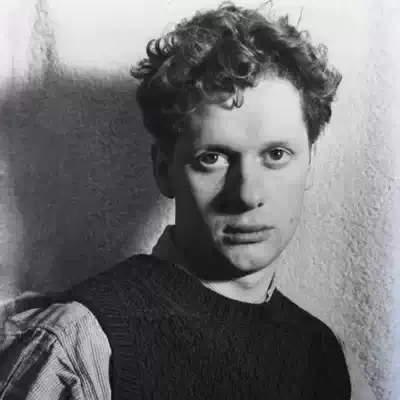
Dylan Thomas
I Fellowed Sleep
I fellowed sleep who kissed me in the brain,
Let fall the tear of time; the sleeper's eye,
Shifting to light, turned on me like a moon.
So, planning-heeled, I flew along my man
And dropped on dreaming and the upward sky.
I fled the earth and, naked, climbed the weather,
Reaching a second ground far from the stars;
And there we wept I and a ghostly other,
My mothers-eyed, upon the tops of trees;
I fled that ground as lightly as a feather.
'My fathers' globe knocks on its nave and sings.'
'This that we tread was, too, your father's land.'
'But this we tread bears the angelic gangs
Sweet are their fathered faces in their wings.'
'These are but dreaming men. Breathe, and they fade.'
Faded my elbow ghost, the mothers-eyed,
As, blowing on the angels, I was lost
On that cloud coast to each grave-grabbing shade;
I blew the dreaming fellows to their bed
Where still they sleep unknowing of their ghost.
Then all the matter of the living air
Raised up a voice, and, climbing on the words,
I spelt my vision with a hand and hair,
How light the sleeping on this soily star,
How deep the waking in the worlded clouds.
There grows the hours' ladder to the sun,
Each rung a love or losing to the last,
The inches monkeyed by the blood of man.
And old, mad man still climbing in his ghost,
My fathers' ghost is climbing in the rain.
291
Henry Lawson
The Song Of Old Joe Swallow
When I was up the country in the rough and early days,
I used to work along ov Jimmy Nowlett's bullick-drays;
Then the reelroad wasn't heered on, an' the bush was wild an' strange,
An' we useter draw the timber from the saw-pits in the range --
Load provisions for the stations, an' we'd travel far and slow
Through the plains an' 'cross the ranges in the days of long ago.
Then it's yoke up the bullicks and tramp beside 'em slow,
An' saddle up yer horses an' a-ridin' we will go,
To the bullick-drivin', cattle-drovin',
Nigger, digger, roarin', rovin'
Days o' long ago.
Once me and Jimmy Nowlett loaded timber for the town,
But we hadn't gone a dozen mile before the rain come down,
An' me an' Jimmy Nowlett an' the bullicks an' the dray
Was cut off on some risin' ground while floods around us lay;
An' we soon run short of tucker an' terbacca, which was bad,
An' pertaters dipped in honey was the only tuck we had.
An' half our bullicks perished when the drought was on the land,
An' the burnin' heat that dazzles as it dances on the sand;
When the sun-baked clay an' gravel paves for miles the burnin' creeks,
An' at ev'ry step yer travel there a rottin' carcase reeks --
But we pulled ourselves together, for we never used ter know
What a feather bed was good for in those days o' long ago.
But in spite ov barren ridges an' in spite ov mud an' heat,
An' dust that browned the bushes when it rose from bullicks' feet,
An' in spite ov cold and chilblains when the bush was white with frost,
An' in spite of muddy water where the burnin' plain was crossed,
An' in spite of modern progress, and in spite of all their blow,
'Twas a better land to live in, in the days o' long ago.
When the frosty moon was shinin' o'er the ranges like a lamp,
An' a lot of bullick-drivers was a-campin' on the camp,
When the fire was blazin' cheery an' the pipes was drawin' well,
Then our songs we useter chorus an' our yarns we useter tell;
An' we'd talk ov lands we come from, and ov chaps we useter know,
For there always was behind us OTHER days o' long ago.
Ah, them early days was ended when the reelroad crossed the plain,
But in dreams I often tramp beside the bullick-team again:
Still we pauses at the shanty just to have a drop er cheer,
Still I feels a kind ov pleasure when the campin'-ground is near;
Still I smells the old tarpaulin me an' Jimmy useter throw
O'er the timber-truck for shelter in the days ov long ago.
I have been a-driftin' back'ards with the changes ov the land,
An' if I spoke ter bullicks now they wouldn't understand,
But when Mary wakes me sudden in the night I'll often say:
`Come here, Spot, an' stan' up, Bally, blank an' blank an' come-eer-way.'
An' she says that, when I'm sleepin', oft my elerquince 'ill flow
In the bullick-drivin' language ov the days o' long ago.
Well, the pub will soon be closin', so I'll give the thing a rest;
But if you should drop on Nowlett in the far an' distant west --
An' if Jimmy uses doubleyou instead of ar an' vee,
An' if he drops his aitches, then you're sure to know it's he.
An' yer won't forgit to arsk him if he still remembers Joe
As knowed him up the country in the days o' long ago.
Then it's yoke up the bullicks and tramp beside 'em slow,
An' saddle up yer horses an' a-ridin' we will go,
To the bullick-drivin', cattle-drovin',
Nigger, digger, roarin', rovin'
Days o' long ago.
291

William Wordsworth
Yarrow Unvisited
. From Stirling castle we had seen
The mazy Forth unravelled;
Had trod the banks of Clyde, and Tay,
And with the Tweed had travelled;
And when we came to Clovenford,
Then said my "winsome Marrow ,"
"Whate'er betide, we'll turn aside,
And see the Braes of Yarrow."
"Let Yarrow folk, frae Selkirk town,
Who have been buying, selling,
Go back to Yarrow, 'tis their own;
Each maiden to her dwelling!
On Yarrow's banks let her herons feed,
Hares couch, and rabbits burrow!
But we will downward with the Tweed
Nor turn aside to Yarrow.
"There's Galla Water, Leader Haughs,
Both lying right before us;
And Dryborough, where with chiming Tweed
The lintwhites sing in chorus;
There's pleasant Tiviot-dale, a land
Made blithe with plough and harrow:
Why throw away a needful day
To go in search of Yarrow?
"What's Yarrow but a river bare,
That glides the dark hills under?
There are a thousand such elsewhere
As worthy of your wonder."
--Strange words they seemed of slight and scorn;
My True-love sighed for sorrow;
And looked me in the face, to think
I thus could speak of Yarrow!
"Oh! green," said I, "are Yarrow's holms,
And sweet is Yarrow flowing!
Fair hangs the apple frae the rock,
But we will leave it growing.
O'er hilly path, and open Strath,
We'll wander Scotland thorough;
But, though so near, we will not turn
Into the dale of Yarrow.
"Let beeves and home-bred kine partake
The sweets of Burn-mill meadow,
The swan on still St. Mary's Lake
Float double, swan and shadow!
We will not see them; will not go,
To-day, nor yet to-morrow;
Enough if in our hearts we know
There's such a place as Yarrow.
"Be Yarrow stream unseen, unknown!
It must, or we shall rue it:
We have a vision of our own;
Ah! why should we undo it?
The treasured dreams of times long past,
We'll keep them, winsome Marrow!
For when we'er there, although 'tis fair,
'Twill be another Yarrow!
"If Care with freezing years should come,
And wandering seem but folly,--
Should we be loth to stir from home,
And yet be melancholy;
Should life be dull, and spirits low,
'Twill soothe us in our sorrow,
That earth has something yet to show,
The bonny holms of Yarrow!"
289

William Butler Yeats
A Man Young And Old: X. His Wildness
O bid me mount and sail up there
Amid the cloudy wrack,
For peg and Meg and Paris' love
That had so straight a back,
Are gone away, and some that stay
Have changed their silk for sack.
Were I but there and none to hear
I'd have a peacock cry,
For that is natural to a man
That lives in memory,
Being all alone I'd nurse a stone
And sing it lullaby.
289
Henry Lawson
Golden Gully
No one lives in Golden Gully, for its golden days are o’er,
And its clay shall never sully blucher-boots of diggers more,
For the diggers long have vanished — nought but broken shafts remain,
And the bush, by diggers banished, fast reclaims its own again.
Now, when dying Daylight slowly draws her fingers from the “Peak”,
The Weird Empress Melancholy rises from the reedy creek —
In the gap above the gully, while the dismal curlews scream
Loud to welcome her as ruler of the dreary night supreme —
Takes her throne, and by her presence fills the strange, uncertain air
With a ghostly phosphorescence of the horrors hidden there.
None would think, by camp-fire blazy, lighting fitfully the scene,
In the seasons that are hazy, how in seasons gone between,
Diggers yarned or joined in jolly ballads of the field and foam,
Or grew sad and melancholy over songs like “Home, Sweet Home” —
Songs of other times, demanding sullen tears that would not start,
Every digger understanding what was in his comrade’s heart.
It may seem to you a riddle how a poet’s fancies roam,
But methinks I hear a fiddle softly playing “Home, Sweet Home”
’Mid the trees, while meditative diggers round the camp-fire stand.
(Those were days before Australians learned to love their native land.)
Now the dismal curlew screeches round the shafts when night winds sough;
Startling murmurs, broken speeches, shake each twisted, tangled bough,
And whene’er the night comes dreary, darkened by the falling rain,
Voices, loud and dread and eerie, come again and come again —
Come like troubled souls forbidden rest until their tales are told —
Tales of deeds of darkness hidden in the whirl of days of gold —
Come like troubled spirits telling tales of dire and dread mishaps,
Kissing, falling, rising, swelling, dying in the dismal gaps.
When the coming daylight slowly lays her fingers on the “Peak”
Then the Empress Melancholy hurries off to swamps that reek.
But the scene is never cheery, be it sunshine, be it rain,
For the Gully keeps its dreary look till darkness comes again.
As you stand beside the broken shafts, where grass is growing thick,
You can almost hear a spoken word, or hear a thudding pick;
And your very soul seems sinking, foetid grows the morning air,
For you cannot help believing that there’s something buried there.
There’s a ring amid the saplings by a travelling circus worn,
That amused the noisy diggers e’er the rising race was born;
There’s a road where scrub encroaches that was once the main highway,
Over which two rival coaches dashed in glory twice a day;
Gone — all gone from Golden Gully, for its golden days are o’er,
And its clay shall never sully wheels of crowded coaches more.
289

Thomas Hardy
Beeny Cliff
I
O the opal and the sapphire of that wandering western sea,
And the woman riding high above with bright hair flapping free-
The woman whom I loved so, and who loyally loved me.
I I
The pale mews plained below us, and the waves seemed far away
In a nether sky, engrossed in saying their ceaseless babbling say,
As we laughed light-heartedly aloft on that clear-sunned March day.
III
A little cloud then cloaked us, and there flew an irised rain,
And the Atlantic dyed its levels with a dull misfeatured stain,
And then the sun burst out again, and purples prinked the main.
IV
-Still in all its chasmal beauty bulks old Beeny to the sky,
And shall she and I not go there once again now March is nigh,
And the sweet things said in that March say anew there by and by?
V
What if still in chasmal beauty looms that wild weird western shore,
The woman now is-elsewhere-whom the ambling pony bore,
And nor knows nor cares for Beeny, and will laugh there nevermore.
289

James Whitcomb Riley
There Was a Cherry-Tree
There was a cherry-tree. Its bloomy snows
Cool even now the fevered sight that knows
No more its airy visions of pure joy --
As when you were a boy.
There was a cherry-tree. The Bluejay sat
His blue against its white -- O blue as jet
He seemed there then!-- But now -- Whoever knew
He was so pale a blue!
There was a cherry-tree -- our child-eyes saw
The miracle:-- Its pure white snows did thaw
Into a crimson fruitage, far too sweet
But for a boy to eat.
There was a cherry-tree, give thanks and joy!--
There was a bloom of snow -- There was a boy --
There was a bluejay of the realest blue --
And fruit for both of you.
285
John Greenleaf Whittier
Remembrance
WITH COPIES OF THE AUTHOR'S WRITINGS.
Friend of mine! whose lot was cast
With me in the distant past;
Where, like shadows flitting fast,
Fact and fancy, thought and theme,
Word and work, begin to seem
Like a half-remembered dream!
Touched by change have all things been,
Yet I think of thee as when
We had speech of lip and pen.
For the calm thy kindness lent
To a path of discontent,
Rough with trial and dissent;
Gentle words where such were few,
Softening blame where blame was true,
Praising where small praise was due;
For a waking dream made good,
For an ideal understood,
For thy Christian womanhood;
For thy marvellous gift to cull
From our common life and dull
Whatsoe'er is beautiful;
Thoughts and fancies, Hybla's bees
Dropping sweetness; true heart's-ease
Of congenial sympathies;-
Still for these I own my debt;
Memory, with her eyelids wet,
Fain would thank thee even yet!
And as one who scatters flowers
Where the Queen of May's sweet hours
Sits, o'ertwined with blossomed bowers,
In superfluous zeal bestowing
Gifts where gifts are overflowing,
So I pay the debt I'm owing.
To thy full thoughts, gay or sad,
Sunny-hued or sober clad,
Something of my own I add;
Well assured that thou wilt take
Even the offering which I make
Kindly for the giver's sake.
286
Henry Lawson
The Stringy-Bark Tree
There's the whitebox and pine on the ridges afar,
Where the iron-bark, blue-gum, and peppermint are;
There is many another, but dearest to me,
And the king of them all was the stringy-bark tree.
Then of stringy-bark slabs were the walls of the hut,
And from stringy-bark saplings the rafters were cut;
And the roof that long sheltered my brothers and me
Was of broad sheets of bark from the stringy-bark tree.
And when sawn-timber homes were built out in the West,
Then for walls and for ceilings its wood was the best;
And for shingles and palings to last while men be,
There was nothing on earth like the stringy-bark tree.
Far up the long gullies the timber-trucks went,
Over tracks that seemed hopeless, by bark hut and tent;
And the gaunt timber-finder, who rode at his ease,
Led them on to a gully of stringy-bark trees.
Now still from the ridges, by ways that are dark,
Come the shingles and palings they call stringy-bark;
Though you ride through long gullies a twelve months you’ll see
But the old whitened stumps of the stringy-bark tree.
286

Henry Wadsworth Longfellow
In The Harbour: Chimes
Sweet chimes! that in the loneliness of night
Salute the passing hour, and in the dark
And silent chambers of the household mark
The movements of the myriad orbs of light!
Through my closed eyelids, by the inner sight,
I see the constellations in the arc
Of their great circles moving on, and hark!
I almost hear them singing in their flight.
Better than sleep it is to lie awake,
O'er-canopied by the vast starry dome
Of the immeasurable sky; to feel
The slumbering world sink under us, and make
Hardly an eddy,--a mere rush of foam
On the great sea beneath a sinking keel.
283

Emily Dickinson
We miss Her, not because We see
We miss Her, not because We see-
The Absence of an Eye-
Except its Mind accompany
Abridge Society
As slightly as the Routes of StarsOurselves-
asleep below-
We know that their superior Eyes
Include Us-as they go-
The Absence of an Eye-
Except its Mind accompany
Abridge Society
As slightly as the Routes of StarsOurselves-
asleep below-
We know that their superior Eyes
Include Us-as they go-
284
James Whitcomb Riley
Kingry's Mill
On old Brandywine-- about
Where White's Lots is now laid out,
And the old crick narries down
To the ditch that splits the town--,
Kingry's Mill stood. Hardly see
Where the old dam ust to be;
Shallor, long, dry trought o' grass
Where the old race ust to pass!
That's be'n forty years ago--
Forty years o' frost and snow--
Forty years o' shade and shine
Sence them boyhood-days o' mine--!
All the old landmarks o' town.
Changed about, er rotted down!
Where's the Tanyard? Where's the Still?
Tell me where's old Kingry's Mill?
Don't seem furder back, to me,
I'll be dogg'd! Than yisterd'y,
Since us fellers, in bare feet
And straw hats, went through the wheat,
Cuttin' 'crost the shortest shoot
Fer that-air old ellum root
Jest above the mill-dam-- where
The blame' cars now crosses there!
Through the willers down the crick
We could see the old mill stick
Its red gable up, as if
It jest knowed we'd stol'd the skiff!
See the winders in the sun
Blink like they wuz wonderun'
What the miller ort to do
With sich boys as me and you!
But old Kingry--! Who could fear
That old chap, with all his cheer--?
Leanin' at the window-sill,
Er the half-door o' the mill,
Swoppin' lies, and pokin' fun,
'N jigglin' like his hoppers done--
Laughin' grists o' gold and red
Right out o' the wagon-bed!
What did he keer where we went--?
'Jest keep out o' devilment,
And don't fool around the belts,
Bolts, ner burrs, ner nothin' else
'Bout the blame machinery,
And that's all I ast!' says-ee.
Then we'd climb the stairs, and play
In the bran-bins half the day!
Rickollect the dusty wall,
And the spider-webs, and all!
Rickollect the trimblin' spout
Where the meal come josslln' out--
Stand and comb yer fingers through
The fool-truck an hour er two--
Felt so sorto' warm-like and
Soothin' to a feller's hand!
Climb, high up above the stream,
And 'coon' out the wobbly beam
And peek down from out the lof'
Where the weather-boards was off-Gee-
mun-nee! w'y, it takes grit
Even jest to think of it--!
Lookin' 'way down there below
On the worter roarin' so!
Rickollect the flume, and wheel,
And the worter slosh and reel
And jest ravel out in froth
Flossier'n satin cloth!
Rickollect them paddles jest
Knock the bubbles galley-west,
And plunge under, and come up
Drippin' like a worter-pup!
And to see them old things gone
That I onc't was bettin' on,
In rale p'int o' fact, I feel
kindo' like that worter-wheel--,
Sorto' drippy-like and wet
Round the eyes-- but paddlin' yet,
And in mem'ry, loafin' still
Down around old Kingry's Mill!
282

Emily Jane Brontë
That Wind I Used to Hear it Swelling
That wind I used to hear it swelling
With joy divinely deep
You might have seen my hot tears welling
But rapture made me weep
I used to love on winter nights
To lie and dream alone
Of all the hopes and real delights
My early years had known
And oh above the rest of those
That coming time should [bear]
Like heaven's own glorious stars they rose
Still beaming bright and fair
281
William Wordsworth
Memory
A pen--to register; a key--
That winds through secret wards
Are well assigned to Memory
By allegoric Bards.
As aptly, also, might be given
A Pencil to her hand;
That, softening objects, sometimes even
Outstrips the heart's demand;
That smooths foregone distress, the lines
Of lingering care subdues,
Long-vanished happiness refines,
And clothes in brighter hues;
Yet, like a tool of Fancy, works
Those Spectres to dilate
That startle Conscience, as she lurks
Within her lonely seat.
Oh! that our lives, which flee so fast,
In purity were such,
That not an image of the past
Should fear that pencil's touch!
Retirement then might hourly look
Upon a soothing scene,
Age steal to his allotted nook
Contented and serene;
With heart as calm as lakes that sleep,
In frosty moonlight glistening;
Or mountain rivers, where they creep
Along a channel smooth and deep,
To their own far-off murmurs listening.
281
James Whitcomb Riley
Waitin' Fer The Cat To Die
Lawzy! don't I rickollect
That-'air old swing in the lane!
Right and proper, I expect,
Old times _can't_ come back again;
But I want to state, ef they
_Could_ come back, and I could say
What _my_ pick 'ud be, i jing!
I'd say, Gimme the old swing
'Nunder the old locus'-trees
On the old place, ef you please!--
Danglin' there with half-shet eye,
Waitin' fer the cat to die!
I'd say, Gimme the old gang
Of barefooted, hungry, lean,
Ornry boys you want to hang
When you're growed up twic't as mean!
The old gyarden-patch, the old
Truants, and the stuff we stol'd!
The old stompin'-groun', where we
Wore the grass off, wild and free
As the swoop of the old swing,
Where we ust to climb and cling,
And twist roun', and fight, and lie--
Waitin' fer the cat to die!
'Pears like I 'most allus could
Swing the highest of the crowd--
Jes sail up there tel I stood
Downside-up, and screech out loud,--
Ketch my breath, and jes drap back
Fer to let the old swing slack,
Yit my tow-head dippin' still
In the green boughs, and the chill
Up my backbone taperin' down,
With my shadder on the ground'
Slow and slower trailin' by--
Waitin' fer the cat to die!
Now my daughter's little Jane's
Got a kind o' baby-swing
On the porch, so's when it rains
She kin play there--little thing!
And I'd limped out t'other day
With my old cheer this-a-way,
Swingin' _her_ and rockin' too,
Thinkin' how _I_ ust to do
At _her_ age, when suddently,
'Hey, Gran'pap!' she says to me,
'Why you rock so slow?' ... Says I,
'Waitin' fer the cat to die!'
282
William Wordsworth
Extempore Effusion upon the Death of James Hogg
. When first, descending from the moorlands,
I saw the Stream of Yarrow glide
Along a bare and open valley,
The Ettrick Shepherd was my guide.
When last along its banks I wandered,
Through groves that had begun to shed
Their golden leaves upon the pathways,
My steps the Border-minstrel led.
The mighty Minstrel breathes no longer,
'Mid mouldering ruins low he lies;
And death upon the braes of Yarrow,
Has closed the Shepherd-poet's eyes:
Nor has the rolling year twice measured,
From sign to sign, its stedfast course,
Since every mortal power of Coleridge
Was frozen at its marvellous source;
The rapt One, of the godlike forehead,
The heaven-eyed creature sleeps in earth:
And Lamb, the frolic and the gentle,
Has vanished from his lonely hearth.
Like clouds that rake the mountain-summits,
Or waves that own no curbing hand,
How fast has brother followed brother,
From sunshine to the sunless land!
Yet I, whose lids from infant slumber
Were earlier raised, remain to hear
A timid voice, that asks in whispers,
"Who next will drop and disappear?"
Our haughty life is crowned with darkness,
Like London with its own black wreath,
On which with thee, O Crabbe! forth-looking,
I gazed from Hampstead's breezy heath.
As if but yesterday departed,
Thou too art gone before; but why,
O'er ripe fruit, seasonably gathered,
Should frail survivors heave a sigh?
Mourn rather for that holy Spirit,
Sweet as the spring, as ocean deep;
For Her who, ere her summer faded,
Has sunk into a breathless sleep.
No more of old romantic sorrows,
For slaughtered Youth or love-lorn Maid!
With sharper grief is Yarrow smitten,
And Ettrick mourns with her their Poet dead.
281
James Whitcomb Riley
A Dream Of Long Ago
Lying listless in the mosses
Underneath a tree that tosses
Flakes of sunshine, and embosses
Its green shadow with the snow-Drowsy-
eyed, I sink in slumber
Born of fancies without number--
Tangled fancies that encumber
Me with dreams of long ago.
Ripples of the river singing;
And the water-lilies swinging
Bells of Parian, and ringing
Peals of perfume faint and fine,
While old forms and fairy faces
Leap from out their hiding-places
In the past, with glad embraces
Fraught with kisses sweet as wine.
Willows dip their slender fingers
O'er the little fisher's stringers,
While he baits his hook and lingers
Till the shadows gather dim;
And afar off comes a calling
Like the sounds of water falling,
With the lazy echoes drawling
Messages of haste to him.
Little naked feet that tinkle
Through the stubble-fields, and twinkle
Down the winding road, and sprinkle
Little mists of dusty rain,
While in pasture-lands the cattle
Cease their grazing with a rattle
Of the bells whose clappers tattle
To their masters down the lane.
Trees that hold their tempting treasures
O'er the orchard's hedge embrasures,
Furnish their forbidden pleasures
As in Eden lands of old;
And the coming of the master
Indicates a like disaster
To the frightened heart that faster
Beats pulsations manifold.
Puckered lips whose pipings tingle
In staccato notes that mingle
Musically with the jingle-
Haunted winds that lightly fan
Mellow twilights, crimson-tinted
By the sun, and picture-printed
Like a book that sweetly hinted
Of the Nights Arabian.
Porticoes with columns plaited
And entwined with vines and freighted
With a bloom all radiated
With the light of moon and star;
Where some tender voice is winging
In sad flights of song, and singing
To the dancing fingers flinging
Dripping from the sweet guitar.
Would my dreams were never taken
From me: that with faith unshaken
I might sleep and never waken
On a weary world of woe!
Links of love would never sever
As I dreamed them, never, never!
I would glide along forever
Through the dreams of long ago.
280
Henry Lawson
The Glass On The Bar
Three bushmen one morning rode up to an inn,
And one of them called for the drinks with a grin;
They'd only returned from a trip to the North,
And, eager to greet them, the landlord came forth.
He absently poured out a glass of Three Star.
And set down that drink with the rest on the bar.
`There, that is for Harry,' he said, `and it's queer,
'Tis the very same glass that he drank from last year;
His name's on the glass, you can read it like print,
He scratched it himself with an old piece of flint;
I remember his drink -- it was always Three Star' --
And the landlord looked out through the door of the bar.
He looked at the horses, and counted but three:
`You were always together -- where's Harry?' cried he.
Oh, sadly they looked at the glass as they said,
`You may put it away, for our old mate is dead;'
But one, gazing out o'er the ridges afar,
Said, `We owe him a shout -- leave the glass on the bar.'
They thought of the far-away grave on the plain,
They thought of the comrade who came not again,
They lifted their glasses, and sadly they said:
`We drink to the name of the mate who is dead.'
And the sunlight streamed in, and a light like a star
Seemed to glow in the depth of the glass on the bar.
And still in that shanty a tumbler is seen,
It stands by the clock, ever polished and clean;
And often the strangers will read as they pass
The name of a bushman engraved on the glass;
And though on the shelf but a dozen there are,
That glass never stands with the rest on the bar.
280
James Whitcomb Riley
As she told me it was father
From a foreign land returned.
. . . . . . .
I said--when I was calm again,
And thoughtfully once more
Had dwelt upon my mother's words
Of just the day before,-
'I DON'T look like my father,
As you told me yesterday--
I know I don't--or father
Would have run the other way.'
. . . . . . .
I said--when I was calm again,
And thoughtfully once more
Had dwelt upon my mother's words
Of just the day before,-
'I DON'T look like my father,
As you told me yesterday--
I know I don't--or father
Would have run the other way.'
277

Robert W. Service
New Year's Eve
It's cruel cold on the water-front, silent and dark and drear;
Only the black tide weltering, only the hissing snow;
And I, alone, like a storm-tossed wreck, on this night of the glad New Year,
Shuffling along in the icy wind, ghastly and gaunt and slow.
They're playing a tune in McGuffy's saloon, and it's cheery and bright in there
(God! but I'm weak -- since the bitter dawn, and never a bite of food);
I'll just go over and slip inside -- I mustn't give way to despair -Perhaps
I can bum a little booze if the boys are feeling good.
They'll jeer at me, and they'll sneer at me, and they'll call me a whiskey soak;
("Have a drink? Well, thankee kindly, sir, I don't mind if I do.")
A drivelling, dirty, gin-joint fiend, the butt of the bar-room joke;
Sunk and sodden and hopeless -- "Another? Well, here's to you!"
McGuffy is showing a bunch of the boys how Bob Fitzsimmons hit;
The barman is talking of Tammany Hall, and why the ward boss got fired.
I'll just sneak into a corner and they'll let me alone a bit;
The room is reeling round and round . . .O God! but I'm tired, I'm tired. . . .
* * * * *
Roses she wore on her breast that night. Oh, but their scent was sweet!
Alone we sat on the balcony, and the fan-palms arched above;
The witching strain of a waltz by Strauss came up to our cool retreat,
And I prisoned her little hand in mine, and I whispered my plea of love.
Then sudden the laughter died on her lips, and lowly she bent her head;
And oh, there came in the deep, dark eyes a look that was heaven to see;
And the moments went, and I waited there, and never a word was said,
And she plucked from her bosom a rose of red and shyly gave it to me.
Then the music swelled to a crash of joy, and the lights blazed up like day,
And I held her fast to my throbbing heart, and I kissed her bonny brow.
"She is mine, she is mine for evermore!" the violins seemed to say,
And the bells were ringing the New Year in -- O God! I can hear them now.
Don't you remember that long, last waltz, with its sobbing, sad refrain?
Don't you remember that last good-by, and the dear eyes dim with tears?
Don't you remember that golden dream, with never a hint of pain,
Of lives that would blend like an angel-song in the bliss of the coming years?
Oh, what have I lost! What have I lost! Ethel, forgive, forgive!
The red, red rose is faded now, and it's fifty years ago.
'Twere better to die a thousand deaths than live each day as I live!
I have sinned, I have sunk to the lowest depths -- but oh, I have suffered so!
Hark! Oh, hark! I can hear the bells! . . . Look! I can see her there,
Fair as a dream . . . but it fades . . . And now -- I can hear the dreadful hum
Of the crowded court . . . See! the Judge looks down . . .
NOT GUILTY, my Lord, I swear . . .
The bells -- I can hear the bells again! . . . Ethel, I come, I come! . . .
* * * * *
"Rouse up, old man, it's twelve o'clock. You can't sleep here, you know.
Say! ain't you got no sentiment? Lift up your muddled head;
Have a drink to the glad New Year, a drop before you go -You
darned old dirty hobo . . . My God! Here, boys! He's DEAD!"
276

D.H. Lawrence
Dreams Old
I have opened the window to warm my hands on the sill
Where the sunlight soaks in the stone: the afternoon
Is full of dreams, my love, the boys are all still
In a wistful dream of Lorna Doone.
The clink of the shunting engines is sharp and fine,
Like savage music striking far off, and there
On the great, uplifted blue palace, lights stir and shine
Where the glass is domed in the blue, soft air.
There lies the world, my darling, full of wonder and wistfulness and strange
Recognition and greetings of half-acquaint things, as I greet the cloud
Of blue palace aloft there, among misty indefinite dreams that range
At the back of my life’s horizon, where the dreamings of past lives crowd.
Over the nearness of Norwood Hill, through the mellow veil
Of the afternoon glows to me the old romance of David and Dora,
With the old, sweet, soothing tears, and laughter that shakes the sail
Of the ship of the soul over seas where dreamed dreams lure the unoceaned explorer.
All the bygone, hushèd years
Streaming back where the mist distils
Into forgetfulness: soft-sailing waters where fears
No longer shake, where the silk sail fills
With an unfelt breeze that ebbs over the seas, where the storm
Of living has passed, on and on
Through the coloured iridescence that swims in the warm
Wake of the tumult now spent and gone,
Drifts my boat, wistfully lapsing after
The mists of vanishing tears and the echo of laughter.
276
Emily Dickinson
Joy to have merited the Pain
Joy to have merited the Pain-
To merit the Release-
Joy to have perished every step-
To Compass Paradise
Pardon-to look upon thy face-
With these old fashioned Eyes-
Better than new-could be-for that-
Though bought in Paradise-
Because they looked on thee before-
And thou hast looked on them-
Prove Me-My Hazel Witnesses
The features are the same-
So fleet thou wert, when present-
So infinite-when gone-
An Orient's Apparition-
Remanded of the Morn-
The Height I recollect'
Twas even with the Hills-
The Depth upon my Soul was notched-
As Floods-on Whites of Wheels-
To Haunt-till Time have dropped
His last Decade away,
And Haunting actualize-to last
At least-Eternity-
276