
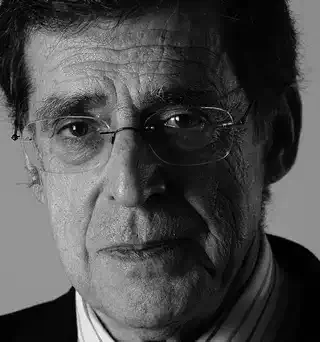
Vasco Graça Moura
 PT
PT
Vasco Graça Moura was a multifaceted figure of Portuguese culture, excelling as a poet, essayist, literary critic, and translator. His poetic work is recognized for its erudition, rigorous formal construction, and exploration of complex themes, frequently interlinking history, mythology, and contemporaneity. With a dense and evocative language, Graça Moura addressed the human condition, memory, identity, and the individual's relationship with time and space. His vast culture and profound intelligence lent his writing a unique dimension, establishing him as one of the great names in Portuguese literature of the second half of the 20th century and early 21st century.
n. 1942-01-03, Freguesia de Foz do Douro · m. 2014-04-27, Lisboa
Bio
Identification and basic context
Vasco Graça Moura, full name Vasco de Mello Graça Moura, was born in Tomar, Portugal. He was a poet, essayist, literary critic, and translator. He is a prominent figure in contemporary Portuguese literature, writing in the Portuguese language.Childhood and education
Born into a family with tradition and culture, Vasco Graça Moura's childhood and education were marked by an environment conducive to intellectual development. He attended the University of Coimbra, where he studied Law, but his passion for literature and culture in general shaped his path. He absorbed diverse influences, from classical literature to philosophy and the arts, revealing from an early age a vast culture and an insatiable curiosity.Literary career
Vasco Graça Moura's literary career began early, demonstrating a precocious talent for writing. His work evolved significantly over the decades, exploring different genres and approaches. He was a regular contributor to important literary magazines and newspapers, such as "Diário de Lisboa" and "O Comércio do Porto," where he published literary criticism and essays. He also played a crucial role as a translator of highly relevant works, bringing foreign literature closer to the Lusophone audience.Work, style, and literary characteristics
Work, style, and literary characteristics Among his most important poetic works are "Os Poemas Alheios" (1961), "A Sombra Legível" (1970), and "Matéria" (2002). The central themes of his poetry include memory, history, mythology, identity, human finitude, and the relationship with time. His style is characterized by great erudition, conceptual density, and rigorous formal construction, with a preference for measured verse and classical structure, although he did not adhere to rigid formulas. He used a rich and evocative language, full of cultural and historical allusions, giving his poetry a universal dimension. The poetic voice is often reflective, intellectualized, and sometimes ironic.Work, style, and literary characteristics
Cultural and historical context Vasco Graça Moura lived through a period of intense transformations in Portugal, from the Salazarist dictatorship to democracy. His work dialogues with historical events, political issues, and the cultural currents of his time. He belonged to a generation of intellectuals who marked Portuguese cultural life, maintaining relationships with other writers and critics with whom he shared debates and visions on art and society.Work, style, and literary characteristics
Personal life Beyond his literary activity, Vasco Graça Moura had a public career as a politician and diplomat, having served as Secretary of State for Culture. His emotional and family relationships, although not detailed in his work, certainly contributed to his worldview and the depth of his reflections. His vast erudition and remarkable intelligence were defining traits of his personality.Work, style, and literary characteristics
Recognition and reception Vasco Graça Moura was widely recognized in Portugal and abroad. He received numerous awards and distinctions, including the Prémio Pessoa in 2005. His work is studied in universities, and his importance in contemporary Portuguese literature is unquestionable, being considered one of the most relevant poets of his generation.Work, style, and literary characteristics
Influences and legacy Vasco Graça Moura's influences are vast, ranging from classical Greek and Latin poets to the great masters of universal and Portuguese poetry. His work, in turn, has influenced subsequent generations of writers and poets through its formal rigor, intellectual depth, and the way he integrated tradition with modernity.Work, style, and literary characteristics
Interpretation and critical analysis Vasco Graça Moura's work has been the subject of intense critical analysis, highlighting its thematic and formal complexity. Interpretations focus on the intersection of culture, history, and individual experience, on how the poet deals with finitude and memory, and on his ability to evoke the past to understand the present.Work, style, and literary characteristics
Curiosities and lesser-known aspects Beyond his facet as a poet, Vasco Graça Moura was known for his sharp wit and sense of humor. His vast culture was not limited to literature, encompassing other areas of arts and sciences, which was reflected in his conversations and writings.Work, style, and literary characteristics
Death and memory Vasco Graça Moura passed away in Porto. His death represented a significant loss to Portuguese culture. His memory is celebrated through his work, which continues to be published, studied, and inspire new readers and creators.Poems
0No poems found
Videos
50
Comments (0)
No comments yet. Be the first to comment.