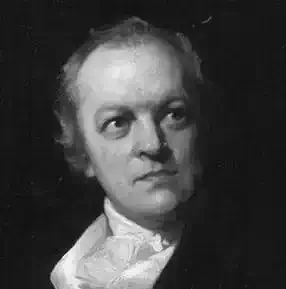
William Blake

William Blake

1757–1827 · lived 69 years GB GB

William Blake was an English poet, painter, and printmaker whose visionary works explored profound spiritual and philosophical themes. He is renowned for his prophetic books, which combine his unique mythology with his distinct artistic style, often characterized by intense symbolism and imaginative power. Blake's work defied easy categorization, blending elements of Romanticism with his own highly personal brand of mysticism. His poetry, such as "Songs of Innocence and of Experience," continues to captivate readers with its exploration of dualities like innocence and corruption, joy and sorrow, and the spiritual and the material.

n. 1757-11-28, Londres · m. 1827-08-12, Charing Cross

58,958 Views

Why Was Cupid a Boy

Why Was Cupid a Boy
Why was Cupid a boy,
And why a boy was he?
He should have been a girl,
For aught that I can see.
For he shoots with his bow,
And the girl shoots with her eye,
And they both are merry and glad,
And laugh when we do cry.
And to make Cupid a boy
Was the Cupid girl's mocking plan;
For a boy can't interpret the thing
Till he is become a man.
And then he's so pierc'd with cares,
And wounded with arrowy smarts,
That the whole business of his life
Is to pick out the heads of the darts.
'Twas the Greeks' love of war
Turn'd Love into a boy,
And woman into a statue of stone--
And away fled every joy.
Read full poem
Bio

Identification and basic context

William Blake was an English poet, painter, and printmaker. He is widely regarded as a visionary artist and a key figure in the Romantic movement, though his work often defied conventional categorization and is characterized by its unique spiritual and philosophical depth. Blake's primary language of expression was English. His imaginative and often mystical worldview set him apart from many of his contemporaries. He is best known for his illuminated books, which combine his poetry with his own intricate illustrations.

Childhood and education

Born in London, Blake came from a modest background. His father was a hosier. He received little formal schooling, attending only a dame school. However, he was a voracious reader and possessed a remarkable natural talent for drawing and poetry from a young age. His parents recognized his artistic abilities and apprenticed him to an engraver at the age of ten. This apprenticeship provided him with crucial technical skills and exposed him to various artistic styles and historical prints, which would later inform his own work. His early education was thus largely practical and self-directed, fueled by an innate creative drive.

Literary trajectory

Blake began his literary career by writing poetry, including early works that would later be revised and published in collections like "Poetical Sketches" (1783). His true innovation came with the development of his "illuminated printing" technique, where he combined his poetry and illustrations into single plates, printed and colored by hand. This led to the creation of his prophetic books, beginning with "Songs of Innocence" (1789) and "Songs of Experience" (1794), which explore complex theological and philosophical ideas through allegorical poetry and vivid imagery. His literary trajectory was marked by a consistent development of his personal mythology and a relentless pursuit of spiritual and artistic expression, often in defiance of contemporary literary and artistic conventions.

Works, style, and literary characteristics

Blake's most famous works include "Songs of Innocence and of Experience," "The Marriage of Heaven and Hell," "Jerusalem," and "Milton." His dominant themes often revolve around the dualities of human existence: innocence and experience, good and evil, heaven and hell, reason and imagination, freedom and oppression. He developed a complex personal mythology populated by symbolic figures like Urizen (reason), Los (imagination), and Enitharmon (spirituality). His style is characterized by its visionary intensity, rich symbolism, and often paradoxical pronouncements. Blake employed a variety of forms, from lyrical songs to epic prophecies, often utilizing rhythmic structures and vivid, dreamlike imagery. His language can be both deceptively simple and profoundly complex, challenging conventional interpretations of morality and spirituality.

Cultural and historical context

Blake lived during a period of significant social and political upheaval in Britain, including the American and French Revolutions, which deeply influenced his thinking on liberty, tyranny, and social justice. He was part of a generation of artists and writers associated with Romanticism, which emphasized emotion, individualism, and the sublime in nature, though Blake's vision was often more overtly spiritual and prophetic. He was deeply critical of the established church, state, and industrialization, viewing them as forces that stifled human imagination and spiritual freedom. His radical religious and political views often led to his isolation from mainstream artistic and literary circles.

Personal life

Blake's personal life was marked by his deep devotion to his wife, Catherine Boucher, whom he taught to read and write and who became his artistic collaborator. They lived a relatively simple life, often facing financial hardship. Blake's intense inner world and visionary experiences sometimes led others to perceive him as eccentric or even insane, though he maintained a consistent creative output. His spiritual beliefs were central to his life and work, forming the basis of his unique cosmology.

Recognition and reception

During his lifetime, Blake was largely unrecognized for his poetic genius and was primarily known as a talented engraver. His visionary works were often misunderstood or dismissed by critics and the public. It was only in the 20th century, with the rise of modernist and postmodernist thought, that his work began to be re-evaluated and appreciated for its originality, depth, and prophetic power. Today, he is considered one of Britain's greatest poets and artists, with his work studied extensively in literature and art history.

Influences and legacy

Blake was influenced by the Bible, Milton, Shakespeare, and various mystical traditions. His radical ideas and unique artistic vision, in turn, influenced numerous artists, writers, and thinkers, including the Pre-Raphaelites, the Symbolists, and later figures in literature and art who embraced his emphasis on imagination and spiritual truth. His critique of industrial society and his celebration of individual vision continue to resonate. His inclusion in the literary and artistic canon is now firmly established, and his works are widely translated and studied internationally.

Interpretation and critical analysis

Blake's work is rich with layers of symbolic meaning, inviting diverse interpretations. Critics often analyze his complex mythology, his critique of established religious and political institutions, and his exploration of the human psyche. Debates frequently arise concerning the precise nature of his spiritual beliefs and the extent to which his visions should be understood literally or metaphorically. His exploration of the "contraries" of life remains a central theme for critical inquiry.

Curiosities and lesser-known aspects

Blake claimed to have seen visions from childhood, including seeing angels in a tree. He developed a unique method of printing his books, which he called "illuminated printing," involving etching both text and image onto copper plates. He was a vocal critic of the rationalism and materialism of his age. His personal notebooks contain numerous aphorisms and observations that reveal his independent and often provocative thinking.

Death and memory

William Blake died in relative obscurity in 1827. His memory was kept alive by a small circle of admirers, but his widespread recognition as a major artistic and literary figure only emerged much later. Posthumous publications and exhibitions have cemented his legacy as a unique and profoundly influential visionary artist and poet.

Poems

93

Never Seek to Tell thy Love

Never Seek to Tell thy Love
Never seek to tell thy love
Love that never told can be;
For the gentle wind does move
Silently, invisibly.
I told my love, I told my love,
I told her all my heart,
Trembling, cold, in ghastly fears--
Ah, she doth depart.
Soon as she was gone from me
A traveller came by
Silently, invisibly--
O, was no deny.
467

Night

Night
The sun descending in the west,
The evening star does shine;
The birds are silent in their nest,
And I must seek for mine.
The moon, like a flower,
In heaven's high bower,
With silent delight
Sits and smiles on the night.
Farewell, green fields and happy groves,
Where flocks have took delight.
Where lambs have nibbled, silent moves
The feet of angels bright;
Unseen they pour blessing,
And joy without ceasing,
On each bud and blossom,
And each sleeping bosom.
They look in every thoughtless nest,
Where birds are covered warm;
They visit caves of every beast,
To keep them all from harm.
If they see any weeping
That should have been sleeping,
They pour sleep on their head,
And sit down by their bed.
When wolves and tigers howl for prey,
They pitying stand and weep;
Seeking to drive their thirst away,
And keep them from the sheep.
But if they rush dreadful,
The angels, most heedful,
Receive each mild spirit,
New worlds to inherit.
And there the lion's ruddy eyes
Shall flow with tears of gold,
And pitying the tender cries,
And walking round the fold,
Saying, 'Wrath, by His meekness,
And, by His health, sickness
Is driven away
From our immortal day.
'And now beside thee, bleating lamb,
I can lie down and sleep;
Or think on Him who bore thy name,
Graze after thee and weep.
For, washed in life's river,
My bright mane for ever
Shall shine like the gold


As I guard o'er the fold.'
492

My Pretty Rose Tree

My Pretty Rose Tree
A flower was offered to me,
Such a flower as May never bore;
But I said 'I've a pretty rose tree,'
And I passed the sweet flower o'er.
Then I went to my pretty rose tree,
To tend her by day and by night;
But my rose turned away with jealousy,
And her thorns were my only delight.
403

My Spectre Around Me

My Spectre Around Me
My spectre around me night and day
Like a wild beast guards my way.
My emanation far within
Weeps incessantly for my sin.
A fathomless and boundless deep,
There we wander, there we weep;
On the hungry craving wind
My spectre follows thee behind.
He scents thy footsteps in the snow,
Wheresoever thou dost go
Through the wintry hail and rain.
When wilt thou return again?
Dost thou not in pride and scorn
Fill with tempests all my morn,
And with jealousies and fears
Fill my pleasant nights with tears?
Seven of my sweet loves thy knife
Has bereaved of their life.
Their marble tombs I built with tears
And with cold and shuddering fears.
Seven more loves weep night and day
Round the tombs where my loves lay,
And seven more loves attend each night
Around my couch with torches bright.
And seven more loves in my bed
Crown with wine my mournful head,
Pitying and forgiving all
Thy transgressions, great and small.
458

Milton: And did those feet in ancient time

Milton: And did those feet in ancient time
And did those feet in ancient time
Walk upon England's mountains green?
And was the holy Lamb of God
On England's pleasant pastures seen?
And did the Countenance Divine
Shine forth upon our clouded hills?
And was Jerusalem builded here
Among these dark Satanic mills?
Bring me my bow of burning gold:
Bring me my arrows of desire:
Bring me my spear: O clouds unfold!
Bring me my chariot of fire.
I will not cease from mental fight,
Nor shall my sword sleep in my hand
Till we have built Jerusalem
In England's green and pleasant land.
336

Milton: The Sky is an Immortal Tent Built by the Sons of Los

Milton: The Sky is an Immortal Tent Built by the Sons of Los
The sky is an immortal tent built by the Sons of Los:
And every space that a man views around his dwelling-place
Standing on his own roof or in his garden on a mount
Of twenty-five cubits in height, such space is his universe:
And on its verge the sun rises and sets, the clouds bow
To meet the flat earth and the sea in such an order'd space:
The starry heavens reach no further, but here bend and set
On all sides, and the two Poles turn on their valves of gold:
And if he moves his dwelling-place, his heavens also move
Where'er he goes, and all his neighbourhood bewail his loss.
Such are the spaces called Earth and such its dimension.
As to that false appearance which appears to the reasoner
As of a globe rolling through voidness, it is a delusion of Ulro.
The microscope knows not of this nor the telescope: they alter
The ratio of the spectator's organs, but leave objects untouch'd.
For every space larger than a red globule of Man's blood
Is visionary, and is created by the Hammer of Los;
And every space smaller than a globule of Man's blood opens
Into Eternity of which this vegetable Earth is but a shadow.
The red globule is the unwearied sun by Los created
To measure time and space to mortal men every morning
436

Love and Harmony

Love and Harmony
Love and harmony combine,
And round our souls entwine
While thy branches mix with mine,
And our roots together join.
Joys upon our branches sit,
Chirping loud and singing sweet;
Like gentle streams beneath our feet
Innocence and virtue meet.
Thou the golden fruit dost bear,
I am clad in flowers fair;
Thy sweet boughs perfume the air,
And the turtle buildeth there.
There she sits and feeds her young,
Sweet I hear her mournful song;
And thy lovely leaves among,
There is love, I hear his tongue.
There his charming nest doth lay,
There he sleeps the night away;
There he sports along the day,
And doth among our branches play.
622

Mad Song

Mad Song
The wild winds weep
And the night is a-cold;
Come hither, Sleep,
And my griefs infold:
But lo! the morning peeps
Over the eastern steeps,
And the rustling birds of dawn
The earth do scorn.
Lo! to the vault
Of paved heaven,
With sorrow fraught
My notes are driven:
They strike the ear of night,
Make weep the eyes of day;
They make mad the roaring winds,
And with tempests play.
Like a fiend in a cloud,
With howling woe,
After night I do crowd,
And with night will go;
I turn my back to the east,
From whence comforts have increas'd;
For light doth seize my brain
With frantic pain.
467

Little Boy Found, The

Little Boy Found, The
The little boy lost in the lonely fen,
Led by the wandering light,
Began to cry, but God, ever nigh,
Appeared like his father, in white.
He kissed the child, and by the hand led,
And to his mother brought,
Who in sorrow pale, through the lonely dale,
The little boy weeping sought.
407

Little Vagabond, The

Little Vagabond, The
Dear mother, dear mother, the church is cold,
But the ale-house is healthy and pleasant and warm;
Besides I can tell where I am used well,
Such usage in Heaven will never do well.
But if at the church they would give us some ale,
And a pleasant fire our souls to regale,
We'd sing and we'd pray all the live-long day,
Nor ever once wish from the church to stray.
Then the parson might preach, and drink, and sing,
And we'd be as happy as birds in the spring;
And modest Dame Lurch, who is always at church,
Would not have bandy children, nor fasting, nor birch.
And God, like a father rejoicing to see
His children as pleasant and happy as he,
Would have no more quarrel with the Devil or the barrel,
But kiss him, and give him both drink and apparel.
481

Quotes

40

Videos

50

Comments (0)

Share
Log in to post a comment.

No comments yet. Be the first to comment.