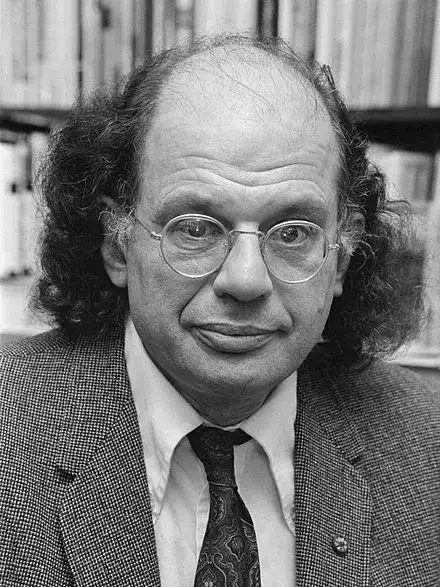
Identification and basic context
Allen Ginsberg was an American poet and writer, widely considered one of the most influential figures of the Beat Generation. He was born on June 3, 1926, and died on April 5, 1997. He was a significant voice in 20th-century American literature, known for his confrontational, prophetic, and deeply personal style. He was openly gay and a lifelong advocate for various social and political causes. His nationality was American, and he wrote primarily in English.
Childhood and education
Ginsberg was born in Newark, New Jersey, to Jewish parents. His mother, Naomi Ginsberg, suffered from mental illness throughout his childhood, a theme that would profoundly influence his poetry, particularly in "Howl." He attended Columbia University, where he began to develop his literary interests, though he was often at odds with the academic establishment. During his university years, he was exposed to various literary and philosophical currents, including modernism, surrealism, and Eastern mysticism, which would later shape his unique poetic vision.
Literary trajectory
Ginsberg's literary journey began during his university years, where he met key figures like Jack Kerouac and William S. Burroughs. His breakthrough came with the publication of "Howl and Other Poems" in 1956. The poem's explicit content and anti-establishment themes led to an obscenity trial, which Ginsberg ultimately won, establishing a landmark victory for freedom of speech in American literature. He continued to write prolifically throughout his life, producing numerous collections of poetry, essays, and letters. His work evolved over time, incorporating elements of Eastern philosophy, jazz rhythms, and a continued engagement with social and political issues.
Works, style, and literary characteristics
Ginsberg's major works include "Howl" (1956), "Kaddish" (1961), "Reality Sandwiches" (1963), "Planet News" (1972), and "White Shroud" (1986). His dominant themes encompass spirituality (often influenced by Buddhism), homosexuality, drug use, madness, social injustice, war, and the critique of American capitalism and conformity. His style is characterized by long, Whitmanesque lines, a confessional and prophetic tone, vivid and often shocking imagery, and a rhythmic intensity that evokes spoken word performance. He embraced free verse and experimented with form, often structuring his poems as epic narratives or ecstatic outpourings. His poetic voice is intensely personal, yet seeks a universal resonance, speaking truth to power and lamenting the spiritual desolation of modern society. He was associated with the Beat Generation and influenced by figures like Walt Whitman and William Blake.
Cultural and historical context
Ginsberg lived and wrote during a period of immense social and political upheaval in the United States, including the Cold War, the Civil Rights Movement, the Vietnam War, and the counterculture of the 1960s. He was a vocal critic of these events and the prevailing social norms. He was closely associated with other Beat writers like Kerouac and Burroughs, forming a significant literary circle that challenged conventional literary and social values. Ginsberg's work directly engaged with the cultural anxieties and aspirations of his time, becoming a voice for those marginalized or disillusioned by mainstream American society.
Personal life
Ginsberg's personal life was marked by intense relationships, including his lifelong love for Peter Orlovsky. His mother's mental illness deeply affected him and fueled much of his early writing. He was an outspoken advocate for gay rights and spiritual exploration, often incorporating his personal experiences with drugs, meditation, and travel into his poetry. He maintained friendships with many artists and writers and was known for his passionate engagement with political activism.
Recognition and reception
While initially controversial, Ginsberg's work gained significant recognition over time. "Howl" is now considered a seminal work of 20th-century American literature, and he received numerous awards, including the National Book Award for Poetry in 1974 for "The Fall of America." He was celebrated both by countercultural movements and in academic circles, though his work continued to challenge conventional tastes. His influence extended internationally.
Influences and legacy
Ginsberg was heavily influenced by Walt Whitman, William Blake, and Eastern spiritual traditions, particularly Buddhism. His legacy is immense; he inspired generations of poets and artists with his courage in confronting difficult subjects, his innovative use of language, and his commitment to social justice. He is a key figure in the American literary canon, and his works continue to be studied, translated, and performed worldwide. His impact on spoken word poetry and performance art is also significant.
Interpretation and critical analysis
Ginsberg's poetry has been interpreted as a spiritual quest, a cry against conformity, and a profound exploration of the human condition in the modern age. Critics have analyzed his use of confessional elements, his engagement with social and political issues, and his spiritual dimensions. Debates often center on the balance between his radical politics and his spiritual aspirations, and the raw, often disturbing, nature of his imagery.
Curiosities and lesser-known aspects
Ginsberg was a prolific letter writer and kept extensive journals. He had a lifelong fascination with Tibetan Buddhism and was a practicing Buddhist. He was also a talented photographer, documenting his life and the lives of his friends. Despite his often wild public persona, he was also known for his intellectual curiosity and his deep compassion.
Death and memory
Allen Ginsberg died of liver cancer at the age of 70. His death was mourned by literary and activist communities worldwide. His literary estate continues to be managed, and his works remain widely available, ensuring his continued presence and influence in literature and culture. His papers are housed at Stanford University.