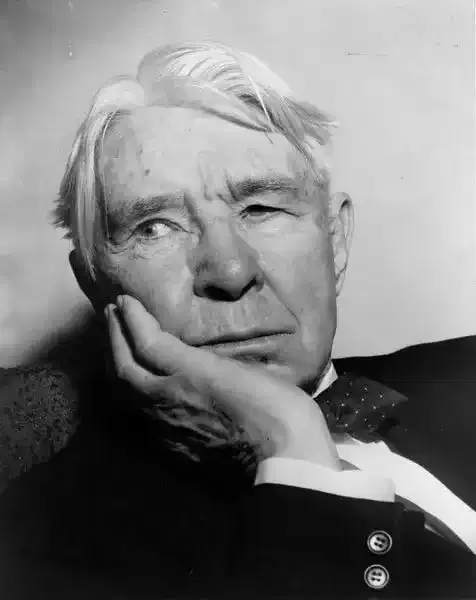
Carl Sandburg

Carl Sandburg

1878–1967 · lived 89 years US US

Carl Sandburg was an American poet, historian, novelist, and lexicographer. He is considered one of the most important American poets of the 20th century, known for his free verse and his focus on the American working class and the landscapes of the American Midwest. His poetry often celebrated the common man and the industrial might of America, earning him a reputation as the "poet of the people." Beyond his poetry, Sandburg was also a prolific biographer, most notably of Abraham Lincoln, and a collector of folklore and songs.

n. 1878-01-06, Galesburg · m. 1967-07-22, Flat Rock

52,800 Views

Grass

Pile the bodies high at Austerlitz and Waterloo.
Shovel them under and let me work
-I am the grass; I cover all.

And pile them high at Gettysburg
And pile them high at Ypres and Verdun.
Shovel them under and let me work.
Two years, ten years, and the passengers ask the conductor:

What place is this?
Where are we now?

I am the grass.
Let me work.
Read full poem
Bio

Identification and basic context

Carl Sandburg was an American poet, writer, historian, novelist, and lexicographer. He is widely celebrated for his free verse poetry, which often depicted the American people, especially the working class, and the landscapes of the American Midwest. His work captured the spirit of industrial America and the lives of ordinary people. Sandburg was born in Galesburg, Illinois, and was of Swedish immigrant descent. His linguistic background and early exposure to different cultures influenced his writing style.

Childhood and education

Sandburg's childhood was marked by hard work and limited formal schooling. He left school at the age of thirteen to work and help support his family. Despite this, he was an avid reader and possessed a strong desire for self-education. He worked various jobs, including as a milkman, a railroad laborer, and a salesman, which exposed him to a wide range of American life and experiences. His early readings included works that would later influence his poetic voice, instilling in him a deep appreciation for the vernacular and the common person's experience.

Literary trajectory

Sandburg's literary career began to take shape in his early adulthood. He attended Lombard College in Galesburg, Illinois, where he began writing poetry. His early work was published in small magazines. A pivotal moment was his involvement with Alfred Stieglitz's gallery and his association with the avant-garde literary scene in Chicago. He gained national recognition with the publication of "Chicago Poems" in 1916. His work evolved through distinct phases, increasingly embracing themes of American identity, industry, and the lives of everyday people. He was also active as a journalist, contributing to various publications and anthologies.

Works, style, and literary characteristics

Sandburg's major works include "Chicago Poems" (1916), "Cornhuskers" (1918), "Smoke and Steel" (1920), and "The People, Yes" (1936). His style is characterized by its use of free verse, colloquial language, and vivid imagery, often drawing from the sounds and sights of industrial America. He explored themes of the American dream, the struggle of the working class, the beauty of the common, and the vastness of the American landscape. His poetic voice is often direct, celebratory, and deeply empathetic towards ordinary individuals. Sandburg's language was accessible, reflecting the vernacular of the people he wrote about, and his poems often possessed a strong, rhythmic quality, reminiscent of American folk music. He is noted for bringing the language and spirit of the American Midwest into poetry.

Cultural and historical context

Sandburg lived and wrote during a period of immense transformation in American history, including industrialization, World War I, the Roaring Twenties, the Great Depression, and World War II. He was closely associated with the Chicago Renaissance, a flourishing of arts and literature in Chicago in the early 20th century. He was part of a generation of poets who sought to break away from traditional poetic forms and embrace a more modern, American idiom. His work often reflected the social and economic conditions of his time, particularly the lives of laborers and immigrants. He engaged with the political and social issues of his era, aligning himself with progressive ideals.

Personal life

Sandburg was married to photographer and artist Lilian Steichen, sister of photographer Edward Steichen. They had three daughters. His personal life, though often private, was deeply intertwined with his work, providing him with inspiration and grounding. He was known for his deep connection to the land and his simple lifestyle. He and his family lived on a farm in North Carolina for many years, where he continued to write and pursue his interests in folklore and music. His beliefs were generally progressive, and he was a strong advocate for the common person.

Recognition and reception

Sandburg received significant recognition during his lifetime, including two Pulitzer Prizes: one for his "Complete Poems" (1951) and another for his biography of Abraham Lincoln (1940). He was widely read and admired, hailed as a voice for the common American. His work continues to be studied and appreciated for its enduring portrayal of American life and its innovative use of language. While some critics noted his departure from more traditional poetic forms, his impact and popularity have solidified his place in American literature.

Influences and legacy

Sandburg was influenced by Walt Whitman's embrace of democracy and expansive verse, as well as by the realism and social consciousness of other contemporary writers. He, in turn, influenced generations of American poets with his accessible style, his championing of vernacular language, and his focus on the lives of ordinary Americans. His biography of Lincoln is considered a monumental work in American historiography. Sandburg's legacy lies in his profound connection to the American spirit and his ability to make the lives and experiences of common people the subject of celebrated poetry.

Interpretation and critical analysis

Sandburg's poetry is often interpreted as a celebration of American democracy and the resilience of its people. Critics have analyzed his use of free verse and colloquial language as a deliberate attempt to democratize poetry, making it accessible to a wider audience. His works are seen as a vital record of early 20th-century American life, capturing its industrial dynamism and its social struggles. The critical discourse often centers on his ability to balance a grounded realism with a lyrical sensibility.

Curiosities and lesser-known aspects

Sandburg was also a dedicated folk singer and collector of American folk songs. He amassed a large collection of these songs, which he performed and compiled. He was a multifaceted figure, also known for his collection of Lincolniana. His writing habits were often described as disciplined, but he also possessed a spontaneous and improvisational spirit, much like the folk music he loved. He was known to carry notebooks and jot down observations constantly.

Death and memory

Carl Sandburg died of natural causes at the age of 89. His passing was widely mourned, and his contributions to American literature and culture were deeply acknowledged. His home in Flat Rock, North Carolina, has been preserved as the Carl Sandburg Home National Historic Site, ensuring his legacy continues to inspire future generations.

Poems

116

Chicago Poet

Chicago Poet

I saluted a nobody.
I saw him in a looking-glass.
He smiled--so did I.
He crumpled the skin on his forehead, frowning--so did I.
Everything I did he did.
I said, "Hello, I know you."
And I was a liar to say so.


Ah, this. looking-glass man!
Liar, fool, dreamer, play-actor,
Soldier, dusty drinker of dust--
Ah! he will go with me
Down the dark stairway
When nobody else is looking,
When everybody else is gone.


He locks his elbow in mine,
I lose all--but not him.
657

Bronzes

Bronzes


I


The bronze General Grant riding a bronze horse in Lincoln
Park
Shrivels in the sun by day when the motor cars whirr
by in long processions going somewhere to keep appointment
for dinner and matineés and buying and
selling
Though in the dusk and nightfall when high waves are
piling
On the slabs of the promenade along the lake shore near
by
I have seen the general dare the combers come closer
And make to ride his bronze horse out into the hoofs
and guns of the storm.


II


I cross Lincoln Park on a winter night when the snow
is falling.
Lincoln in bronze stands among the white lines of snow,
his bronze forehead meeting soft echoes of the newsies
crying forty thousand men are dead along the
Yser, his bronze ears listening to the mumbled roar
of the city at his bronze feet.
A lithe Indian on a bronze pony, Shakespeare seated with
long legs in bronze, Garibaldi in a bronze cape, they
hold places in the cold, lonely snow to-night on their
pedestals and so they will hold them past midnight
and into the dawn.
385

Chamfort

Chamfort


There's Chamfort. He’s a sample.
Locked himself in his library with a gun,
Shot off his nose and shot out his right eye.
And this Chamfort knew how to write
And thousands read his books on how to live,
But he himself didn’t know
How to die by force of his own hand—see?
They found him a red pool on the carpet
Cool as an April forenoon,
Talking and talking gay maxims and grim epigrams.
Well, he wore bandages over his nose and right eye,
Drank coffee and chatted many years
With men and women who loved him
Because he laughed and daily dared Death:
“Come and take me.”
406

Broadway

Broadway


I shall never forget you, Broadway
Your golden and calling lights.


I’ll remember you long,
Tall-walled river of rush and play.


Hearts that know you hate you
And lips that have given you laughter
Have gone to their ashes of life and its roses,
Cursing the dreams that were lost
In the dust of your harsh and trampled stones.
372

Bricklayer Love

Bricklayer Love

I thought of killing myself because I am only a bricklayer
and you a woman who loves the man who runs a drug store.


I don't care like I used to; I lay bricks straighter than I
used to and I sing slower handling the trowel afternoons.


When the sun is in my eyes and the ladders are shaky and the
mortar boards go wrong, I think of you.
360

'Boes

'Boes


I waited today for a freight train to pass.


Cattle cars with steers butting their horns against the
bars, went by.


And a half a dozen hoboes stood on bumpers between
cars.


Well, the cattle are respectable, I thought.


Every steer has its transportation paid for by the farmer
sending it to market,


While the hoboes are law-breakers in riding a railroad
train without a ticket.


It reminded me of ten days I spent in the Allegheny
County jail in Pittsburgh.


I got ten days even though I was a veteran of the
Spanish-American war.


Cooped in the same cell with me was an old man, a
bricklayer and a booze-fighter.


But it just happened he, too, was a veteran soldier, and
he had fought to preserve the Union and free the
niggers.


We were three in all, the other being a Lithuanian who
got drunk on pay day at the steel works and got to
fighting a policeman;


All the clothes he had was a shirt, pants and shoes-somebody
got his hat and coat and what money he
had left over when he got drunk.
379

Blacklisted

Blacklisted


Why shall I keep the old name?
What is a name anywhere anyway?
A name is a cheap thing all fathers and mothers leave each child:
A job is a job and I want to live, so
Why does God Almighty or anybody else care whether I take a new name to go by?
350

Basket

Basket


speak, sir, and be wise.
Speak choosing your words, sir, like an old woman over a bushel of apples.
406

Bath

Bath


A man saw the whole world as a grinning skull and cross-bones. The rose flesh of life
shriveled from all faces. Nothing counts. Everything is a fake. Dust to dust and ashes
to ashes and then an old darkness and a useless silence. So he saw it all. Then he went
to a Mischa Elman concert. Two hours waves of sound beat on his eardrums. Music
washed something or other inside him. Music broke down and rebuilt something or
other in his head and heart. He joined in five encores for the young Russian Jew with
the fiddle. When he got outside his heels hit the sidewalk a new way. He was the same
man in the same world as before. Only there was a singing fire and a climb of roses
everlastingly over the world he looked on.
391

Baltic Fog Notes

Baltic Fog Notes

Seven days all fog, all mist, and the turbines pounding through high seas.
I was a plaything, a rat’s neck in the teeth of a scuffling mastiff.
Fog and fog and no stars, sun, moon.
Then an afternoon in fjords, low-lying lands scrawled in granite languages on a gray
sky,
A night harbor, blue dusk mountain shoulders against a night sky,
And a circle of lights blinking: Ninety thousand people here.
Among the Wednesday night thousands in goloshes and coats slickered for rain,
I learned how hungry I was for streets and people.


I would rather be water than anything else.
I saw a drive of salt fog and mist in the North Atlantic and an iceberg dusky as a cloud
in the gray of morning.
And I saw the dream pools of fjords in Norway … and the scarf of dancing water on the
rocks and over the edges of mountain shelves.
Bury me in a mountain graveyard in Norway.
Three tongues of water sing around it with snow from the mountains.


Bury me in the North Atlantic.
A fog there from Iceland will be a murmur in gray over me and a long deep wind sob
always.


Bury me in an Illinois cornfield.
The blizzards loosen their pipe organ voluntaries in winter stubble and the spring rains
and the fall rains bring letters from the sea.
403

Quotes

40

Videos

50

Comments (0)

Share
Log in to post a comment.

No comments yet. Be the first to comment.