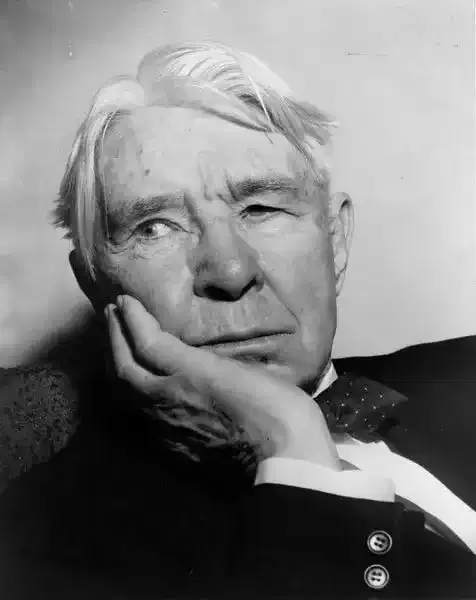
Carl Sandburg

Carl Sandburg

1878–1967 · lived 89 years US US

Carl Sandburg was an American poet, historian, novelist, and lexicographer. He is considered one of the most important American poets of the 20th century, known for his free verse and his focus on the American working class and the landscapes of the American Midwest. His poetry often celebrated the common man and the industrial might of America, earning him a reputation as the "poet of the people." Beyond his poetry, Sandburg was also a prolific biographer, most notably of Abraham Lincoln, and a collector of folklore and songs.

n. 1878-01-06, Galesburg · m. 1967-07-22, Flat Rock

52,800 Views

Grass

Pile the bodies high at Austerlitz and Waterloo.
Shovel them under and let me work
-I am the grass; I cover all.

And pile them high at Gettysburg
And pile them high at Ypres and Verdun.
Shovel them under and let me work.
Two years, ten years, and the passengers ask the conductor:

What place is this?
Where are we now?

I am the grass.
Let me work.
Read full poem
Bio

Identification and basic context

Carl Sandburg was an American poet, writer, historian, novelist, and lexicographer. He is widely celebrated for his free verse poetry, which often depicted the American people, especially the working class, and the landscapes of the American Midwest. His work captured the spirit of industrial America and the lives of ordinary people. Sandburg was born in Galesburg, Illinois, and was of Swedish immigrant descent. His linguistic background and early exposure to different cultures influenced his writing style.

Childhood and education

Sandburg's childhood was marked by hard work and limited formal schooling. He left school at the age of thirteen to work and help support his family. Despite this, he was an avid reader and possessed a strong desire for self-education. He worked various jobs, including as a milkman, a railroad laborer, and a salesman, which exposed him to a wide range of American life and experiences. His early readings included works that would later influence his poetic voice, instilling in him a deep appreciation for the vernacular and the common person's experience.

Literary trajectory

Sandburg's literary career began to take shape in his early adulthood. He attended Lombard College in Galesburg, Illinois, where he began writing poetry. His early work was published in small magazines. A pivotal moment was his involvement with Alfred Stieglitz's gallery and his association with the avant-garde literary scene in Chicago. He gained national recognition with the publication of "Chicago Poems" in 1916. His work evolved through distinct phases, increasingly embracing themes of American identity, industry, and the lives of everyday people. He was also active as a journalist, contributing to various publications and anthologies.

Works, style, and literary characteristics

Sandburg's major works include "Chicago Poems" (1916), "Cornhuskers" (1918), "Smoke and Steel" (1920), and "The People, Yes" (1936). His style is characterized by its use of free verse, colloquial language, and vivid imagery, often drawing from the sounds and sights of industrial America. He explored themes of the American dream, the struggle of the working class, the beauty of the common, and the vastness of the American landscape. His poetic voice is often direct, celebratory, and deeply empathetic towards ordinary individuals. Sandburg's language was accessible, reflecting the vernacular of the people he wrote about, and his poems often possessed a strong, rhythmic quality, reminiscent of American folk music. He is noted for bringing the language and spirit of the American Midwest into poetry.

Cultural and historical context

Sandburg lived and wrote during a period of immense transformation in American history, including industrialization, World War I, the Roaring Twenties, the Great Depression, and World War II. He was closely associated with the Chicago Renaissance, a flourishing of arts and literature in Chicago in the early 20th century. He was part of a generation of poets who sought to break away from traditional poetic forms and embrace a more modern, American idiom. His work often reflected the social and economic conditions of his time, particularly the lives of laborers and immigrants. He engaged with the political and social issues of his era, aligning himself with progressive ideals.

Personal life

Sandburg was married to photographer and artist Lilian Steichen, sister of photographer Edward Steichen. They had three daughters. His personal life, though often private, was deeply intertwined with his work, providing him with inspiration and grounding. He was known for his deep connection to the land and his simple lifestyle. He and his family lived on a farm in North Carolina for many years, where he continued to write and pursue his interests in folklore and music. His beliefs were generally progressive, and he was a strong advocate for the common person.

Recognition and reception

Sandburg received significant recognition during his lifetime, including two Pulitzer Prizes: one for his "Complete Poems" (1951) and another for his biography of Abraham Lincoln (1940). He was widely read and admired, hailed as a voice for the common American. His work continues to be studied and appreciated for its enduring portrayal of American life and its innovative use of language. While some critics noted his departure from more traditional poetic forms, his impact and popularity have solidified his place in American literature.

Influences and legacy

Sandburg was influenced by Walt Whitman's embrace of democracy and expansive verse, as well as by the realism and social consciousness of other contemporary writers. He, in turn, influenced generations of American poets with his accessible style, his championing of vernacular language, and his focus on the lives of ordinary Americans. His biography of Lincoln is considered a monumental work in American historiography. Sandburg's legacy lies in his profound connection to the American spirit and his ability to make the lives and experiences of common people the subject of celebrated poetry.

Interpretation and critical analysis

Sandburg's poetry is often interpreted as a celebration of American democracy and the resilience of its people. Critics have analyzed his use of free verse and colloquial language as a deliberate attempt to democratize poetry, making it accessible to a wider audience. His works are seen as a vital record of early 20th-century American life, capturing its industrial dynamism and its social struggles. The critical discourse often centers on his ability to balance a grounded realism with a lyrical sensibility.

Curiosities and lesser-known aspects

Sandburg was also a dedicated folk singer and collector of American folk songs. He amassed a large collection of these songs, which he performed and compiled. He was a multifaceted figure, also known for his collection of Lincolniana. His writing habits were often described as disciplined, but he also possessed a spontaneous and improvisational spirit, much like the folk music he loved. He was known to carry notebooks and jot down observations constantly.

Death and memory

Carl Sandburg died of natural causes at the age of 89. His passing was widely mourned, and his contributions to American literature and culture were deeply acknowledged. His home in Flat Rock, North Carolina, has been preserved as the Carl Sandburg Home National Historic Site, ensuring his legacy continues to inspire future generations.

Poems

116

Honky Tonk in Cleveland, Ohio

Honky Tonk in Cleveland, Ohio

It's a jazz affair, drum crashes and coronet razzes.
The trombone pony neighs and the tuba jackass snorts.
The banjo tickles and titters too awful.
The chippies talk about the funnies in the papers.
The cartoonists weep in their beer.
Shop riveters talk with their feet
To the feet of floozies under the tables.
A quartet of white hopes mourn with interspersed snickers:
"I got the blues.
I got the blues.
I got the blues."
And . . . as we said earlier:
The cartoonists weep in their beer.
355

Gypsy

Gypsy


I asked a gypsy pal
To imitate an old image
And speak old wisdom.
She drew in her chin,
Made her neck and head
The top piece of a Nile obelisk
and said:
Snatch off the gag from thy mouth, child,
And be free to keep silence.
Tell no man anything for no man listens,
Yet hold thy lips ready to speak.
384

Happiness

Happiness


I asked the professors who teach the meaning of life to tell
me what is happiness.
And I went to famous executives who boss the work of
thousands of men.
They all shook their heads and gave me a smile as though
I was trying to fool with them
And then one Sunday afternoon I wandered out along
the Desplaines river
And I saw a crowd of Hungarians under the trees with
their women and children and a keg of beer and an
accordion.
384

Gone

Gone


Everybody loved Chick Lorimer in our town.
Far off
Everybody loved her.
So we all love a wild girl keeping a hold
On a dream she wants.
Nobody knows now where Chick Lorimer went.
Nobody knows why she packed her trunk .. a few old things
And is gone,
Gone with her little chin
Thrust ahead of her
And her soft hair blowing careless
From under a wide hat,
Dancer, singer, a laughing passionate lover.


Were there ten men or a hundred hunting Chick?
Were there five men or fifty with aching hearts?
Everybody loved Chick Lorimer.
Nobody knows where she’s gone.
391

Government

Government


The Government -- I heard about the Government and
I went out to find it. I said I would look closely at
it when I saw it.
Then I saw a policeman dragging a drunken man to
the callaboose. It was the Government in action.
I saw a ward alderman slip into an office one morning
and talk with a judge. Later in the day the judge
dismissed a case against a pickpocket who was a
live ward worker for the alderman. Again I saw
this was the Government, doing things.
I saw militiamen level their rifles at a crowd of
workingmen who were trying to get other workingmen
to stay away from a shop where there was a strike
on. Government in action.
Everywhere I saw that Government is a thing made of
men, that Government has blood and bones, it is
many mouths whispering into many ears, sending
telegrams, aiming rifles, writing orders, saying
"yes" and "no."
Government dies as the men who form it die and are laid
away in their graves and the new Government that
comes after is human, made of heartbeats of blood,
ambitions, lusts, and money running through it all,
money paid and money taken, and money covered
up and spoken of with hushed voices.
A Government is just as secret and mysterious and sensitive
as any human sinner carrying a load of germs,
traditions and corpuscles handed down from
fathers and mothers away back.
289

Follies

Follies


Shaken,
The blossoms of lilac,
And shattered,
The atoms of purple.
Green dip the leaves,
Darker the bark,
Longer the shadows.


Sheer lines of poplar
Shimmer with masses of silver
And down in a garden old with years
And broken walls of ruin and story,
Roses rise with red rain-memories.
May!
In the open world
The sun comes and finds your face,
Remembering all.
297

Fog

Fog


The fog comes
on little cat feet.


It sits looking
over harbor and city
on silent haunches
and then moves on.
390

Fire Pages

Fire Pages

I will read ashes for you, if you ask me.
I will look on the fire and tell you from the gray lashes
And out of the red and black tongues and stripes,
I will tell how fire comes
And how fire runs far as the sea.
337

Flanders

Flanders


Flanders, the name of a place, a country of people,
Spells itself with letters, is written in books.


"Where is Flanders?" was asked one time,
Flanders known only to those who lived there
And milked cows and made cheese and spoke the home language.


"Where is Flanders?" was asked.
And the slang adepts shot the reply: Search me.


A few thousand people milking cows, raising radishes,
On a land of salt grass and dunes, sand-swept with a sea-breath on it:
This was Flanders, the unknown, the quiet,
The place where cows hunted lush cuds of green on lowlands,
And the raw-boned plowmen took horses with long shanks
Out in the dawn to the sea-breath.


Flanders sat slow-spoken amid slow-swung windmills,
Slow-circling windmill arms turning north or west,
Turning to talk to the swaggering winds, the childish winds,
So Flanders sat with the heart of a kitchen girl
Washing wooden bowls in the winter sun by a window.
302

Eleventh Avenue Racket

Eleventh Avenue Racket

There is something terrible
about a hurdy-gurdy,
a gipsy man and woman,
and a monkey in red flannel
all stopping in front of a big house
with a sign “For Rent” on the door
and the blinds hanging loose
and nobody home.
I never saw this.
I hope to God I never will.


Whoop-de-doodle-de-doo.
Hoodle-de-harr-de-hum.
Nobody home? Everybody home.
Whoop-de-doodle-de-doo.


Mamie Riley married Jimmy Higgins last night: Eddie Jones died of whooping cough:
George Hacks got a job on the police force: the Rosenheims bought a brass bed: Lena
Hart giggled at a jackie: a pushcart man called tomaytoes, tomaytoes.
Whoop-de-doodle-de-doo.
Hoodle-de-harr-de-hum.
Nobody home? Everybody home.
326

Quotes

40

Videos

50

Comments (0)

Share
Log in to post a comment.

No comments yet. Be the first to comment.