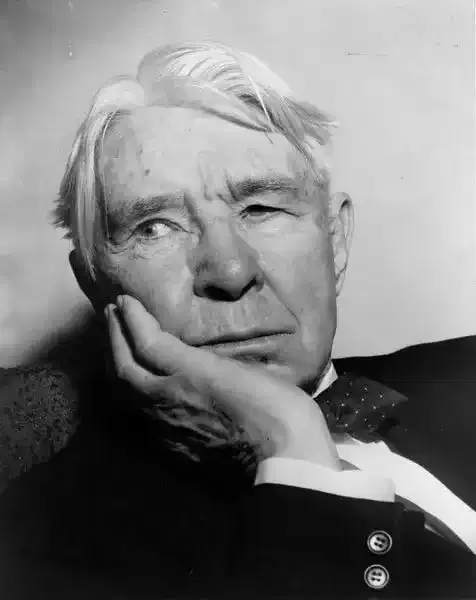
Carl Sandburg

Carl Sandburg

1878–1967 · lived 89 years US US

Carl Sandburg was an American poet, historian, novelist, and lexicographer. He is considered one of the most important American poets of the 20th century, known for his free verse and his focus on the American working class and the landscapes of the American Midwest. His poetry often celebrated the common man and the industrial might of America, earning him a reputation as the "poet of the people." Beyond his poetry, Sandburg was also a prolific biographer, most notably of Abraham Lincoln, and a collector of folklore and songs.

n. 1878-01-06, Galesburg · m. 1967-07-22, Flat Rock

52,800 Views

Grass

Pile the bodies high at Austerlitz and Waterloo.
Shovel them under and let me work
-I am the grass; I cover all.

And pile them high at Gettysburg
And pile them high at Ypres and Verdun.
Shovel them under and let me work.
Two years, ten years, and the passengers ask the conductor:

What place is this?
Where are we now?

I am the grass.
Let me work.
Read full poem
Bio

Identification and basic context

Carl Sandburg was an American poet, writer, historian, novelist, and lexicographer. He is widely celebrated for his free verse poetry, which often depicted the American people, especially the working class, and the landscapes of the American Midwest. His work captured the spirit of industrial America and the lives of ordinary people. Sandburg was born in Galesburg, Illinois, and was of Swedish immigrant descent. His linguistic background and early exposure to different cultures influenced his writing style.

Childhood and education

Sandburg's childhood was marked by hard work and limited formal schooling. He left school at the age of thirteen to work and help support his family. Despite this, he was an avid reader and possessed a strong desire for self-education. He worked various jobs, including as a milkman, a railroad laborer, and a salesman, which exposed him to a wide range of American life and experiences. His early readings included works that would later influence his poetic voice, instilling in him a deep appreciation for the vernacular and the common person's experience.

Literary trajectory

Sandburg's literary career began to take shape in his early adulthood. He attended Lombard College in Galesburg, Illinois, where he began writing poetry. His early work was published in small magazines. A pivotal moment was his involvement with Alfred Stieglitz's gallery and his association with the avant-garde literary scene in Chicago. He gained national recognition with the publication of "Chicago Poems" in 1916. His work evolved through distinct phases, increasingly embracing themes of American identity, industry, and the lives of everyday people. He was also active as a journalist, contributing to various publications and anthologies.

Works, style, and literary characteristics

Sandburg's major works include "Chicago Poems" (1916), "Cornhuskers" (1918), "Smoke and Steel" (1920), and "The People, Yes" (1936). His style is characterized by its use of free verse, colloquial language, and vivid imagery, often drawing from the sounds and sights of industrial America. He explored themes of the American dream, the struggle of the working class, the beauty of the common, and the vastness of the American landscape. His poetic voice is often direct, celebratory, and deeply empathetic towards ordinary individuals. Sandburg's language was accessible, reflecting the vernacular of the people he wrote about, and his poems often possessed a strong, rhythmic quality, reminiscent of American folk music. He is noted for bringing the language and spirit of the American Midwest into poetry.

Cultural and historical context

Sandburg lived and wrote during a period of immense transformation in American history, including industrialization, World War I, the Roaring Twenties, the Great Depression, and World War II. He was closely associated with the Chicago Renaissance, a flourishing of arts and literature in Chicago in the early 20th century. He was part of a generation of poets who sought to break away from traditional poetic forms and embrace a more modern, American idiom. His work often reflected the social and economic conditions of his time, particularly the lives of laborers and immigrants. He engaged with the political and social issues of his era, aligning himself with progressive ideals.

Personal life

Sandburg was married to photographer and artist Lilian Steichen, sister of photographer Edward Steichen. They had three daughters. His personal life, though often private, was deeply intertwined with his work, providing him with inspiration and grounding. He was known for his deep connection to the land and his simple lifestyle. He and his family lived on a farm in North Carolina for many years, where he continued to write and pursue his interests in folklore and music. His beliefs were generally progressive, and he was a strong advocate for the common person.

Recognition and reception

Sandburg received significant recognition during his lifetime, including two Pulitzer Prizes: one for his "Complete Poems" (1951) and another for his biography of Abraham Lincoln (1940). He was widely read and admired, hailed as a voice for the common American. His work continues to be studied and appreciated for its enduring portrayal of American life and its innovative use of language. While some critics noted his departure from more traditional poetic forms, his impact and popularity have solidified his place in American literature.

Influences and legacy

Sandburg was influenced by Walt Whitman's embrace of democracy and expansive verse, as well as by the realism and social consciousness of other contemporary writers. He, in turn, influenced generations of American poets with his accessible style, his championing of vernacular language, and his focus on the lives of ordinary Americans. His biography of Lincoln is considered a monumental work in American historiography. Sandburg's legacy lies in his profound connection to the American spirit and his ability to make the lives and experiences of common people the subject of celebrated poetry.

Interpretation and critical analysis

Sandburg's poetry is often interpreted as a celebration of American democracy and the resilience of its people. Critics have analyzed his use of free verse and colloquial language as a deliberate attempt to democratize poetry, making it accessible to a wider audience. His works are seen as a vital record of early 20th-century American life, capturing its industrial dynamism and its social struggles. The critical discourse often centers on his ability to balance a grounded realism with a lyrical sensibility.

Curiosities and lesser-known aspects

Sandburg was also a dedicated folk singer and collector of American folk songs. He amassed a large collection of these songs, which he performed and compiled. He was a multifaceted figure, also known for his collection of Lincolniana. His writing habits were often described as disciplined, but he also possessed a spontaneous and improvisational spirit, much like the folk music he loved. He was known to carry notebooks and jot down observations constantly.

Death and memory

Carl Sandburg died of natural causes at the age of 89. His passing was widely mourned, and his contributions to American literature and culture were deeply acknowledged. His home in Flat Rock, North Carolina, has been preserved as the Carl Sandburg Home National Historic Site, ensuring his legacy continues to inspire future generations.

Poems

116

Fellow Citizens

Fellow Citizens

I drank musty ale at the Illinois Athletic Club with
the millionaire manufacturer of Green River butter
one night
And his face had the shining light of an old-time Quaker,
he spoke of a beautiful daughter, and I knew he had
a peace and a happiness up his sleeve somewhere.
Then I heard Jim Kirch make a speech to the Advertising
Association on the trade resources of South America.
And the way he lighted a three-for-a-nickel stogie and
cocked it at an angle regardless of the manners of
our best people,
I knew he had a clutch on a real happiness even though
some of the reporters on his newspaper say he is
the living double of Jack London's Sea Wolf.
In the mayor's office the mayor himself told me he was
happy though it is a hard job to satisfy all the officeseekers
and eat all the dinners he is asked to eat.
Down in Gilpin Place, near Hull House, was a man with
his jaw wrapped for a bad toothache,
And he had it all over the butter millionaire, Jim Kirch
and the mayor when it came to happiness.
He is a maker of accordions and guitars and not only
makes them from start to finish, but plays them
after he makes them.
And he had a guitar of mahogany with a walnut bottom
he offered for seven dollars and a half if I wanted it,
And another just like it, only smaller, for six dollars,
though he never mentioned the price till I asked him,
And he stated the price in a sorry way, as though the
music and the make of an instrument count for a
million times more than the price in money.
I thought he had a real soul and knew a lot about God.
There was light in his eyes of one who has conquered
sorrow in so far as sorrow is conquerable or worth
conquering.
Anyway he is the only Chicago citizen I was jealous of
that day.
He played a dance they play in some parts of Italy
when the harvest of grapes is over and the wine
presses are ready for work.
352

Dunes

Dunes


What do we see here in the sand dunes of the white moon alone with our thoughts,
Bill,
Alone with our dreams, Bill, soft as the women tying scarves around their heads
dancing,
Alone with a picture and a picture coming one after the other of all the dead,
The dead more than all these grains of sand one by one piled here in the moon,
Piled against the sky-line taking shapes like the hand of the wind wanted,
What do we see here, Bill, outside of what the wise men beat their heads on,
Outside of what the poets cry for and the soldiers drive on headlong and leave their
skulls in the sun for—what, Bill?
346

Dusty Doors

Dusty Doors

Child of the Aztec gods,
how long must we listen here,
how long before we go?


The dust is deep on the lintels.
The dust is dark on the doors.
If the dreams shake our bones,
what can we say or do?


Since early morning we waited.
Since early, early morning, child.
There must be dreams on the way now.
There must be a song for our bones.


The dust gets deeper and darker.
Do the doors and lintels shudder?
How long must we listen here?
How long before we go?
332

Dream Girl

Dream Girl

You will come one day in a waver of love,
Tender as dew, impetuous as rain,
The tan of the sun will be on your skin,
The purr of the breeze in your murmuring speech,
You will pose with a hill-flower grace.


You will come, with your slim, expressive arms,
A poise of the head no sculptor has caught
And nuances spoken with shoulder and neck,
Your face in a pass-and-repass of moods
As many as skies in delicate change
Of cloud and blue and flimmering sun.


Yet,
You may not come, O girl of a dream,
We may but pass as the world goes by
And take from a look of eyes into eyes,
A film of hope and a memoried day.
367

Death Snips Proud Men

Death Snips Proud Men

DEATH is stronger than all the governments because
the governments are men and men die and then
death laughs: Now you see 'em, now you don't.

Death is stronger than all proud men and so death
snips proud men on the nose, throws a pair of
dice and says: Read 'em and weep.


Death sends a radiogram every day: When I want
you I'll drop in--and then one day he comes with a
master-key and lets himself in and says: We'll
go now.

Death is a nurse mother with big arms: 'Twon't hurt
you at all; it's your time now; just need a
long sleep, child; what have you had anyhow
better than sleep?
323

Crimson

Crimson


Crimson is the slow smolder of the cigar end I hold,
Gray is the ash that stiffens and covers all silent the fire.
(A great man I know is dead and while he lies in his coffin a gone flame I sit here in
cumbering shadows and smoke and watch my thoughts come and go.)
311

Crucible

Crucible


Hot gold runs a winding stream on the inside of a green bowl.


Yellow trickles in a fan figure, scatters a line of skirmishes, spreads a chorus
of dancing girls, performs blazing ochre evolutions, gathers the whole show into
one stream, forgets the past and rolls on.


The sea-mist green of the bowl's bottom is a dark throat of sky crossed by
quarreling forks of umber and ochre and yellow changing faces.
295

Clark Street Bridge

Clark Street Bridge

Dust of the feet
And dust of the wheels,
Wagons and people going,
All day feet and wheels.


Now. . .
. . Only stars and mist
A lonely policeman,
Two cabaret dancers,
Stars and mist again,
No more feet or wheels,
No more dust and wagons.


Voices of dollars
And drops of blood
. . . . .
Voices of broken hearts,
. . Voices singing, singing,
. . Silver voices, singing,
Softer than the stars,
Softer than the mist.
356

Choices

Choices


They offer you many things,
I a few.
Moonlight on the play of fountains at night
With water sparkling a drowsy monotone,
Bare-shouldered, smiling women and talk
And a cross-play of loves and adulteries
And a fear of death
and a remembering of regrets:
All this they offer you.
I come with:
salt and bread
a terrible job of work
and tireless war;
Come and have now:
hunger.
danger
and hate.
376

Child Moon

Child Moon

The child's wonder
At the old moon
Comes back nightly.
She points her finger
To the far silent yellow thing
Shining through the branches
Filtering on the leaves a golden sand,
Crying with her little tongue, “See the moon!”
And in her bed fading to sleep
With babblings of the moon on her little mouth.
344

Quotes

40

Videos

50

Comments (0)

Share
Log in to post a comment.

No comments yet. Be the first to comment.