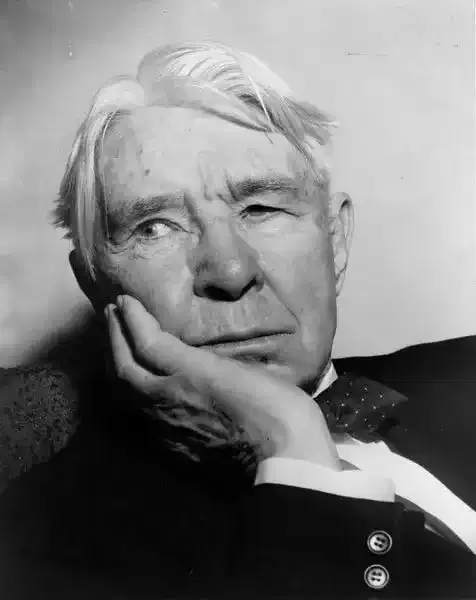
Carl Sandburg

Carl Sandburg

1878–1967 · lived 89 years US US

Carl Sandburg was an American poet, historian, novelist, and lexicographer. He is considered one of the most important American poets of the 20th century, known for his free verse and his focus on the American working class and the landscapes of the American Midwest. His poetry often celebrated the common man and the industrial might of America, earning him a reputation as the "poet of the people." Beyond his poetry, Sandburg was also a prolific biographer, most notably of Abraham Lincoln, and a collector of folklore and songs.

n. 1878-01-06, Galesburg · m. 1967-07-22, Flat Rock

52,800 Views

Grass

Pile the bodies high at Austerlitz and Waterloo.
Shovel them under and let me work
-I am the grass; I cover all.

And pile them high at Gettysburg
And pile them high at Ypres and Verdun.
Shovel them under and let me work.
Two years, ten years, and the passengers ask the conductor:

What place is this?
Where are we now?

I am the grass.
Let me work.
Read full poem
Bio

Identification and basic context

Carl Sandburg was an American poet, writer, historian, novelist, and lexicographer. He is widely celebrated for his free verse poetry, which often depicted the American people, especially the working class, and the landscapes of the American Midwest. His work captured the spirit of industrial America and the lives of ordinary people. Sandburg was born in Galesburg, Illinois, and was of Swedish immigrant descent. His linguistic background and early exposure to different cultures influenced his writing style.

Childhood and education

Sandburg's childhood was marked by hard work and limited formal schooling. He left school at the age of thirteen to work and help support his family. Despite this, he was an avid reader and possessed a strong desire for self-education. He worked various jobs, including as a milkman, a railroad laborer, and a salesman, which exposed him to a wide range of American life and experiences. His early readings included works that would later influence his poetic voice, instilling in him a deep appreciation for the vernacular and the common person's experience.

Literary trajectory

Sandburg's literary career began to take shape in his early adulthood. He attended Lombard College in Galesburg, Illinois, where he began writing poetry. His early work was published in small magazines. A pivotal moment was his involvement with Alfred Stieglitz's gallery and his association with the avant-garde literary scene in Chicago. He gained national recognition with the publication of "Chicago Poems" in 1916. His work evolved through distinct phases, increasingly embracing themes of American identity, industry, and the lives of everyday people. He was also active as a journalist, contributing to various publications and anthologies.

Works, style, and literary characteristics

Sandburg's major works include "Chicago Poems" (1916), "Cornhuskers" (1918), "Smoke and Steel" (1920), and "The People, Yes" (1936). His style is characterized by its use of free verse, colloquial language, and vivid imagery, often drawing from the sounds and sights of industrial America. He explored themes of the American dream, the struggle of the working class, the beauty of the common, and the vastness of the American landscape. His poetic voice is often direct, celebratory, and deeply empathetic towards ordinary individuals. Sandburg's language was accessible, reflecting the vernacular of the people he wrote about, and his poems often possessed a strong, rhythmic quality, reminiscent of American folk music. He is noted for bringing the language and spirit of the American Midwest into poetry.

Cultural and historical context

Sandburg lived and wrote during a period of immense transformation in American history, including industrialization, World War I, the Roaring Twenties, the Great Depression, and World War II. He was closely associated with the Chicago Renaissance, a flourishing of arts and literature in Chicago in the early 20th century. He was part of a generation of poets who sought to break away from traditional poetic forms and embrace a more modern, American idiom. His work often reflected the social and economic conditions of his time, particularly the lives of laborers and immigrants. He engaged with the political and social issues of his era, aligning himself with progressive ideals.

Personal life

Sandburg was married to photographer and artist Lilian Steichen, sister of photographer Edward Steichen. They had three daughters. His personal life, though often private, was deeply intertwined with his work, providing him with inspiration and grounding. He was known for his deep connection to the land and his simple lifestyle. He and his family lived on a farm in North Carolina for many years, where he continued to write and pursue his interests in folklore and music. His beliefs were generally progressive, and he was a strong advocate for the common person.

Recognition and reception

Sandburg received significant recognition during his lifetime, including two Pulitzer Prizes: one for his "Complete Poems" (1951) and another for his biography of Abraham Lincoln (1940). He was widely read and admired, hailed as a voice for the common American. His work continues to be studied and appreciated for its enduring portrayal of American life and its innovative use of language. While some critics noted his departure from more traditional poetic forms, his impact and popularity have solidified his place in American literature.

Influences and legacy

Sandburg was influenced by Walt Whitman's embrace of democracy and expansive verse, as well as by the realism and social consciousness of other contemporary writers. He, in turn, influenced generations of American poets with his accessible style, his championing of vernacular language, and his focus on the lives of ordinary Americans. His biography of Lincoln is considered a monumental work in American historiography. Sandburg's legacy lies in his profound connection to the American spirit and his ability to make the lives and experiences of common people the subject of celebrated poetry.

Interpretation and critical analysis

Sandburg's poetry is often interpreted as a celebration of American democracy and the resilience of its people. Critics have analyzed his use of free verse and colloquial language as a deliberate attempt to democratize poetry, making it accessible to a wider audience. His works are seen as a vital record of early 20th-century American life, capturing its industrial dynamism and its social struggles. The critical discourse often centers on his ability to balance a grounded realism with a lyrical sensibility.

Curiosities and lesser-known aspects

Sandburg was also a dedicated folk singer and collector of American folk songs. He amassed a large collection of these songs, which he performed and compiled. He was a multifaceted figure, also known for his collection of Lincolniana. His writing habits were often described as disciplined, but he also possessed a spontaneous and improvisational spirit, much like the folk music he loved. He was known to carry notebooks and jot down observations constantly.

Death and memory

Carl Sandburg died of natural causes at the age of 89. His passing was widely mourned, and his contributions to American literature and culture were deeply acknowledged. His home in Flat Rock, North Carolina, has been preserved as the Carl Sandburg Home National Historic Site, ensuring his legacy continues to inspire future generations.

Poems

116

Kin

Kin


Brother, I am fire
Surging under the ocean floor.
I shall never meet you, brother—
Not for years, anyhow;
Maybe thousands of years, brother.
Then I will warm you,
Hold you close, wrap you in circles,
Use you and change you—
Maybe thousands of years, brother.
425

Jan Kubelik

Jan Kubelik

Your bow swept over a string, and a long low note quivered to the air.
(A mother of Bohemia sobs over a new child perfect learning to suck milk.)


Your bow ran fast over all the high strings fluttering and wild.
(All the girls in Bohemia are laughing on a Sunday afternoon in the hills with their
lovers.)
390

Joy

Joy


Let a joy keep you.
Reach out your hands
And take it when it runs by,
As the Apache dancer
Clutches his woman.
I have seen them
Live long and laugh loud,
Sent on singing, singing,
Smashed to the heart
Under the ribs
With a terrible love.
Joy always,
Joy everywhere--
Let joy kill you!
Keep away from the little deaths.
418

Interior

Interior


In the cool of the night time
The clocks pick off the points
And the mainsprings loosen.
They will need winding.
One of these days
they will need winding.


Rabelais in red boards,
Walt Whitman in green,
Hugo in ten-cent paper covers,
Here they stand on shelves
In the cool of the night time
And there is nothing . . . .
To be said against them . . . .
Or for them . . . .
In the cool of the night time
And the docks.


A man in pigeon-gray pyjamas.
The open window begins at his feet
And goes taller than his head.
Eight feet high is the pattern.


Moon and mist make an oblong layout.
Silver at the man's bare feet.
He swings one foot in a moon silver.
And it costs nothing.


(One more day of bread and work.
One more day . . . .so much rags .


The man barefoot in moon silver
Mutters "You" and "You"
To things hidden
In the cool of the night time,
In Rabelais, Whitman, Hugo,
In an oblong of moon mist.


Out from the window . . . . prairielands.
Moon mist whitens a golf ground.
Whiter yet is a limestone quarry.
The crickets keep on chirring.


Switch engines of the Great Western
Sidetrack box cars, make up trains
For Weehawken, Oskaloosa, Saskatchewan;
The cattle, the coal, the corn, must go
In the night . . . . on the prairielands.


Chuff-chuff go the pulses.
They beat in the cool of the night time.
Chuff-chuff and chuff-chuff . . . .


These heartbeats travel the night a mile
And touch the moon silver at the window
And the hones of the man.
It costs nothing.


Rabelais in red boards,
Whitman in green,
Hugo in ten-cent paper covers,
Here they stand on shelves
In the cool of the night time
And the clocks.
414

It Is Much

It Is Much

Women of night life amid the lights
Where the line of your full, round throats
Matches in gleam the glint of your eyes
And the ring of your heart-deep laughter:
It is much to be warm and sure of to-morrow.


Women of night life along the shadows,
Lean at your throats and skulking the walls,
Gaunt as a bitch worn to the bone,
Under the paint of your smiling faces:
It is much to be warm and sure of to-morrow.
351

In a Back Alley

In a Back Alley

Remembrance for a great man is this.
The newsies are pitching pennies.
And on the copper disk is the man’s face.
Dead lover of boys, what do you ask for now?
402

Ice Handler

Ice Handler

I know an ice handler who wears a flannel shirt with pearl buttons the size of a dollar,
And he lugs a hundred-pound hunk into a saloon ice-box, helps himself to cold ham
and rye bread,
Tells the bartender it’s hotter than yesterday and will be hotter yet to-morrow, by
Jesus,
And is on his way with his head in the air and a hard pair of fists.
He spends a dollar or so every Saturday night on a two hundred pound woman who
washes dishes in the Hotel Morrison.
He remembers when the union was organized he broke the noses of two scabs and
loosened the nuts so the wheels came off six different wagons one morning, and he
came around and watched the ice melt in the street.
All he was sorry for was one of the scabs bit him on the knuckles of the right hand so
they bled when he came around to the saloon to tell the boys about it.
346

Horses and Men in Rain

Horses and Men in Rain

Let us sit by a hissing steam radiator a winter's day, gray wind pattering frozen
raindrops on the window,
And let us talk about milk wagon drivers and grocery delivery boys.


Let us keep our feet in wool slippers and mix hot punches--and talk about mail carriers
and
messenger boys slipping along the icy sidewalks.
Let us write of olden, golden days and hunters of the
Holy Grail and men called "knights" riding horses in the rain, in the cold frozen rain for
ladies they loved.


A roustabout hunched on a coal wagon goes by, icicles drip on his hat rim, sheets of ice
wrapping
the hunks of coal, the caravanserai a gray blur in slant of rain.
Let us nudge the steam radiator with our wool slippers and write poems of Launcelot,
the hero, and
Roland, the hero, and all the olden golden men who rode horses in the rain.
385

I Am The People, The Mob

I Am The People, The Mob

I Am the people--the mob--the crowd--the mass.
Do you know that all the great work of the world is
done through me?
I am the workingman, the inventor, the maker of the
world's food and clothes.


I am the audience that witnesses history. The Napoleons
come from me and the Lincolns. They die. And
then I send forth more Napoleons and Lincolns.

I am the seed ground. I am a prairie that will stand
for much plowing. Terrible storms pass over me.
I forget. The best of me is sucked out and wasted.
I forget. Everything but Death comes to me and
makes me work and give up what I have. And I
forget.

Sometimes I growl, shake myself and spatter a few red
drops for history to remember. Then--I forget.

When I, the People, learn to remember, when I, the
People, use the lessons of yesterday and no longer
forget who robbed me last year, who played me for
a fool--then there will be no speaker in all the world
say the name: 'The People,' with any fleck of a
sneer in his voice or any far-off smile of derision.

The mob--the crowd--the mass--will arrive then.
292

Haunts

Haunts


There are places I go when I am strong.
One is a marsh pool where I used to go
with a long-ear hound-dog.
One is a wild crabapple tree; I was there
a moonlight night with a girl.
The dog is gone; the girl is gone; I go to these
places when there is no other place to go.
382

Quotes

40

Videos

50

Comments (0)

Share
Log in to post a comment.

No comments yet. Be the first to comment.