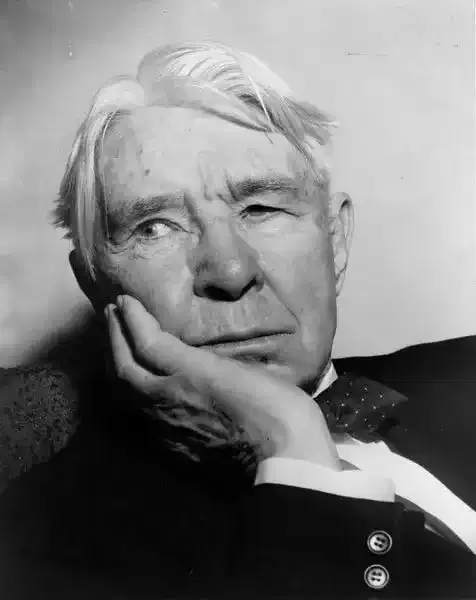
Carl Sandburg

Carl Sandburg

1878–1967 · lived 89 years US US

Carl Sandburg was an American poet, historian, novelist, and lexicographer. He is considered one of the most important American poets of the 20th century, known for his free verse and his focus on the American working class and the landscapes of the American Midwest. His poetry often celebrated the common man and the industrial might of America, earning him a reputation as the "poet of the people." Beyond his poetry, Sandburg was also a prolific biographer, most notably of Abraham Lincoln, and a collector of folklore and songs.

n. 1878-01-06, Galesburg · m. 1967-07-22, Flat Rock

52,800 Views

Grass

Pile the bodies high at Austerlitz and Waterloo.
Shovel them under and let me work
-I am the grass; I cover all.

And pile them high at Gettysburg
And pile them high at Ypres and Verdun.
Shovel them under and let me work.
Two years, ten years, and the passengers ask the conductor:

What place is this?
Where are we now?

I am the grass.
Let me work.
Read full poem
Bio

Identification and basic context

Carl Sandburg was an American poet, writer, historian, novelist, and lexicographer. He is widely celebrated for his free verse poetry, which often depicted the American people, especially the working class, and the landscapes of the American Midwest. His work captured the spirit of industrial America and the lives of ordinary people. Sandburg was born in Galesburg, Illinois, and was of Swedish immigrant descent. His linguistic background and early exposure to different cultures influenced his writing style.

Childhood and education

Sandburg's childhood was marked by hard work and limited formal schooling. He left school at the age of thirteen to work and help support his family. Despite this, he was an avid reader and possessed a strong desire for self-education. He worked various jobs, including as a milkman, a railroad laborer, and a salesman, which exposed him to a wide range of American life and experiences. His early readings included works that would later influence his poetic voice, instilling in him a deep appreciation for the vernacular and the common person's experience.

Literary trajectory

Sandburg's literary career began to take shape in his early adulthood. He attended Lombard College in Galesburg, Illinois, where he began writing poetry. His early work was published in small magazines. A pivotal moment was his involvement with Alfred Stieglitz's gallery and his association with the avant-garde literary scene in Chicago. He gained national recognition with the publication of "Chicago Poems" in 1916. His work evolved through distinct phases, increasingly embracing themes of American identity, industry, and the lives of everyday people. He was also active as a journalist, contributing to various publications and anthologies.

Works, style, and literary characteristics

Sandburg's major works include "Chicago Poems" (1916), "Cornhuskers" (1918), "Smoke and Steel" (1920), and "The People, Yes" (1936). His style is characterized by its use of free verse, colloquial language, and vivid imagery, often drawing from the sounds and sights of industrial America. He explored themes of the American dream, the struggle of the working class, the beauty of the common, and the vastness of the American landscape. His poetic voice is often direct, celebratory, and deeply empathetic towards ordinary individuals. Sandburg's language was accessible, reflecting the vernacular of the people he wrote about, and his poems often possessed a strong, rhythmic quality, reminiscent of American folk music. He is noted for bringing the language and spirit of the American Midwest into poetry.

Cultural and historical context

Sandburg lived and wrote during a period of immense transformation in American history, including industrialization, World War I, the Roaring Twenties, the Great Depression, and World War II. He was closely associated with the Chicago Renaissance, a flourishing of arts and literature in Chicago in the early 20th century. He was part of a generation of poets who sought to break away from traditional poetic forms and embrace a more modern, American idiom. His work often reflected the social and economic conditions of his time, particularly the lives of laborers and immigrants. He engaged with the political and social issues of his era, aligning himself with progressive ideals.

Personal life

Sandburg was married to photographer and artist Lilian Steichen, sister of photographer Edward Steichen. They had three daughters. His personal life, though often private, was deeply intertwined with his work, providing him with inspiration and grounding. He was known for his deep connection to the land and his simple lifestyle. He and his family lived on a farm in North Carolina for many years, where he continued to write and pursue his interests in folklore and music. His beliefs were generally progressive, and he was a strong advocate for the common person.

Recognition and reception

Sandburg received significant recognition during his lifetime, including two Pulitzer Prizes: one for his "Complete Poems" (1951) and another for his biography of Abraham Lincoln (1940). He was widely read and admired, hailed as a voice for the common American. His work continues to be studied and appreciated for its enduring portrayal of American life and its innovative use of language. While some critics noted his departure from more traditional poetic forms, his impact and popularity have solidified his place in American literature.

Influences and legacy

Sandburg was influenced by Walt Whitman's embrace of democracy and expansive verse, as well as by the realism and social consciousness of other contemporary writers. He, in turn, influenced generations of American poets with his accessible style, his championing of vernacular language, and his focus on the lives of ordinary Americans. His biography of Lincoln is considered a monumental work in American historiography. Sandburg's legacy lies in his profound connection to the American spirit and his ability to make the lives and experiences of common people the subject of celebrated poetry.

Interpretation and critical analysis

Sandburg's poetry is often interpreted as a celebration of American democracy and the resilience of its people. Critics have analyzed his use of free verse and colloquial language as a deliberate attempt to democratize poetry, making it accessible to a wider audience. His works are seen as a vital record of early 20th-century American life, capturing its industrial dynamism and its social struggles. The critical discourse often centers on his ability to balance a grounded realism with a lyrical sensibility.

Curiosities and lesser-known aspects

Sandburg was also a dedicated folk singer and collector of American folk songs. He amassed a large collection of these songs, which he performed and compiled. He was a multifaceted figure, also known for his collection of Lincolniana. His writing habits were often described as disciplined, but he also possessed a spontaneous and improvisational spirit, much like the folk music he loved. He was known to carry notebooks and jot down observations constantly.

Death and memory

Carl Sandburg died of natural causes at the age of 89. His passing was widely mourned, and his contributions to American literature and culture were deeply acknowledged. His home in Flat Rock, North Carolina, has been preserved as the Carl Sandburg Home National Historic Site, ensuring his legacy continues to inspire future generations.

Poems

116

Under A Hat Rim

Under A Hat Rim

While the hum and the hurry
Of passing footfalls
Beat in my ear like the restless surf
Of a wind-blown sea,
A soul came to me
Out of the look on a face.


Eyes like a lake


Where a storm-wind roams


Caught me from under


The rim of a hat.
I thought of a midsea wreck
and bruised fingers clinging
to a broken state-room door.
335

To Certain Journeymen

To Certain Journeymen

Undertakers, hearse drivers, grave diggers,
I speak to you as one not afraid of your business.


You handle dust going to a long country,


You know the secret behind your job is the same whether
you lower the coffin with modern, automatic machinery,
well-oiled and noiseless, or whether the
body is laid in by naked hands and then covered
by the shovels.


Your day's work is done with laughter many days of the year,
And you earn a living by those who say good-by today
in thin whispers.
364

Troths

Troths


Yellow dust on a bumble
bee's wing,
Grey lights in a woman's
asking eyes,
Red ruins in the changing
sunset embers:
I take you and pile high
the memories.
Death will break her claws
on some I keep.
294

To A Dead Man

To A Dead Man

Over the dead line we have called to you
To come across with a word to us,
Some beaten whisper of what happens
Where you are over the dead line
Deaf to our calls and voiceless.


The flickering shadows have not answered
Nor your lips sent a signal
Whether love talks and roses grow
And the sun breaks at morning
Splattering the sea with crimson.
313

Threes

Threes


I was a boy when I heard three red words
a thousand Frenchmen died in the streets
for: Liberty, Equality, Fraternity--I asked
why men die for words.


I was older; men with mustaches, sideburns,
lilacs, told me the high golden words are:
Mother, Home, and Heaven--other older men with
face decorations said: God, Duty, Immortality
--they sang these threes slow from deep lungs.


Years ticked off their say-so on the great clocks
of doom and damnation, soup, and nuts: meteors flashed
their say-so: and out of great Russia came three
dusky syllables workmen took guns and went out to die
for: Bread, Peace, Land.


And I met a marine of the U.S.A., a leatherneck with a girl on his knee
for a memory in ports circling the earth and he said: Tell me how to say
three things and I always get by--gimme a plate of ham and eggs--how
much--and--do you love me, kid?
347

They All Want to Play Hamlet

They All Want to Play Hamlet

They all want to play Hamlet.
They have not exactly seen their fathers killed
Nor their mothers in a frame-up to kill,
Nor an Ophelia lying with dust gagging the heart,
Not exactly the spinning circles of singing golden spiders,
Not exactly this have they got at nor the meaning of flowers--O flowers, flowers slung
by a dancing girl--in the saddest play the inkfish, Shakespeare ever wrote;
Yet they all want to play Hamlet because it is sad like all actors are sad and to stand by
an open grave with a joker's skull in the hand and then to say over slow and over slow
wise, keen, beautiful words asking the heart that's breaking, breaking,
This is something that calls and calls to their blood.
They are acting when they talk about it and they know it is acting to be particular
about it and yet: They all want to play Hamlet.
388

The Year

The Year

I


A storm of white petals,
Buds throwing open baby fists
Into hands of broad flowers.


II


Red roses running upward,
Clambering to the clutches of life
Soaked in crimson.


III


Rabbles of tattered leaves
Holding golden flimsy hopes
Against the tramplings
Into the pits and gullies.


IV


Hoarfrost and silence:
Only the muffling
Of winds dark and lonesome--
Great lullabies to the long sleepers.
344

The Shovel Man

The Shovel Man

On the street
Slung on his shoulder is a handle half way across,
Tied in a big knot on the scoop of cast iron
Are the overalls faded from sun and rain in the ditches;
Spatter of dry clay sticking yellow on his left sleeve

And a flimsy shirt open at the throat,
I know him for a shovel man,
A dago working for a dollar six bits a day


And a dark-eyed woman in the old country dreams of
him for one of the world's ready men with a pair
of fresh lips and a kiss better than all the wild
grapes that ever grew in Tuscany.
366

The Right To Grief

The Right To Grief

To Certain Poets About to Die


Take your fill of intimate remorse, perfumed sorrow,
Over the dead child of a millionaire,
And the pity of Death refusing any check on the bank
Which the millionaire might order his secretary to


scratch off
And get cashed.

Very well,
You for your grief and I for mine.
Let me have a sorrow my own if I want to.


I shall cry over the dead child of a stockyards hunky.
His job is sweeping blood off the floor.
He gets a dollar seventy cents a day when he works
And it's many tubs of blood he shoves out with a broom


day by day.


Now his three year old daughter
Is in a white coffin that cost him a week's wages.
Every Saturday night he will pay the undertaker fifty

cents till the debt is wiped out.


The hunky and his wife and the kids
Cry over the pinched face almost at peace in the white box.


They remember it was scrawny and ran up high doctor bills.
They are glad it is gone for the rest of the family now
will have more to eat and wear.


Yet before the majesty of Death they cry around the coffin
And wipe their eyes with red bandanas and sob when
the priest says, "God have mercy on us all."


I have a right to feel my throat choke about this.
You take your grief and I mine--see?
To-morrow there is no funeral and the hunky goes back


to his job sweeping blood off the floor at a dollar
seventy cents a day.
All he does all day long is keep on shoving hog blood
ahead of him with a broom.
345

The Noon Hour

The Noon Hour

She sits in the dust at the walls
And makes cigars,
Bending at the bench
With fingers wage-anxious,
Changing her sweat for the day’s pay.


Now the noon hour has come,
And she leans with her bare arms
On the window-sill over the river,
Leans and feels at her throat
Cool-moving things out of the free open ways:


At her throat and eyes and nostrils
The touch and the blowing cool
Of great free ways beyond the walls.
360

Quotes

40

Videos

50

Comments (0)

Share
Log in to post a comment.

No comments yet. Be the first to comment.