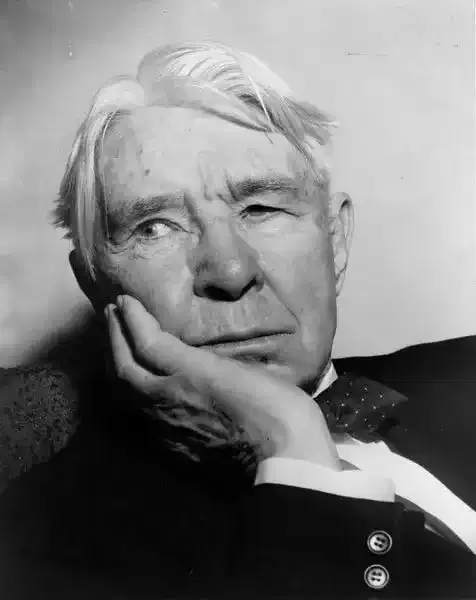
Carl Sandburg

Carl Sandburg

1878–1967 · lived 89 years US US

Carl Sandburg was an American poet, historian, novelist, and lexicographer. He is considered one of the most important American poets of the 20th century, known for his free verse and his focus on the American working class and the landscapes of the American Midwest. His poetry often celebrated the common man and the industrial might of America, earning him a reputation as the "poet of the people." Beyond his poetry, Sandburg was also a prolific biographer, most notably of Abraham Lincoln, and a collector of folklore and songs.

n. 1878-01-06, Galesburg · m. 1967-07-22, Flat Rock

52,800 Views

Grass

Pile the bodies high at Austerlitz and Waterloo.
Shovel them under and let me work
-I am the grass; I cover all.

And pile them high at Gettysburg
And pile them high at Ypres and Verdun.
Shovel them under and let me work.
Two years, ten years, and the passengers ask the conductor:

What place is this?
Where are we now?

I am the grass.
Let me work.
Read full poem
Bio

Identification and basic context

Carl Sandburg was an American poet, writer, historian, novelist, and lexicographer. He is widely celebrated for his free verse poetry, which often depicted the American people, especially the working class, and the landscapes of the American Midwest. His work captured the spirit of industrial America and the lives of ordinary people. Sandburg was born in Galesburg, Illinois, and was of Swedish immigrant descent. His linguistic background and early exposure to different cultures influenced his writing style.

Childhood and education

Sandburg's childhood was marked by hard work and limited formal schooling. He left school at the age of thirteen to work and help support his family. Despite this, he was an avid reader and possessed a strong desire for self-education. He worked various jobs, including as a milkman, a railroad laborer, and a salesman, which exposed him to a wide range of American life and experiences. His early readings included works that would later influence his poetic voice, instilling in him a deep appreciation for the vernacular and the common person's experience.

Literary trajectory

Sandburg's literary career began to take shape in his early adulthood. He attended Lombard College in Galesburg, Illinois, where he began writing poetry. His early work was published in small magazines. A pivotal moment was his involvement with Alfred Stieglitz's gallery and his association with the avant-garde literary scene in Chicago. He gained national recognition with the publication of "Chicago Poems" in 1916. His work evolved through distinct phases, increasingly embracing themes of American identity, industry, and the lives of everyday people. He was also active as a journalist, contributing to various publications and anthologies.

Works, style, and literary characteristics

Sandburg's major works include "Chicago Poems" (1916), "Cornhuskers" (1918), "Smoke and Steel" (1920), and "The People, Yes" (1936). His style is characterized by its use of free verse, colloquial language, and vivid imagery, often drawing from the sounds and sights of industrial America. He explored themes of the American dream, the struggle of the working class, the beauty of the common, and the vastness of the American landscape. His poetic voice is often direct, celebratory, and deeply empathetic towards ordinary individuals. Sandburg's language was accessible, reflecting the vernacular of the people he wrote about, and his poems often possessed a strong, rhythmic quality, reminiscent of American folk music. He is noted for bringing the language and spirit of the American Midwest into poetry.

Cultural and historical context

Sandburg lived and wrote during a period of immense transformation in American history, including industrialization, World War I, the Roaring Twenties, the Great Depression, and World War II. He was closely associated with the Chicago Renaissance, a flourishing of arts and literature in Chicago in the early 20th century. He was part of a generation of poets who sought to break away from traditional poetic forms and embrace a more modern, American idiom. His work often reflected the social and economic conditions of his time, particularly the lives of laborers and immigrants. He engaged with the political and social issues of his era, aligning himself with progressive ideals.

Personal life

Sandburg was married to photographer and artist Lilian Steichen, sister of photographer Edward Steichen. They had three daughters. His personal life, though often private, was deeply intertwined with his work, providing him with inspiration and grounding. He was known for his deep connection to the land and his simple lifestyle. He and his family lived on a farm in North Carolina for many years, where he continued to write and pursue his interests in folklore and music. His beliefs were generally progressive, and he was a strong advocate for the common person.

Recognition and reception

Sandburg received significant recognition during his lifetime, including two Pulitzer Prizes: one for his "Complete Poems" (1951) and another for his biography of Abraham Lincoln (1940). He was widely read and admired, hailed as a voice for the common American. His work continues to be studied and appreciated for its enduring portrayal of American life and its innovative use of language. While some critics noted his departure from more traditional poetic forms, his impact and popularity have solidified his place in American literature.

Influences and legacy

Sandburg was influenced by Walt Whitman's embrace of democracy and expansive verse, as well as by the realism and social consciousness of other contemporary writers. He, in turn, influenced generations of American poets with his accessible style, his championing of vernacular language, and his focus on the lives of ordinary Americans. His biography of Lincoln is considered a monumental work in American historiography. Sandburg's legacy lies in his profound connection to the American spirit and his ability to make the lives and experiences of common people the subject of celebrated poetry.

Interpretation and critical analysis

Sandburg's poetry is often interpreted as a celebration of American democracy and the resilience of its people. Critics have analyzed his use of free verse and colloquial language as a deliberate attempt to democratize poetry, making it accessible to a wider audience. His works are seen as a vital record of early 20th-century American life, capturing its industrial dynamism and its social struggles. The critical discourse often centers on his ability to balance a grounded realism with a lyrical sensibility.

Curiosities and lesser-known aspects

Sandburg was also a dedicated folk singer and collector of American folk songs. He amassed a large collection of these songs, which he performed and compiled. He was a multifaceted figure, also known for his collection of Lincolniana. His writing habits were often described as disciplined, but he also possessed a spontaneous and improvisational spirit, much like the folk music he loved. He was known to carry notebooks and jot down observations constantly.

Death and memory

Carl Sandburg died of natural causes at the age of 89. His passing was widely mourned, and his contributions to American literature and culture were deeply acknowledged. His home in Flat Rock, North Carolina, has been preserved as the Carl Sandburg Home National Historic Site, ensuring his legacy continues to inspire future generations.

Poems

116

The Mayor of Gary

The Mayor of Gary

I asked the mayor of Gary about the 12-hour day and the 7-day week.
And the mayor of Gary answered more workmen steal time on the job in Gary than any
other place in the United States.
"Go into the plants and you will see men sitting around doing nothing--machinery does
everything," said the mayor of Gary when I asked him about the 12-hour day and the
7-day week.
And he wore cool cream pants, the Mayor of Gary, and white shoes, and a barber had
fixed him up with a shampoo and a shave and he was east and imperturbable though
the government weather bureau thermometer said 96 and children were soaking their
heads at bubbling fountains on the street corners.
And I said good-bye to the Mayor of Gary and I went out from the city hall and turned
the corner into Broadway.
And I saw workmen wearing leather shoes scruffed with fire and cinders, and pitted
with little holes from running molten steel,
And some had bunches of specialized muscles around their shoulder blades hard as pig
iron, muscles of their forearms were sheet steel and they looked to me like men who
had been somewhere.
411

The Has-Been

The Has-Been

A stone face higher than six horses stood five thousand years gazing at the world
seeming to clutch a secret.
A boy passes and throws a niggerhead that chips off the end of the nose from the
stone face; he lets fly a mud ball that spatters the right eye and cheek of the old
looker-on.
The boy laughs and goes whistling “ee-ee-ee ee-ee-ee.” The stone face stands silent,
seeming to clutch a secret.
314

The Hangman at Home

The Hangman at Home

What does a hangman think about
When he goes home at night from work?
When he sits down with his wife and
Children for a cup of coffee and a
Plate of ham and eggs, do they ask
Him if it was a good day's work
And everything went well or do they
Stay off some topics and kill about
The weather, baseball, politics
And the comic strips in the papers
And the movies? Do they look at his
Hands when he reaches for the coffee
Or the ham and eggs? If the little
Ones say, Daddy, play horse, here's
A rope--does he answer like a joke:
I seen enough rope for today?
Or does his face light up like a
Bonfire of joy and does he say:
It's a good and dandy world we live
'In. And if a white face moon looks
In through a window where a baby girl
Sleeps and the moon-gleams mix with
Baby ears and baby hair--the hangman--
How does he act then? It must be easy
For him. Anything is easy for a hangman,
I guess.
335

The Answer

The Answer

You have spoken the answer.
A child searches far sometimes
Into the red dust
On a dark rose leaf
And so you have gone far
For the answer is:
Silence.


In the republic
Of the winking stars
and spent cataclysms
Sure we are it is off there the answer
is hidden and folded over,
Sleeping in the sun, careless whether
it is Sunday or any other day of
the week,


Knowing silence will bring all one way or another.


Have we not seen
Purple of the pansy
out of the mulch
and mold
crawl
into a dusk
of velvet?
blur of yellow?


Almost we thought from nowhere but it was the silence,
the future,
working.
352

Summer Stars

Summer Stars

Bend low again, night of summer stars.
So near you are, sky of summer stars,
So near, a long-arm man can pick off stars,
Pick off what he wants in the sky bowl,
So near you are, summer stars,
So near, strumming, strumming,
So lazy and hum-strumming.
408

Statistics

Statistics


Napoleon shifted,
Restless in the old sarcophagus
And murmured to a watchguard:
"Who goes there?"
"Twenty-one million men,
Soldiers, armies, guns,
Twenty-one million
Afoot, horseback,
In the air,
Under the sea."
And Napoleon turned to his sleep:
"It is not my world answering;
It is some dreamer who knows not
The world I marched in
From Calais to Moscow."
And he slept on
In the old sarcophagus
While the aeroplanes
Droned their motors
Between Napoleon's mausoleum
And the cool night stars.
409

Style

Style


Style--go ahead talking about style.


You can tell where a man gets his style just
as you can tell where Pavlowa got her legs
or Ty Cobb his batting eye.

Go on talking.


Only don't take my style away.
It's my face.
Maybe no good

but anyway, my face.
I talk with it, I sing with it, I see, taste and feel with it,
I know why I want to keep it.


Kill my style
and you break Pavlowa's legs,
and you blind Ty Cobb's batting eye.
328

Soup

Soup


I saw a famous man eating soup.
I say he was lifting a fat broth
Into his mouth with a spoon.
His name was in the newspapers that day
Spelled out in tall black headlines
And thousands of people were talking about him.


When I saw him,
He sat bending his head over a plate
Putting soup in his mouth with a spoon.
614

Skyscraper

Skyscraper


By day the skyscraper looms in the smoke and sun and
has a soul.


Prairie and valley, streets of the city, pour people into
it and they mingle among its twenty floors and are
poured out again back to the streets, prairies and
valleys.


It is the men and women, boys and girls so poured in and
out all day that give the building a soul of dreams
and thoughts and memories.


(Dumped in the sea or fixed in a desert, who would care
for the building or speak its name or ask a policeman
the way to it?)


Elevators slide on their cables and tubes catch letters and
parcels and iron pipes carry gas and water in and
sewage out.


Wires climb with secrets, carry light and carry words,
and tell terrors and profits and loves--curses of men
grappling plans of business and questions of women
in plots of love.


Hour by hour the caissons reach down to the rock of the
earth and hold the building to a turning planet.


Hour by hour the girders play as ribs and reach out and
hold together the stone walls and floors.


Hour by hour the hand of the mason and the stuff of the
mortar clinch the pieces and parts to the shape an
architect voted.


Hour by hour the sun and the rain, the air and the rust,
and the press of time running into centuries, play
on the building inside and out and use it.


Men who sunk the pilings and mixed the mortar are laid
in graves where the wind whistles a wild song
without words


And so are men who strung the wires and fixed the pipes
and tubes and those who saw it rise floor by floor.


Souls of them all are here, even the hod carrier begging
at back doors hundreds of miles away and the bricklayer
who went to state's prison for shooting another
man while drunk.


(One man fell from a girder and broke his neck at the
end of a straight plunge--he is here--his soul has
gone into the stones of the building.)


On the office doors from tier to tier--hundreds of names
and each name standing for a face written across
with a dead child, a passionate lover, a driving
ambition for a million dollar business or a lobster's
ease of life.


Behind the signs on the doors they work and the walls
tell nothing from room to room.


Ten-dollar-a-week stenographers take letters from
corporation officers, lawyers, efficiency engineers,
and tons of letters go bundled from the building to all
ends of the earth.


Smiles and tears of each office girl go into the soul of
the building just the same as the master-men who
rule the building.


Hands of clocks turn to noon hours and each floor
empties its men and women who go away and eat
and come back to work.


Toward the end of the afternoon all work slackens and
all jobs go slower as the people feel day closing on
them.


One by one the floors are emptied. . . The uniformed
elevator men are gone. Pails clang. . . Scrubbers
work, talking in foreign tongues. Broom and water
and mop clean from the floors human dust and spit,
and machine grime of the day.


Spelled in electric fire on the roof are words telling
miles of houses and people where to buy a thing for
money. The sign speaks till midnight.


Darkness on the hallways. Voices echo. Silence
holds. . . Watchmen walk slow from floor to floor
and try the doors. Revolvers bulge from their hip
pockets. . . Steel safes stand in corners. Money
is stacked in them.


A young watchman leans at a window and sees the lights
of barges butting their way across a harbor, nets of
red and white lanterns in a railroad yard, and a span
of glooms splashed with lines of white and blurs of
crosses and clusters over the sleeping city.


By night the skyscraper looms in the smoke and the stars
and has a soul.
320

Shirt

Shirt


My shirt is a token and symbol,
more than a cover for sun and rain,
my shirt is a signal,
and a teller of souls.


I can take off my shirt and tear it,
and so make a ripping razzly noise,
and the people will say,
"Look at him tear his shirt."


I can keep my shirt on.
I can stick around and sing like a little bird
and look 'em all in the eye and never be fazed.
I can keep my shirt on.
372

Quotes

40

Videos

50

Comments (0)

Share
Log in to post a comment.

No comments yet. Be the first to comment.