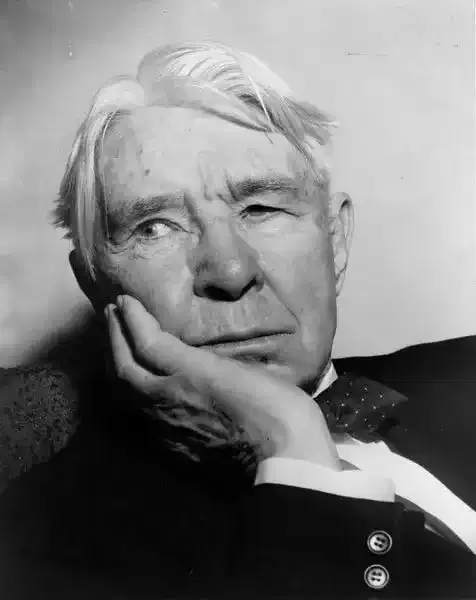
Carl Sandburg

Carl Sandburg

1878–1967 · lived 89 years US US

Carl Sandburg was an American poet, historian, novelist, and lexicographer. He is considered one of the most important American poets of the 20th century, known for his free verse and his focus on the American working class and the landscapes of the American Midwest. His poetry often celebrated the common man and the industrial might of America, earning him a reputation as the "poet of the people." Beyond his poetry, Sandburg was also a prolific biographer, most notably of Abraham Lincoln, and a collector of folklore and songs.

n. 1878-01-06, Galesburg · m. 1967-07-22, Flat Rock

52,800 Views

Grass

Pile the bodies high at Austerlitz and Waterloo.
Shovel them under and let me work
-I am the grass; I cover all.

And pile them high at Gettysburg
And pile them high at Ypres and Verdun.
Shovel them under and let me work.
Two years, ten years, and the passengers ask the conductor:

What place is this?
Where are we now?

I am the grass.
Let me work.
Read full poem
Bio

Identification and basic context

Carl Sandburg was an American poet, writer, historian, novelist, and lexicographer. He is widely celebrated for his free verse poetry, which often depicted the American people, especially the working class, and the landscapes of the American Midwest. His work captured the spirit of industrial America and the lives of ordinary people. Sandburg was born in Galesburg, Illinois, and was of Swedish immigrant descent. His linguistic background and early exposure to different cultures influenced his writing style.

Childhood and education

Sandburg's childhood was marked by hard work and limited formal schooling. He left school at the age of thirteen to work and help support his family. Despite this, he was an avid reader and possessed a strong desire for self-education. He worked various jobs, including as a milkman, a railroad laborer, and a salesman, which exposed him to a wide range of American life and experiences. His early readings included works that would later influence his poetic voice, instilling in him a deep appreciation for the vernacular and the common person's experience.

Literary trajectory

Sandburg's literary career began to take shape in his early adulthood. He attended Lombard College in Galesburg, Illinois, where he began writing poetry. His early work was published in small magazines. A pivotal moment was his involvement with Alfred Stieglitz's gallery and his association with the avant-garde literary scene in Chicago. He gained national recognition with the publication of "Chicago Poems" in 1916. His work evolved through distinct phases, increasingly embracing themes of American identity, industry, and the lives of everyday people. He was also active as a journalist, contributing to various publications and anthologies.

Works, style, and literary characteristics

Sandburg's major works include "Chicago Poems" (1916), "Cornhuskers" (1918), "Smoke and Steel" (1920), and "The People, Yes" (1936). His style is characterized by its use of free verse, colloquial language, and vivid imagery, often drawing from the sounds and sights of industrial America. He explored themes of the American dream, the struggle of the working class, the beauty of the common, and the vastness of the American landscape. His poetic voice is often direct, celebratory, and deeply empathetic towards ordinary individuals. Sandburg's language was accessible, reflecting the vernacular of the people he wrote about, and his poems often possessed a strong, rhythmic quality, reminiscent of American folk music. He is noted for bringing the language and spirit of the American Midwest into poetry.

Cultural and historical context

Sandburg lived and wrote during a period of immense transformation in American history, including industrialization, World War I, the Roaring Twenties, the Great Depression, and World War II. He was closely associated with the Chicago Renaissance, a flourishing of arts and literature in Chicago in the early 20th century. He was part of a generation of poets who sought to break away from traditional poetic forms and embrace a more modern, American idiom. His work often reflected the social and economic conditions of his time, particularly the lives of laborers and immigrants. He engaged with the political and social issues of his era, aligning himself with progressive ideals.

Personal life

Sandburg was married to photographer and artist Lilian Steichen, sister of photographer Edward Steichen. They had three daughters. His personal life, though often private, was deeply intertwined with his work, providing him with inspiration and grounding. He was known for his deep connection to the land and his simple lifestyle. He and his family lived on a farm in North Carolina for many years, where he continued to write and pursue his interests in folklore and music. His beliefs were generally progressive, and he was a strong advocate for the common person.

Recognition and reception

Sandburg received significant recognition during his lifetime, including two Pulitzer Prizes: one for his "Complete Poems" (1951) and another for his biography of Abraham Lincoln (1940). He was widely read and admired, hailed as a voice for the common American. His work continues to be studied and appreciated for its enduring portrayal of American life and its innovative use of language. While some critics noted his departure from more traditional poetic forms, his impact and popularity have solidified his place in American literature.

Influences and legacy

Sandburg was influenced by Walt Whitman's embrace of democracy and expansive verse, as well as by the realism and social consciousness of other contemporary writers. He, in turn, influenced generations of American poets with his accessible style, his championing of vernacular language, and his focus on the lives of ordinary Americans. His biography of Lincoln is considered a monumental work in American historiography. Sandburg's legacy lies in his profound connection to the American spirit and his ability to make the lives and experiences of common people the subject of celebrated poetry.

Interpretation and critical analysis

Sandburg's poetry is often interpreted as a celebration of American democracy and the resilience of its people. Critics have analyzed his use of free verse and colloquial language as a deliberate attempt to democratize poetry, making it accessible to a wider audience. His works are seen as a vital record of early 20th-century American life, capturing its industrial dynamism and its social struggles. The critical discourse often centers on his ability to balance a grounded realism with a lyrical sensibility.

Curiosities and lesser-known aspects

Sandburg was also a dedicated folk singer and collector of American folk songs. He amassed a large collection of these songs, which he performed and compiled. He was a multifaceted figure, also known for his collection of Lincolniana. His writing habits were often described as disciplined, but he also possessed a spontaneous and improvisational spirit, much like the folk music he loved. He was known to carry notebooks and jot down observations constantly.

Death and memory

Carl Sandburg died of natural causes at the age of 89. His passing was widely mourned, and his contributions to American literature and culture were deeply acknowledged. His home in Flat Rock, North Carolina, has been preserved as the Carl Sandburg Home National Historic Site, ensuring his legacy continues to inspire future generations.

Poems

116

Sixteen Months

Sixteen Months

On the lips of the child Janet float changing dreams.
It is a thin spiral of blue smoke,
A morning campfire at a mountain lake.


On the lips of the child Janet,
Wisps of haze on ten miles of corn,
Young light blue calls to young light gold of morning.
300

Sea-Wash

Sea-Wash


The sea-wash never ends.
The sea-wash repeats, repeats.
Only old songs? Is that all the sea knows?
Only the old strong songs?
Is that all?
The sea-wash repeats, repeats.
421

Salvage

Salvage


Guns on the battle lines have pounded now a year
between Brussels and Paris.


And, William Morris, when I read your old chapter on
the great arches and naves and little whimsical
corners of the Churches of Northern France--Brr-rr!


I'm glad you're a dead man, William Morris, I'm glad
you're down in the damp and mouldy, only a memory
instead of a living man--I'm glad you're gone.


You never lied to us, William Morris, you loved the
shape of those stones piled and carved for you to
dream over and wonder because workmen got joy
of life into them,


Workmen in aprons singing while they hammered, and
praying, and putting their songs and prayers into
the walls and roofs, the bastions and cornerstones
and gargoyles--all their children and kisses of
women and wheat and roses growing.


I say, William Morris, I'm glad you're gone, I'm glad
you're a dead man.


Guns on the battle lines have pounded a year now between
Brussels and Paris.
396

Prayers of Steel

Prayers of Steel

Lay me on an anvil, O God.
Beat me and hammer me into a crowbar.
Let me pry loose old walls.
Let me lift and loosen old foundations.


Lay me on an anvil, O God.
Beat me and hammer me into a steel spike.
Drive me into the girders that hold a skyscraper together.
Take red-hot rivets and fasten me into the central girders.
Let me be the great nail holding a skyscraper through blue nights into white stars.
298

Ready to Kill

Ready to Kill

Ten minutes now I have been looking at this.
I have gone by here before and wondered about it.
This is a bronze memorial of a famous general
Riding horseback with a flag and a sword and a revolver
on him.
I want to smash the whole thing into a pile of junk to be
hauled away to the scrap yard.
I put it straight to you,
After the farmer, the miner, the shop man, the factory
hand, the fireman and the teamster,
Have all been remembered with bronze memorials,
Shaping them on the job of getting all of us
Something to eat and something to wear,
When they stack a few silhouettes
Against the sky
Here in the park,
And show the real huskies that are doing the work of
the world, and feeding people instead of butchering them,
Then maybe I will stand here
And look easy at this general of the army holding a flag
in the air,
And riding like hell on horseback
Ready to kill anybody that gets in his way,
Ready to run the red blood and slush the bowels of men
all over the sweet new grass of the prairie.
392

Pool

Pool


Out of the fire
Came a man sunken
To less than cinders,
A tea-cup of ashes or so.
And I,
The gold in the house,
Writhed into a stiff pool.
394

Population Drifts

Population Drifts

New-mown hay smell and wind of the plain made her
a woman whose ribs had the power of the hills in
them and her hands were tough for work and there
was passion for life in her womb.


She and her man crossed the ocean and the years that
marked their faces saw them haggling with landlords
and grocers while six children played on the stones
and prowled in the garbage cans.


One child coughed its lungs away, two more have adenoids
and can neither talk nor run like their mother,
one is in jail, two have jobs in a box factory


And as they fold the pasteboard, they wonder what the
wishing is and the wistful glory in them that flutters
faintly when the glimmer of spring comes on
the air or the green of summer turns brown:


They do not know it is the new-mown hay smell calling
and the wind of the plain praying for them to come
back and take hold of life again with tough hands
and with passion.
354

Plowboy

Plowboy


After the last red sunset glimmer,
Black on the line of a low hill rise,
Formed into moving shadows, I saw
A plowboy and two horses lined against the gray,
Plowing in the dusk the last furrow.
The turf had a gleam of brown,
And smell of soil was in the air,
And, cool and moist, a haze of April.


I shall remember you long,
Plowboy and horses against the sky in shadow.
I shall remember you and the picture
You made for me,
Turning the turf in the dusk
And haze of an April gloaming.
353

Personality

Personality


Musings of a Police Reporter in the Identification Bureau


You have loved forty women, but you have only one thumb.
You have led a hundred secret lives, but you mark only
one thumb.


You go round the world and fight in a thousand wars and
win all the world's honors, but when you come back
home the print of the one thumb your mother gave
you is the same print of thumb you had in the old
home when your mother kissed you and said good-by.


Out of the whirling womb of time come millions of men


and their feet crowd the earth and they cut one anothers'
throats for room to stand and among them all
are not two thumbs alike.


Somewhere is a Great God of Thumbs who can tell the
inside story of this.
371

Passers-By

Passers-By


Passers-by,
Out of your many faces
Flash memories to me
Now at the day end
Away from the sidewalks
Where your shoe soles traveled
And your voices rose and blent
To form the city's afternoon roar
Hindering an old silence.


Passers-by,
I remember lean ones among you,
Throats in the clutch of a hope,
Lips written over with strivings,
Mouths that kiss only for love.
Records of great wishes slept with,
Held long
And prayed and toiled for. .


Yes,
Written on
Your mouths
And your throats
I read them
When you passed by.
299

Quotes

40

Videos

50

Comments (0)

Share
Log in to post a comment.

No comments yet. Be the first to comment.