
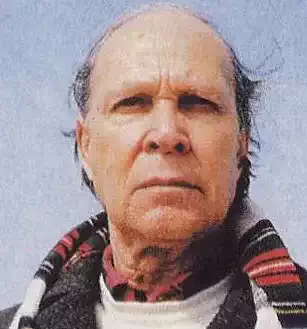
Eugénio de Andrade
 PT
PT
Eugénio de Andrade was one of the most important Portuguese poets of the 20th century, known for the purity and musicality of his language, and for his deep connection to nature, the body, and sensory experience. His work is characterized by a refined lyricism that celebrates life, light, and beauty, without ignoring the darker dimensions of existence. With poetry distinguished by its conciseness, clarity, and apparent simplicity that hides great reflective depth, Eugénio de Andrade consolidated an unmistakable style and a unique voice in contemporary Portuguese-language poetry.
n. 1923-01-19, Fundão · m. 2005-06-13, Porto
Bio
Identification and basic context
Eugénio de Andrade, real name José Fontinhas da Fonseca, was born in 1923 and died in 2005. He was a Portuguese poet, essayist, and translator. He lived most of his life in Porto. He is known for his Portuguese nationality and for writing in the Portuguese language. The historical context in which he lived was one of a long dictatorship in Portugal, followed by democracy, and the cultural transformations of the 20th century.Childhood and education
He was born and spent his childhood in Póvoa de Atalaia, Beira Baixa, a rural region that profoundly marked his sensitivity and his work, with an appreciation for nature, the land, and popular traditions. His schooling was in his hometown and then in Castelo Branco. He moved to Porto in 1945, where he lived the rest of his life and developed his professional career as a teacher and, later, as a reading inspector.Literary career
His literary career began with the publication of "As Mãos e os Frutos" (The Hands and the Fruits) in 1948, a work that already announced his refined style and themes. Over the following decades, he published an extensive and cohesive body of poetry, divided into thematic cycles that reflect his evolution and deepening understanding. He was also a notable translator of classical and modern poetry, rendering into Portuguese authors such as Sappho, Virgil, Horace, and Camões, and an active promoter of Portuguese poetry in anthologies.Work, style, and literary characteristics
Some of his most representative works include "As Mãos e os Frutos" (1948), "O Coração Dobrado" (The Folded Heart) (1956), "Matéria Solar" (Solar Matter) (1962), "O Sal" (The Salt) (1965), "Escola de Mitos" (School of Myths) (1980), and "O Outro Nome do Vento" (The Other Name of the Wind) (1982). The central themes of his poetry are nature (with emphasis on the sun, water, earth), the human body, sensuality, death, memory, and the poetic word itself. His poetic form is marked by conciseness, clarity, musicality, and a rhythm that evokes nature and breathing. He frequently uses free verse, but with a sense of balance and harmony. His language is pure, luminous, and stripped of excess, favoring imagery and suggestion. He is often associated with poetry of a classical nature, but with an inherent modernity, celebrating life and its beauty intensely and serenely. His poetic voice is lyrical, contemplative, and of profound humanity.Cultural and historical context
Eugénio de Andrade lived most of his adult life under the dictatorial regime in Portugal, but his poetry always maintained a dimension of celebration of inner freedom and beauty, without explicit political engagement. He developed a strong relationship with classical culture and universal poetry, subtly dialoguing with his contemporaries, but maintaining a striking aesthetic autonomy.Personal life
Originally from Beira Baixa, his childhood in a rural setting left an indelible mark on his work. He moved to Porto, where he established his life and career. His personal discretion contrasted with the lyrical intensity of his poetry. He was known for his dedication to literature and the promotion of poetry.Recognition and reception
Eugénio de Andrade is widely considered one of the greatest Portuguese poets of the second half of the 20th century. His work has received several important awards and distinctions in Portugal and abroad. He is an author studied and admired by both the general public and specialized critics, and has been translated into several languages.Influences and legacy
He was influenced by classical Greek and Latin poetry, Provençal poetry, and poets such as Fernando Pessoa. His legacy lies in the purity of his language, his celebration of life and nature, and his ability to evoke timeless beauty. He has inspired and continues to inspire generations of readers and poets with his formal mastery and the depth of his lyricism.Interpretation and critical analysis
Eugénio de Andrade's work is often interpreted as a hymn to existence, to light, and to matter, exploring the sensory and spiritual dimension of human life. His poetry invites contemplation, the rediscovery of the world through the senses, and the serene acceptance of the human condition.Curiosities and lesser-known aspects
A curiosity is his dual activity as a poet and translator of classics, demonstrating a vast literary culture. His poems are often described as having a visual and tactile quality, reflecting his deep connection to the natural world and the body.Death and memory
Eugénio de Andrade died in 2005. His work continues to be published and widely circulated, consolidating his position as one of the pillars of contemporary Portuguese-language poetry and a key author for understanding modern lyricism.Poems
0No poems found
Videos
50
Comments (0)
No comments yet. Be the first to comment.