
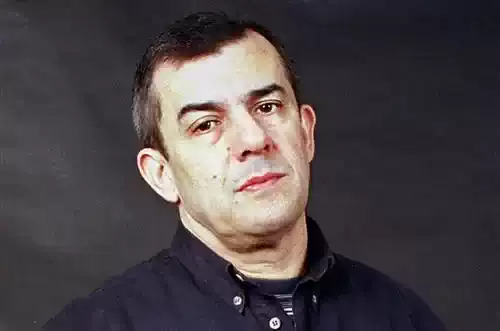
Gastão Cruz
1941–2022
· lived 80 years
 PT
PT
PT
Gastão Cruz was a Portuguese poet and literary critic, known for his refined and intellectualized poetry. His work explores themes such as memory, time, language, and the ephemerality of existence, with a strong awareness of literary tradition and its reformulation. He was also an important figure in the dissemination and study of literature, with a career marked by erudition and aesthetic sensitivity.
n. 1941-07-20, Faro · m. 2022-03-20, Lisboa
79
Views
Bio
Identification and Basic Context
Gastão de Holm Teixeira de Sousa Cruz was a Portuguese poet, essayist, literary critic, and professor. He was born in Faro, Portugal, on January 19, 1940, and died in Lisbon on November 19, 2020. He was Portuguese and wrote in the Portuguese language. Connected to a family with intellectual and cultural traditions, his origin was the Algarvian bourgeoisie. He lived a large part of his adult life in Lisbon.Childhood and Education
He spent his childhood and adolescence in Faro. He attended the Liceu Nacional de Faro and later graduated in Germanic Philology from the Faculty of Letters of the University of Lisbon. He showed an early interest in literature, having absorbed influences from classical and modern poetry, as well as philosophical thought. His university education marked his intellectual and critical path.Literary Career
Gastão Cruz began publishing poetry in the 1960s. His literary debut was with the book "A Poesia de Antero de Quental: Ensaio de Interpretação" (The Poetry of Antero de Quental: An Interpretation Essay), in 1963, which already revealed his critical vein. As a poet, his work consolidated with the publication of "A Sei Lá" (Who Knows), in 1970. Throughout his career, he published several poetry books, which evolved in terms of themes and language, always with a mark of rigor and reflection. He actively participated in literary and cultural magazines, and was also a university professor, which allowed him to combine creation with academic and critical activity.Work, Style, and Literary Characteristics
His main poetic works include "A Sei Lá" (1970), "A Morte Percutiva" (The Percussive Death, 1975), "As Pedras Negras" (The Black Stones, 1985), "O Poema e o Fantasma" (The Poem and the Ghost, 1997), and "A Trama" (The Plot, 2003). The central themes of his poetry are memory, the passage of time, the ephemerality of life, language as a means of knowledge, and the relationship between the real and the apparent. His style is characterized by formal refinement, metrical and rhythmic rigor, and conceptual density. He uses careful language, sometimes erudite, but always musical and evocative. His poetic voice is often reflective and melancholic, exploring the human condition with depth. He introduced an intellectualized approach to lyric poetry in Portuguese poetry, with strong ties to tradition, but also with an attentive eye to modernity.Cultural and Historical Context
Gastão Cruz lived and produced his work during a period of great transformation in Portugal, from the end of the Salazar dictatorship to democracy. His poetry, although personal and introspective, implicitly dialogues with the historical context through reflection on the human condition and the fragility of existence. He was an intellectual integrated into Lisbon's literary circles, collaborating with various publications and participating in cultural debates. He belonged to a generation of poets who sought to reconcile the heritage of tradition with the formal and thematic innovations of contemporary poetry.Personal Life
He was married to the writer Maria Alberta Menéres. His life was deeply connected to the academic world, where he taught literature and literary theory. He was known for his discretion and intellectual rigor. Poetry was his main passion, but criticism and essays also occupied an important place in his career.Recognition and Reception
Gastão Cruz is recognized as one of the important Portuguese poets of the second half of the 20th century and the beginning of the 21st century. His work received critical acclaim for its aesthetic and intellectual quality. Although perhaps not achieving massive popularity, his name is essential in studies of contemporary Portuguese poetry and in the literary canon. He received several awards and distinctions throughout his career.Influences and Legacy
In his work, influences from poets such as Fernando Pessoa, Antero de Quental, and European authors are noticeable. His legacy lies in poetry of great intellectual and formal density, which influenced subsequent generations of poets seeking a line of continuity with tradition, but with a critical and contemporary perspective. His work continues to be studied and valued for its depth and rigor.Interpretation and Critical Analysis
Gastão Cruz's poetry has been the subject of critical analysis that highlights his reflection on the human condition, temporality, and the nature of language. His work is seen as a constant dialogue with literary tradition, reinterpreting it in a contemporary light. The relationship between the lyrical self and the world, finitude, and the search for meaning are recurring themes in critical readings.Curiosities and Lesser-Known Aspects
Gastão Cruz was known for his perfectionism in writing, dedicating much time to revising and polishing his verses. His academic career as a university professor coexisted with his intense poetic activity. His personal discretion contrasted with the depth and breadth of his literary thought.Death and Memory
He passed away in 2020, leaving behind a consolidated poetic work and an important legacy in the Portuguese literary landscape. His memory is preserved through his published work and the academic studies that continue to explore his poetry.Poems
0No poems found
Videos
50
Comments (0)
Log in
to post a comment.
No comments yet. Be the first to comment.