
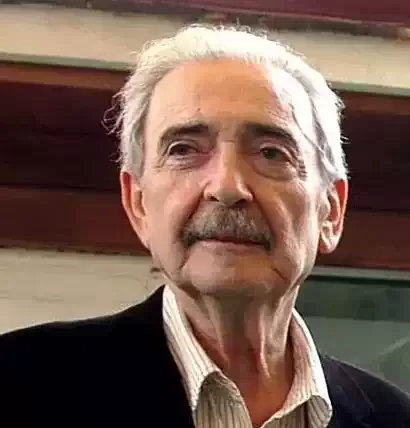
Juan Gelman
1930–2014
· lived 83 years
 AR
AR
AR
Juan Gelman was one of the most important Argentine poets of the 20th and 21st centuries, known for his dense, political, and profoundly human work. His poetry, marked by an incessant search for language and reflection on memory, loss, and justice, traversed different phases, from initial lyricism to a more engaged and philosophical expression. Gelman was also a journalist and translator, and his life was intrinsically linked to the political upheavals in Argentina and Latin America.
n. 1930-05-03, Buenos Aires · m. 2014-01-14, Cidade do México
129
Views
Bio
Identification and Basic Context
Juan Gelman was an Argentine poet, journalist, and translator, widely considered one of the greatest Spanish-language poets of the 20th and early 21st centuries. He was born in Buenos Aires, Argentina, on June 3, 1930, and died in Mexico City, Mexico, on January 14, 2014. He is known for his vast poetic work, which addresses themes such as memory, identity, politics, fatherhood, loss, and the search for language. Gelman wrote in Spanish.Childhood and Education
Son of Russian Jewish immigrants, Gelman grew up in a family environment that valued culture and reading. He began his literary activity at a very young age, publishing his first book, "El viaje", in 1953. He graduated in journalism, and his professional career was always linked to writing and communication, influencing his direct and engaged style.Literary Career
Juan Gelman's literary career is extensive and diverse. He began publishing poetry in the 1950s, quickly establishing himself as an important voice in Argentine poetry. Over the decades, his work evolved, reflecting his personal experiences and the political and social context of Argentina and Latin America. Gelman also distinguished himself as a journalist, literary critic, and translator of authors such as Bertolt Brecht and Pier Paolo Pasolini.Work, Style, and Literary Characteristics
Among his most significant poetic works are "Gotán" (1962), "Los poemas de Juan sin Nada" (1967), "Ni el sol ni la sombra" (1977), "Com/posiciones" (1983), "La sal de la tierra" (1985), "Mantra" (1991), and "País que anhelas" (2001). The central themes of his work include personal and collective memory, fragmented identity, social and political criticism, love, death, and the search for the right word. His style is characterized by clarity, expressive force, irony, and profound existential and social reflection. Gelman frequently used free verse, but with his own musicality and rhythm. His language is both accessible and dense, capable of evoking powerful images and deep emotions. He is often associated with social and testimonial poetry, but his work transcends labels, exploring the complexity of the human condition.Cultural and Historical Context
Gelman lived and wrote during a period of great cultural and political effervescence in Argentina and Latin America, including military dictatorships and periods of democratic transition. His work reflects the anxieties, hopes, and disappointments of a generation marked by political and social instability. He was a committed intellectual whose poetry became a vehicle for denunciation and reflection on reality.Personal Life
Juan Gelman's life was marked by profound personal experiences, including the loss of children and grandchildren in tragic circumstances related to the Argentine dictatorship. These losses had a significant impact on his work, especially on his reflection on memory and justice. His experience as an exile and his fight for the recovery of the identity of a disappeared grandson are testaments to his resilience and his commitment to truth and memory.Recognition and Reception
Juan Gelman is widely recognized as one of the most important poets in Spanish-language literature. He received numerous awards and distinctions throughout his career, including the Cervantes Prize in 2007, the most important literary award in the Spanish language. His work is studied and admired worldwide.Influences and Legacy
Influenced by poets such as Pablo Neruda and César Vallejo, Gelman, in turn, left an indelible mark on Latin American poetry. His legacy lies in his ability to combine lyricism and social engagement, in his deep exploration of memory and identity, and in his tireless search for the word that can account for the complexity of the human experience.Interpretation and Critical Analysis
Gelman's work is often interpreted as a testimony to the recent history of Latin America, but also as a universal exploration of the human condition. His poetry invites reflection on the fragility of memory, the persistence of pain, and the need for justice and recognition.Curiosities and Lesser-Known Aspects
One of the most striking facets of Gelman's life was his tireless search for his grandson, Macarena Gelman, who was kidnapped with her pregnant mother during the Argentine dictatorship. This personal episode became a symbol of the fight for memory and justice in Argentina. Gelman was also an avid reader and translator, enriching the literary landscape with his translations and essays.Death and Memory
Juan Gelman passed away in 2014 in Mexico, where he resided. His death was mourned by the entire literary and cultural community. His memory is kept alive through his immense work and the impact he had on contemporary poetry, as well as his importance as a voice of denunciation and hope.Poems
0No poems found
Comments (0)
Log in
to post a comment.
No comments yet. Be the first to comment.