Wallace Stevens

Wallace Stevens

1879–1955 · lived 75 years US US

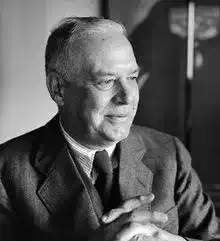
Wallace Stevens was a prominent American Modernist poet. He is known for his meticulously crafted verse that explores the relationship between imagination and reality, the role of the poet in society, and the nature of beauty and perception. His work is characterized by its philosophical depth, vivid imagery, and distinctive use of language, often evoking a sense of rich, sensory experience.

n. 1879-10-02, Reading · m. 1955-08-02, Hartford

7,334 Views

Two Figures in Dense Violet Light

Two Figures in Dense Violet Light
I had as lief be embraced by the portier of the hotel
As to get no more from the moonlight
Than your moist hand.
Be the voice of the night and Florida in my ear.
Use dasky words and dusky images.
Darken your speech.
Speak, even, as if I did not hear you speaking,
But spoke for you perfectly in my thoughts,
Conceiving words,
As the night conceives the sea-sound in silence,
And out of the droning sibilants makes
A serenade.
Say, puerile, that the buzzards crouch on the ridge-pole
and sleep with one eye watching the stars fall
Beyond Key West.
Say that the palms are clear in the total blue.
Are clear and are obscure; that it is night;
That the moon shines.
Read full poem
Bio

Identification and basic context

Wallace Stevens was an American poet. He often used his full name, Wallace Stevens, but is not widely known for pseudonyms or heteronyms. He was born on October 2, 1879, and died on August 2, 1955. Stevens came from a middle-class family of German and English descent. He was born in Reading, Pennsylvania, and spent much of his adult life in Hartford, Connecticut. He was an American citizen and wrote exclusively in English. His life spanned a period of significant industrialization and cultural change in the United States.

Childhood and education

Stevens was born into a Lutheran family and was exposed to a religious upbringing. His father was a lawyer. He attended Reading High School. Stevens showed an early aptitude for language and poetry. He studied at Harvard University, where he was part of the Harvard Lampoon and graduated in 1897. He then attended New York University School of Law, graduating in 1903. Early influences included the poetry of Walt Whitman and the philosophical ideas of Friedrich Nietzsche.

Literary trajectory

Stevens began writing poetry early in his life, but his first major collection, 'Harmonium,' was not published until he was 44 years old. His literary career developed steadily, with distinct phases marked by thematic and stylistic evolution. He published several subsequent collections, including 'Ideas of Order,' 'The Man with the Blue Guitar,' 'Transport to Summer,' and 'The Auroras of Autumn.' Stevens was not extensively involved with literary magazines or anthologies during his life, preferring to focus on his book publications. He was not known as a critic or translator in a public capacity.

Works, style, and literary characteristics

Major works include 'Harmonium' (1923), 'The Man with the Blue Guitar' (1937), and 'Collected Poems' (1954). Dominant themes in his poetry are the imagination, reality, perception, beauty, death, and the search for order and meaning in a changing world. Stevens is known for his philosophical explorations and his abstract yet vividly imagined landscapes. His style is characterized by its intellectual rigor, rich vocabulary, and musicality. He experimented with form, often using a syllabic count and intricate internal rhymes, but he also wrote in free verse. His poetic voice is often detached, philosophical, and authoritative, though sometimes imbued with a sense of awe or wonder. His language is precise and evocative, creating dense imagery and exploring complex ideas. Stevens is associated with American Modernism, though he maintained a somewhat solitary position within the movement.

Cultural and historical context

Stevens's poetry reflects the cultural and intellectual ferment of early 20th-century America, a period of rapid industrialization, urbanization, and evolving philosophical thought. He lived through World War I and World War II, though these events are not overtly central to his work, which tends to focus on internal landscapes and the act of perception. He was a contemporary of other major American Modernists like T.S. Eliot and Ezra Pound, but his style and concerns were distinct. His work often engaged with philosophical ideas of the time, such as existentialism and phenomenology.

Personal life

Stevens was married to Elsie Viola Kachel. His personal life was largely kept separate from his public literary persona. He was a successful insurance executive for much of his career, working for the Hartford Accident and Indemnity Company. This dual career as a poet and businessman is a notable aspect of his life. His personal beliefs were complex, evolving from a Lutheran upbringing to a more secular and philosophical outlook.

Recognition and reception

Stevens's work gained significant recognition during his lifetime, culminating in the National Book Award for Poetry in 1955 for 'Collected Poems.' He also received the Pulitzer Prize for Poetry posthumously in 1956. His place in American literature is that of a major, albeit somewhat enigmatic, figure of Modernism. While highly regarded by critics and academics, his work's intellectual demands have sometimes limited its popular appeal compared to more accessible poets.

Influences and legacy

Stevens was influenced by poets like Walt Whitman and Arthur Rimbaud, as well as philosophers such as Friedrich Nietzsche and George Santayana. His own work has profoundly influenced subsequent generations of poets, particularly in its exploration of the imagination and its sophisticated use of language. His inclusion in the literary canon is secure, and his poems are widely studied in academic settings. His work has been translated into numerous languages, attesting to his international dissemination.

Interpretation and critical analysis

Stevens's poetry invites multiple interpretations, often focusing on the interplay between the subjective experience of the individual and the objective reality of the world. His work is frequently analyzed through the lens of philosophy, particularly concerning epistemology and aesthetics. Debates often revolve around the role of art and the artist in providing order and meaning to existence.

Curiosities and lesser-known aspects

Stevens's long career as an insurance executive, seemingly divorced from his poetic life, is a significant curiosity. He was known for his meticulous attention to detail, both in his business and his poetry. He often wrote his poems on the backs of envelopes or other scraps of paper. He was known to be reserved and private.

Death and memory

Wallace Stevens died of heart failure on August 2, 1955. His 'Collected Poems' were published shortly before his death, ensuring his major works were consolidated. His legacy is maintained through ongoing critical study, academic inclusion, and the enduring impact of his unique poetic vision.

Poems

18

Nomad Exquisite

Nomad Exquisite
As the immense dew of Florida
Brings forth
The big-finned palm
And green vine angering for life,
As the immense dew of Florida
Brings forth hymn and hymn
From the beholder,
Beholding all these green sides
And gold sides of green sides,
And blessed mornings,
Meet for the eye of the young alligator,
And lightning colors
So, in me, comes flinging
Forms, flames, and the flakes of flames.
216

Of Modern Poetry

Of Modern Poetry
The poem of the mind in the act of finding
What will suffice. It has not always had
To find: the scene was set; it repeated what
Was in the script.
Then the theatre was changed
To something else. Its past was a souvenir.
It has to be living, to learn the speech of the place.
It has to face the men of the time and to meet
The women of the time. It has to think about war
And it has to find what will suffice. It has
To construct a new stage. It has to be on that stage,
And, like an insatiable actor, slowly and
With meditation, speak words that in the ear,
In the delicatest ear of the mind, repeat,
Exactly, that which it wants to hear, at the sound
Of which, an invisible audience listens,
Not to the play, but to itself, expressed
In an emotion as of two people, as of two
Emotions becoming one. The actor is
A metaphysician in the dark, twanging
An instrument, twanging a wiry string that gives
Sounds passing through sudden rightnesses, wholly
Containing the mind, below which it cannot descend,
Beyond which it has no will to rise.
It must
Be the finding of a satisfaction, and may
Be of a man skating, a woman dancing, a woman
Combing. The poem of the act of the mind.
316

Gray Room

Gray Room
Although you sit in a room that is gray,
Except for the silver
Of the straw-paper,
And pick
At your pale white gown;
Or lift one of the green beads
Of your necklace,
To let it fall;
Or gaze at your green fan
Printed with the red branches of a red willow;
Or, with one finger,
Move the leaf in the bowl--
The leaf that has fallen from the branches of the forsythia
Beside you...
What is all this?
I know how furiously your heart is beating.
303

Madame la Fleurie

Madame la Fleurie
Weight him down, O side-stars, with the great weightings of
the end.
Seal him there. He looked in a glass of the earth and thought
he lived in it.
Now, he brings all that he saw into the earth, to the waiting
parent.
His crisp knowledge is devoured by her, beneath a dew.
Weight him, weight, weight him with the sleepiness of the
moon.
It was only a glass because he looked in it. It was nothing he
could be told.
It was a language he spoke, because he must, yet did not know.
It was a page he had found in the handbook of heartbreak.
The black fugatos are strumming the blackness of black...
The thick strings stutter the finial gutturals.
He does not lie there remembering the blue-jay, say the jay.
His grief is that his mother should feed on him, himself and
what he saw,
In that distant chamber, a bearded queen, wicked in her dead
light.
309

Domination Of Black

Domination Of Black
At night, by the fire,
The colors of the bushes
And of the fallen leaves,
Repeating themselves,
Turned in the room,
Like the leaves themselves
Turning in the wind.
Yes: but the color of the heavy hemlocks
Came striding.
And I remembered the cry of the peacocks.
The colors of their tails
Were like the leaves themselves
Turning in the wind,
In the twilight wind.
They swept over the room,
Just as they flew from the boughs of the hemlocks
Down to the ground.
I heard them cry -- the peacocks.
Was it a cry against the twilight
Or against the leaves themselves
Turning in the wind,
Turning as the flames
Turned in the fire,
Turning as the tails of the peacocks
Turned in the loud fire,
Loud as the hemlocks
Full of the cry of the peacocks?
Or was it a cry against the hemlocks?
Out of the window,
I saw how the planets gathered
Like the leaves themselves
Turning in the wind.
I saw how the night came,
Came striding like the color of the heavy hemlocks
I felt afraid.
And I remembered the cry of the peacocks.
340

Continual Conversation With A Silent Man

Continual Conversation With A Silent Man
The old brown hen and the old blue sky,
Between the two we live and die--
The broken cartwheel on the hill.
As if, in the presence of the sea,
We dried our nets and mended sail
And talked of never-ending things,
Of the never-ending storm of will,
One will and many wills, and the wind,
Of many meanings in the leaves,
Brought down to one below the eaves,
Link, of that tempest, to the farm,
The chain of the turquoise hen and sky
And the wheel that broke as the cart went by.
It is not a voice that is under the eaves.
It is not speech, the sound we hear
In this conversation, but the sound
Of things and their motion: the other man,
A turquoise monster moving round.
372

Anecdote of the Jar

Anecdote of the Jar
I placed a jar in Tennessee,
And round it was, upon a hill.
It made the slovenly wilderness
Surround that hill.
The wilderness rose up to it,
And sprawled around, no longer wild.
The jar was round upon the ground
And tall and of a port in air.
It took dominion everywhere.
The jar was gray and bare.
It did not give of bird or bush,
Like nothing else in Tennessee.
264

A High-Toned Old Christian Woman

A High-Toned Old Christian Woman
Poetry is the supreme fiction, madame.
Take the moral law and make a nave of it
And from the nave build haunted heaven. Thus,
The conscience is converted into palms,
Like windy citherns hankering for hymns.
We agree in principle. That's clear. But take
The opposing law and make a peristyle,
And from the peristyle project a masque
Beyond the planets. Thus, our bawdiness,
Unpurged by epitaph, indulged at last,
Is equally converted into palms,
Squiggling like saxophones. And palm for palm,
Madame, we are where we began. Allow,
Therefore, that in the planetary scene
Your disaffected flagellants, well-stuffed,
Smacking their muzzy bellies in parade,
Proud of such novelties of the sublime,
Such tink and tank and tunk-a-tunk-tunk,
May, merely may, madame, whip from themselves
A jovial hullabaloo among the spheres.
This will make widows wince. But fictive things
Wink as they will. Wink most when widows wince.
331

Quotes

40

Videos

50

Comments (0)

Share
Log in to post a comment.

No comments yet. Be the first to comment.