
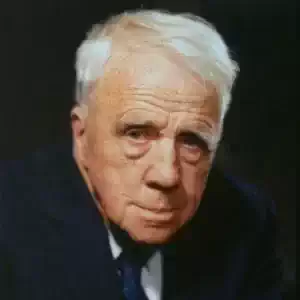
Robert Frost

Robert Frost

1874–1963 · lived 88 years US US

Robert Frost was an American poet whose work is often associated with the rural life of New England. His poetry is characterized by its accessible language, conversational tone, and exploration of profound themes about nature, human existence, and the choices people make. Despite often being perceived as a simple observer of country life, Frost's poems delve into complex psychological states and philosophical questions, making him one of America's most celebrated and enduring literary figures.

n. 1874-03-26, São Francisco · m. 1963-01-29, Boston

48,164 Views

Two Look at Two

Two Look at Two
Love and forgetting might have carried them
A little further up the mountain side
With night so near, but not much further up.
They must have halted soon in any case
With thoughts of a path back, how rough it was
With rock and washout, and unsafe in darkness;
When they were halted by a tumbled wall
With barbed-wire binding. They stood facing this,
Spending what onward impulse they still had
In One last look the way they must not go,
On up the failing path, where, if a stone
Or earthslide moved at night, it moved itself;
No footstep moved it. 'This is all,' they sighed,
Good-night to woods.' But not so; there was more.
A doe from round a spruce stood looking at them
Across the wall, as near the wall as they.
She saw them in their field, they her in hers.
The difficulty of seeing what stood still,
Like some up-ended boulder split in two,
Was in her clouded eyes; they saw no fear there.
She seemed to think that two thus they were safe.
Then, as if they were something that, though strange,
She could not trouble her mind with too long,
She sighed and passed unscared along the wall.
'This, then, is all. What more is there to ask?'
But no, not yet. A snort to bid them wait.
A buck from round the spruce stood looking at them
Across the wall as near the wall as they.
This was an antlered buck of lusty nostril,
Not the same doe come back into her place.
He viewed them quizzically with jerks of head,
As if to ask, 'Why don't you make some motion?
Or give some sign of life? Because you can't.
I doubt if you're as living as you look."
Thus till he had them almost feeling dared
To stretch a proffering hand -- and a spell-breaking.
Then he too passed unscared along the wall.
Two had seen two, whichever side you spoke from.
'This must be all.' It was all. Still they stood,
A great wave from it going over them,
As if the earth in one unlooked-for favour
Had made them certain earth returned their love.
Read full poem
Bio

Identification and basic context

Robert Frost is widely recognized as an American poet, though he also held Canadian citizenship and spent significant time in England. His birth and death occurred in the United States. He was a prominent figure in 20th-century American literature, known for his distinctive voice and his engagement with themes of rural life and nature.

Childhood and education

Frost's early life was marked by personal loss and a move from California to Massachusetts. He attended Dartmouth College briefly and then Lawrence High School, where he began writing poetry. His formal education was somewhat interrupted, but he was a voracious reader and largely self-taught, developing a deep appreciation for classical literature and the natural world. Early influences included Romantic poets like Wordsworth and Coleridge, as well as the philosophical underpinnings of Transcendentalism.

Literary trajectory

Frost began writing poetry in his teens and early twenties, with his first poems published in magazines like the *Independent* and the *New England Magazine*. His initial attempts to establish himself as a poet in America were met with limited success, leading him to spend several years in England. It was during his time in England that his first two collections, *A Boy's Will* (1913) and *North of Boston* (1914), were published and received critical acclaim. Upon his return to the United States, his reputation grew, and he became a celebrated figure, publishing numerous collections throughout his career.

Works, style, and literary characteristics

Major works include *The Road Not Taken* (1916), *Mountain Interval* (1916), *New Hampshire* (1923), *West-Running Brook* (1929), and *A Further Range* (1936). Frost's poetry often focuses on the New England landscape, exploring themes of nature, isolation, the human condition, choices and their consequences, and the tension between individual freedom and societal constraints. He is renowned for his mastery of traditional forms, particularly blank verse and the sonnet, but he infused these forms with a modern sensibility and a conversational, often colloquial, language. His style is characterized by its apparent simplicity, its underlying philosophical depth, and its use of vivid imagery drawn from the natural world. His poetic voice is often that of a wise, reflective observer.

Cultural and historical context

Frost lived and wrote during a period of significant social and technological change in America, including the Progressive Era, World War I, the Great Depression, and World War II. While his work often evokes a timeless, rural setting, it is also subtly responsive to the modern world. He was a contemporary of other major American modernist poets, but his style remained distinct, often seen as more traditional in form yet modern in its psychological exploration. He belonged to no specific literary movement but was influential in bringing a more accessible, yet profound, voice back into American poetry.

Personal life

Frost's personal life was marked by tragedy, including the deaths of children and his wife, Elinor. These experiences undoubtedly informed the elegiac and somber tones present in some of his work. He had a complex relationship with his family and struggled with financial insecurity early in his career. Despite his academic associations later in life, he maintained a strong connection to the land and to the rural communities that inspired him.

Recognition and reception

Robert Frost received immense recognition during his lifetime. He won the Pulitzer Prize for Poetry four times and was appointed the Poet Laureate of Vermont. His work was widely read and admired by both the general public and the academic community. He was invited to read his poetry at presidential inaugurations, solidifying his status as a national treasure.

Influences and legacy

Frost was influenced by poets like William Wordsworth and the New England Transcendentalists. His legacy lies in his ability to connect profound philosophical insights with accessible, natural language and imagery. He profoundly influenced subsequent generations of American poets by demonstrating the power of traditional forms to convey modern sensibilities and by re-establishing a vital link between poetry and the American landscape. His work remains widely taught and studied.

Interpretation and critical analysis

Interpretations of Frost's work often highlight the dual nature of his poetry: its surface simplicity masking deeper philosophical complexities. Critics have explored themes of existential choice, the nature of reality, the relationship between humanity and nature, and the psychological dimensions of loneliness and doubt. His poem "The Road Not Taken" is frequently analyzed for its ambiguity and its commentary on the construction of personal narratives.

Curiosities and lesser-known aspects

Despite his later fame, Frost faced significant rejections early in his career. He worked as a teacher and a farmer before finding widespread success. His strong opinions and sometimes cantankerous personality are also noted aspects of his character. He was known for his intellectual curiosity and his engagement with a wide range of subjects beyond poetry.

Death and memory

Robert Frost passed away in Boston, Massachusetts. His death was mourned as the loss of a major American literary figure. His home in Ripton, Vermont, has been preserved as a museum and educational center, and his works continue to be read, studied, and celebrated for their enduring wisdom and artistry.

Poems

59

Rose Pogonias

Rose Pogonias
A saturated meadow,
Sun-shaped and jewel-small,
A circle scarcely wider
Than the trees around were tall;
Where winds were quite excluded,
And the air was stifling sweet
With the breath of many flowers, --
A temple of the heat.
There we bowed us in the burning,
As the sun's right worship is,
To pick where none could miss them
A thousand orchises;
For though the grass was scattered,
yet every second spear
Seemed tipped with wings of color,
That tinged the atmosphere.
We raised a simple prayer
Before we left the spot,
That in the general mowing
That place might be forgot;
Or if not all so favored,
Obtain such grace of hours,
that none should mow the grass there
While so confused with flowers.
507

Reluctance

Reluctance
Out through the fields and the woods And over the walls I have wended; I have
climbed the hills of view And looked at the world, and descended; I have come by the
highway home, And lo, it is ended. The leaves are all dead on the group, Save those
that the oak is keeping To ravel them one by one And let them go scraping and
creeping Out over the crusted snow, When others are sleeping. And the dead leaves
lie huddled and still, No longer blown hither and thither; The last long aster is gone;
The flowers of the witch-hazel wither; The heart is still aching to seek, But the feel
question 'Whither?' Ah, when to the heart of man Was it ever less than a treason To
go with the drift of things, To yield with a grace to reason, And bow and accept the end
Of a love or a season?
447

Plowmen

Plowmen
A plow, they say, to plow the snow.
They cannot mean to plant it, no --
Unless in bitterness to mock
At having cultivated rock.
427

Putting In The Seed

Putting In The Seed
You come to fetch me from my work to-night
When supper's on the table, and we'll see
If I can leave off burying the white
Soft petals fallen from the apple tree
(Soft petals, yes, but not so barren quite,
Mingled with these, smooth bean and wrinkled pea);
And go along with you ere you lose sight
Of what you came for and become like me,
Slave to a Springtime passion for the earth.
How Love burns through the Putting in the Seed
On through the watching for that early birth
When, just as the soil tarnishes with weed,
The sturdy seedling with arched body comes
Shouldering its way and shedding the earth crumbs.
624

One Step Backward Taken

One Step Backward Taken
Not only sands and gravels
Were once more on their travels,
But gulping muddy gallons
Great boulders off their balance
Bumped heads together dully
And started down the gully.
Whole capes caked off in slices.
I felt my standpoint shaken
In the universal crisis.
But with one step backward taken
I saved myself from going.
A world torn loose went by me.
Then the rain stopped and the blowing,
And the sun came out to dry me.
365

Out, out--

Out, out--
The buzz-saw snarled and rattled in the yard
And made dust and dropped stove-length sticks of wood,
Sweet-scented stuff when the breeze drew across it.
And from there those that lifted eyes could count
Five mountain ranges one behind the other
Under the sunset far into Vermont.
And the saw snarled and rattled, snarled and rattled,
As it ran light, or had to bear a load.
And nothing happened: day was all but done.
Call it a day, I wish they might have said
To please the boy by giving him the half hour
That a boy counts so much when saved from work.
His sister stood beside them in her apron
To tell them "Supper." At the word, the saw,
As if to prove saws knew what supper meant,
Leaped out at the boy's hand, or seemed to leap--
He must have given the hand. However it was,
Neither refused the meeting. But the hand!
The boy's first outcry was a rueful laugh,
As he swung toward them holding up the hand
Half in appeal, but half as if to keep
The life from spilling. Then the boy saw all--
Since he was old enough to know, big boy
Doing a man's work, though a child at heart--
He saw all spoiled. "Don't let him cut my hand off--
The doctor, when he comes. Don't let him, sister!"
So. But the hand was gone already.
The doctor put him in the dark of ether.
He lay and puffed his lips out with his breath.
And then--the watcher at his pulse took fright.
No one believed. They listened at his heart.
Little--less--nothing!--and that ended it.
No more to build on there. And they, since they
Were not the one dead, turned to their affairs.
485

On Looking Up by Chance at the Constellations

On Looking Up by Chance at the Constellations
You'll wait a long, long time for anything much
To happen in heaven beyond the floats of cloud
And the Northern Lights that run like tingling nerves.
The sun and moon get crossed, but they never touch,
Nor strike out fire from each other nor crash out loud.
The planets seem to interfere in their curves -
But nothing ever happens, no harm is done.
We may as well go patiently on with our life,
And look elsewhere than to stars and moon and sun
For the shocks and changes we need to keep us sane.
It is true the longest drout will end in rain,
The longest peace in China will end in strife.
Still it wouldn't reward the watcher to stay awake
In hopes of seeing the calm of heaven break
On his particular time and personal sight.
That calm seems certainly safe to last to-night.
465

October

October
O hushed October morning mild, Thy leaves have ripened to the fall; Tomorrow's wind,
if it be wild, Should waste them all. The crows above the forest call; Tomorrow they
may form and go. O hushed October morning mild, Begin the hours of this day slow.
Make the day seem to us less brief. Hearts not averse to being beguiled, Beguile us in
the way you know. Release one leaf at break of day; At noon release another leaf; one
from our trees, one far away. Retard the sun with gentle mist; Enchant the land with
amethyst. Slow, slow! For the grapes' sake, if the were all, Whose elaves already are
burnt with frost, Whose clustered fruit must else be lost-- For the grapes' sake along
the all.
434

Never Again Would Bird's Song Be the Same

Never Again Would Bird's Song Be the Same
He would declare and could himself believe
That the birds there in all the garden round
From having heard the daylong voice of Eve
Had added to their own an oversound,
Her tone of meaning but without the words.
Admittedly an eloquence so soft
Could only have had an influence on birds
When call or laughter carried it aloft.
Be that as may be, she was in their song.
Moreover her voice upon their voices crossed
Had now persisted in the woods so long
That probably it never would be lost.
Never again would birds' song be the same.
And to do that to birds was why she came.
508

Nothing Gold Can Stay

Nothing Gold Can Stay
Nature's first green is gold,
Her hardest hue to hold.
Her early leaf's a flower;
But only so an hour.
Then leaf subsides to leaf,
So Eden sank to grief,
So dawn goes down to day
Nothing gold can stay.
389

Quotes

40

Videos

50

Comments (0)

Share
Log in to post a comment.

No comments yet. Be the first to comment.