
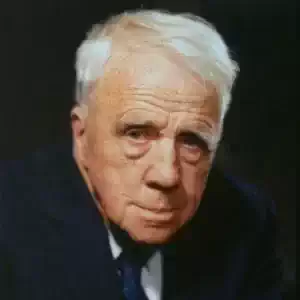
Robert Frost

Robert Frost

1874–1963 · lived 88 years US US

Robert Frost was an American poet whose work is often associated with the rural life of New England. His poetry is characterized by its accessible language, conversational tone, and exploration of profound themes about nature, human existence, and the choices people make. Despite often being perceived as a simple observer of country life, Frost's poems delve into complex psychological states and philosophical questions, making him one of America's most celebrated and enduring literary figures.

n. 1874-03-26, São Francisco · m. 1963-01-29, Boston

48,164 Views

Two Look at Two

Two Look at Two
Love and forgetting might have carried them
A little further up the mountain side
With night so near, but not much further up.
They must have halted soon in any case
With thoughts of a path back, how rough it was
With rock and washout, and unsafe in darkness;
When they were halted by a tumbled wall
With barbed-wire binding. They stood facing this,
Spending what onward impulse they still had
In One last look the way they must not go,
On up the failing path, where, if a stone
Or earthslide moved at night, it moved itself;
No footstep moved it. 'This is all,' they sighed,
Good-night to woods.' But not so; there was more.
A doe from round a spruce stood looking at them
Across the wall, as near the wall as they.
She saw them in their field, they her in hers.
The difficulty of seeing what stood still,
Like some up-ended boulder split in two,
Was in her clouded eyes; they saw no fear there.
She seemed to think that two thus they were safe.
Then, as if they were something that, though strange,
She could not trouble her mind with too long,
She sighed and passed unscared along the wall.
'This, then, is all. What more is there to ask?'
But no, not yet. A snort to bid them wait.
A buck from round the spruce stood looking at them
Across the wall as near the wall as they.
This was an antlered buck of lusty nostril,
Not the same doe come back into her place.
He viewed them quizzically with jerks of head,
As if to ask, 'Why don't you make some motion?
Or give some sign of life? Because you can't.
I doubt if you're as living as you look."
Thus till he had them almost feeling dared
To stretch a proffering hand -- and a spell-breaking.
Then he too passed unscared along the wall.
Two had seen two, whichever side you spoke from.
'This must be all.' It was all. Still they stood,
A great wave from it going over them,
As if the earth in one unlooked-for favour
Had made them certain earth returned their love.
Read full poem
Bio

Identification and basic context

Robert Frost is widely recognized as an American poet, though he also held Canadian citizenship and spent significant time in England. His birth and death occurred in the United States. He was a prominent figure in 20th-century American literature, known for his distinctive voice and his engagement with themes of rural life and nature.

Childhood and education

Frost's early life was marked by personal loss and a move from California to Massachusetts. He attended Dartmouth College briefly and then Lawrence High School, where he began writing poetry. His formal education was somewhat interrupted, but he was a voracious reader and largely self-taught, developing a deep appreciation for classical literature and the natural world. Early influences included Romantic poets like Wordsworth and Coleridge, as well as the philosophical underpinnings of Transcendentalism.

Literary trajectory

Frost began writing poetry in his teens and early twenties, with his first poems published in magazines like the *Independent* and the *New England Magazine*. His initial attempts to establish himself as a poet in America were met with limited success, leading him to spend several years in England. It was during his time in England that his first two collections, *A Boy's Will* (1913) and *North of Boston* (1914), were published and received critical acclaim. Upon his return to the United States, his reputation grew, and he became a celebrated figure, publishing numerous collections throughout his career.

Works, style, and literary characteristics

Major works include *The Road Not Taken* (1916), *Mountain Interval* (1916), *New Hampshire* (1923), *West-Running Brook* (1929), and *A Further Range* (1936). Frost's poetry often focuses on the New England landscape, exploring themes of nature, isolation, the human condition, choices and their consequences, and the tension between individual freedom and societal constraints. He is renowned for his mastery of traditional forms, particularly blank verse and the sonnet, but he infused these forms with a modern sensibility and a conversational, often colloquial, language. His style is characterized by its apparent simplicity, its underlying philosophical depth, and its use of vivid imagery drawn from the natural world. His poetic voice is often that of a wise, reflective observer.

Cultural and historical context

Frost lived and wrote during a period of significant social and technological change in America, including the Progressive Era, World War I, the Great Depression, and World War II. While his work often evokes a timeless, rural setting, it is also subtly responsive to the modern world. He was a contemporary of other major American modernist poets, but his style remained distinct, often seen as more traditional in form yet modern in its psychological exploration. He belonged to no specific literary movement but was influential in bringing a more accessible, yet profound, voice back into American poetry.

Personal life

Frost's personal life was marked by tragedy, including the deaths of children and his wife, Elinor. These experiences undoubtedly informed the elegiac and somber tones present in some of his work. He had a complex relationship with his family and struggled with financial insecurity early in his career. Despite his academic associations later in life, he maintained a strong connection to the land and to the rural communities that inspired him.

Recognition and reception

Robert Frost received immense recognition during his lifetime. He won the Pulitzer Prize for Poetry four times and was appointed the Poet Laureate of Vermont. His work was widely read and admired by both the general public and the academic community. He was invited to read his poetry at presidential inaugurations, solidifying his status as a national treasure.

Influences and legacy

Frost was influenced by poets like William Wordsworth and the New England Transcendentalists. His legacy lies in his ability to connect profound philosophical insights with accessible, natural language and imagery. He profoundly influenced subsequent generations of American poets by demonstrating the power of traditional forms to convey modern sensibilities and by re-establishing a vital link between poetry and the American landscape. His work remains widely taught and studied.

Interpretation and critical analysis

Interpretations of Frost's work often highlight the dual nature of his poetry: its surface simplicity masking deeper philosophical complexities. Critics have explored themes of existential choice, the nature of reality, the relationship between humanity and nature, and the psychological dimensions of loneliness and doubt. His poem "The Road Not Taken" is frequently analyzed for its ambiguity and its commentary on the construction of personal narratives.

Curiosities and lesser-known aspects

Despite his later fame, Frost faced significant rejections early in his career. He worked as a teacher and a farmer before finding widespread success. His strong opinions and sometimes cantankerous personality are also noted aspects of his character. He was known for his intellectual curiosity and his engagement with a wide range of subjects beyond poetry.

Death and memory

Robert Frost passed away in Boston, Massachusetts. His death was mourned as the loss of a major American literary figure. His home in Ripton, Vermont, has been preserved as a museum and educational center, and his works continue to be read, studied, and celebrated for their enduring wisdom and artistry.

Poems

59

A Soldier

A Soldier
He is that fallen lance that lies as hurled,
That lies unlifted now, come dew, come rust,
But still lies pointed as it plowed the dust.
If we who sight along it round the world,
See nothing worthy to have been its mark,
It is because like men we look too near,
Forgetting that as fitted to the sphere,
Our missiles always make too short an arc.
They fall, they rip the grass, they intersect
The curve of earth, and striking, break their own;
They make us cringe for metal-point on stone.
But this we know, the obstacle that checked
And tripped the body, shot the spirit on
Further than target ever showed or shone.
477

Acquainted with the Night

Acquainted with the Night
I have been one acquainted with the night.
I have walked out in rain -- and back in rain.
I have outwalked the furthest city light.
I have looked down the saddest city lane.
I have passed by the watchman on his beat
And dropped my eyes, unwilling to explain.
I have stood still and stopped the sound of feet
When far away an interrupted cry
Came over houses from another street,
But not to call me back or say good-bye;
And further still at an unearthly height,
A luminary clock against the sky
Proclaimed the time was neither wrong nor right.
I have been one acquainted with the night.
485

A Patch of Old Snow

A Patch of Old Snow
There's a patch of old snow in a corner
That I should have guessed
Was a blow-away paper the rain
Had brought to rest.
It is speckled with grime as if
Small print overspread it,
The news of a day I've forgotten --
If I ever read it.
393

A Question

A Question
A voice said, Look me in the stars
And tell me truly, men of earth,
If all the soul-and-body scars
Were not too much to pay for birth.
364

A Line-Storm Song

A Line-Storm Song
The line-storm clouds fly tattered and swift,
The road is forlorn all day,
Where a myriad snowy quartz stones lift,
And the hoof-prints vanish away.
The roadside flowers, too wet for the bee,
Expend their bloom in vain.
Come over the hills and far with me,
And be my love in the rain.
The birds have less to say for themselves
In the wood-world’s torn despair
Than now these numberless years the elves,
Although they are no less there:
All song of the woods is crushed like some
Wild, easily shattered rose.
Come, be my love in the wet woods; come,
Where the boughs rain when it blows.
There is the gale to urge behind
And bruit our singing down,
And the shallow waters aflutter with wind
From which to gather your gown.
What matter if we go clear to the west,
And come not through dry-shod?
For wilding brooch shall wet your breast
The rain-fresh goldenrod.
Oh, never this whelming east wind swells
But it seems like the sea’s return
To the ancient lands where it left the shells
Before the age of the fern;
And it seems like the time when after doubt
Our love came back amain.
Oh, come forth into the storm and rout
And be my love in the rain.
758

A Dream Pang

A Dream Pang
I had withdrawn in forest, and my song
Was swallowed up in leaves that blew alway;
And to the forest edge you came one day
(This was my dream) and looked and pondered long,
But did not enter, though the wish was strong:
You shook your pensive head as who should say,
‘I dare not—too far in his footsteps stray—
He must seek me would he undo the wrong.
Not far, but near, I stood and saw it all
Behind low boughs the trees let down outside;
And the sweet pang it cost me not to call
And tell you that I saw does still abide.
But ’tis not true that thus I dwelt aloof,
For the wood wakes, and you are here for proof.
482

A Boundless Moment

A Boundless Moment
He halted in the wind, and -- what was that
Far in the maples, pale, but not a ghost?
He stood there bringing March against his thought,
And yet too ready to believe the most.
"Oh, that's the Paradise-in-bloom," I said;
And truly it was fair enough for flowers
had we but in us to assume in march
Such white luxuriance of May for ours.
We stood a moment so in a strange world,
Myself as one his own pretense deceives;
And then I said the truth (and we moved on).
A young beech clinging to its last year's leaves.
508

A Cliff Dwelling

A Cliff Dwelling
There sandy seems the golden sky
And golden seems the sandy plain.
No habitation meets the eye
Unless in the horizon rim,
Some halfway up the limestone wall,
That spot of black is not a stain
Or shadow, but a cavern hole,
Where someone used to climb and crawl
To rest from his besetting fears.
I see the callus on his soul
The disappearing last of him
And of his race starvation slim,
Oh years ago - ten thousand years.
403

In White: Frost's Early Version Of Design

"In White": Frost's Early Version Of Design
A dented spider like a snow drop white
On a white Heal-all, holding up a moth
Like a white piece of lifeless satin cloth -
Saw ever curious eye so strange a sight? -
Portent in little, assorted death and blight
Like the ingredients of a witches' broth? -
The beady spider, the flower like a froth,
And the moth carried like a paper kite.
What had that flower to do with being white,
The blue prunella every child's delight.
What brought the kindred spider to that height?
(Make we no thesis of the miller's plight.)
What but design of darkness and of night?
Design, design! Do I use the word aright?
Anonymous submission.
376

Quotes

40

Videos

50

Comments (0)

Share
Log in to post a comment.

No comments yet. Be the first to comment.