
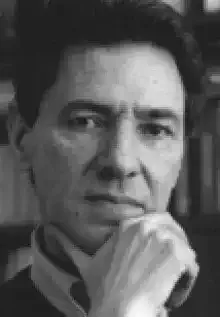
António Franco Alexandre
b. 1944
 PT
PT
PT
António Franco Alexandre was a Portuguese poet, known for his complex, erudite, and deeply reflective poetry, often marked by a strong philosophical and existential charge. His work explores themes such as language, memory, time, death, and the human condition, resorting to rigorous vocabulary and elaborate poetic structures. Franco Alexandre is an important figure in Portuguese poetry of the second half of the 20th century, standing out for the originality and depth of his poetic vision.
n. 1944, Viseu · m. , Lisboa, Portugal
99
Views
Bio
Identification and basic context
António Franco Alexandre was a Portuguese poet. He was born in 1949 and died in 2000. The historical context in which he lived and produced his work spans the last decades of the Estado Novo and the transition to democracy in Portugal, a period of great social, political, and cultural upheavals.Childhood and education
António Franco Alexandre's childhood and education took place in Portugal. His formal education, presumed to be solid and comprehensive, was crucial for the development of a vast general culture and a refined critical sense. His readings, which certainly included philosophy, literature, and other arts, were crucial for shaping his sensibility and poetic thought.Literary career
António Franco Alexandre's literary career was marked by the publication of significant works that demonstrated an evolution in his poetic expression. He began his literary activity at a time when Portuguese poetry was undergoing important renewals. His work, although sometimes considered difficult to access, established itself as a landmark in contemporary poetry for its originality and depth.Work, style, and literary characteristics
António Franco Alexandre's work is characterized by its conceptual density, erudition, and exploration of philosophical and existential themes, such as language, memory, time, death, and the search for meaning. His language is rigorous, precise, sometimes abstract, and his poetic structures are often complex, revealing technical mastery and an intention to articulate thought and form in an intricate way. The tone of his poetry can be reflective, introspective, and his poetic voice is often marked by deep questioning about existence and the human condition. His work dialogues with the literary and philosophical tradition, but with an innovative and critical gaze, associating him with poetry of an intellectual and metaphysical nature.Cultural and historical context
António Franco Alexandre lived and wrote in a time of great transformations in Portugal. His work reflects, in a way, the anxieties and intellectual debates of the second half of the 20th century. Inserted in a context of literary renewal, his poetry stood out for its originality and its approach to complex themes, distinguishing him from more immediately accessible or conventional currents.Personal life
Specific information about António Franco Alexandre's personal life, such as family relationships or private life episodes, is not the main focus of his public disclosure. However, the depth and intensity of his poetic work suggest a rich inner life and a deep dedication to reflection on the great existential themes.Recognition and reception
Although António Franco Alexandre's poetry is recognized for its quality and depth in literary circles, its complexity and erudition may have limited its popularity among a wider audience. However, he is widely respected by critics and academics as one of the most important poets of his generation, and his work is the subject of study and analysis.Influences and legacy
António Franco Alexandre's influences are vast, encompassing philosophy, literature, and the arts. His legacy lies in his contribution to Portuguese poetry with a body of work that challenges the reader and expands the boundaries of poetic expression in terms of intellectual and formal depth. He influenced later poets through his rigorous approach to language and existential themes.Interpretation and critical analysis
António Franco Alexandre's work is a fertile ground for interpretation and critical analysis, due to its thematic and formal complexity. His explorations of language as a constructor and, at times, a limiter of reality, as well as his reflections on mortality and the search for meaning in an uncertain world, are central to the critique of his poetry.Curiosities and lesser-known aspects
Lesser-known aspects of António Franco Alexandre's personality or details about his writing habits may not be widely documented. His dedication to poetry suggests an introspective nature and a fascination with exploring the depths of thought and language.Death and memory
António Franco Alexandre passed away in 2000. His memory endures through his work, which continues to be read, studied, and inspire new generations of poets and readers, securing his place in the history of Portuguese literature.Poems
0No poems found
Videos
50
Comments (0)
Log in
to post a comment.
No comments yet. Be the first to comment.