
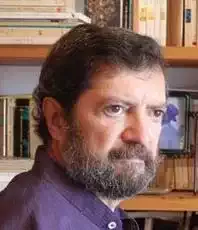
Manuel Gusmão
 PT
PT
Manuel Gusmão is a Portuguese poet whose work is distinguished by its rigorous exploration of language and the incessant search for new forms of poetic expression. Throughout his career, Gusmão has developed a poetry that is simultaneously intellectual and visceral, marked by profound reflection on time, memory, identity, and the very nature of poetry. With a body of work that defies easy classification, Gusmão is recognized for his formal experimentation and the density of his poetic discourse. His poetry invites the reader into a complex dialogue, where form and content are intrinsically intertwined, solidifying him as a unique and influential figure in contemporary Portuguese poetry.
n. 1945-12-11, Évora · m. 2023-11-09, Lisboa
Bio
Identification and basic context
Manuel Gusmão is a Portuguese poet. He was born in Lisbon on November 25, 1952. He is the son of António Gusmão and Maria Teresa Gusmão. He belongs to a middle-class family. He writes in Portuguese. He lived and developed his work in a historical context marked by the last decades of the Salazar dictatorship, the Carnation Revolution, and the consolidation of democracy in Portugal.Childhood and education
Manuel Gusmão grew up in a family environment that, although not directly linked to the literary scene, provided him with access to culture. His education took place in Portugal, where he likely absorbed the cultural and literary influences of his time. The period of his youth coincided with significant social and political transformations in Portugal, which undoubtedly shaped his worldview and, consequently, his writing.Literary career
Manuel Gusmão's writing began in his youth, with an evolution marked by experimentation and the search for an authentic poetic voice. His work evolved over time, reflecting a constant questioning of language and the poetic condition itself. Gusmão has actively participated in anthologies and literary publications, consolidating his presence in the panorama of contemporary Portuguese poetry. He has collaborated with various literary magazines and contributed to the dissemination of poetry through critical and reflective activities.Work, style, and literary characteristics
Manuel Gusmão's work is characterized by a rigorous exploration of language and the search for new forms of expression. Central themes include time, memory, identity, and the nature of poetry. Gusmão uses formal experimentation as a crucial element of his poetry, challenging traditional structures and exploring free verse with great freedom. His poetic resources include imagistic density and subtle musicality, often with a reflective and intellectual tone. The language is carefully crafted, sometimes dense, demanding attentive reading. Gusmão is situated within the context of contemporary Portuguese poetry, engaging with tradition while simultaneously seeking innovation. He is often associated with poetry that focuses on meta-poetry, questioning the act of writing and the relationship between word and reality. Lesser-known works can be found in literary magazines and more specific publications.Work, style, and literary characteristics
Cultural and historical context Manuel Gusmão lived and wrote during a period of transition and democratic consolidation in Portugal. His work engages with the post-revolutionary cultural context, characterized by an effervescence of new ideas and forms of artistic expression. Although not explicitly associated with a specific literary movement, his poetry shares with contemporary Portuguese poetry an attention to language and form. His philosophical and literary position centers on a profound reflection on language and the human experience.Work, style, and literary characteristics
Personal life Information about Manuel Gusmão's personal life, including significant affective and family relationships, friendships, personal experiences and crises, parallel professions, religious, spiritual, or philosophical beliefs, and political positions or civic involvement, requires in-depth research in biographical sources and interviews.Work, style, and literary characteristics
Recognition and reception Manuel Gusmão is recognized as an important poet in contemporary Portuguese poetry. While institutional awards and distinctions may not be the main focus of his dissemination, his work has been the subject of study and favorable critical reception from specialists and readers attentive to avant-garde poetry. His place in national literature is consolidated by the originality and depth of his work.Work, style, and literary characteristics
Influences and legacy Manuel Gusmão's influences may stem from poets who explored language innovatively and from the Portuguese poetic tradition, reinterpreted from a contemporary perspective. His legacy lies in his contribution to the renewal of Portuguese-language poetry, opening paths for new formal and thematic approaches. His work continues to influence later generations of poets seeking more reflective and experimental poetry.Work, style, and literary characteristics
Interpretation and critical analysis Manuel Gusmão's work allows for diverse interpretations, with a particular focus on analyzing his relationship with language, metalanguage, and the exploration of subjectivity. His reflections on time, memory, and identity are recurring themes in critical studies. The complexity of his poetry can generate debates about the accessibility and depth of his discourse.Work, style, and literary characteristics
Curiosities and lesser-known aspects Lesser-known aspects of Manuel Gusmão's personality, contradictions between life and work, significant or anecdotal episodes that illuminate his profile, objects, places, or rituals associated with poetic creation, writing habits, or information about manuscripts, diaries, or correspondence, require specific research and access to less public sources.Work, style, and literary characteristics
Death and memory Manuel Gusmão is alive. There is no information about his death or posthumous publications.Poems
0No poems found
Videos
50
Comments (0)
No comments yet. Be the first to comment.