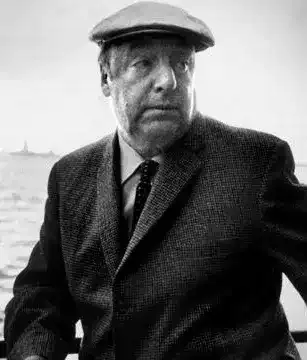
Pablo Neruda

Pablo Neruda

1904–1973 · lived 69 years CL CL

Pablo Neruda was a Chilean poet, diplomat, and politician. He is widely regarded as one of the most influential poets of the 20th century, celebrated for his lyrical and evocative verse, which often explored themes of love, nature, politics, and everyday life. Neruda's prolific output and diverse thematic concerns earned him international acclaim, culminating in the Nobel Prize in Literature in 1971. His work is characterized by its passionate imagery, sensuous language, and profound connection to the landscapes and people of Latin America.

n. 1904-07-12, Parral · m. 1973-09-23, Santiago

48,550 Views

Your Laughter

Your Laughter

Take bread away from me, if you wish,
take air away, but
do not take from me your laughter.


Do not take away the rose,
the lance flower that you pluck,
the water that suddenly
bursts forth in joy,
the sudden wave
of silver born in you.


My struggle is harsh and I come back
with eyes tired
at times from having seen
the unchanging earth,
but when your laughter enters
it rises to the sky seeking me
and it opens for me all
the doors of life.


My love, in the darkest
hour your laughter
opens, and if suddenly
you see my blood staining
the stones of the street,
laugh, because your laughter
will be for my hands
like a fresh sword.


Next to the sea in the autumn,
your laughter must raise
its foamy cascade,
and in the spring, love,
I want your laughter like
the flower I was waiting for,
the blue flower, the rose
of my echoing country.


Laugh at the night,
at the day, at the moon,
laugh at the twisted
streets of the island,
laugh at this clumsy
boy who loves you,
but when I open
my eyes and close them,
when my steps go,
when my steps return,
deny me bread, air,
light, spring,
but never your laughter
for I would die.
Read full poem
Bio

Identification and basic context

Pablo Neruda, born Ricardo Eliécer Neftalí Reyes Basoalto, was a renowned Chilean poet, diplomat, and politician. He is considered one of the most important literary figures of the 20th century and a significant voice for social justice in Latin America. Neruda's work is characterized by its passionate, often surreal imagery, its deep connection to nature, and its engagement with political and social issues. He wrote in Spanish, and his poetry has been translated into numerous languages.

Childhood and education

Neruda was born in Parral, Chile. His mother died shortly after his birth, and he was raised by his father and stepmother in Temuco. He showed an early aptitude for literature, publishing his first poems at the age of 13. He studied French at the Temuco Normal School for Men and later moved to Santiago to study at the University of Chile, although his primary focus remained his literary pursuits. His early life in the Chilean landscape, with its forests, rivers, and the proximity to the ocean, profoundly shaped his poetic sensibility.

Literary trajectory

Neruda's literary career began in his youth, and he quickly gained recognition. He published his first book, "Crepusculario" (Twilight), in 1923. However, it was "Veinte poemas de amor y una canción desesperada" (Twenty Love Poems and a Song of Despair, 1924) that brought him widespread fame. He served as a diplomat for Chile in various countries, including Burma, Ceylon, Java, Argentina, Spain, Mexico, and France. These experiences significantly influenced his writing, broadening his perspective and introducing him to new political and cultural landscapes. His poetry evolved from early romanticism and surrealism to a more politically engaged and socially conscious style.

Works, style, and literary characteristics

Neruda's vast body of work includes "Residencia en la tierra" (Residence on Earth), "Canto general" (General Song), and "Odas elementales" (Elemental Odes). His style is marked by its sensuousness, its rich metaphors, and its profound connection to the natural world. He explored themes of love, death, time, memory, political struggle, and the beauty of everyday objects and natural phenomena. His language is often direct yet deeply evocative, capable of capturing both the grand sweep of history and the intimate details of human experience. He experimented with various forms, from traditional verse to free verse, and his "Elemental Odes" are known for their concise, accessible celebration of ordinary things.

Cultural and historical context

Neruda lived through a turbulent period in Latin American history, marked by political instability, social upheaval, and the rise of authoritarian regimes. As a member of the Communist Party, his political activism led to periods of exile and persecution. His poetry often reflected these historical realities, serving as a voice for the oppressed and a testament to the struggles of the common people. He was a contemporary of other major Latin American writers and intellectuals, contributing to the vibrant literary and political discourse of the region.

Personal life

Neruda had three marriages and several significant relationships that influenced his poetry. His political activities often led to periods of separation from his loved ones. He was a dedicated communist, and his political beliefs deeply informed his life and work, leading him to serve as a senator and a presidential candidate before going into exile. He was known for his deep love of Chile, its landscapes, and its people, which he sought to express through his art and his political actions.

Recognition and reception

Neruda received numerous awards and honors throughout his career, most notably the Nobel Prize in Literature in 1971 for "his poetic works which, with the action of an elemental force, have given a continent its destiny and dreams." He is one of the most widely read poets in the world, and his work continues to resonate with readers across cultures and generations. His reception has been overwhelmingly positive, celebrating his lyrical genius and his unwavering commitment to humanity.

Influences and legacy

Neruda was influenced by poets like Walt Whitman and the European surrealists, but he forged a unique voice that became emblematic of Latin American poetry. He, in turn, influenced countless poets throughout the world with his passionate style, his commitment to social justice, and his ability to find poetry in the ordinary. His "Canto General" is considered a monumental epic of the Americas. Neruda's legacy is that of a poet who captured the soul of a continent and used his art as a powerful tool for social and political change.

Interpretation and critical analysis

Neruda's poetry is frequently analyzed for its exploration of identity, belonging, and the relationship between the individual and the collective. His surrealist leanings in earlier works are often contrasted with the direct political engagement of his later poetry. Critics have examined his role as a national poet and a voice for the marginalized, exploring the ways in which his work both reflects and shapes Latin American consciousness.

Curiosities and lesser-known aspects

Neruda was an avid collector of unusual objects, including various types of shells, ships in bottles, and typewriters, which he displayed in his homes. His houses, particularly La Chascona in Santiago, Isla Negra, and El Cañete in Buenos Aires, are now museums dedicated to his life and work. He was also known for his immense generosity and his support for other artists and writers.

Death and memory

Pablo Neruda died in 1973, shortly after the military coup in Chile that overthrew Salvador Allende's government. While officially attributed to cancer, there have been ongoing investigations and debates surrounding the possibility of foul play. His death was a profound loss for Chile and the literary world. His works continue to be widely read and celebrated, and his memory remains a potent symbol of artistic expression and political conviction in Latin America and beyond.

Poems

72

Enigma with Flower

Enigma with Flower

Victory. It has come late, I had not learnt
how to arrive, like the lily, at will,
the white figure, that pierces
the motionless eternity of earth,
pushing at clear, faint, form,
till the hour strikes: that clay,
with a white ray, or a spur of milk.
Shedding of clothing, the thick darkness of soil,
on whose cliff the fair flower advances,
till the flag of its whiteness
defeats the contemptible deep of night,
and, from the motion of light,
spills itself in astonished seed.
603

Drunk as Drunk

Drunk as Drunk

Translated from the Spanish by Christopher Logue

Drunk as drunk on turpentine
From your open kisses,
Your wet body wedged
Between my wet body and the strake
Of our boat that is made of flowers,
Feasted, we guide it - our fingers
Like tallows adorned with yellow metal -
Over the sky's hot rim,
The day's last breath in our sails.

Pinned by the sun between solstice
And equinox, drowsy and tangled together
We drifted for months and woke
With the bitter taste of land on our lips,
Eyelids all sticky, and we longed for lime
And the sound of a rope
Lowering a bucket down its well. Then,
We came by night to the Fortunate Isles,
And lay like fish
Under the net of our kisses.
562

Cat's Dream

Cat's Dream

How neatly a cat sleeps,
sleeps with its paws and its posture,
sleeps with its wicked claws,
and with its unfeeling blood,
sleeps with all the rings-a
series of burnt circles-which
have formed the odd geology
of its sand-colored tail.


I should like to sleep like a cat,
with all the fur of time,
with a tongue rough as flint,
with the dry sex of fire;
and after speaking to no one,
stretch myself over the world,
over roofs and landscapes,
with a passionate desire
to hunt the rats in my dreams.


I have seen how the cat asleep
would undulate, how the night
flowed through it like dark water;
and at times, it was going to fall
or possibly plunge into
the bare deserted snowdrifts.
Sometimes it grew so much in sleep
like a tiger's great-grandfather,
and would leap in the darkness over
rooftops, clouds and volcanoes.


Sleep, sleep cat of the night,
with episcopal ceremony
and your stone-carved moustache.
Take care of all our dreams;
control the obscurity
of our slumbering prowess
with your relentless heart
and the great ruff of your tail.


Translated by Alastair Reid


Submitted by Jen
727

Clenched Soul

Clenched Soul

We have lost even this twilight.
No one saw us this evening hand in hand
while the blue night dropped on the world.


I have seen from my window
the fiesta of sunset in the distant mountain tops.


Sometimes a piece of sun
burned like a coin in my hand.


I remembered you with my soul clenched
in that sadness of mine that you know.


Where were you then?
Who else was there?
Saying what?
Why will the whole of love come on me suddenly
when I am sad and feel you are far away?


The book fell that always closed at twilight
and my blue sweater rolled like a hurt dog at my feet.


Always, always you recede through the evenings
toward the twilight erasing statues.
584

Canto XII from The Heights of Macchu Picchu

Canto XII from The Heights of Macchu Picchu

Arise to birth with me, my brother.
Give me your hand out of the depths
sown by your sorrows.
You will not return from these stone fastnesses.
You will not emerge from subterranean time.
Your rasping voice will not come back,
nor your pierced eyes rise from their sockets.


Look at me from the depths of the earth,
tiller of fields, weaver, reticent shepherd,
groom of totemic guanacos,
mason high on your treacherous scaffolding,
iceman of Andean tears,
jeweler with crushed fingers,
farmer anxious among his seedlings,
potter wasted among his clays-bring
to the cup of this new life
your ancient buried sorrows.
Show me your blood and your furrow;
say to me: here I was scourged
because a gem was dull or because the earth
failed to give up in time its tithe of corn or stone.
Point out to me the rock on which you stumbled,
the wood they used to crucify your body.
Strike the old flints
to kindle ancient lamps, light up the whips
glued to your wounds throughout the centuries
and light the axes gleaming with your blood.


I come to speak for your dead mouths.


Throughout the earth
let dead lips congregate,
out of the depths spin this long night to me
as if I rode at anchor here with you.


And tell me everything, tell chain by chain,
and link by link, and step by step;
sharpen the knives you kept hidden away,
thrust them into my breast, into my hands,
like a torrent of sunbursts,
an Amazon of buried jaguars,
and leave me cry: hours, days and years,
blind ages, stellar centuries.


And give me silence, give me water, hope.


Give me the struggle, the iron, the volcanoes.


Let bodies cling like magnets to my body.


Come quickly to my veins and to my mouth.


Speak through my speech, and through my blood.
645

Bird

Bird


It was passed from one bird to another,
the whole gift of the day.
The day went from flute to flute,
went dressed in vegetation,
in flights which opened a tunnel
through the wind would pass
to where birds were breaking open
the dense blue air and
there, night came in.


When I returned from so many journeys,
I stayed suspended and green
between sun and geography -
I saw how wings worked,
how perfumes are transmitted
by feathery telegraph,
and from above I saw the path,
the springs and the roof tiles,
the fishermen at their trades,
the trousers of the foam;
I saw it all from my green sky.
I had no more alphabet
than the swallows in their courses,
the tiny, shining water
of the small bird on fire
which dances out of the pollen.
914

Absence

Absence


I have scarcely left you
When you go in me, crystalline,
Or trembling,
Or uneasy, wounded by me
Or overwhelmed with love, as
when your eyes
Close upon the gift of life
That without cease I give you.


My love,
We have found each other
Thirsty and we have
Drunk up all the water and the
Blood,
We found each other
Hungry
And we bit each other
As fire bites,
Leaving wounds in us.


But wait for me,
Keep for me your sweetness.
I will give you too
A rose.
677

Always

Always


I am not jealous
of what came before me.


Come with a man
on your shoulders,
come with a hundred men in your hair,
come with a thousand men between your breasts and your feet,
come like a river
full of drowned men
which flows down to the wild sea,
to the eternal surf, to Time!


Bring them all
to where I am waiting for you;
we shall always be alone,
we shall always be you and I
alone on earth,
to start our life!
604

‘Perhaps not to be is to be without your being.’

‘Perhaps not to be is to be without your being.’

Perhaps not to be is to be without your being,
without your going, that cuts noon light
like a blue flower, without your passing
later through fog and stones,
without the torch you lift in your hand
that others may not see as golden,
that perhaps no one believed blossomed
the glowing origin of the rose,
without, in the end, your being, your coming
suddenly, inspiringly, to know my life,
blaze of the rose-tree, wheat of the breeze:
and it follows that I am, because you are:
it follows from ‘you are’, that I am, and we:
and, because of love, you will, I will,
We will, come to be.

587

A Lemon

A Lemon

Out of lemon flowers
loosed
on the moonlight, love's
lashed and insatiable
essences,
sodden with fragrance,
the lemon tree's yellow
emerges,
the lemons
move down
from the tree's planetarium


Delicate merchandise!
The harbors are big with itbazaars
for the light and the
barbarous gold.
We open
the halves
of a miracle,
and a clotting of acids
brims
into the starry
divisions:
creation's
original juices,
irreducible, changeless,
alive:
so the freshness lives on
in a lemon,
in the sweet-smelling house of the rind,
the proportions, arcane and acerb.


Cutting the lemon
the knife
leaves a little cathedral:
alcoves unguessed by the eye
that open acidulous glass
to the light; topazes
riding the droplets,
altars,
aromatic facades.


So, while the hand
holds the cut of the lemon,
half a world
on a trencher,
the gold of the universe
wells
to your touch:
a cup yellow
with miracles,


a breast and a nipple
perfuming the earth;
a flashing made fruitage,
the diminutive fire of a planet.
972

Quotes

18

Videos

50

Comments (0)

Share
Log in to post a comment.

No comments yet. Be the first to comment.