
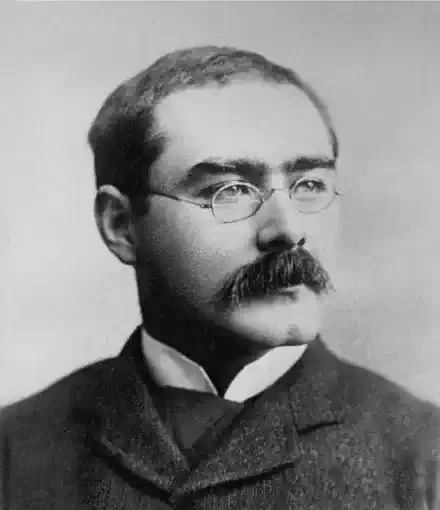
Rudyard Kipling

Rudyard Kipling

1865–1936 · lived 70 years GB GB

Rudyard Kipling was a prolific English writer and poet, best known for his works on British India and his children's stories. He championed the idea of the 'White Man's Burden' and his writings often reflected imperialist sentiments. Despite controversy surrounding his political views, his imaginative storytelling and mastery of language continue to be recognized, with works like 'The Jungle Book' and 'Kim' remaining popular.

n. 1865-12-30, Bombaim · m. 1936-01-18, Londres

137,390 Views

Columns

Columns
(Mobile Columns of the Boer War)
Out o' the wilderness, dusty an' dry
(Time, an' 'igh time to be trekkin' again!)
Oo is it 'eads to the Detail Supply?
A sectioin, a pompom, an' six 'undred men.
'Ere comes the clerk with 'is lantern an' keys
(Time, an 'igh time to be trekkin 'again!)
" Surplus of everything--draw what you please
"For the section, the pompom, an' six 'unrdred men."
"What are our orders an' where do we lay? .
(Time, an 'igh time to be trekkin' again!)
"You came after dark--you will leave before day,
"You section, you pompom, you six' undred men!"
Down the tin street, 'alf awake an 'unfed,
'Ark to 'em blessin' the Gen'ral in bed!
Now by the church an' the outspan they wind--
Over the ridge an' it's all lef' be'ind
For the section, etc.
Soon they will camp as the dawn's growin' grey,
Roll up for coffee an' sleep while they may--
The section , etc.
Read their 'ome letters, their papers an' such,
For they'll move after dark to astonish the Dutch
With a section, etc.
'Untin' for shade as the long hours pass--
Blankets on rifles or burrows in grass,
Lies the section, etc.
Dossin' or beatin' a shirt in the sun,
Watching chameleons or cleanin' a gun,
Waits the section, etc.
With nothin' but stillness as far as you please,
An' the silly mirage stringin' islands an' seas
Round the section, etc.
So they strips off their hide an' they grills in their bones,
Till the shadows crawl out from beneath the pore stones
Toward the section, etc.
An' the Mauser-bird stops an' the jacals begin
A the 'orse-guard comes up and the Gunners 'ook in
As a 'int the pompom an' six 'undred men . . . .


Off through the dark with the stars to rely on---
(Alpha Centauri an' somethin' Orion)
Moves the section, etc.
Same bloomin' 'ole which the ant-bear 'as broke,
Same bloomin' stumble an' same bloomin' joke
Down the section, etc.
Same "which is right?" where the cart-tracks divide,
Same "give it up" from the same clever guide
To the section, etc.
Same tumble-down on the same 'idden farm,
Same white-eyed Kaffir 'oo gives the alarm--
Of the section, etc.
Same shootin' wild at the end o' the night,
Same flyin'-tackle an' same messy fight,
By the section, etc.
Same ugly 'iccup an' same 'orrid squeal,
When it's too dark to see an' it's too late to feel
In the section, etc.
(Same batch of prisoners, 'airy an' still,
Watchin' their comrades bolt over the 'ill
From the section, etc.)
Same chilly glare in the eye of the sun
As 'e gets up displeasured to see what was done
By the section, etc.
Same splash o' pink on the stoep or the kraal,
An' the same quiet face which 'as finished with all
In the section, the pompom, an' six 'undred men.
Out o' the wilderness, dusty an' dry
(Time, an' 'igh time to be trekkin' again!)
' Oo is it 'eads to the Detail Supply ?
A section, a pompom, an 'six' 'undred men.
Read full poem
Bio

Identification and basic context

Joseph Rudyard Kipling was an English writer and poet. He is widely known by his middle name, Rudyard. Born in Bombay, British India, he spent much of his formative years there and later in England. His father was an artist and principal of an art school in India. Kipling was a British national and wrote in English.

Childhood and education

Kipling's early childhood in India deeply shaped his worldview and literary output. After returning to England for his education, he attended the United Services College in Westward Ho!, Devon, which provided the setting for his novel 'Stalky & Co.'. His time there was marked by a harsh but formative experience. He received a practical education rather than a formal university degree, returning to India to begin his career in journalism.

Literary trajectory

Kipling began his literary career as a journalist in Lahore, India, in the 1880s. His early stories, often published in periodicals, showcased his keen observation of Indian life and his developing narrative skill. He gained significant fame with collections like 'Plain Tales from the Hills' and 'Soldiers Three'. His move to London in the 1890s further cemented his international reputation. He also wrote novels, essays, and songs, demonstrating a remarkable versatility.

Works, style, and literary characteristics

Kipling's major works include 'The Jungle Book' (1894), 'Kim' (1901), 'The Just So Stories' (1902), and numerous poems like 'If—' and 'The White Man's Burden'. His dominant themes often revolve around India, the British Empire, the lives of soldiers, the relationship between humans and animals, and the complexities of loyalty and duty. His style is characterized by vivid imagery, a strong narrative drive, and a colloquial yet precise use of language. He mastered various forms, from short stories and novels to ballads and epic poems. His poetic voice is often didactic, authoritative, and nationalistic. He employed powerful metaphors and rhythms, making his works highly memorable.

Cultural and historical context

Kipling was a prominent voice during the height of the British Empire, and his work is inextricably linked to the imperialist project. He lived through periods of expansion, conflict, and colonial administration, which heavily influenced his perspective. He was part of a generation of writers grappling with themes of empire, race, and cultural encounter. His strong espousal of the 'White Man's Burden' placed him at the center of contemporary debates about colonialism.

Personal life

Kipling's personal life was marked by his experiences in India and his strong sense of duty and patriotism. His marriage to Caroline Starr Balestier provided a stable partnership. He experienced personal tragedies, including the early death of his daughter Josephine, which deeply affected him and is thought to have influenced some of his later works, such as 'Kim'. He was a complex figure, deeply devoted to his family and his work.

Recognition and reception

Kipling achieved immense fame and recognition during his lifetime. He was awarded the Nobel Prize in Literature in 1907, becoming the first English-language recipient. His works were widely translated and celebrated internationally. However, his strong imperialist views also drew criticism, and his reception has been complex, with ongoing discussions about the political implications of his writings.

Influences and legacy

Kipling was influenced by his experiences in India, classical literature, and the journalistic tradition. His legacy is significant, though debated. He is credited with profoundly shaping the adventure story genre and children's literature. His influence can be seen in subsequent generations of writers who explored themes of empire, adventure, and the wilderness. His poems, particularly 'If—', remain widely quoted. His work continues to be adapted into films and other media.

Interpretation and critical analysis

Kipling's work is often analyzed through the lens of colonialism, examining his portrayal of indigenous peoples and his support for British imperial rule. Critical interpretations highlight his narrative skill and imaginative power while also scrutinizing his problematic political stances. Debates continue regarding the extent to which his stories can be separated from their imperialist context.

Curiosities and lesser-known aspects

Despite his fame, Kipling was notoriously private and sometimes irascible. He had a deep fascination with machinery and technology, which sometimes found its way into his stories. He was also known for his meticulous attention to detail in his writing. A lesser-known aspect is his significant contribution to the development of the short story form.

Death and memory

Rudyard Kipling died in London. His memory is preserved through his vast literary output, which continues to be read and studied, albeit often with critical commentary on his political views. His home, Batemans, is now a National Trust property and museum, offering insights into his life and work.

Poems

275

Tomlinson

Tomlinson
Now Tomlinson gave up the ghost in his house in Berkeley Square,
And a Spirit came to his bedside and gripped him by the hair --
A Spirit gripped him by the hair and carried him far away,
Till he heard as the roar of a rain-fed ford the roar of the Milky Way:
Till he heard the roar of the Milky Way die down and drone and cease,
And they came to the Gate within the Wall where Peter holds the keys.
"Stand up, stand up now, Tomlinson, and answer loud and high
The good that ye did for the sake of men or ever ye came to die --
The good that ye did for the sake of men in little earth so lone!"
And the naked soul of Tomlinson grew white as a rain-washed bone.
"O I have a friend on earth," he said, "that was my priest and guide,
And well would he answer all for me if he were by my side."
-- "For that ye strove in neighbour-love it shall be written fair,
But now ye wait at Heaven's Gate and not in Berkeley Square:
Though we called your friend from his bed this night,
he could not speak for you,
For the race is run by one and one and never by two and two."
Then Tomlinson looked up and down, and little gain was there,
For the naked stars grinned overhead, and he saw that his soul was bare:
The Wind that blows between the worlds, it cut him like a knife,
And Tomlinson took up his tale and spoke of his good in life.
"This I have read in a book," he said, "and that was told to me,
And this I have thought that another man thought of a Prince in Muscovy."
The good souls flocked like homing doves and bade him clear the path,
And Peter twirled the jangling keys in weariness and wrath.
"Ye have read, ye have heard, ye have thought," he said,
"and the tale is yet to run:
By the worth of the body that once ye had, give answer -- what ha' ye done?"
Then Tomlinson looked back and forth, and little good it bore,
For the Darkness stayed at his shoulder-blade and Heaven's Gate before: --
"O this I have felt, and this I have guessed, and this I have heard men say,
And this they wrote that another man wrote of a carl in Norroway."
-- "Ye have read, ye have felt, ye have guessed, good lack!
Ye have hampered Heaven's Gate;
There's little room between the stars in idleness to prate!
O none may reach by hired speech of neighbour, priest, and kin
Through borrowed deed to God's good meed that lies so fair within;
Get hence, get hence to the Lord of Wrong, for doom has yet to run,
And. . .the faith that ye share with Berkeley Square uphold you, Tomlinson!"
. . . . .
The Spirit gripped him by the hair, and sun by sun they fell
Till they came to the belt of Naughty Stars that rim the mouth of Hell:
The first are red with pride and wrath, the next are white with pain,
But the third are black with clinkered sin that cannot burn again:
They may hold their path, they may leave their path,
with never a soul to mark,
They may burn or freeze, but they must not cease
in the Scorn of the Outer Dark.
The Wind that blows between the worlds, it nipped him to the bone,
And he yearned to the flare of Hell-Gate


there as the light of his own hearth-stone.
The Devil he sat behind the bars, where the desperate legions drew,
But he caught the hasting Tomlinson and would not let him through.
"Wot ye the price of good pit-coal that I must pay?" said he,
"That ye rank yoursel' so fit for Hell and ask no leave of me?
I am all o'er-sib to Adam's breed that ye should give me scorn,
For I strove with God for your First Father the day that he was born.
Sit down, sit down upon the slag, and answer loud and high
The harm that ye did to the Sons of Men or ever you came to die."
And Tomlinson looked up and up, and saw against the night
The belly of a tortured star blood-red in Hell-Mouth light;
And Tomlinson looked down and down, and saw beneath his feet
The frontlet of a tortured star milk-white in Hell-Mouth heat.
"O I had a love on earth," said he, "that kissed me to my fall,
And if ye would call my love to me I know she would answer all."
-- "All that ye did in love forbid it shall be written fair,
But now ye wait at Hell-Mouth Gate and not in Berkeley Square:
Though we whistled your love from her bed to-night, I trow she would not run,
For the sin ye do by two and two ye must pay for one by one!"
The Wind that blows between the worlds, it cut him like a knife,
And Tomlinson took up the tale and spoke of his sin in life: --
"Once I ha' laughed at the power of Love and twice at the grip of the Grave,
And thrice I ha' patted my God on the head that men might call me brave."
The Devil he blew on a brandered soul and set it aside to cool: --
"Do ye think I would waste my good pit-coal on the hide of a brain-sick fool?
I see no worth in the hobnailed mirth or the jolthead jest ye did
That I should waken my gentlemen that are sleeping three on a grid."
Then Tomlinson looked back and forth, and there was little grace,
For Hell-Gate filled the houseless Soul with the Fear of Naked Space.
"Nay, this I ha' heard," quo' Tomlinson, "and this was noised abroad,
And this I ha' got from a Belgian book on the word of a dead French lord."
-- "Ye ha' heard, ye ha' read, ye ha' got, good lack!
and the tale begins afresh --
Have ye sinned one sin for the pride o' the eye
or the sinful lust of the flesh?"
Then Tomlinson he gripped the bars and yammered, "Let me in --
For I mind that I borrowed my neighbour's wife to sin the deadly sin."
The Devil he grinned behind the bars, and banked the fires high:
"Did ye read of that sin in a book?" said he; and Tomlinson said, "Ay!"
The Devil he blew upon his nails, and the little devils ran,
And he said: "Go husk this whimpering thief that comes in the guise of a man:
Winnow him out 'twixt star and star, and sieve his proper worth:
There's sore decline in Adam's line if this be spawn of earth."
Empusa's crew, so naked-new they may not face the fire,
But weep that they bin too small to sin to the height of their desire,
Over the coal they chased the Soul, and racked it all abroad,
As children rifle a caddis-case or the raven's foolish hoard.
And back they came with the tattered Thing, as children after play,
And they said: "The soul that he got from God he has bartered clean away.
We have threshed a stook of print and book, and winnowed a chattering wind
And many a soul wherefrom he stole, but his we cannot find:
We have handled him, we have dandled him, we have seared him to the bone,


And sure if tooth and nail show truth he has no soul of his own."
The Devil he bowed his head on his breast and rumbled deep and low: --
"I'm all o'er-sib to Adam's breed that I should bid him go.
Yet close we lie, and deep we lie, and if I gave him place,
My gentlemen that are so proud would flout me to my face;
They'd call my house a common stews and me a careless host,
And -- I would not anger my gentlemen for the sake of a shiftless ghost."
The Devil he looked at the mangled Soul that prayed to feel the flame,
And he thought of Holy Charity, but he thought of his own good name: --
"Now ye could haste my coal to waste, and sit ye down to fry:
Did ye think of that theft for yourself?" said he; and Tomlinson said, "Ay!"
The Devil he blew an outward breath, for his heart was free from care: --
"Ye have scarce the soul of a louse," he said,
"but the roots of sin are there,
And for that sin should ye come in were I the lord alone.
But sinful pride has rule inside -- and mightier than my own.
Honour and Wit, fore-damned they sit, to each his priest and whore:
Nay, scarce I dare myself go there, and you they'd torture sore.
Ye are neither spirit nor spirk," he said; "ye are neither book nor brute --
Go, get ye back to the flesh again for the sake of Man's repute.
I'm all o'er-sib to Adam's breed that I should mock your pain,
But look that ye win to worthier sin ere ye come back again.
Get hence, the hearse is at your door -- the grim black stallions wait --
They bear your clay to place to-day. Speed, lest ye come too late!
Go back to Earth with a lip unsealed -- go back with an open eye,
And carry my word to the Sons of Men or ever ye come to die:
That the sin they do by two and two they must pay for one by one --
And. . .the God that you took from a printed book be with you, Tomlinson!"
579

To the Companions

To the Companions
How comes it that, at even-tide,
When level beams should show most truth,
Man, failing, takes unfailing pride
In memories of his frolic youth?
Venus and Liber fill their hour;
The games engage, the law-courts prove;
Till hardened life breeds love of power
Or Avarice, Age's final love.
Yet at the end, these comfort not--
Nor any triumph Fate decrees--
Compared with glorious, unforgot--
Ten innocent enormities
Of frontless days before the beard,
When, instant on the casual jest,
The God Himself of Mirth appeared
And snatched us to His heaving breast
And we--not caring who He was
But certain He would come again--
Accepted all He brought to pass
As Gods accept the lives of men...
Then He withdrew from sight and speech,
Nor left a shrine. How comes it now,
While Charon's keel grates on the beach,
He calls so clear: "Rememberest thou?"
468

To the Unknown Goddess

To the Unknown Goddess
Will you conquer my heart with your beauty; my sould going out from afar?
Shall I fall to your hand as a victim of crafty and cautions shikar?
Have I met you and passed you already, unknowing, unthinking and blind?
Shall I meet you next session at Simla, O sweetest and best of your kind?
Does the P. and O. bear you to meward, or, clad in short frocks in the West,
Are you growing the charms that shall capture and torture the heart in my breast?
Will you stay in the Plains till September -- my passion as warm as the day?
Will you bring me to book on the Mountains, or where the thermantidotes play?
When the light of your eyes shall make pallid the mean lesser lights I pursue,
And the charm of your presence shall lure me from love of the gay "thirteen-two";
When the peg and the pig-skin shall please not; when I buy me Calcutta-build clothes;
When I quit the Delight of Wild Asses; foreswearing the swearing of oaths ;
As a deer to the hand of the hunter when I turn 'mid the gibes of my friends;
When the days of my freedom are numbered, and the life of the bachelor ends.
Ah, Goddess! child, spinster, or widow -- as of old on Mars Hill whey they raised
To the God that they knew not an altar -- so I, a young Pagan, have praised
The Goddess I know not nor worship; yet, if half that men tell me be true,
You will come in the future, and therefore these verses are written to you.
478

To T. A.

To T. A.
I have made for you a song,
And it may be right or wrong,
But only you can tell me if it's true;
I have tried for to explain
Both your pleasure and your pain,
And, Thomas, here's my best respects to you!
O there'll surely come a day
When they'll give you all your pay,
And treat you as a Christian ought to do;
So, until that day comes round,
Heaven keep you safe and sound,
And, Thomas, here's my best respects to you!
403

To James Whitcomb Riley

To James Whitcomb Riley
Your trail runs to the westward,
And mine to my own place;
There is water between our lodges,
And I have not seen your face.
But since I have read your verses
'Tis easy to guess the rest,--
Because in the hearts of the children
There is neither East nor West.
Born to a thousand fortunes
Of good or evil hap,
Once they were kings together,
Throned in a mother's lap.
Surely they know that secret--
Yellow and black and white--
When they meet as kings together
In innocent dreams at night.
By a moon they all can play with--
Grubby and grimed and unshod,
Very happy together,
And very near to God.
Your trail runs to the westward,
And mine to my own place:
There is water between our lodges,
And you cannot see my face.--
And that is well--for crying
Should neither be written nor seen,
But if I call you Smoke-in-the-Eyes,
I know you will know what I mean.
522

Three Friends

Three Friends
There were three friends that buried the fourth,
The mould in his mouth and the dust in his eyes,
And they went south and east and north—
The strong man fights but the sick man dies.
There were three friends that spoke of the dead—
The strong man fights but the sick man dies—
"And would he were here with us now," they said,
"The sun in our face and the wind in our eyes."
478

Tiger--Tiger!

Tiger--Tiger!
What of the hunting, hunter bold?
Brother, the watch was long and cold.
What of the quarry ye went to kill?
Brother, he crops in the jungle still.
Where is the power that made your pride?
Brother, it ebbs from my flank and side.
Where is the haste that ye hurry by?
Brother, I go to my lair to die!
416

The Winners

The Winners
("The Story of the Gadsbys")
What the moral? Who rides may read.
When the night is thick and the tracks are blind
A friend at a pinch is a friend, indeed,
But a fool to wait for the laggard behind.
Down to Gehenna or up to the Throne,
He travels the fastest who travels alone.
White hands cling to the tightened rein,
Slipping the spur from the booted heel,
Tenderest voices cry " Turn again!"
Red lips tarnish the scabbarded steel,
High hopes faint on a warm hearth-stone--
He travels the fastest who travels alone.
One may fall but he falls by himself--
Falls by himself with himself to blame.
One may attain and to him is pelf--
Loot of the city in Gold or Fame.
Plunder of earth shall be all his own
Who travels the fastest and travels alone.
Wherefore the more ye be helpen-.en and stayed,
Stayed by a friend in the hour of toil,
Sing the heretical song I have made--
His be the labour and yours be the spoil.
Win by his aid and the aid disown--
He travels the fastest who travels alone!
845

The Young British Soldier

The Young British Soldier
When the 'arf-made recruity goes out to the East
'E acts like a babe an' 'e drinks like a beast,
An' 'e wonders because 'e is frequent deceased
Ere 'e's fit for to serve as a soldier.
Serve, serve, serve as a soldier,
So-oldier ~OF~ the Queen!
Now all you recruities what's drafted to-day,
You shut up your rag-box an' 'ark to my lay,
An' I'll sing you a soldier as far as I may:
A soldier what's fit for a soldier.
Fit, fit, fit for a soldier . . .
First mind you steer clear o' the grog-sellers' huts,
For they sell you Fixed Bay'nets that rots out your guts --
Ay, drink that 'ud eat the live steel from your butts --
An' it's bad for the young British soldier.
Bad, bad, bad for the soldier . . .
When the cholera comes -- as it will past a doubt --
Keep out of the wet and don't go on the shout,
For the sickness gets in as the liquor dies out,
An' it crumples the young British soldier.
Crum-, crum-, crumples the soldier . . .
But the worst o' your foes is the sun over'ead:
You ~must~ wear your 'elmet for all that is said:
If 'e finds you uncovered 'e'll knock you down dead,
An' you'll die like a fool of a soldier.
Fool, fool, fool of a soldier . . .
If you're cast for fatigue by a sergeant unkind,
Don't grouse like a woman nor crack on nor blind;
Be handy and civil, and then you will find
That it's beer for the young British soldier.
Beer, beer, beer for the soldier . . .
Now, if you must marry, take care she is old --
A troop-sergeant's widow's the nicest I'm told,
For beauty won't help if your rations is cold,
Nor love ain't enough for a soldier.
'Nough, 'nough, 'nough for a soldier . . .
If the wife should go wrong with a comrade, be loath
To shoot when you catch 'em -- you'll swing, on my oath! --
Make 'im take 'er and keep 'er: that's Hell for them both,
An' you're shut o' the curse of a soldier.
Curse, curse, curse of a soldier . . .
When first under fire an' you're wishful to duck,


Don't look nor take 'eed at the man that is struck,
Be thankful you're livin', and trust to your luck
And march to your front like a soldier.
Front, front, front like a soldier . . .
When 'arf of your bullets fly wide in the ditch,
Don't call your Martini a cross-eyed old bitch;
She's human as you are -- you treat her as sich,
An' she'll fight for the young British soldier.
Fight, fight, fight for the soldier . . .
When shakin' their bustles like ladies so fine,
The guns o' the enemy wheel into line,
Shoot low at the limbers an' don't mind the shine,
For noise never startles the soldier.
Start-, start-, startles the soldier . . .
If your officer's dead and the sergeants look white,
Remember it's ruin to run from a fight:
So take open order, lie down, and sit tight,
And wait for supports like a soldier.
Wait, wait, wait like a soldier . . .
When you're wounded and left on Afghanistan's plains,
And the women come out to cut up what remains,
Jest roll to your rifle and blow out your brains
An' go to your Gawd like a soldier.
Go, go, go like a soldier,
So-oldier ~of~ the Queen!
535

The White Seal

The White Seal
Oh! hush thee, my baby, the night is behind us,
And black are the waters that sparkled so green.
The moon, o'er the combers, looks downward to find us
At rest in the hollows that rustle between.
Where billow meets billow, there soft be thy pillow;
Ah, weary wee flipperling, curl at thy ease!
The storm shall not wake thee, nor shark overtake thee,
Asleep in the arms of the slow-swinging seas.
You mustn't swim till you're six weeks old,
Or your head will be sunk by your heels;
And summer gales and Killer Whales
Are bad for baby seals.
Are bad for baby seals, dear rat,
As bad as bad can be.
But splash and grow strong,
And you can't be wrong,
Child of the Open Sea!
717

Quotes

40

Videos

50

Comments (0)

Share
Log in to post a comment.

No comments yet. Be the first to comment.